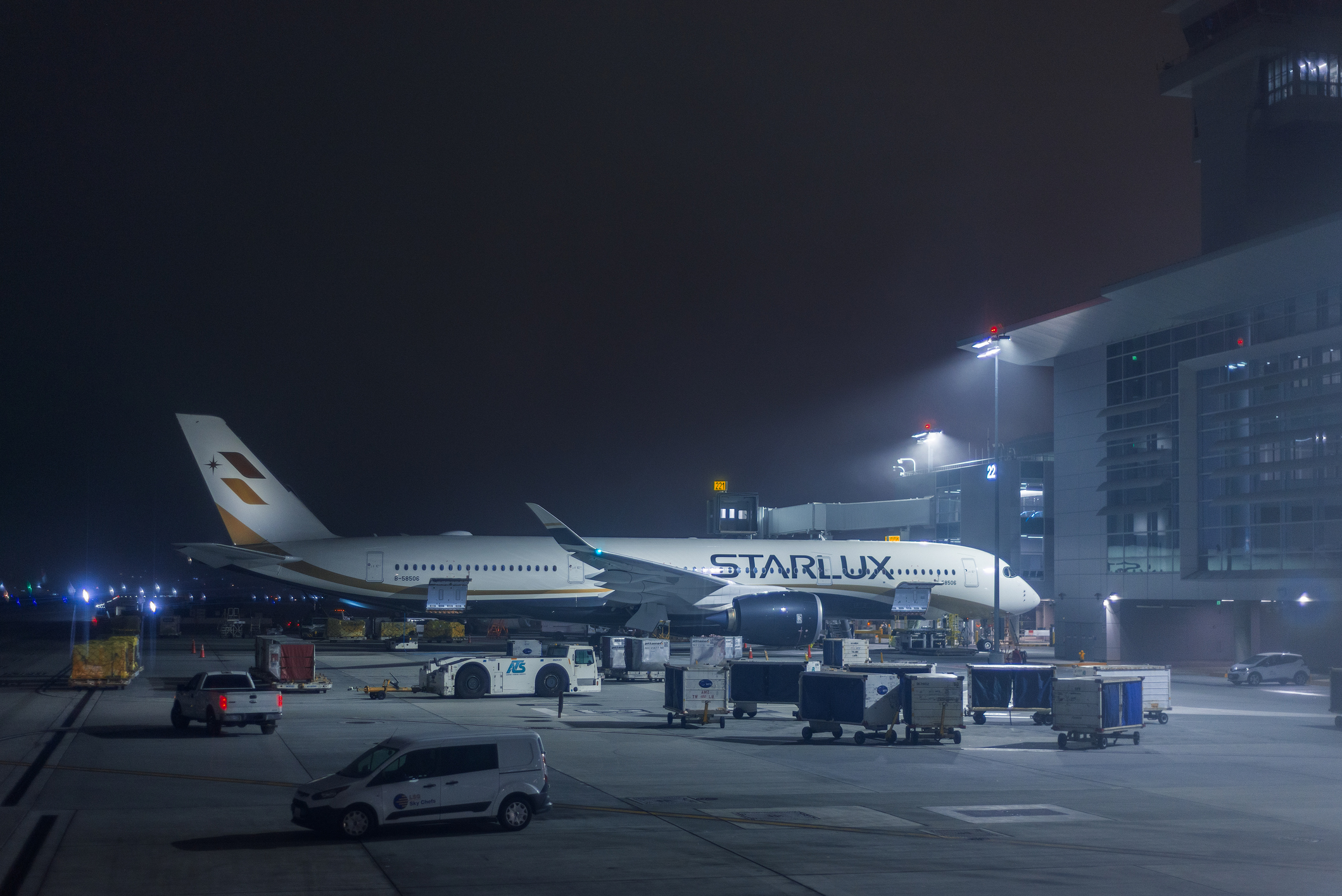
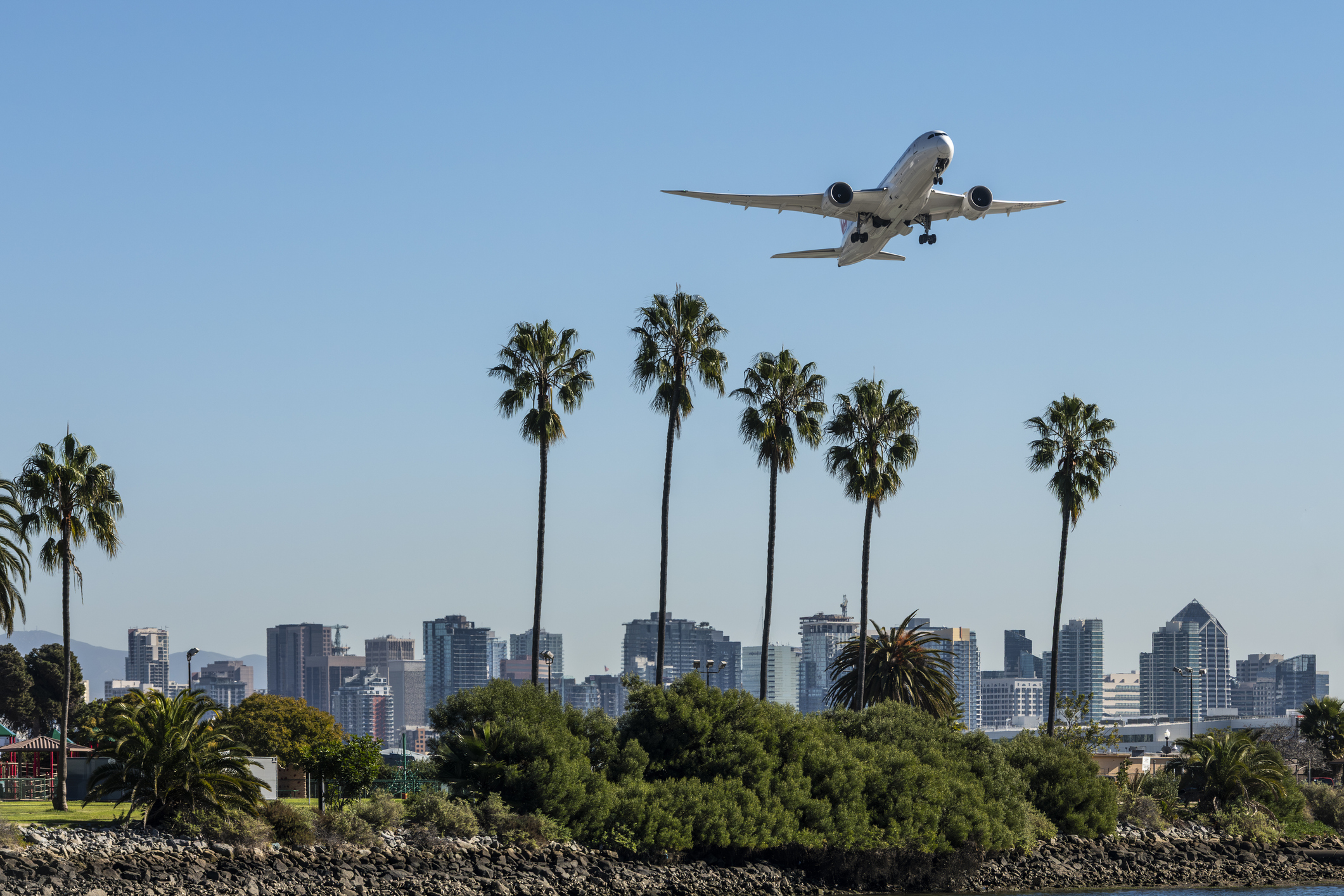
American Airlines and STARLUX have officially launched their codeshare partnership. But for anyone with American miles, the more interesting part is what could come next.
American says the airlines are working toward mileage redemptions and additional benefits. If that happens, STARLUX would become another way to use AAdvantage miles to get to Asia.
That’s already one of the more useful aspects of American’s program. AAdvantage miles can be used on American’s own flights across the Pacific, along with partners including Japan Airlines and Cathay Pacific. Malaysia Airlines can help with trips farther into Southeast Asia, while Qantas opens up additional possibilities through Australia.
STARLUX could add another piece to that network, with flights from several U.S. cities to Taipei and connections throughout Asia.
The codeshare is the first step. American is now selling select STARLUX flights from Los Angeles (LAX), Ontario (ONT), San Francisco (SFO), and Seattle (SEA) to Taipei (TPE), with Phoenix (PHX) expected to follow pending approval.
AAdvantage members can earn miles and Loyalty Points when those STARLUX flights are sold under an American flight number.
What isn’t possible yet is booking a STARLUX flight with AAdvantage miles.
American says the airlines will work together on future opportunities including “mileage redemption and additional travel benefits,” but hasn’t said when that will happen, what flights will be available, or how many miles they’ll cost.
STARLUX isn’t the only potential addition, either. Philippine Airlines is preparing to join Oneworld, the airline alliance that includes American, Japan Airlines, Cathay Pacific, Qantas, and several other carriers. Its membership should eventually create another way to use American miles for flights in Asia.
There’s plenty left to learn about both additions. But the direction is pretty interesting. AAdvantage already offers several ways to cross the Pacific using miles, and that list looks likely to get longer.
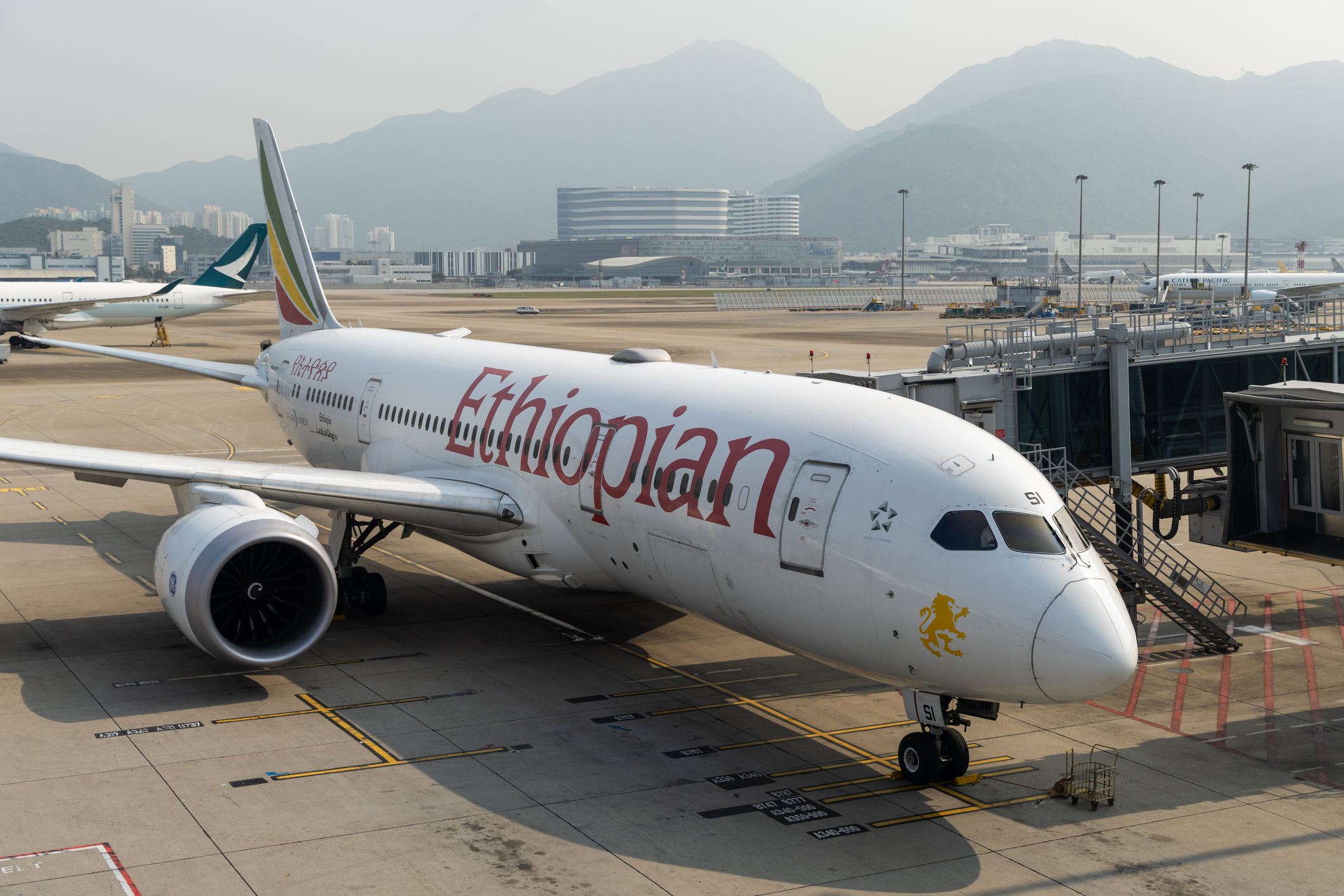
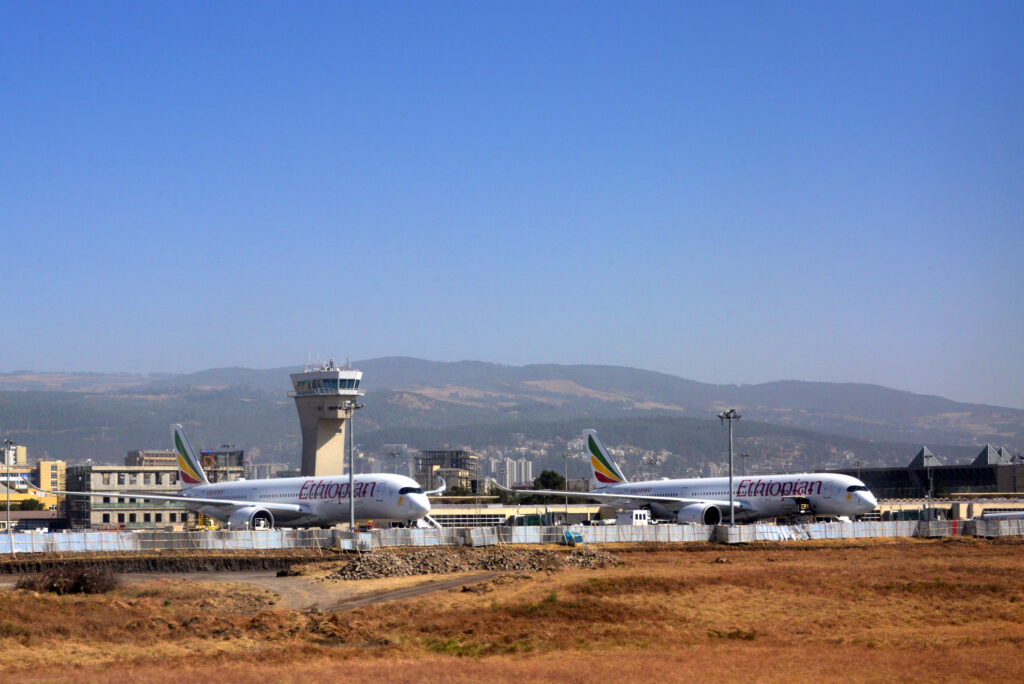
When U.S. Bank launched points transfers to airline partners less than a month ago, one addition caught my eye: Ethiopian Airlines ShebaMiles.
It got me wondering whether ShebaMiles could be the next non-U.S. airline program to make a bigger push into the U.S. points and miles market, following programs such as Avios, Aeroplan, LifeMiles, Flying Blue, Virgin Atlantic Flying Club, and Japan Airlines Mileage Bank.
Airline points and miles are a multibillion-dollar business and a reliable cash cow for carriers. Airlines sell billions of dollars’ worth of miles to banks and other partners every year, and during COVID, several pledged their loyalty programs as collateral to raise billions in cash. More recently, Air Canada sold a 25% stake in Aeroplan for C$2.5 billion.
The U.S. is by far the largest miles market globally, followed distantly by Brazil. Given how profitable selling miles can be, more and more non-U.S. airlines want a piece of that cash flow.
Domestically, the U.S. “Big Three” each pursue their own strategy, backed by a physical presence across the entire country. Foreign airlines, by contrast, have a much smaller footprint in the U.S., so they lean on miles sales and bank partnerships to generate cash and attract members from the world’s largest points and miles market.
Origins of the Non-U.S. Airline Playbook
The strategy was pioneered by British Airways Avios, under International Airlines Group (IAG), and later refined by LifeMiles after its parent airline, Avianca, joined Star Alliance in 2012. The formula included:
Buy-miles promotions
Bank transfer partnerships and promotions
Intentionally curated redemption “sweet spots” to generate word-of-mouth buzz, particularly for partner redemptions
Change, cancellation, and partner-redemption fees as additional revenue streams
Other non-U.S. and regional carriers later adopted a similar model to attract members outside their home markets. Air France-KLM’s Flying Blue and Air Canada’s Aeroplan are chief among them, particularly because the U.S. market dwarfs their home markets in size.
MTCURADO / ISTOCK
COVID as a Turning Point
When COVID hit, people stopped traveling and airlines across the industry were suffering. Several major airlines turned to their loyalty programs as collateral to raise billions in cash, making the value of these businesses impossible to ignore.
Virgin Atlantic Flying Club is a prime example of how programs have evolved since then. In just a few years, it transformed from a currency centered largely around Virgin Atlantic flights into one of the more prominent programs in the space by expanding bank transfer partnerships, joining SkyTeam, launching online partner redemptions, and shifting to dynamic pricing on its own flights and select partners.
As a side note, Alaska Airlines’ Atmos Rewards program took a slightly different path. Still U.S.-based and historically regional, it broadened the program’s appeal by pairing a highly competitive elite program on the West Coast with a unique co-brand credit card, a broad range of airline partners, and other benefits that extend beyond Alaska’s traditional footprint.
The Next Movers
More recently, the spotlight has shifted to Japan Airlines Mileage Bank, which has added partnerships with Bilt, Capital One, and most recently Citi.
Now, it may be Ethiopian Airlines ShebaMiles’ turn. The program has already checked several boxes:
Star Alliance membership
A website supporting partner redemptions
Buy-miles promotions
Its first U.S. bank partnership
If ShebaMiles continues following the playbook used by programs such as Avios, LifeMiles, Aeroplan, Flying Blue, Flying Club, and JAL Mileage Bank over the past 15 years, I think there are several likely next moves:
Creating/Maintaining a few redemption sweet spots to generate buzz, potentially while continuing to use an award chart for the time being
Adding more bank partners with attractive pricing for those partners, potentially below 130 basis points per mile
Launching bank transfer promotions
Introducing multi-tier and eventually dynamic redemptions on Ethiopian’s own flights, with some inventory reserved exclusively for ShebaMiles members rather than relying on the current single-tier, inventory-based system
Improving customer service and adding online changes, or at least cancellations, paired with change and cancellation fees
Adjusting fees over time as members become more familiar with the program
Africa has also become an increasingly popular destination in recent years. I’ve personally visited the continent six times over the past 15 years and traveled through about half of it.
There are very few places Ethiopian Airlines doesn’t fly across Africa today, apart from some North and Southern African markets served by partners such as EgyptAir and Airlink. That’s the result of a network Ethiopian began building years ago.
Fathala Wildlife Reserve. TROY LIU / POINTS INSIDER
Sure, United MileagePlus, Air Canada Aeroplan, and Turkish Miles&Smiles can already be used to book Ethiopian flights, but those programs only have access to the award inventory Ethiopian makes available to partners.
If ShebaMiles eventually introduces multi-tier redemptions on Ethiopian’s own flights, with additional inventory reserved exclusively for its own members, that could become a real competitive advantage.
U.S. customers would have another option when choosing a miles program, and I’ve never been more bullish on the future of this industry as more banks and programs enter the market.
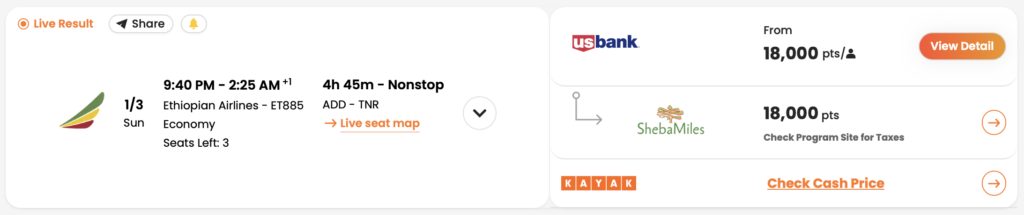
And with ShebaMiles becoming more relevant in the U.S., we’ve added the program to PointsYeah Live Search, making it possible to search ShebaMiles award availability alongside other supported programs.
I had some time to kill at the Philadelphia airport recently and started noticing the lines.
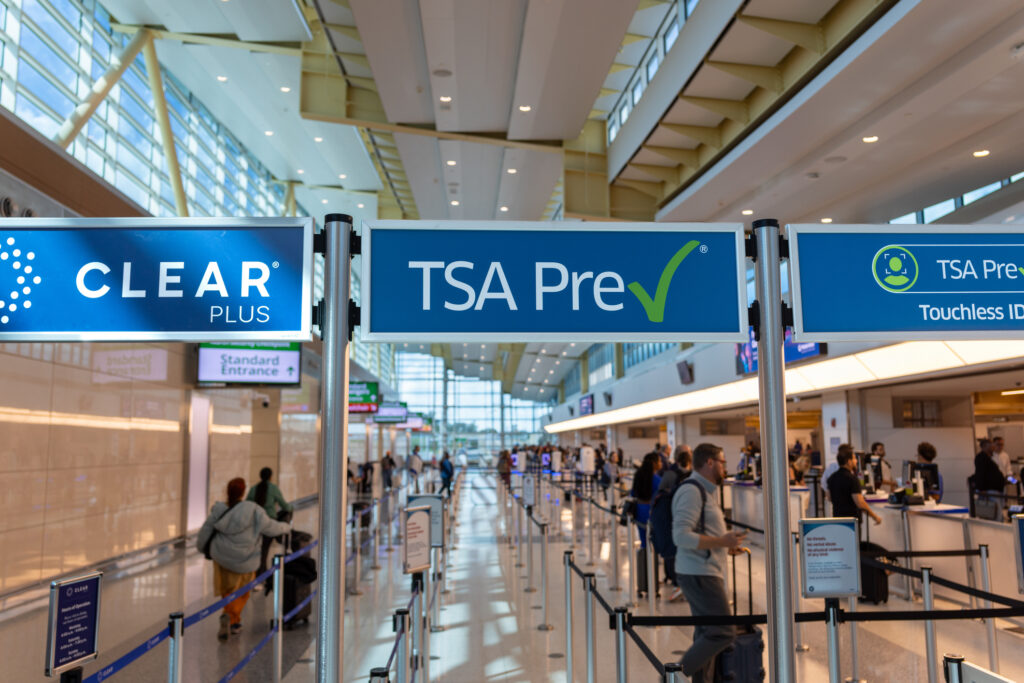
The regular TSA security line was long. PreCheck had a few people waiting. The separate Touchless ID lane had absolutely nobody at all.
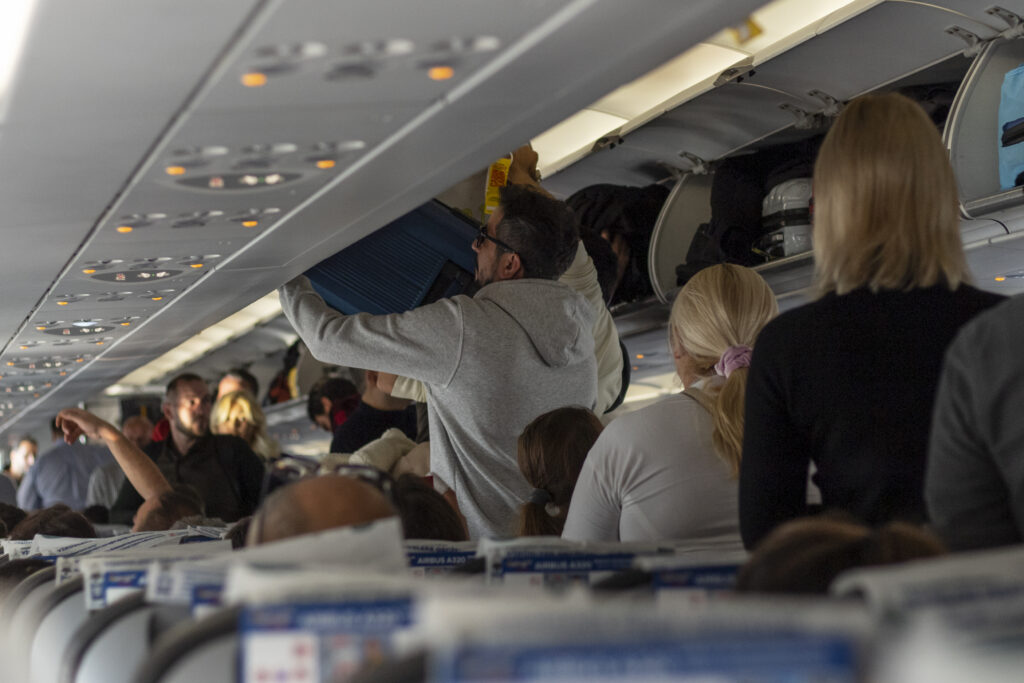
A couple of minutes after collecting my belongings from security, I watched a separate American Airlines flight board. Plenty of passengers were still waiting when Groups 7 and 8 were called, followed by Group 9.
Joining AAdvantage (American’s free loyalty program) would have put some of them in Group 6 and possibly saved them from gate-checking their bags.
Neither observation was particularly groundbreaking. But they got me thinking about the small things that can make a trip easier without buying a better seat or having airline status.
Some take a few minutes to set up. Others are just useful habits to have when something goes wrong.
Here are five that can make a difference.
Join the Airline’s Loyalty Program
There doesn’t need to be much loyalty involved in joining a loyalty program.
American is a good example. AAdvantage members board in Group 6. Nonmembers flying in Main Cabin board in Groups 7 or 8, while basic economy passengers without another form of priority board in Group 9.
Signing up is free.
Moving up a boarding group or two isn’t going to transform a trip, but it can mean getting on the plane before overhead bin space starts disappearing. And it’s an easy benefit to get even if you only fly American more than once or twice a year.
AAdvantage members get access to free onboard Wi-Fi, too.
SERHIL IVASHCHUK / ISTOCK
Having an account also keeps reservations in one place, saves information such as a Known Traveler Number (KTN), and makes sure miles from a flight don’t disappear into nowhere.
Not every airline gives members an earlier boarding group just for signing up, so this isn’t a reason to open a dozen loyalty accounts tonight. But when booking a flight, it’s worth seeing what joining the airline’s program gets beyond miles.
Sometimes there’s a useful perk hiding behind a free signup.
The difference between the security lines at Philadelphia was hard to miss.
TSA PreCheck doesn’t guarantee a short wait. I’ve certainly stood in some long PreCheck lines. But it does offer dedicated lanes at participating airports and a less cumbersome screening process, like leaving shoes on and laptops in bags.
New enrollment currently starts as low as $76.75, depending on the provider. Renewals can start at $58.75, depending on the method.
Global Entry is another option, particularly for international trips. It costs $120, includes TSA PreCheck benefits, and adds expedited processing when returning to the U.S.
Before paying for either, check the credit cards already in the wallet. Plenty of travel cards (typically ones with annual fees) reimburse the application fee for TSA PreCheck or Global Entry. Enroll, charge the fee to an eligible card, and the reimbursement typically comes back as a statement credit.
GREGGORY DISALVO / ISTOCK
PreCheck can also unlock an even easier option at some airports.
TSA PreCheck Touchless ID uses facial comparison technology for identity verification and has dedicated lanes. I’ve increasingly found those lines shorter than PreCheck itself. At PHL that day, nobody was waiting.
Eligible PreCheck members with a valid passport can opt in through participating airlines. With an airline, that means adding a Known Traveler Number and passport information to the profile, then opting in either there or during check-in. A Touchless ID indicator on the boarding pass shows when it’s ready to use.
American, Alaska, Delta, Hawaiian, Southwest, and United currently participate.
Touchless ID isn’t everywhere yet. But after doing the work to get PreCheck, it’s worth checking whether there’s an even shorter line available.
Download the Airline App Before Something Goes Wrong
Airline apps aren’t particularly exciting when everything is running on time.
They’re considerably more useful when a flight isn’t.
Most handle the basics, including boarding passes, gate changes, delay notifications, and bag tracking. But they’re more helpful during a disruption.
When a flight gets canceled, the instinct is often to head straight for a customer-service desk or call the airline, only to hear that “higher than normal call volume” message. Everyone else is doing the same thing.
Depending on the airline, the app may already offer rebooking options while the line at the airport is still growing. Meal or hotel vouchers may show up there, too.
That doesn’t mean an app can fix every problem. Sometimes an agent really is necessary. But it’s much easier to find out with the app already downloaded, logged in, and connected to the reservation.
A flight cancellation is a bad time to discover the password doesn’t work.
Know What Else Is Flying That Day
When I really need to be somewhere, I like to know what comes after my flight.
That doesn’t require memorizing the day’s schedule. A quick look can answer the important questions. Is there another nonstop that afternoon? Does another airline fly the route? Would a connection still get there in time?
That information becomes much more useful when the original flight starts slipping.
Instead of starting from scratch after a cancellation, there’s already some idea of what to ask for or look at next. If there’s a 3 p.m. flight that still gets there before dinner, that’s worth knowing before joining the line at the airport.
The same applies to trips booked with points. A quick PointsYeah search can show other award options around the same time or day, including flights available through different loyalty programs.
{{ search-widget mode=”flight-hotel” }}
Availability can disappear quickly during a disruption, so none of this guarantees a seat. The point is knowing where to look before everyone else on the flight starts looking, too.
Keep Some Points and Miles Around for When Things Go Sideways
Some of my most useful points redemptions are the ones I never end up using.
I needed to get to Boston recently, and my JetBlue flight kept getting delayed. At some point, another delay could have meant not getting there when I needed to.
American had another flight leaving later that day, and there was award availability. So I booked it with AAdvantage miles.
I didn’t particularly want to take that flight. It was there in case JetBlue never went anywhere.
The cancellation terms on the American award gave me enough flexibility to hold onto the backup while I waited to see what happened. JetBlue eventually got moving, so I canceled the American flight and got the miles back.
SHUNYU FAN / ISTOCK
This is something to be careful with, though. Cancellation rules vary, it’s always worth checking the terms before booking something that may need to be canceled fairly close to departure.
But it’s a good example of why having some miles available can be useful beyond planning the next vacation.
The same goes for hotels. A cancellation, missed connection, or bad weather can unexpectedly create the need for a room near an airport, sometimes at an ugly last-minute price. Hotel points can cover the night instead. Transferable points can be even more useful because they provide options across several airline and hotel programs.
There doesn’t need to be a giant balance sitting around indefinitely. But using every point down to zero can leave fewer options when a trip goes sideways.
Points are usually the fun part of planning a trip. Sometimes they’re just a very useful Plan B.
None of these will prevent a delay, guarantee an empty security line, or make boarding particularly glamorous.
But that’s what struck me at PHL. Some people were waiting in a long security line while another had nobody in it. Others were boarding later than they needed to because they hadn’t joined a free airline program.
Flying comes with plenty of hassles that can’t be avoided. It makes sense to skip the ones that can.
Sometimes the flight you want doesn’t leave from your home airport.
Maybe there’s no award availability from where you live, but plenty from an airport a short flight away. Or maybe starting somewhere else gets you a nonstop flight or costs fewer points.
A positioning flight is a separate flight booked to get to the airport where the trip actually begins.
For example, say someone lives in Raleigh (RDU) and finds a business-class award to Europe from Washington Dulles (IAD). They could book a separate flight to Washington, then begin the international itinerary from there.
That first flight is the positioning flight.
Why Book a Positioning Flight?
Positioning gives you more airports to work with when searching for flights.
Award availability can vary considerably depending on where a trip starts. A flight that isn’t available from a home airport might be available from another city, sometimes for fewer points or with a better itinerary.
And positioning doesn’t always require another flight. If another airport is within driving distance, driving works too. In some places, a train might be an option.
The idea is the same: getting to the airport where the itinerary you want begins.
What to Know Before Booking a Positioning Flight
The biggest thing to remember is that positioning flights are usually booked separately from the main itinerary.
That means making the connection is your responsibility. If the positioning flight is delayed and the next flight is missed, the airline operating the main itinerary generally isn’t obligated to rebook it.
A few things can make positioning less risky:
Leave plenty of time. For an important international flight, arriving the night before may make sense.
Be careful with checked bags. Bags may need to be collected and checked again before the next flight.
Consider the entire cost. Factor in the positioning flight, hotel, transportation, parking, and other expenses before deciding whether the better award is worth it.
Have a backup plan. Know what other options exist if the positioning flight is delayed or canceled.
Are Positioning Flights Worth It?
Sometimes.
If getting to another airport requires a short flight or drive and opens up a much better itinerary, positioning can be worth the extra step.
Other times, the additional cost and risk outweigh whatever the alternative itinerary saves.
But knowing to search from other airports can open up options that aren’t obvious when looking only from home. Just leave enough room between separate itineraries that a good award doesn’t turn into a missed flight.
Southwest has a new sale that could cut the cost of a fall or winter trip, whether paying with cash or points.
Through October 8, Southwest is offering up to 40% off select flights for travel from October 26, 2026, through March 3, 2027. That covers more than four months of travel, although Thanksgiving, Christmas, New Year’s, and several other busy dates are excluded.
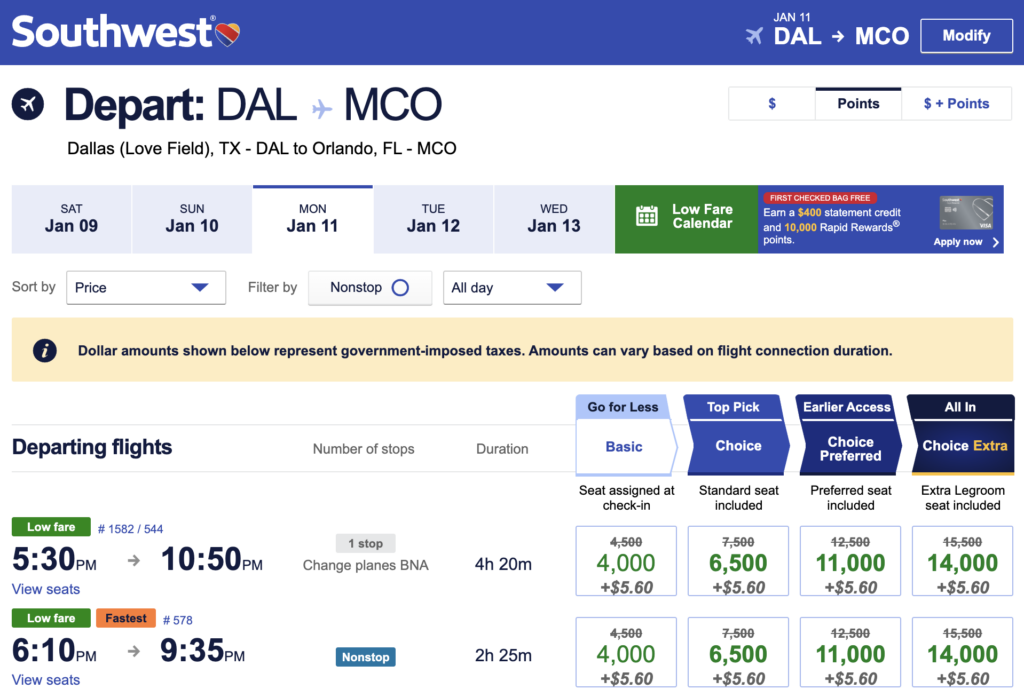
The discount also applies when booking with Rapid Rewards points. So if a discounted flight normally costs 15,000 points, for example, the sale could bring that price down along with the cash fare.
Southwest’s 40% Off Sale
There’s no promo code to enter. Southwest automatically applies the discount to eligible flights. It’ll show the discounted base fare alongside the original price.
Book by: October 8, 2026
Travel from: October 26, 2026, through March 3, 2027
Discount: Up to 40% off select base fares
Cash and points bookings: Eligible
Interisland Hawaii flights: Excluded
There are some restrictions, particularly around busy holiday periods.
For travel within the continental U.S., blackout dates include November 20–23, November 28–30, December 18–22, December 24–29, December 31–January 4, January 18, February 12, and February 15.
Flights from the continental U.S. to international destinations, Hawaii, Anchorage, St. Thomas, and San Juan have additional blackout dates around Thanksgiving and Christmas. The same applies in the other direction.
Not every route or flight will be discounted, either. Southwest says seats, days, and markets are limited, and the discount applies to the base fare before government taxes and fees.
This Could Make a Fall or Winter Trip Cheaper
The useful part of this sale is that it isn’t limited to cash tickets. Southwest prices flights in both dollars and Rapid Rewards points, and eligible points bookings get the promotional discount too.
That makes it worth checking any fall or winter trip already in the works. Search the dates on Southwest, switch between dollars and points, and compare the options.
SOUTHWEST.COM
Trips already booked are worth checking, too. Southwest says the promotion applies to new reservations rather than changes to existing ones, but eligible flights can be canceled and rebooked at the lower price. If the new points price is lower, the difference goes back into the Rapid Rewards account.
The booking window is short. The sale ends October 8, leaving just a few days to see whether the discount lines up with a trip.
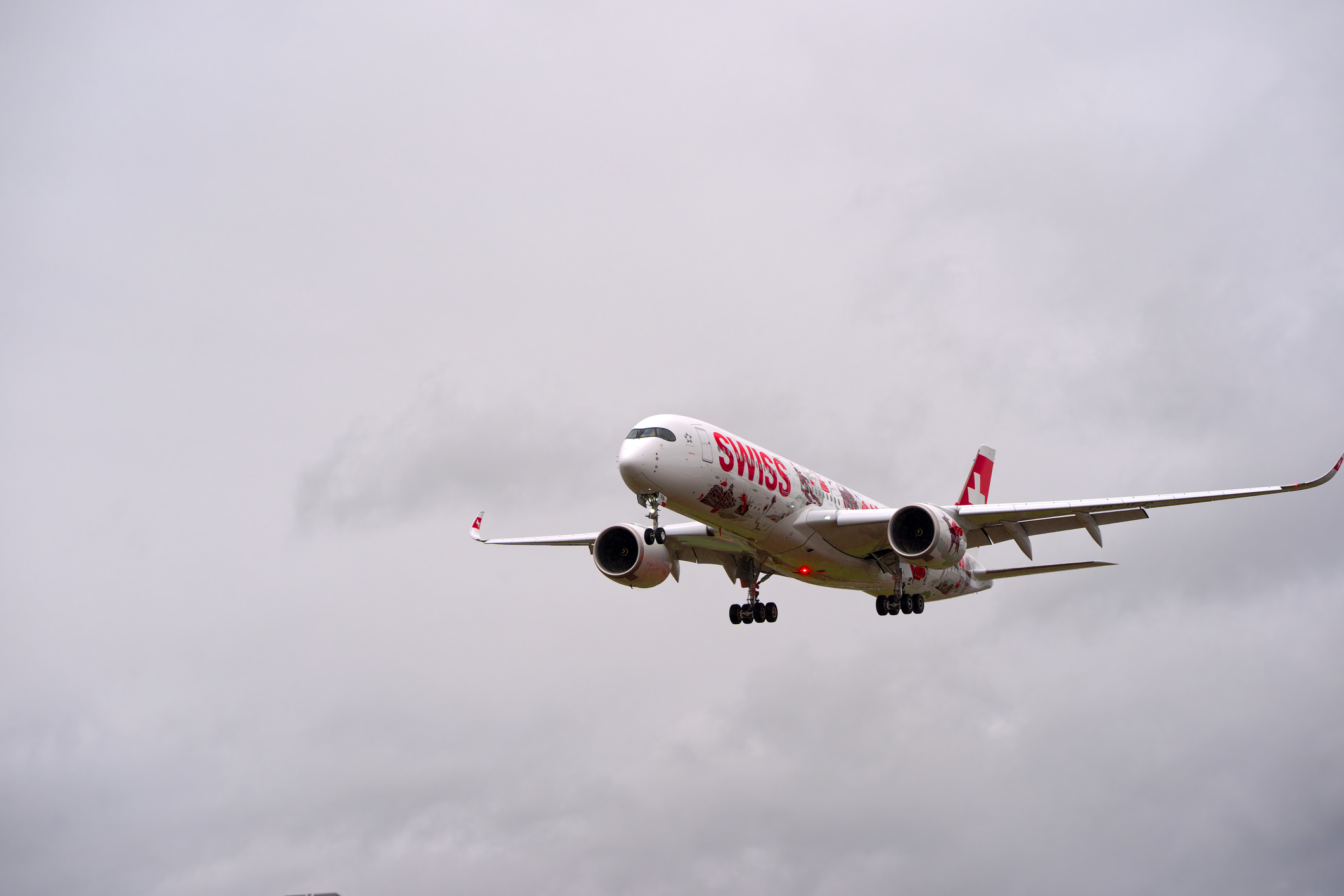
SWISS is about to have a third Airbus A350 in its fleet.
The airline announced that it expects its newest A350-900 to arrive in Zurich on Saturday, September 12, following a delivery flight from Airbus in Toulouse. The aircraft, registered HB-IFC and named Zug, is scheduled to land around 9:30 a.m. local time.
Three airplanes isn’t a huge fleet. But SWISS only has 10 A350s on order, which means 30% of them will have arrived once Zug touches down in Zurich.
SWISS is also bringing its newest cabins to some older aircraft through retrofits. The difference with the A350 is that each one arrives from the factory with the entire new SWISS Senses interior already installed.
SWISS Is Slowly Getting More of Its New Cabins
SWISS introduced the A350 in 2025 with its new SWISS Senses cabins from front to back.
There are just 243 seats onboard, starting with four first-class suites and 45 business class seats. Another 38 seats are in premium economy, followed by 156 in economy.
Every delivery puts another full set of SWISS’s newest seats into service as the airline gradually replaces some of its older long-haul aircraft. And with only 10 A350s planned, the arrival of a third is a meaningful step in what is still a relatively small fleet.
I’ve seen the new interior firsthand. SWISS showed off its first A350 before it entered service last year, and the cabins are a considerable departure from what can still be found across much of the airline’s long-haul fleet.
The changes aren’t limited to the airplane. SWISS is also updating its experience in Zurich, with two new lounges coming to Dock B in 2027. The roughly 28,000-square-foot project will include separate Business and Senator lounges.
The third A350 will get a small welcome before it reaches the airport. SWISS says the aircraft is expected to circle over Zug, the city whose name it carries, before making its final approach into Zurich.
Another A350 Becomes Bookable With Points
There’s also a practical reason to keep an eye on aircraft deliveries.
SWISS award seats can be booked through several Star Alliance loyalty programs, including United MileagePlus, Air Canada Aeroplan, and Avianca LifeMiles. That means Miles & More isn’t the only option for booking a SWISS flight with points or miles.
Each new A350 therefore puts another aircraft with SWISS’s newest first, business, premium economy, and economy cabins into the mix when searching for an award with points and miles.
Seven A350s are still to come. But with the third arriving Saturday, SWISS is getting closer to the point where its newest long-haul cabins aren’t quite as difficult to find.
Flying Blue members now have more options when booking award flights with Air France and KLM.
The joint loyalty program of Air France and KLM announced the change in mid-August, and the new pricing went live Tuesday, September 8. Instead of a single award option, flights now come in three flavors: Light, Standard, and Flex.
The names are pretty straightforward. Light costs fewer miles and includes less. Standard sits in the middle. Flex costs more miles in exchange for more flexibility and included benefits.
But the differences aren’t limited to mileage prices.
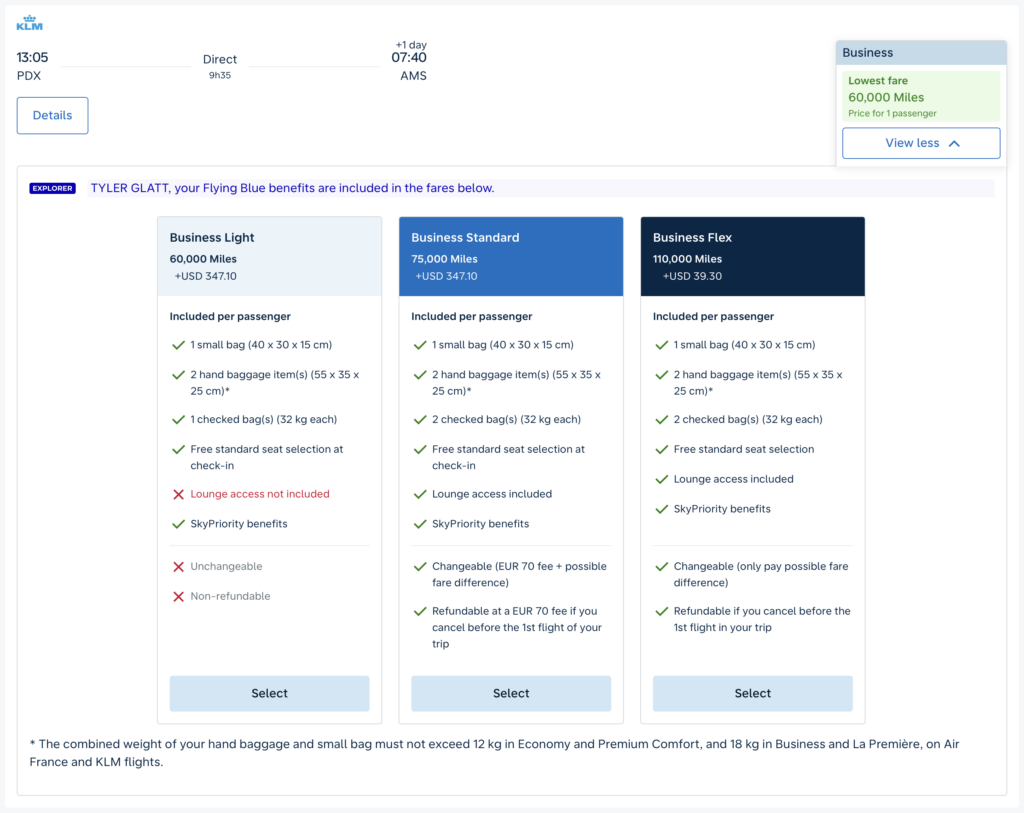
Depending on the tier, checked bags, changes and refunds, seat selection, and even business class lounge access can come and go. Flex awards can also require considerably less cash alongside the miles.
Ultimately, choosing which award to book now takes a little more thought.
Flying Blue Awards Now Come in Three Tiers
Flying Blue modeled the new award tiers after the fares Air France and KLM already sell on paid tickets.
The three options apply to new award bookings on flights operated and marketed by Air France and KLM. Awards on partner airlines aren’t changing. If an itinerary combines an Air France or KLM flight with a partner flight, Standard will be the only option.
SJO / ISTOCK
At the most basic level, the three tiers work like this:
Light: Fewer miles, fewer included benefits, and no changes or refunds.
Standard: More miles, additional baggage, and changes or refunds for €70.
Flex: The most miles, more included benefits, and changes and refunds without a fee.
Exactly what’s included depends on the cabin.
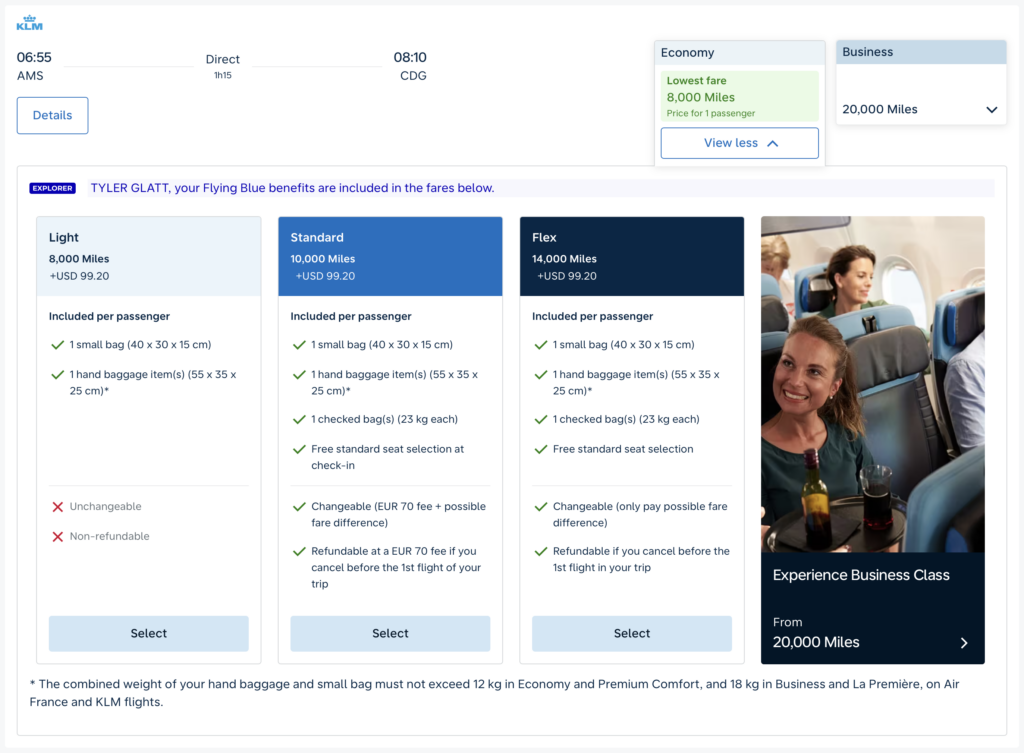
A short economy flight from Amsterdam (AMS) to Paris (CDG) gives a good idea of how the new pricing works.
Award
Miles
Taxes and Fees
Light
8,000
$99.20
Standard
10,000
$99.20
Flex
14,000
$99.20
KLM.COM
Light costs 8,000 miles but doesn’t include a checked bag. It also can’t be changed or refunded.
For another 2,000 miles, Standard adds a checked bag and free standard seat selection at check-in. Changes and refunds are allowed for €70, with any fare difference also due when changing a flight.
Flex costs 14,000 miles. It adds advance standard seat selection and removes the change and refund fees.
On a short flight like this, the differences are relatively easy to weigh. Light saves 6,000 miles over Flex but comes with far fewer options if plans change. Standard splits the difference at 10,000 miles.
Long-haul awards are where the gaps start getting larger.
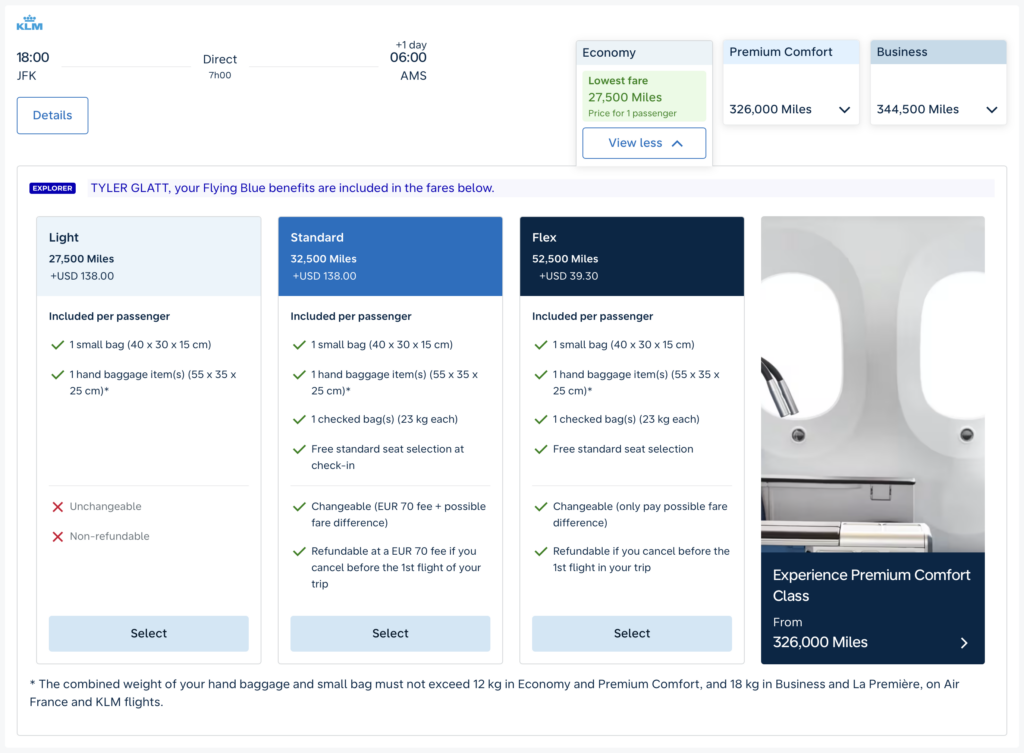
A KLM economy flight from New York (JFK) to Amsterdam (AMS) shows just how far apart the three options can get.
The Light award starts at 27,500 Flying Blue miles.
Award
Miles
Taxes and Fees
Light
27,500
$138
Standard
32,500
$138
Flex
52,500
$39.30
KLM.COM
Light saves 5,000 miles compared with Standard, but there’s no checked bag and no option to change or refund the ticket.
Standard adds the checked bag and allows changes and refunds for €70.
Flex is a much bigger jump at 52,500 miles. That’s another 20,000 miles over Standard for the same economy seat.
There’s something else happening with the price, though. The cash portion drops from $138 to $39.30.
That’s by design. Flying Blue said when it announced the changes that Flex awards would come with a lower mandatory cash contribution.
So the choice isn’t always between spending fewer or more miles for extra flexibility. On some awards, it’s also a choice between spending more miles or more cash.
Business Light Comes With an Even Bigger Catch
The biggest tradeoff might be in business class.
Business Light still includes the business class seat, SkyPriority, two carry-ons, one checked bag weighing up to 32 kilograms, and standard seat selection at check-in.
But lounge access isn’t included.
That’s a notable change for anyone accustomed to thinking of lounge access as part of the business class experience on Air France or KLM.
Here’s how the three options priced on a flight from Portland (PDX) to Amsterdam (AMS):
Award
Miles
Taxes and Fees
Business Light
60,000
$347.10
Business Standard
75,000
$347.10
Business Flex
110,000
$39.30
KLM.COM
Business Light saves 15,000 miles compared with Standard, but lounge access isn’t the only thing missing. Light includes one checked bag instead of two, and the award can’t be changed or refunded.
Standard costs 75,000 miles and brings those benefits back. Lounge access and a second checked bag are included, while changes and refunds cost €70.
Business Flex goes all the way to 110,000 miles. It includes advance standard seat selection, two checked bags, lounge access, and changes and refunds without a fee.
The cash difference is notable, too. Light and Standard both require $347.10. Flex requires just $39.30.
That’s more than $300 less out of pocket, but it comes at the cost of another 35,000 miles over Standard.
Flying Blue Status Can Change the Equation
Flying Blue status can make some of these choices look different.
Status benefits still apply regardless of which award tier is booked. That includes benefits such as additional baggage allowances and waived change and refund fees where applicable.
Flying Blue even accounts for this on the booking page, showing applicable status benefits above the Light, Standard, and Flex options.
OLRAT / ISTOCK
For someone with status, that could make a cheaper Light award more attractive. If an existing status benefit already covers something Light leaves out, spending more miles on Standard or Flex may not add as much.
Without status, there’s more reason to look closely at what’s included before going with the lowest mileage price.
Flying Blue miles are relatively easy to earn without flying Air France or KLM. The program partners with American Express Membership Rewards, Capital One miles, Chase Ultimate Rewards, and Citi ThankYou Rewards, among others.
That’s a big part of what makes Flying Blue useful. Points already sitting in one of those programs can be transferred when an award comes along.
That hasn’t changed. But redeeming those miles on Air France and KLM now comes with a few more things to consider.
Light can save a meaningful number of miles, but it can also mean no checked bag, no changes or refunds, and even no lounge access in business class. Standard adds many of those benefits back. Flex can require substantially more miles, but comes with fewer restrictions and a lower cash contribution.
The 60,000-mile Business Light example sums up the tradeoff pretty well. Saving 15,000 miles over Standard is meaningful. So is giving up lounge access, a second checked bag, and the ability to change or cancel the trip.
The cheapest Flying Blue award may still be the one worth booking. It’s just no longer the only number worth looking at.
Seventy-five thousand Capital One miles can cover $750 in travel.
Book through Capital One Travel, or make an eligible travel purchase elsewhere and use miles to offset the cost afterward. It’s one of the most straightforward ways to redeem Capital One miles.
Capital One miles are worth 1 cent each when used toward eligible travel purchases. That makes 75,000 miles worth $750.
That could cover a $750 hotel stay, knock $500 off a flight and leave 25,000 miles behind, or pay for travel booked through Capital One Travel.
Capital One offers other ways to redeem miles, too. But not all of them provide the same value. Cash back and redemptions toward non-travel purchases, for example, are worth half a cent per mile.
ADENE SANCHEZ / ISTOCK
Get More Than Face Value on Miles Transfers
Capital One also lets cardholders transfer miles to participating airline and hotel loyalty programs. Most transfer at a 1:1 ratio, so 20,000 Capital One miles would become 20,000 miles or points with the receiving program.
That can work well when an airline offers a flight for fewer miles than it would take to cover the cash price through Capital One. Ditto for hotels.
There’s a little more work involved. Availability comes and goes, taxes and fees can apply, and transfers can’t be reversed. Find the flight or hotel first, then transfer the miles needed to book it.
We searched PointsYeah for trips that could be booked with 75,000 Capital One miles or less. All of the examples below were available when we searched on September 8, 2026.
Take two people to Europe
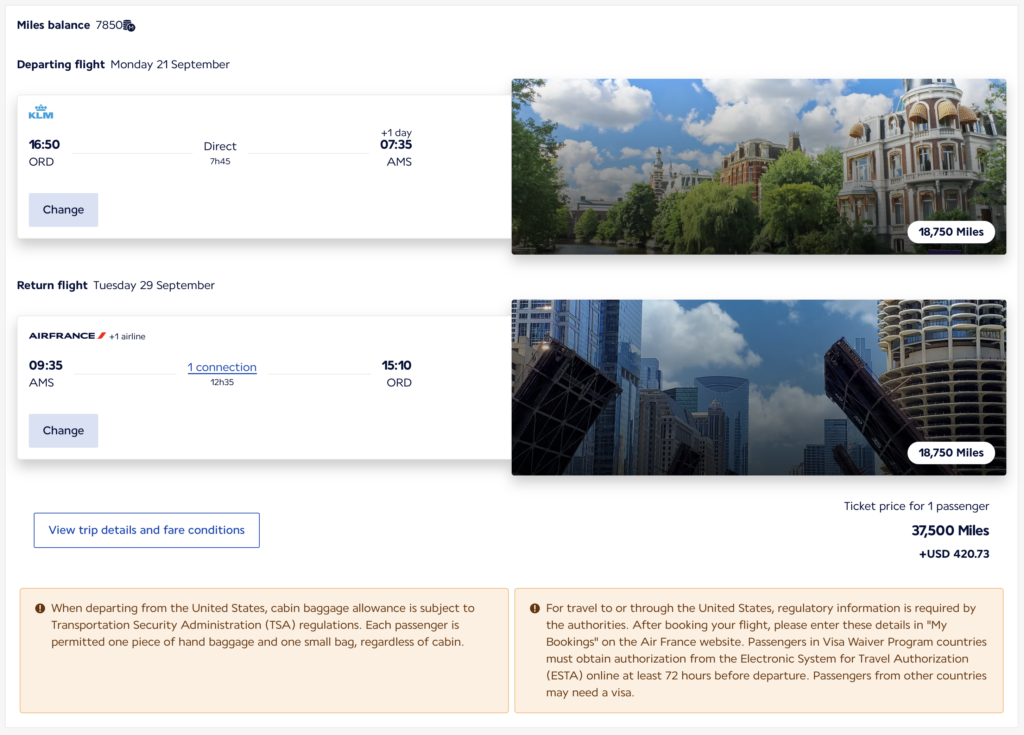
Flying Blue, the loyalty program shared by Air France and KLM, offers monthly Promo Rewards, which discounts flights from several destinations. This month, more than a dozen flights between North America and Europe start at 18,750 miles each way.
At that price, 75,000 miles is enough for two round-trip tickets.
KLM.COM
There were plenty of other options outside the Promo Rewards list, too.
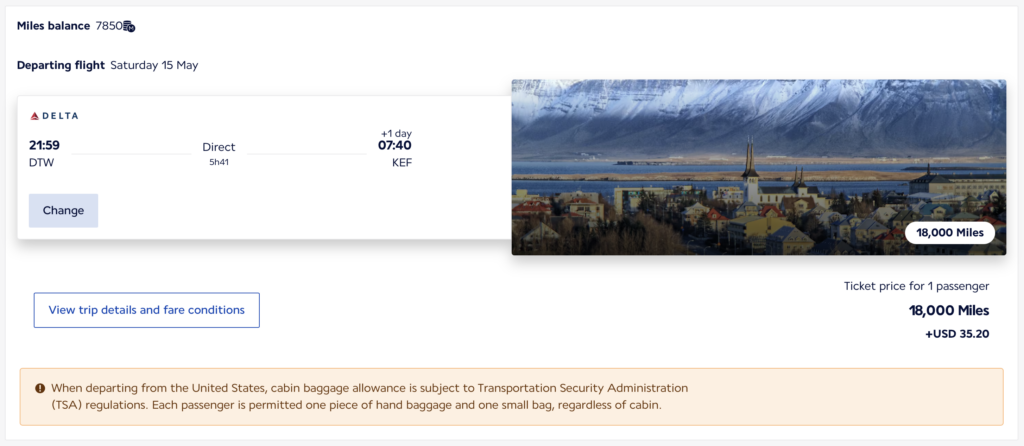
We found Delta flights from Detroit (DTW) to Reykjavik (KEF) for 18,000 Flying Blue miles plus about $35 one way. The return costs the same number of miles, although taxes and fees jumped to about $310.
KLM.COM
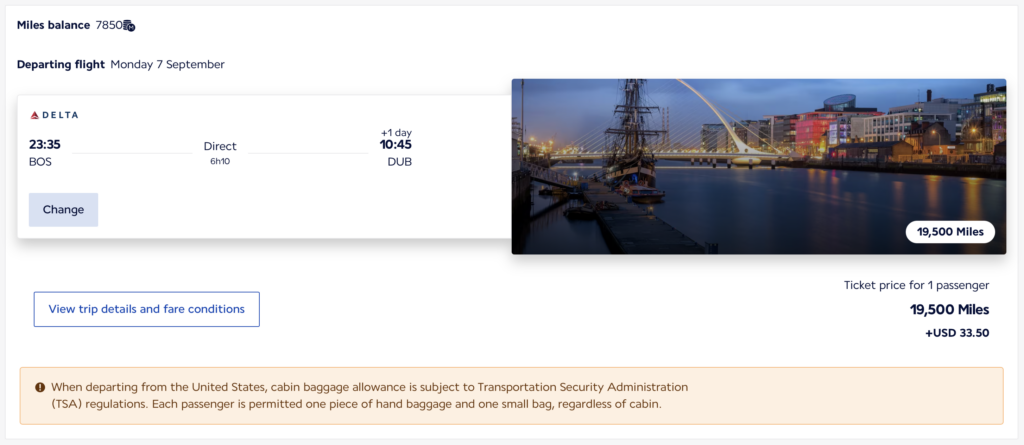
Boston (BOS) to Dublin (DUB) on Delta was available for 19,500 Flying Blue miles plus about $34 one way, again with higher fees on the return from Europe.
KLM.COM
Cover a domestic trip for the family
Seventy-five thousand miles can also cover several shorter flights.
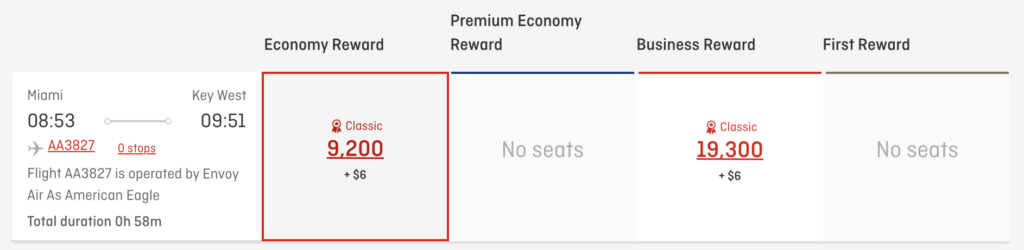
We found American flights from Miami (MIA) to Key West (EYW) for 9,200 Qantas points plus $5.60 each way. Capital One transfers to Qantas, which can use its points to book some American flights.
At that price, four round-trip tickets would require 73,600 miles.
QANTAS.COM
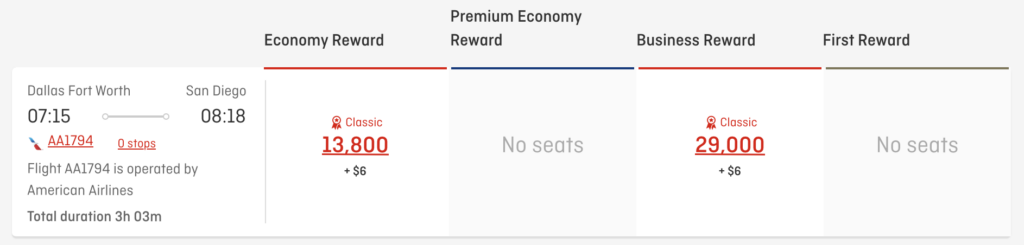
Other examples included American from Dallas (DFW) to San Diego (SAN) for 13,800 Qantas points plus $5.60 each way, and United from Newark (EWR) to Orlando (MCO) for 15,000 Aeroplan points plus about $33 each way.
QANTAS.COM
Escape somewhere warm
A couple could also put 75,000 miles toward a winter trip somewhere warmer.
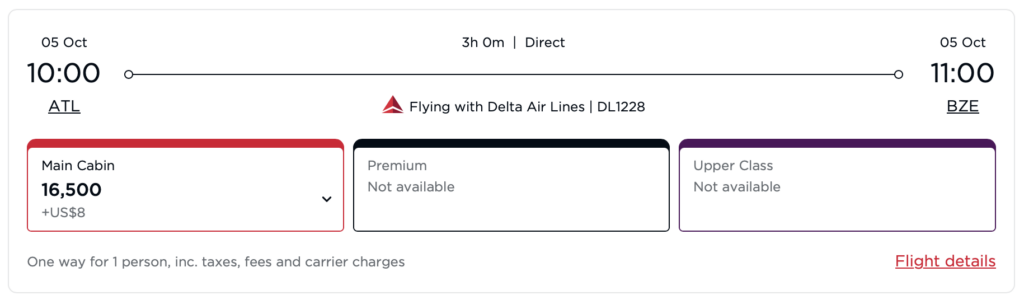
Delta flights from Atlanta (ATL) to Belize City (BZE) and Grand Cayman (GCM) were available through Virgin Atlantic for 16,500 points each way.
Two round-trip tickets would require 66,000 miles. Belize came with about $8 in taxes outbound and $91 returning, while Grand Cayman was about $6 outbound and $109 back.
VIRGINATLANTIC.COM
We also found United flights between San Francisco (SFO) and Honolulu (HNL) for 17,500 Aeroplan points plus about $46 each way. Two round trips would require 70,000 miles.
AIRCANADA.COM
Splurge on business class
Seventy-five thousand miles can even be enough for a one-way business-class ticket across the Atlantic.
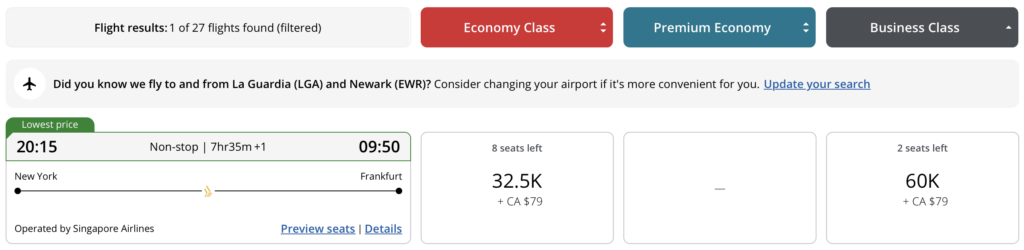
We found several flights through Air Canada Aeroplan for 60,000 points plus about $57 in taxes and fees:
Boston (BOS) to Zurich (ZRH) on SWISS
New York (JFK) to Frankfurt (FRA) on Singapore Airlines
Washington Dulles (IAD) to Brussels (BRU) on Brussels Airlines
Any of those would leave 15,000 Capital One miles behind.
AIRCANADA.COM
Business class gets a lot of attention in the points and miles world, but it isn’t necessarily a better use of the miles. Four economy tickets to Key West could be far more useful than one lie-flat seat to Europe, depending on the trip.
How to Earn 75,000 Capital One Miles
Capital One miles can be earned with several credit cards.
Two options are the venture_full: Capital One Venture Rewards Credit Card and venture_x_full: Capital One Venture X Rewards Credit Card. Both currently offer welcome bonuses of 75,000 Capital One miles after meeting their respective spending requirements.
{{ credit-card-widget uri=”venture” }}
{{ credit-card-widget uri=”venturex” }}
The cards have different annual fees and benefits. Click “Learn More” on either card for its current offer, rates, fees, and other details.
From the U.S., the options range from Singapore Airlines’ New York to Frankfurt flight to its nonstop routes to Singapore. There are also discounted flights throughout Asia and between Singapore and destinations in Europe, Australia, and elsewhere.
Flights From the U.S. Start at 23,375 Miles
The cheapest U.S. option in the sale doesn’t require a trip to Singapore at all.
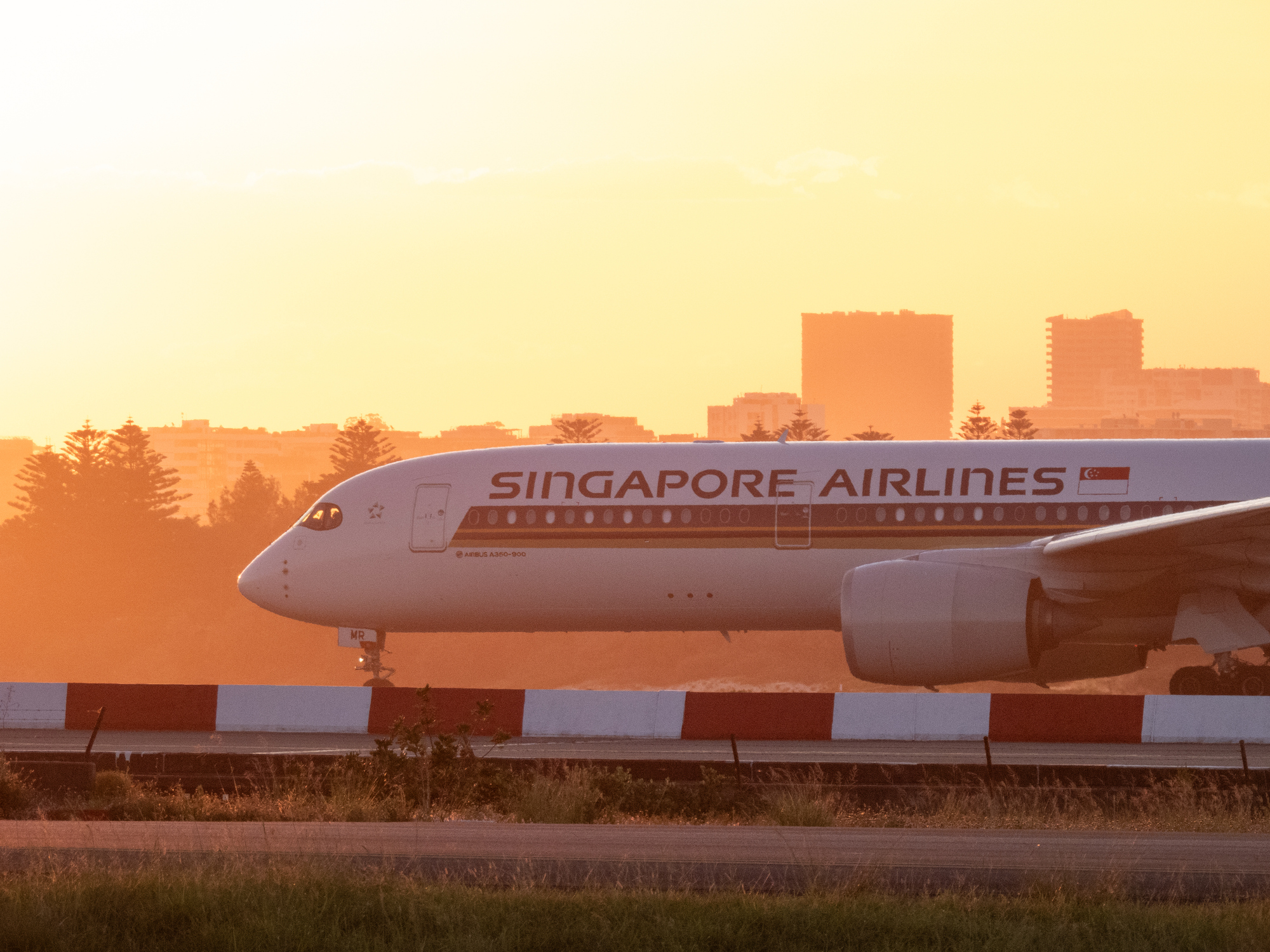
Singapore Airlines flies between New York (JFK) and Frankfurt (FRA) as part of a longer route that continues to Singapore. That flight is available for 23,375 KrisFlyer miles each way in economy during the sale.
There’s another fifth-freedom option on the West Coast, too. These flights allow Singapore Airlines to carry passengers between two countries outside its home country.
The airline flies between Los Angeles (LAX) and Tokyo (NRT), with discounted awards starting at 36,125 miles each way.
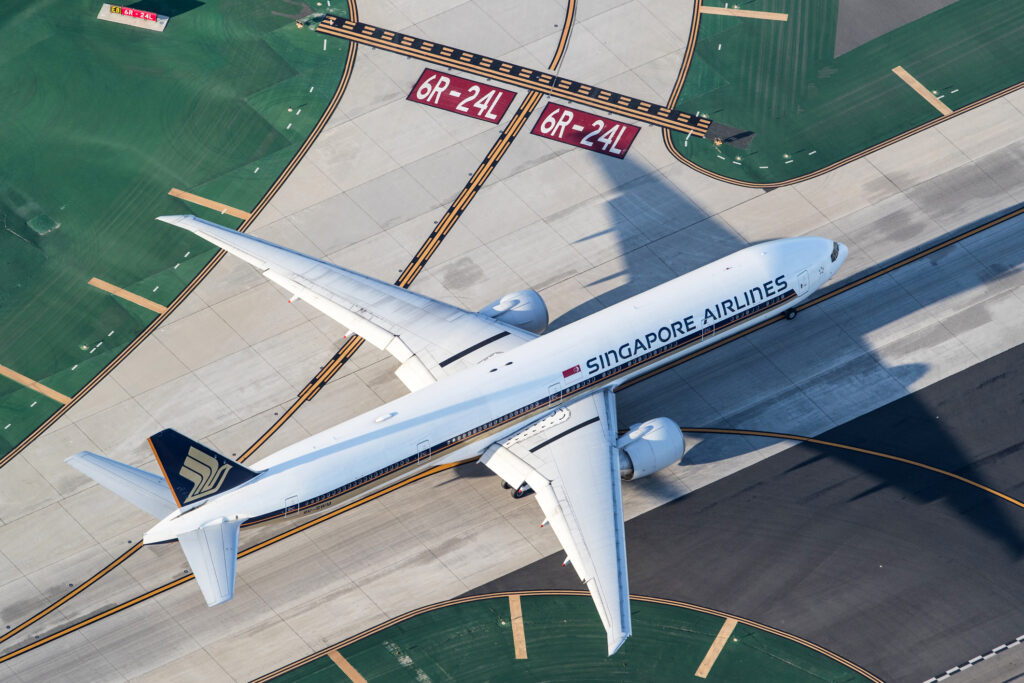
For a trip all the way to Singapore, nonstop flights from Los Angeles, San Francisco, and Seattle start at 37,400 miles.
Here are the U.S. economy options included in the sale:
Route
Sale Price
New York (JFK) → Frankfurt (FRA)
23,375 miles
Frankfurt (FRA) → New York (JFK)
23,375 miles
Los Angeles (LAX) → Tokyo (NRT)
36,125 miles
Tokyo (NRT) → Los Angeles (LAX)
36,125 miles
Los Angeles (LAX) → Singapore (SIN)
37,400 miles
Singapore (SIN) → Los Angeles (LAX)
37,400 miles
San Francisco (SFO) → Singapore (SIN)
37,400 miles
Singapore (SIN) → San Francisco (SFO)
37,400 miles
Seattle (SEA) → Singapore (SIN)
37,400 miles
Singapore (SIN) → Seattle (SEA)
37,400 miles
Prices are per person and one way. Taxes and fees are charged separately.
The promotion has a general blackout period from December 1, 2026, through January 10, 2027. Some routes have additional blackout dates, and only the flight numbers listed by Singapore Airlines qualify for the discount.
Premium Economy Starts at 67,150 Miles
There are fewer U.S. options in premium economy. Several of Singapore Airlines’ longest flights are included, though.
San Francisco to Singapore starts at 67,150 miles each way. Flights between the New York area and Singapore start at 71,825 miles.
Route
Sale Price
San Francisco (SFO) → Singapore (SIN)
67,150 miles
Singapore (SIN) → San Francisco (SFO)
67,150 miles
Newark (EWR) → Singapore (SIN)
71,825 miles
Singapore (SIN) → New York (JFK)
71,825 miles
Only specific flights qualify, and the San Francisco routes have additional blackout dates.
The full Global Redemption Sale extends well beyond these U.S. options. Singapore Airlines is also discounting eligible economy awards throughout Asia and on routes connecting Singapore with Europe, Australia, and other destinations.
How to Get KrisFlyer Miles
KrisFlyer is Singapore Airlines’ loyalty program. Flying with the airline isn’t the only way to earn its miles.
Several major credit card rewards programs allow points to be transferred to KrisFlyer. That includes American Express Membership Rewards, Capital One miles, Chase Ultimate Rewards, and Citi ThankYou Rewards.
JETLINERIMAGES / ISTOCK
There’s one complication. Singapore Airlines restricts award searches for accounts without at least 1,000 KrisFlyer miles. That makes it difficult to check whether a discounted Promo award is available with an empty account.
One workaround is to transfer 1,000 points to KrisFlyer first. Once those miles arrive, it’s possible to search for available awards before transferring the much larger balance needed to book a flight.
Note that eligible discounted flights appear under the “Promo” fare option when searching Singapore Airlines’ website or app.
Bookings must be completed through Singapore Airlines’ website or app by September 20, 2026. Availability is limited and offered on a first-come, first-served basis.
You booked a flight with miles, but now your plans have changed. Or maybe the trip is still on, but you found the same flight for fewer miles.
Can you cancel the award and get your miles back?
Usually, the answer is yes.
Most airline loyalty programs let members cancel award tickets and get their miles back. But whether that’s free, how close to departure it can be done, and what happens to any taxes and fees depends on the program.
Here’s what to know.
What Happens When You Cancel an Award Ticket?
When you cancel an eligible award ticket, the miles are typically returned or redeposited into the loyalty account they came from.
That’s different from what happens with many nonrefundable cash tickets, where canceling can leave you with a credit toward future travel or perhaps empty-handed.
With an award, you’re usually getting the airline’s loyalty currency back so you can use it again. But before canceling, there are four things to double-check:
Whether your miles will be returned
Whether there’s a cancellation or redeposit fee
What happens to the taxes and fees you paid
How long you have to cancel before departure
The answers depend on the loyalty program you used to book and sometimes the type of award you purchased.
The rules vary even among the major U.S. airlines. Some let you cancel most awards and get your miles back for free, while others have different rules for certain types of tickets.
Program
What to Know
Official Policy
American AAdvantage
Cancel before the first flight departs and your miles can be reinstated for free.
Most awards originating in the U.S. or Canada can be canceled without a redeposit fee. Delta Basic awards have different rules and can carry a fee in miles.
Cancel before the no-show deadline and the points are returned. On some fares, failing to cancel at least 10 minutes before departure can mean forfeiting the points.
Policies can change, and additional restrictions may apply. Check the airline’s current terms before canceling.
International Airline Award Cancellation Policies
Cancellation fees are more common among international loyalty programs, and some programs charge substantially more than others.
Program
What to Know
Official Policy
Air Canada Aeroplan
Cancel up to two hours before departure. Online cancellation fees range from C$0 to C$150 depending on the reward fare, while Contact Centre fees can be higher.
Cancel more than 24 hours before departure and your points are returned. The fee is £70 for UK-originating trips or $100 (or the local equivalent) for trips originating elsewhere.
This isn’t an exhaustive list. Other programs have their own deadlines, fees, and restrictions, so it’s worth checking the rules before making any changes.
The Program You Booked Through Matters
This is especially important with partner airlines.
The cancellation policy comes from the loyalty program whose miles or points were used, not necessarily the airline operating the flight.
For example, a United flight booked with Air Canada Aeroplan points is an Aeroplan award. If it’s canceled, Aeroplan’s rules apply.
That can be worth considering before booking, too. The same flight might be available through more than one loyalty program, but the cost to cancel it later could be very different.
What If the Award Gets Cheaper After You Book?
Cancellation policies aren’t only useful when plans change. Award prices change, too.
If the same flight later costs fewer miles, it may be possible to rebook at the lower price and get the difference back.
Before canceling anything, make sure the lower-priced award is still available and check whether the airline allows the existing ticket to be changed instead. That’s especially important with partner awards because a canceled seat isn’t guaranteed to return to award inventory.
American Airlines, for example, lets eligible AAdvantage awards be changed online. If the replacement costs fewer miles, the difference is returned without having to cancel the trip and start over.
Check the Rules Before You Cancel
For most award tickets, canceling doesn’t mean losing the miles. But the details can make a big difference.
Check the deadline, any redeposit fee, and what happens to the taxes and fees before making a change. And if the goal is simply to take advantage of a lower award price, see whether the existing ticket can be changed first.