Thanksgiving, Christmas, ski season, and that point in winter when somewhere warm starts sounding really good all have a way of feeling far away until suddenly they’re not.
Now’s a good time to see what the options look like.
That doesn’t mean there’s a magic deadline for booking. A flight that costs a ton of miles today could cost less next week. It could also cost more, and sometimes a great option pops up at the last minute. Award prices change, and there’s no reliable way to predict exactly when the best price will appear.
But waiting isn’t the only option.
Depending on the airline and the type of award, it may be possible to book a flight that works now and change it later if something better comes along. And if nothing looks good today, there are ways to keep an eye on the trip without searching for the same flights over and over.
Here’s where to start.
Start With the Trips You Know You’re Taking
Thanksgiving with the family is a very different trip from a January ski weekend or escaping somewhere warm in February.
For a holiday, wedding, or another event already on the calendar, start by looking at the options now. Someone who needs to fly the Wednesday before Thanksgiving and return Sunday has much less flexibility than someone who wants to spend a few days on a beach sometime this winter.
Look at both the cash price and the number of points or miles required. That gives you a baseline, even if you’re not ready to book right this minute.
More flexible trips open up more possibilities. A ski trip might work over several weekends. A warm-weather getaway might work in January or February. Try moving the dates, checking nearby airports, or looking at another weekend.
PointsYeah makes it easy to scope out your options without starting a new search every time.
{{ search-widget mode=”flight-hotel” }}
And if the destination isn’t set either, let what’s available offer some inspiration.
PointsYeah’s Daydream Explorer shows destinations that can be booked with points from a selected airport. Instead of searching for one place at a time, it can answer questions like, “Where could I go for a long weekend in January to escape the cold?” or “Where can I fly with my points for a ski trip this winter?”
Finding a flight that works doesn’t necessarily mean the search has to end.
Some airline loyalty programs allow award tickets to be changed or canceled without a fee. That can make it possible to book a workable option now while keeping an eye out for something cheaper or more convenient.
American Airlines is a good example. AAdvantage doesn’t charge change fees on award tickets, although changing to a more expensive award means paying the difference. American also allows eligible awards to be canceled before departure with the miles reinstated at no charge.
Say a Christmas trip costs 25,000 miles today. A few weeks later, the same flight becomes available for 18,000 miles.
The trip stays the same, but 7,000 miles go back into the account.
PHOTOSVIT / ISTOCK
But this is something to check before booking, because every loyalty program has its own rules.
Delta, for example, treats Basic award tickets differently. Basic awards originating in the U.S. or Canada aren’t refundable after the 24-hour risk-free cancellation period, and changing or canceling one comes with a fee assessed in miles.
Other programs have their own policies, and certain bookings can have additional restrictions.
That flexibility can be especially useful for winter trips that aren’t completely settled. Maybe the ski weekend depends on snow conditions, or a warm-weather getaway could move by a few days. If that’s part of the plan, check the rules before booking rather than assuming an award can be changed later.
Don’t Like the Price? Track It
Sometimes there isn’t anything worth booking yet.
Maybe the Christmas flight costs far more miles than expected. Maybe there’s nothing available for the ski weekend. Or maybe the only flight to somewhere warm leaves at 5 a.m. and connects twice.
Waiting can make sense in those situations. But it doesn’t have to mean running the same search every few days.
A PointsYeah Points Price Alert can track a trip and send an alert if the points price changes or something new becomes available.
There’s no guarantee a better option will appear, but the alert can do the checking in the background.
Keep an eye on the cash fare, too. If an award still costs more miles than expected but the cash ticket drops to a comfortable price, paying cash may make more sense.
Points and miles are another way to pay for a trip. They don’t have to be used every time.
DORADALTON / ISTOCK
Check the Hotel Before You Book the Flight
A great flight deal can become a much less appealing trip once the hotel search begins.
That’s especially important for fall and winter trips. College football games, parents’ weekends, Christmas markets, holiday events, ski season, and long weekends can make hotel rooms unusually expensive on certain dates.
A cheap flight to a ski destination, for example, isn’t nearly as exciting if every hotel nearby costs $700 a night.
Before booking a discretionary trip, check the hotel rates alongside the flights.
The hotel might change which weekend makes the most sense. It can also change where points are most useful.
For example, a reasonably priced cash flight paired with an expensive ski resort might be a good opportunity to save the airline miles and use hotel points instead. If hotel rooms at a warm-weather destination are inexpensive but flights are costly, the opposite might make more sense.
There’s no need to pay for every part of a trip the same way. Points can cover the parts where they’re most useful, and cash can cover the rest.
A Thanksgiving trip, Christmas vacation, ski weekend, and February escape don’t need to be planned the same way.
Some trips come with dates that can’t move. Others might have an entire season to work with.
Start with the trips already on the calendar and check both points and cash prices. For a more flexible getaway, see what happens when the dates or destination change. And before booking an award that might need to move, find out what the change and cancellation rules allow.
If nothing works yet, that’s useful information, too. Set an alert and keep looking without having to start from scratch every few days.
There’s no way to know today whether the best fall or winter award will appear tomorrow, next month, or a few days before departure. But knowing what the options look like now leaves plenty of time to decide whether to book, wait, or change the trip entirely.
There’s a new way to book Condor flights with points.
As of September 1, Qantas Frequent Flyer members can redeem points for Condor flights in economy, premium economy, and business class.
Condor has become an increasingly popular redemption partner for airline loyalty programs. Qantas joins Alaska Atmos Rewards, JetBlue TrueBlue, and Emirates Skywards in offering Condor awards.
Qantas Points Can Now Be Used for Condor Flights
Condor is a German airline with a sizable route network between North America and Europe. It flies from several cities across the U.S. and Canada to Frankfurt (FRA), including New York, Los Angeles, San Francisco, Seattle, and Anchorage.
From Germany, Condor also flies throughout Europe and to destinations in Africa, Asia, and the Middle East.
And those flights can now be booked with Qantas Points.
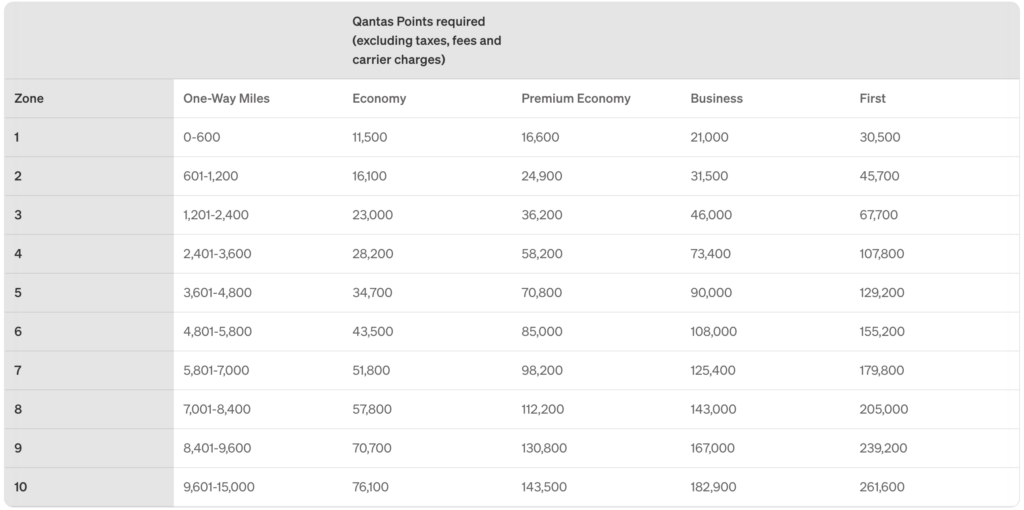
Condor awards booked through Qantas follow the program’s distance-based partner award chart. The number of points required depends on the distance flown and cabin booked.
QANTAS.COM
Qantas award pricing shown above is accurate as of September 1, 2026. Award rates can change, so check Qantas for current pricing before booking.
Taxes and fees are charged in addition to the points required and vary by route.
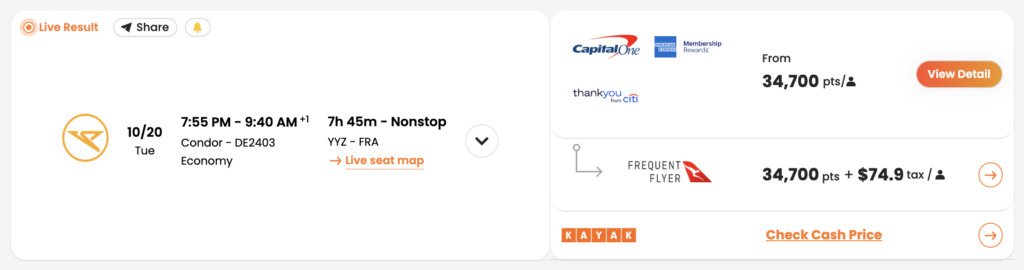
Condor awards bookable with Qantas Points are already appearing in PointsYeah searches.
POINTSYEAH
Searching a route and dates can surface Condor alongside other award options for the same trip. Award space varies by date and cabin, so checking nearby dates can help turn up additional options.
Qantas isn’t the only option for booking Condor awards.
Condor flights can also be booked with Alaska Atmos Rewards points, JetBlue TrueBlue points, and Emirates Skywards miles. Each program prices awards differently, and the seats available through one program may not always match what’s available through another.
But with Qantas now in the mix, there’s one more program to lean on when booking Condor awards to and through Germany.
If Europe is on your travel list for this fall or winter, Flying Blue just released another round of discounted award flights.
Each month, Flying Blue, the loyalty program for Air France and KLM, discounts select award routes through its Promo Rewards program. This month’s offers include several routes between North America and Europe for 25% fewer miles than usual.
Discounted one-way awards start at:
18,750 miles in economy
30,000 miles in premium economy
45,000 miles in business class
The discounts are available for bookings made through October 31, 2026, for travel through March 31, 2027.
Where You Can Fly for Fewer Miles
This month’s discounted awards are available from the following North American departure cities.
Departure City
Cabin
Starts At
Raleigh/Durham (RDU)
Economy
18,750 miles
Houston (IAH)
Economy
18,750 miles
Montreal (YUL)
Economy
18,750 miles
Ottawa (YOW)
Economy
18,750 miles
Boston (BOS)
Economy
18,750 miles
Calgary (YYC)
Economy
18,750 miles
Toronto (YYZ)
Economy
18,750 miles
Vancouver (YVR)
Economy
18,750 miles — Flying Blue Extra only
St. Martin (SXM)
Economy
22,500 miles
Miami (MIA)
Premium economy
30,000 miles
Chicago (ORD)
Premium economy
30,000 miles
Las Vegas (LAS)
Premium economy
30,000 miles
Austin (AUS)
Premium economy
30,000 miles
New York (JFK)
Premium economy
30,000 miles — Flying Blue Extra only
Mexico City (MEX)
Business
45,000 miles
Seattle (SEA)
Business
45,000 miles
Orlando (MCO)
Business
45,000 miles — Flying Blue Extra only
Cancun (CUN)
Business
45,000 miles — Flying Blue Extra only
Those are starting prices, so you won’t find the lowest rate on every date.
It’s also worth remembering that Paris and Amsterdam don’t necessarily have to be your final destination. Depending on availability, Flying Blue can price connecting itineraries to destinations elsewhere in Europe at the same mileage rate.
That means a Promo Reward from the U.S. to Paris could potentially get you to another city in Europe for the same number of miles.
Don’t see your home airport? Check nearby departure cities, too. A separate flight, drive, or train ride to another airport can sometimes open up more options.
How to Find Flying Blue Promo Rewards
The discounted prices aren’t available on every flight, so the next step is finding dates when the lower rates actually appear.
Search your route and compare nearby dates to see when the discounted awards are available.
{{ search-widget mode=”flight” }}
Flying Blue is also a transfer partner of several major credit card rewards programs, including American Express Membership Rewards, Bilt Rewards, Capital One Miles, Chase Ultimate Rewards, Citi ThankYou Rewards, and Wells Fargo Rewards.
Before transferring, check whether there’s a current transfer bonus to Flying Blue. If there is, the number of credit card points you need could be lower than the mileage price shown by Flying Blue.
Book through Air France or KLM using your Flying Blue account.
Taxes and fees are charged in addition to the required miles.
The Promo price reflects the Light fare. Light fares do not include checked baggage in Economy or Premium Economy and cannot be changed or refunded. Platinum and Ultimate members can change or refund Light fares free of charge.
You also don’t need to book a round trip. If you find a good Promo Reward to Europe but the return flight is expensive, you can book the outbound through Flying Blue and use another airline, loyalty program, or cash fare for the trip home.
Find the Flight Before You Transfer
Don’t move credit card points to Flying Blue just because you see a discounted route.
Find the flight you want first and make sure the lower price is available on your travel date. Then compare it with your other options.
Once you’re ready to book, transfer only the points you need. Credit card point transfers can’t be reversed, and leaving points in your credit card rewards account gives you far more options than moving them to Flying Blue without a specific flight in mind.
Plans change. And so does award pricing, for that matter.
If you’ve booked a flight with American Airlines AAdvantage miles, you don’t necessarily need to call to change it. Most award trips can be changed online, whether you need a different flight or happen to stumble across a cheaper option after booking.
There are no change fees, although you’ll pay any increase in miles or taxes. And if the new award happens to cost less, you’ll get the difference back.
Here’s how it works.
How to Change an American Airlines Award Flight Online
Changing an American Airlines award flight online is quick and easy.
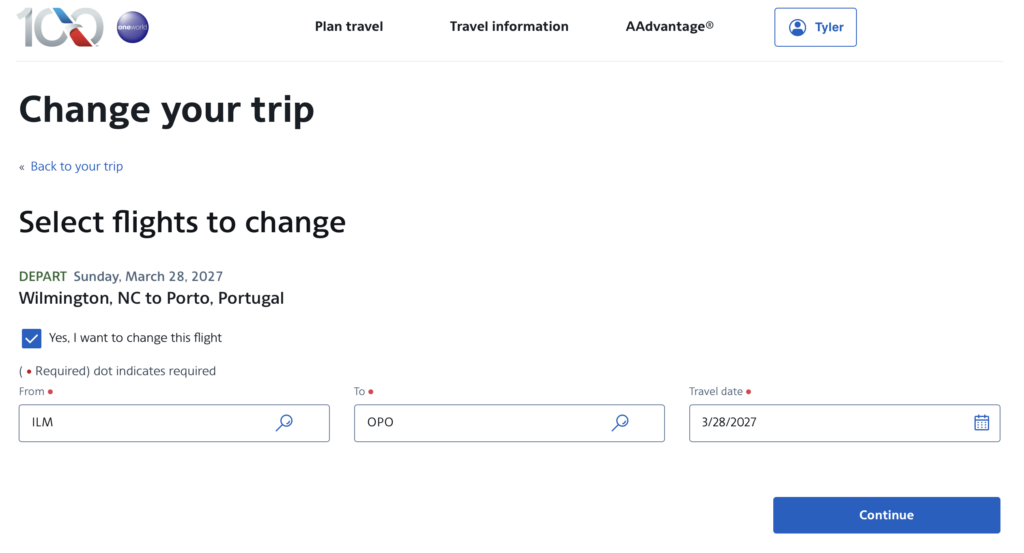
American will ask which flight you want to change. Select the applicable flight and confirm that you want to make a change.
On the next screen, you can change any of three things:
Origin
Destination
Date
You don’t have to change all three. If you just want to look for another flight on the same route and date, leave the existing information in place and continue.
AA.COM
American will search for new options much like it would if you were booking a new award ticket. The difference is that it knows what you’ve already paid.
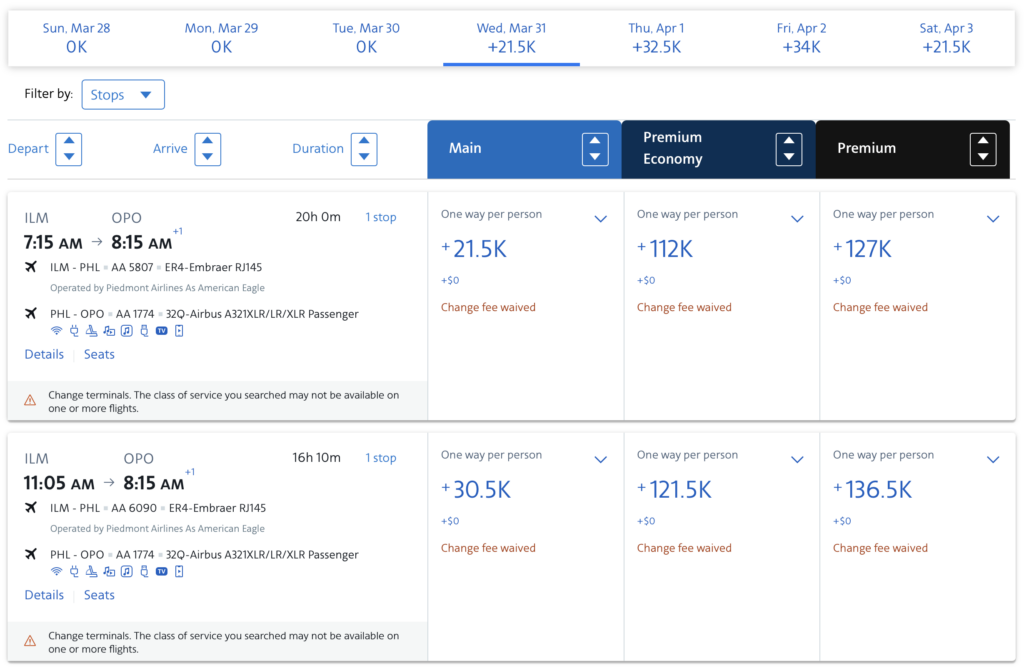
At the top of the results, you’ll see your previous trip value, previous tax value, and available AAdvantage miles. The results below show how much more each new itinerary would cost compared with your existing award.
For example, this trip from Wilmington (ILM) to Porto (OPO) was originally booked for 21,000 AAdvantage miles plus $5.60.
AA.COM
Changing the departure to March 31 would cost another 21,500 miles, while March 28, 29, and 30 show some itineraries with no additional miles required.
Once you’ve found the itinerary you want, select the fare and continue to the confirmation screen. You’ll see any additional miles and taxes due before completing the change. If the new award costs less, you’ll get miles back instead.
The process in the American Airlines app is nearly identical.
What Happens to Your Miles When You Change an Award?
There’s a little more happening behind the scenes than the change screen suggests.
American says it reinstates the miles from the original trip to the AAdvantage account they came from. It then deducts the miles required for the replacement award from that same account, even when the new award costs the same amount.
American also says to allow up to 72 hours for a mileage reinstatement to process. Your AAdvantage balance will update once the reinstatement is complete.
Taxes are settled as part of the change as well. If the new itinerary requires additional taxes, you’ll pay the difference. If you’re owed a refund, American sends it back to the credit card used for the original booking.
After the change is complete, American sends a confirmation email with the new itinerary and ticket number.
SCM JEANS / ISTOCK
Changing Can Be Easier Than Canceling and Rebooking
The online change option is also worth knowing about when you find something better after booking.
American dynamically prices awards on its own flights, so the mileage price can change as the cash fares fluctuate. Most partner awards work differently, although American uses variable pricing for awards on a small number of partners.
If the price drops, you don’t necessarily need to cancel the original award and start over. An online change keeps you within the existing reservation and shows what the new option costs compared with what you’ve already paid. If the replacement costs fewer miles, you’ll get the difference back.
You can do the same thing if a different flight, date, origin, or destination becomes a better option.
American describes online changes as available for “eligible” trips, so you won’t necessarily see the option on every reservation.
American directs travelers to its reservations center for certain awards, including trips that have already started and some itineraries involving partner airlines. Trips affected by circumstances outside your control may also require assistance.
But if your reservation is eligible, you’ll see “Change trip” on the reservation page. From there, you can see what the alternatives cost before confirming anything.
So before canceling an award or calling American, check the reservation online. The change you want to make may only take a few minutes.
If you’ve spent any time reading about points and miles, you’ve probably seen some enormous numbers.
Earn 75,000 points. Earn 100,000 points. Earn 150,000 points. Apply for this card. Transfer points here. Book this business class seat that normally costs $8,000.
Some of that can be useful. But it can also make getting started much harder than it needs to be.
If you want to use points to travel more or spend less on the trips you’re already taking, you don’t need to begin by figuring out which credit card has the biggest welcome offer. You don’t need to become a frequent flyer, either.
You should, however, start with the trip itself.
Where do you want to go? Who do you want to visit? Which trips are getting too expensive? What would you do if airfare or hotels cost a little less?
Once you know what you want points to accomplish, you can figure out which rewards could help you do it and how to earn them.
That’s a points strategy.
And it can be a lot simpler than the internet makes it look.
What Does Traveling With Points Mean?
Airlines and hotel companies have loyalty programs that are free to join. American Airlines has AAdvantage, United Airlines has MileagePlus, Marriott has Bonvoy, Hyatt has World of Hyatt, and so on.
Each program has its own rewards currency that’s called some variation of points or miles. And once you have enough, you can use those rewards to book travel instead of paying the full cash price.
OZGYRCANKAYA / ISTOCK
Say you want to visit family and the round-trip flight costs $500. You might find that the same trip can also be booked for 20,000 airline miles plus $5.60 in taxes.
You have a choice. Pay $500 or use miles and keep most of that cash in your pocket.
The ticket booked with miles is called an award ticket. Hotels work much the same way. A room selling for $300 might also be available for 25,000 hotel points.
That’s the foundation of points travel. You’re earning another type of currency that can be used to pay for some of your travel.
And despite the name, you do not need to be a frequent flyer to participate in a frequent flyer program.
You can join an airline loyalty program even if you fly once or twice a year. You don’t need elite status, and you don’t have to regularly fly an airline to earn its miles.
Plenty of miles are earned without going anywhere.
You Don’t Have to Travel to Earn Points
Flying can earn airline miles, and hotel stays can earn hotel points. But those are just two ways rewards make their way into your accounts.
Airlines and hotels have partnerships that let you earn points through things you may already be doing.
Shopping portals are a good example. Instead of going directly to a retailer’s website, you start at an airline’s shopping portal and click through to the same store. If the retailer is participating, your purchase can earn airline miles in addition to whatever rewards you were already getting from the purchase.
Airlines also have dining programs that can award miles when you eat at participating restaurants. There are promotions, rental car partnerships, hotel offers, and plenty of other opportunities to pick up rewards along the way.
Credit cards are another way to earn them.
MILORAD KRAVIC / ISTOCK
Some cards earn rewards with a particular airline or hotel company. A Marriott card earns Marriott Bonvoy points, for example, while an airline card earns miles in that airline’s program.
Other cards earn rewards through programs run by banks such as American Express, Capital One, Chase, and Citi. Those points can work differently because you may have more than one way to use them.
We’ll get to that.
For now, know that you don’t need to choose between flying constantly and opening credit cards. Points can come from travel, everyday spending, shopping, dining, promotions, and other parts of the loyalty ecosystem.
The more important question is which points make sense for you to earn.
Start With Where You Want to Go
Before applying for a new credit card, signing up for every loyalty program you can find, or chasing a particular kind of point, think about your travel.
What would you like points to help you do?
Maybe you want to fly to see your kids more often, but tickets routinely cost $500. Maybe you’re trying to take a family of four to Europe next summer. Perhaps you mostly take road trips, and hotels are the expense you’d most like to reduce.
Or maybe there isn’t one big trip. You’d just like to take another weekend away every once in a while without every trip putting a dent in the monthly budget.
Those goals can lead to very different strategies.
PYORSKY / ISTOCK
Imagine you visit family three times per year and airfare typically costs $500 round trip. That’s $1,500 per person each year for a trip you already know you want to take.
If those flights can sometimes be booked for a reasonable number of miles instead, you’ve found a job for points. Your goal isn’t to accumulate a million miles or recreate somebody else’s business class trip from Instagram. It’s to make those family visits less expensive.
Someone trying to take four people to Europe has a different problem. So does someone whose biggest travel expense is hotels.
Figure out the travel first. Then work backward.
Don’t Let Someone Else Pick Your Points Strategy
This is where it’s worth being skeptical of some of what you read online.
There are excellent websites, newsletters, and creators covering points and miles. There are also a lot of headlines telling you that a 100,000-point credit card offer is incredible and that you should apply before it disappears.
Sometimes it is a very good offer.
But a big number doesn’t tell you whether those points will help with the trips you want to take.
Credit cards are part of the points ecosystem, and you’ll find information about them on PointsYeah, too. But it’s also important to understand the incentives at work. Websites can earn money when readers apply for cards through their links, which is worth remembering when every new offer starts to sound like something you can’t afford to miss.
That doesn’t mean you should ignore the experts. It means their strategy doesn’t automatically need to become yours.
A 100,000-point offer could be nearly useless for your travel. A much less exciting opportunity to earn rewards that repeatedly save you $500 on trips to see family could be far more valuable.
Start with your game, not theirs.
Look at How You Travel Now and How You Want to Travel
The rewards you’re earning today may not line up with the travel you want to do tomorrow.
Suppose you tend to fly Frontier or Allegiant because they’re inexpensive from your home airport. There’s nothing wrong with that. Sometimes buying the cheap ticket is exactly the right move.
But what happens when you want to visit somewhere those airlines don’t fly?
Say you want to visit family in Wilmington, North Carolina. If the airline whose rewards you’ve been collecting doesn’t serve Wilmington, those points aren’t going to solve that particular problem.
SEAN PAVONE / ISTOCK
The same mismatch can happen with hotels.
You might put most of your everyday spending on a Marriott credit card and have a large balance of Marriott Bonvoy points. That’s useful if hotel stays are a major part of your travel.
But what if what you really want to do is fly more, and you tend to stay with family once you arrive?
You’re earning plenty of rewards. They’re just not necessarily helping with the expense that’s keeping you from taking more trips.
That doesn’t make Frontier miles or Marriott points bad rewards. It means every reward currency has things it’s useful for and things it can’t do.
Think about the places you visit today and the places you’d like to visit. Which airlines can get you there? Which ones serve your home airport? Do you spend more on flights or hotels? Are there trips you keep putting off because one part of them is especially expensive?
You’re beginning to identify which rewards might fit your travel.
Having More Than One Option Can Help
You don’t need to collect points with every airline and hotel program.
Spreading a few thousand points across a dozen accounts can leave you with a lot of balances that aren’t large enough to book much of anything.
But being locked into one corner of the travel world has its own drawbacks.
ANYABERKUT / ISTOCK
If all of your rewards are hotel points, they can’t do much when airfare is keeping you home. If all of your miles sit with one airline, you’re relying on that airline to serve the places you want to go and offer flights that work when you need them.
This is one reason some credit card rewards are useful.
Instead of earning points that immediately belong to one airline or hotel company, certain cards earn rewards that stay within the bank’s own rewards program. Depending on the program, you may later be able to move those points to one of several participating airline or hotel loyalty programs.
Suppose you have 50,000 points with a credit card rewards program. Months later, you’re planning a trip and find a flight that can be booked for 20,000 miles through one of that program’s airline partners.
You may be able to move 20,000 of your credit card points into the airline’s loyalty program and then use the resulting miles to book the flight.
Until you do that, the points haven’t been committed to that particular airline.
You’ll often hear these called transferable points. You may also see the term flexible points, which simply means the rewards give you multiple potential ways to use them rather than tying you to one airline or hotel from the beginning.
That can be useful if your trips don’t all follow the same pattern. The airline that gets you to your parents might be completely different from the one that works for your summer vacation.
You don’t need transferable points to travel with rewards. They’re one tool that can give you more choices.
Once you’ve thought about the travel you want to take, see what you’re already working with.
You may have more rewards than you realize.
Check any airline loyalty programs you’ve joined in the past, even if you don’t fly often. Look at hotel accounts you’ve used. Then check the rewards section of the credit cards already in your wallet.
Make a simple list. It might look like this:
15,000 American Airlines AAdvantage miles
55,000 Marriott Bonvoy points
40,000 points with a credit card rewards program
Don’t worry about assigning a dollar value to every balance. You’re trying to answer two simpler questions.
MSTUDIOIMAGES / ISTOCK
What do I have, and can any of it help with the travel I want to take?
If your goal is flying to see family, the airline miles may be immediately relevant. The Marriott points could be useful for another trip but may not help much if you stay with family when you visit. The credit card points could create additional options depending on the program.
And if you discover that you have almost nothing, that’s fine.
Starting with zero and knowing where you want to go can be more useful than starting with 100,000 points you don’t know what to do with.
PointsYeah’s My Wallet can also help you keep track of rewards in one place, including balances you’ve entered manually and supported accounts you connect.
You know the kinds of trips you want to take. You know which travel expenses you’d like points to help cover, and you’ve taken stock of the rewards you already have.
What’s missing?
Maybe you want to visit family three times a year and have learned that a certain type of airline mile could help with those flights. Perhaps you want to take a bigger trip next summer and would rather have rewards that give you several airline options. Or maybe you’ve spent years accumulating hotel points when airfare is the part of travel you’d really like help paying for.
Now you have a reason to decide what you want to earn next.
MARTIN DM / ISTOCK
That could mean earning miles on flights you’re already taking, clicking through a shopping portal before a purchase, joining a dining program, or watching for promotions.
It could also mean deciding that a credit card makes sense.
A welcome offer can provide a large number of rewards after you meet its requirements, and spending on the card can continue earning points afterward. But by this point in the process, you’re not choosing a card because 100,000 POINTS sounded impressive.
You’re asking whether those 100,000 points can help with your travel.
A credit card can be a useful earning tool. It isn’t the strategy by itself.
Then See What Your Points Can Do
Eventually, all of this needs to turn into a trip.
Airlines let you search their websites for flights that can be booked with miles, just as you’d search for a ticket you were buying with cash. Hotels let you search for rooms that can be booked with points.
These are called award searches.
You could go to each airline or hotel website individually. The challenge is that one trip can sometimes be booked through several loyalty programs, each with its own points price and rules.
This is where PointsYeah can make the process easier.
With a PointsYeah flight search, you enter where you’re leaving from, where you want to go, and when you’d like to travel. PointsYeah searches the supported airline loyalty programs and shows you available options that can be booked with points or miles.
Think of it as the points version of searching for a flight with cash.
If you wanted to fly from Raleigh-Durham (RDU) to New York, for example, you’d enter Raleigh-Durham as your starting point, New York as your destination, and your travel date. The results show which supported loyalty programs have options and how many points or miles they require.
You don’t need to understand every program that appears on the screen. Start by seeing what’s possible.
If you don’t know where you want to go yet, Daydream Explorer starts from a different question. Tell it where you’re leaving from and explore destinations you could reach with points. That’s useful when the goal is something broad like “We want to go somewhere warm in February” rather than “We need to be in Hawaii on June 12.”
Maybe the ticket costs $500 in cash, but you find an option for 20,000 miles plus $5.60 in taxes. If spending $500 is what’s making you hesitate to take the trip, those miles can be extremely useful.
On another weekend, the same route might cost $150 while the airline still wants 20,000 miles. You might decide to spend the $150 and keep the miles for the next expensive trip.
This is where points advice can get unnecessarily mathematical.
You’ll see websites assign monetary values to different kinds of points and calculate whether a redemption produces a certain number of cents per point. That can be useful for comparing options, but it doesn’t need to dictate whether a redemption makes sense for you.
If using points means you can make a trip you otherwise wouldn’t take, that matters. If cash is cheap and you’d rather save the points, that matters too.
Look at what you’d otherwise pay, what the award costs, what you have available, and which resource you’d rather spend.
DRAZEN ZIGIC / ISTOCK
And don’t assume points need to cover the entire trip.
Maybe you have enough miles for two of the four tickets your family needs. Perhaps you pay cash for a cheap flight out and use miles when the return is expensive. You could buy the airfare and use hotel points once you arrive.
Sometimes points will save you hundreds or thousands of dollars. Sometimes paying cash will make more sense.
Both can be part of the same strategy.
Your Points Strategy Is Yours
The deeper you get into points and miles, the more opinions you’ll encounter.
Someone will tell you which credit card you need. Someone else will tell you which airline program has the “best” redemptions. You’ll see people flying business class around the world and others squeezing every possible mile out of shopping portals, promotions, and credit card spending.
There’s plenty to learn from all of them.
But they don’t necessarily want to take the same trips you do.
If your goal is to fly to see your kids more often, build around that. If you want to take your family to Europe, start there. If you’d like to take more weekend trips but don’t particularly care where you go, that’s something you can build around too.
Figure out which rewards can help with the travel you want to take. See what you already have. Then decide how you want to earn what’s missing, whether that’s through flying, shopping, credit cards, or some combination over time.
The goal isn’t to become an expert at points. It’s to make points useful for the way you want to travel.
If you have an eligible Delta credit card, there’s a good chance your next Delta award flight will cost fewer miles than the advertised price.
That’s thanks to TakeOff 15.
This is a benefit that gives eligible Delta American Express cardholders 15% off award flights operated by Delta. The discount is automatic, there’s nothing to activate, and there’s no limit to how many times you can use it.
It’s a surprisingly useful benefit that takes no extra effort to use.
How Delta TakeOff 15 Works
TakeOff 15 is available to primary cardholders of the personal and business versions of the Delta Gold, Platinum, and Reserve American Express cards.
To use the benefit, log into the SkyMiles account associated with your eligible card and search for an award flight on Delta.com or the Fly Delta app. The discount should automatically appear on eligible flights.
DELTA.COM
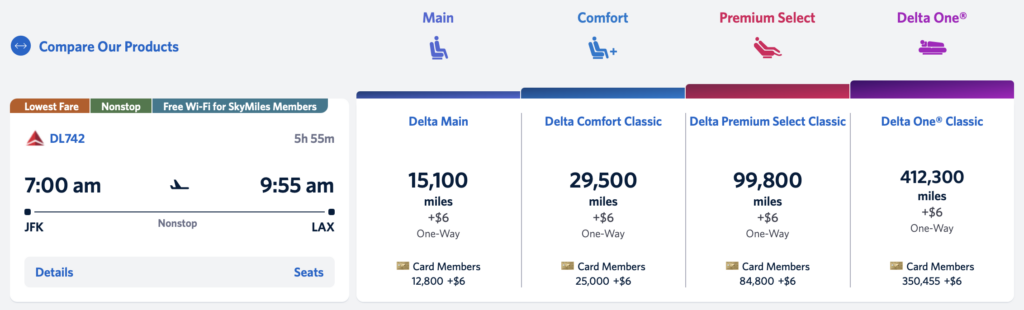
Put differently, if an award normally costs 15,100 SkyMiles, a 15% discount brings it down to 12,800 miles, since Delta likes to round down. On a 412,300-mile award (pricey), you’d save more than 60,000 miles.
That’s pretty wild.
The discount only applies to the mileage portion of the ticket, so you’ll still pay the normal taxes and fees.
There’s no guarantee that a discounted Delta award will be the best option for every trip. But if Delta has the flight you want and you’re planning to use SkyMiles, TakeOff 15 means you can keep 15% of those miles for another trip.
American Airlines is adding seven international routes in 2027, and its Airbus A321XLR will be flying several of them.
Four of the routes announced Thursday will use the long-range narrowbody. That includes brand-new service to Vienna and Porto, along with new flights from New York (JFK) to Amsterdam and Nice.
The A321XLR has been flying for American for less than a year, starting with transcontinental flights before heading across the Atlantic to Edinburgh. Those early routes offered a small preview of what American had planned for the jet.
But its 2027 schedule is giving us a much better idea of what’s ahead.
American’s New International Routes for 2027
American’s expansion includes three destinations joining or returning to its network, plus several new routes to cities it already serves from other gateways.
Some were announced earlier this year, while others are new as of Thursday.
Route
Starts
Aircraft
Chicago (ORD) → Tokyo Narita (NRT)
March 19
Boeing 787-9
New York (JFK) → Amsterdam (AMS)
March 28
Airbus A321XLR
Philadelphia (PHL) → Porto (OPO)
March 28
Airbus A321XLR
New York (JFK) → Nice (NCE)
May 6
Airbus A321XLR
Philadelphia (PHL) → Vienna (VIE)
May 6
Airbus A321XLR
Charlotte (CLT) → Barcelona (BCN)
May 27
Boeing 777-200ER
Philadelphia (PHL) → Reykjavik (KEF)
May 27
Airbus A321neo
Vienna and Porto will be entirely new destinations for American. Reykjavik returns to the airline’s network for the first time since 2019.
Elsewhere, American is bringing back Charlotte to Barcelona and adding new service from New York to Amsterdam and Nice. The Chicago to Tokyo Narita route was previously announced in July but is still included in American’s seven-route expansion for 2027.
There are a few other schedule changes coming next year. American will add a fourth daily flight between New York and London Heathrow (LHR), while seasonal Charlotte to Paris (CDG) and Miami to Milan (MXP) service will extend into early January 2028.
Tickets were supposed to go on sale Monday, August 31, but went on sale a day early.
Four of the seven routes will be flown by an aircraft that carries just 155 passengers.
That’s considerably fewer seats than you’ll find on the Boeing 787s and 777s that do much of American’s long-haul flying. But the A321XLR can still cross the Atlantic. It’s outfitted with 20 Flagship Suite business class seats, 12 Premium Economy seats, and 123 seats in economy.
For American, that means having a smaller aircraft it can send on long international routes without giving up business class or Premium Economy.
The 2027 schedule shows how American can put that flexibility to work. The XLR can open new destinations like Vienna and Porto or add another U.S. gateway to cities already on the map, as American is doing with Amsterdam and Nice.
There are plenty more XLRs coming, too. American has dozens still on order. That could mean more niche European routes or flights to new destinations in South America.
For passengers, there is one very big tradeoff. More long-haul XLR routes also mean more opportunities to spend a transatlantic flight on a single-aisle aircraft.
Whether that matters probably depends on where you’re sitting.
Airlines and hotels regularly sell points and miles with bonuses or discounts. And some promotions can bring the cost down significantly.
Sometimes, buying points or miles for the trip you want to take can even cost less than paying the going cash price.
Whether you’re topping off an account for an award you’ve already found, planning ahead for a trip, or simply waiting for a better offer, it helps to know what’s available now and how it compares with what we’ve seen before.
PointsYeah automatically tracks current offers for buying airline miles and hotel points below, along with each program’s recent promotion history.
Current Buy Points and Miles Offers
Here are the current promotions for buying airline miles and hotel points. The tables below automatically update as new offers begin and existing ones expire.
Note that some promotions are targeted, so you may see a different bonus or discount after logging into your loyalty account. Always confirm the offer and final purchase price before buying.
Active airline buy miles offers
{{ buy-points-table type=”airline” }}
Active hotel buy points offers
{{ buy-points-table type=”hotel” }}
Before You Buy Points or Miles
There’s more to a good buy points or miles promotion than the headline bonus or discount.
Each loyalty program sets its own price, so a 100% bonus from one program isn’t necessarily a better deal than a 50% bonus from another. The final purchase price matters more, and the historical tables below can help you see whether the current offer is especially good or something that comes around regularly.
It also helps to know how you plan to use the points or miles before buying them. If you’re a few thousand miles short of an award, buying the difference can be an easy way to get what you need. In other cases, buying enough points for an entire flight or hotel stay can cost less than paying cash.
If you’re buying airline miles for a particular trip, search for the award first. Availability can change quickly, and you don’t want to buy miles only to discover that the flight you wanted is no longer bookable.
PointsYeah searches live award availability across dozens of rewards programs, so you can see what’s available before making a purchase.
{{ search-widget mode=”flight-hotel” }}
Keep in mind that points and miles purchases are generally nonrefundable. Programs may also limit how many points or miles you can purchase, so check the terms of the specific offer before buying.
A promotion can sound impressive without being particularly unusual. Looking at previous offers gives you a better idea of how today’s bonus or discount stacks up.
Open the dropdown for any airline or hotel program below to see its recent buy points or miles offer history.
Every so often, airlines and hotels put their points and miles on sale.
If you’ve ever come across one of those promotions, you may have wondered why anyone would spend money buying points instead of simply paying for the trip.
The answer depends on what you’re trying to book.
Most of the time, buying points isn’t necessary. But every now and then, purchasing points or miles can lower the cost of your trip or unlock a flight or hotel that would otherwise cost much more.
Here’s when buying points and miles can make sense, and when it’s probably better to keep your wallet in your pocket.
How Buying Points and Miles Works
Most airline and hotel loyalty programs let members purchase points or miles directly through their websites, though the transaction is often processed by a third party such as Points.com.
Instead of earning points by flying, staying at a hotel, or spending on a travel credit card, you’re just buying the points or miles you need.
Sometimes you’ll pay the standard price. Other times, loyalty programs run limited-time promotions that offer bonus points or discounts, making those purchases much more attractive.
Buying points doesn’t automatically save you money, though. Whether it’s a good deal depends entirely on how you plan to use them.
That’s why the first question shouldn’t be, “Are points on sale?”
It should be, “What am I trying to book?”
MSTUDIOIMAGES / ISTOCK
Search First. Buy Second.
Before purchasing points, make sure the flight or hotel you want is available.
Award availability can change quickly, and buying points before confirming you can use them could leave you with a balance you weren’t planning to keep.
A better approach looks like this:
Find the flight or hotel you want.
Compare the cash price with the points price.
Calculate what it would cost to buy any points you’re missing.
If buying points costs less than paying cash, it may be worth it.
In other words, buy points for a trip you’re ready to book, not simply because they’re on sale.
PointsYeah makes this process easier by showing live award availability across supported airline and hotel loyalty programs, allowing you to compare your options before deciding whether buying points is worth it.
Buying points isn’t something you’ll do for every trip, but there are a few situations where it can be worth considering.
You’ve already found the award you want
This is one of the best reasons to buy points.
Imagine a hotel stay costs $400 if you pay cash.
The same stay is available for 15,000 points, and buying those points during a promotion costs $300.
In that case, purchasing the points saves you money while booking the same stay.
How cool is that?
You’re only a few points short
Sometimes you’re on the cusp of a redemption.
If you already have most of the points needed for a flight or hotel stay, buying the remaining amount can be less expensive than paying cash for the entire reservation.
There’s a promotion worth taking advantage of
Airline and hotel loyalty programs regularly offer bonus points or discounts when purchasing points.
A promotion by itself isn’t a reason to buy points, but it can improve the math if you’ve already found the redemption you want.
When You Probably Shouldn’t Buy Points
Buying points isn’t always a good deal. In fact, there are plenty of situations where paying cash or using another redemption option is the better choice.
You may want to skip buying points if:
You don’t have a specific trip in mind.
You haven’t confirmed award availability.
You’re buying simply because there’s a sale.
The cash price is already competitive.
You’d need to buy far more points than you actually plan to use.
If you’re not ready to book, it’s usually better to keep your money in your pocket. Once you’ve found the trip you’re ready to book, you can compare the cost of buying points with your other booking options and decide which makes the most sense.
FG TRADE LATIN / ISTOCK
Check Current Promotions
Airline and hotel loyalty programs regularly offer bonus points or discounts when you buy points. Purchasing during one of these promotions will usually get you a better rate than buying at the standard price.
Once you’ve decided buying points makes sense for your trip, the next question is whether there’s a promotion available.
With each passing day, there are fewer and fewer cities on the world map where you won’t see a United tail. And eight of these new destinations won’t have nonstop service from the U.S. on another U.S. airline.
That means new ways to get to places like Okinawa, Toulouse, Luxembourg, Ibiza, and Ljubljana without connecting overseas. And if you happen to have United MileagePlus miles, it means more places to put them to work.
If those miles are burning a hole in your pocket, there’s no need to wait until next year to start looking. Tickets for all 13 new routes are already on sale.
United’s 13 New International Routes
United’s latest expansion stretches from Japan to the Mediterranean, with most of the new service beginning in spring 2027.
Route
Starts
Aircraft
San Francisco (SFO) → Okinawa (OKA)
March 27
Boeing 777-200ER
Los Angeles (LAX) → Osaka (KIX)
March 27
TBD
Newark (EWR) → Luxembourg (LUX)
April 2
Airbus A321XLR
Washington Dulles (IAD) → Toulouse (TLS)
April 26
Airbus A321XLR
Newark (EWR) → Ljubljana (LJU)
May 12
Boeing 767-400ER
Newark (EWR) → Olbia (OLB)
May 27
Boeing 767-300ER
Denver (DEN) → Paris (CDG)
May 27
TBD
Newark (EWR) → Catania (CTA)
May 28
Boeing 767-300ER
Washington Dulles (IAD) → Milan (MXP)
May 28
TBD
Newark (EWR) → Ibiza (IBZ)
May 31
Airbus A321XLR
Newark (EWR) → Valencia (VLC)
June 2
Airbus A321XLR
Newark (EWR) → Marseille (MRS)
June 4
Airbus A321XLR
Newark (EWR) → Terceira (TER)
June 9
Boeing 737 MAX 8
Five of the new routes will be flown by United’s brand-new Airbus A321XLR, which kicks off international service later this year. Its extended range gives United another way to serve international routes that may not have enough demand to justify a larger aircraft.
That helps explain some of the more unusual additions to the map. Toulouse and Luxembourg aren’t exactly the first cities that come to mind when a U.S. airline announces another round of flights to Europe.
But that’s part of the appeal of this particular jet.
It’s too easy to think about airline miles in terms of price. How many miles does an award cost? Did the price go up? Can you find something cheaper?
Where those miles can take you matters just as much. If not more.
United says it has added nearly 60 international destinations since 2017, giving MileagePlus members an increasingly long list of places to use their miles. These latest additions include several destinations that would otherwise require another flight, train ride, or connection after crossing the Atlantic.
Want to go to Ibiza? United will soon take you there nonstop from Newark. The same goes for Ljubljana, Toulouse, Terceira, and Valencia.
None of that guarantees a cheap award ticket. But every new route creates another opportunity to use your miles for the trip you actually want to take.
United Cardholders Have an Advantage
There’s another wrinkle worth knowing before you start searching.
United doesn’t show every MileagePlus member the same award pricing.
Eligible United credit card holders can receive savings of 10% or more on eligible United-operated award flights. Those with both an eligible card and Premier status can save 15% or more.
That benefit is less obvious than a free checked bag or lounge access, but potentially a lot more valuable when you’re ready to use your miles.
When searching live United award availability through PointsYeah, you can view cardholder-exclusive pricing directly in your results. That means you don’t also need to check United’s website to see if your card gets you a better deal.
United’s new routes don’t begin flying until next spring, but they’re already on sale.
So whether Okinawa caught your attention or Ibiza sounds better, you can use PointsYeah to start looking for award space now, including the cardholder pricing you’re eligible for.