Alaska Airlines has spent the last couple of years building a much bigger airline. Now it’s starting to show what it wants that airline to become in the years ahead.
On Tuesday, September 29, Alaska Air Group announced new premium cabins for both Alaska and Hawaiian Airlines, a new premium economy product, and multiple major lounge projects. The changes will start arriving over the next couple of years as Alaska expands farther into Europe and Asia.
There’s a lot here. But some of the more interesting changes isn’t happening on a long-haul Dreamliner.
Alaska Is Putting Lie-Flat Seats on Some 737s
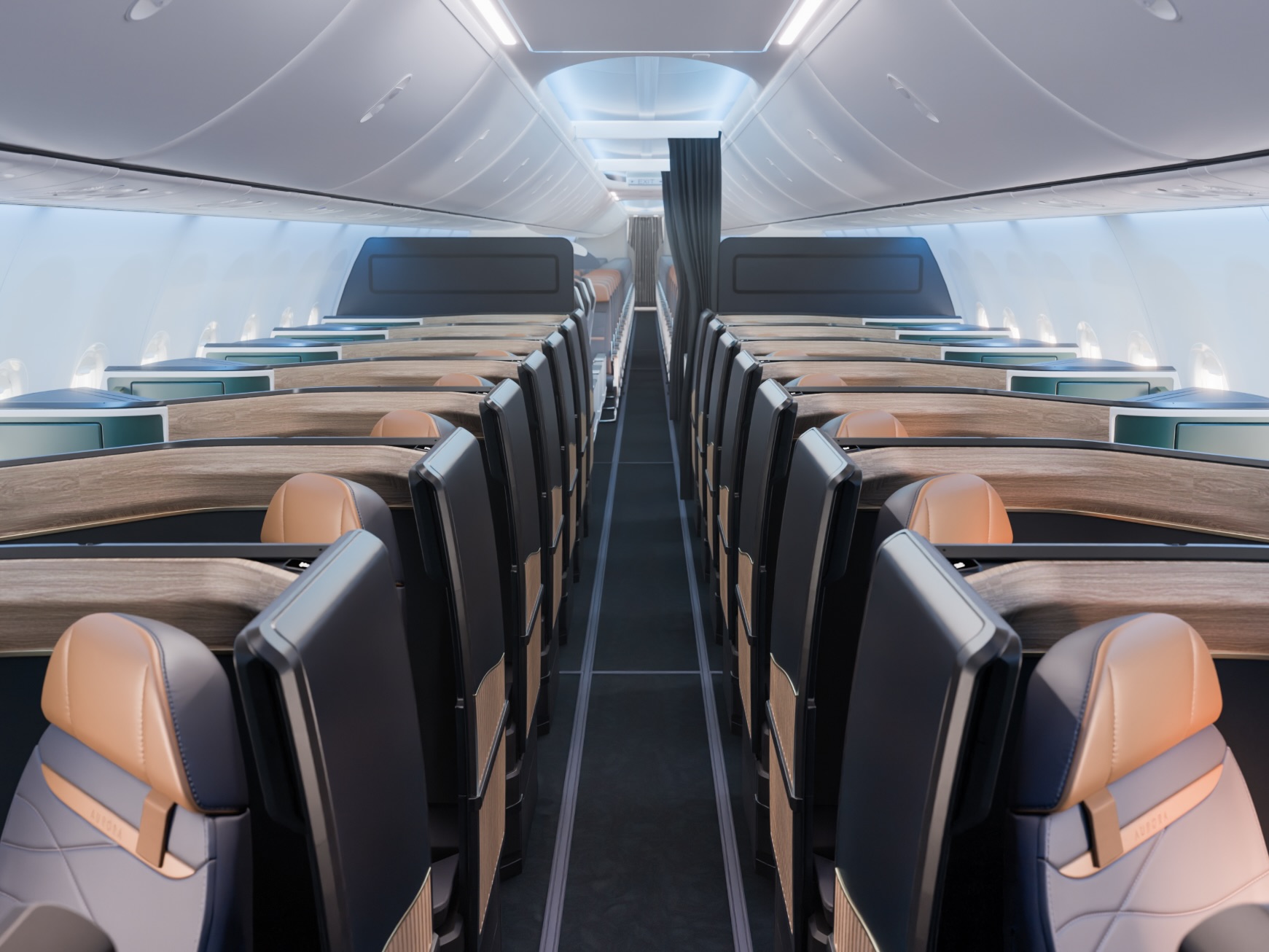
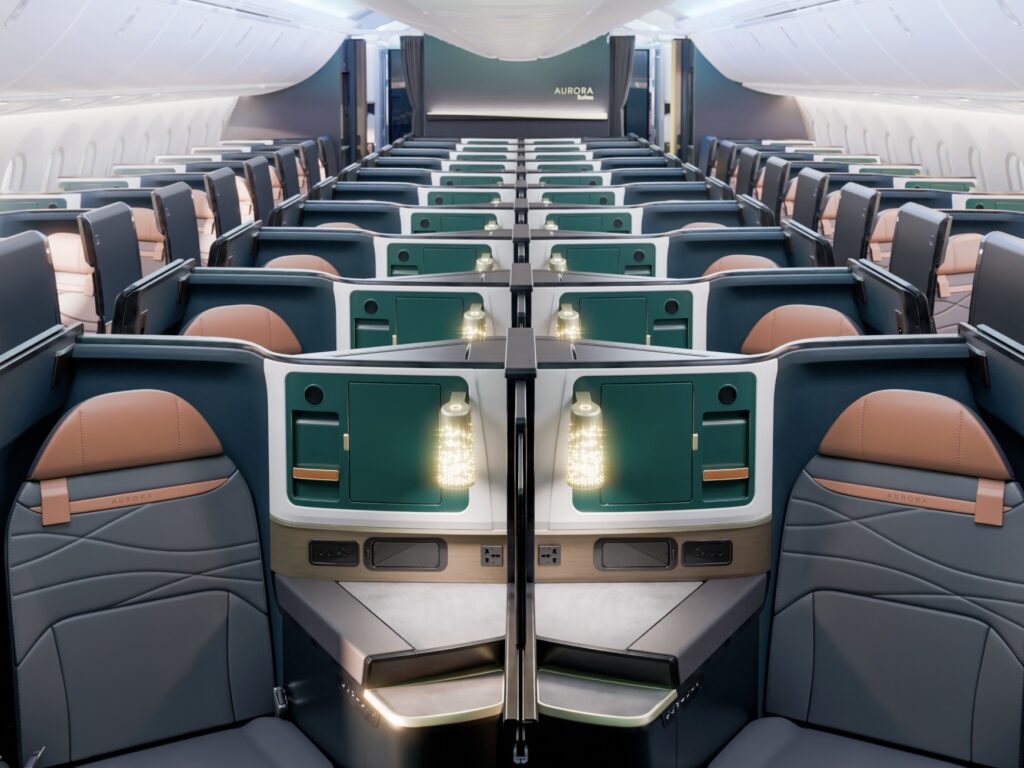
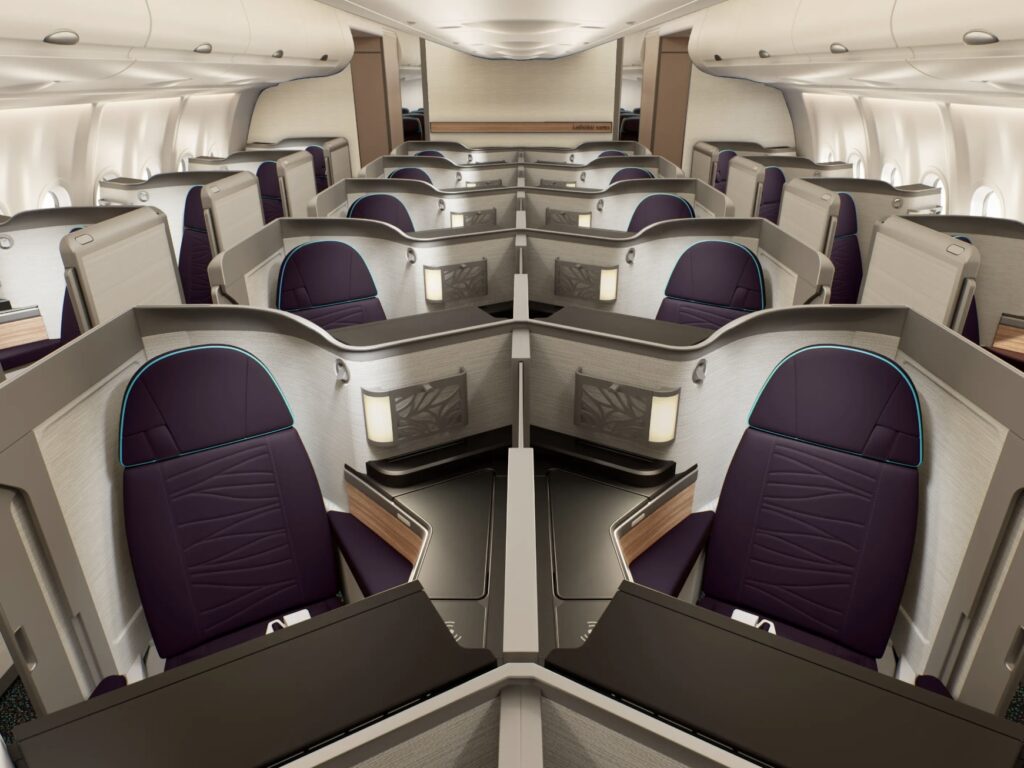
Alaska’s new top-end product will be called Aurora Suites, and it’ll eventually appear on both the airline’s Boeing 787 Dreamliners and at least 25 new Boeing 737-10s.
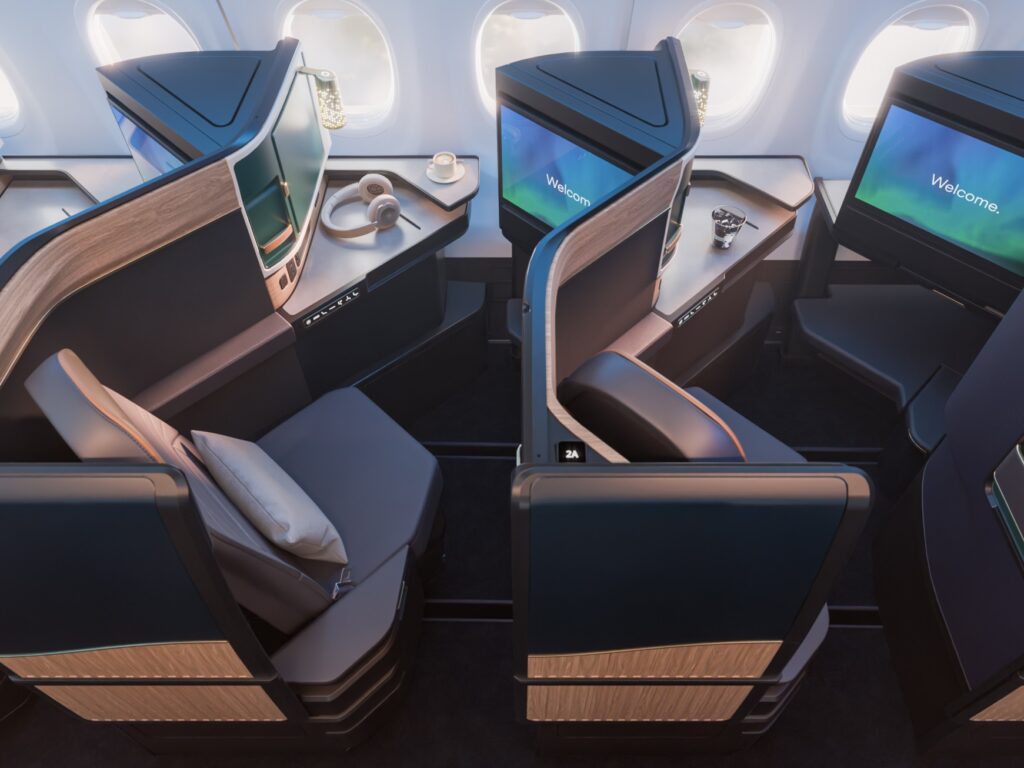
The 787-9 will have 34 Aurora Suites with lie-flat beds, privacy doors, direct aisle access, 19-inch 4K screens, and upgraded dining. The updated aircraft will be about 46% premium seating, up from 38% today.
ALASKA AIRLINES
The 737-10 is where things get more interesting.
At least 25 will be configured with 12 lie-flat Aurora Suites. Alaska says they’ll be used on select transcontinental flights beginning in 2028, bringing lie-flat seats to the airline’s narrowbody fleet for the first time.
ALASKA AIRLINES
These won’t exactly blend into the rest of Alaska’s 737 fleet. They’ll wear the same northern lights-inspired Aurora livery as the 787s and add another 12 Premium Reserve seats behind the suites.
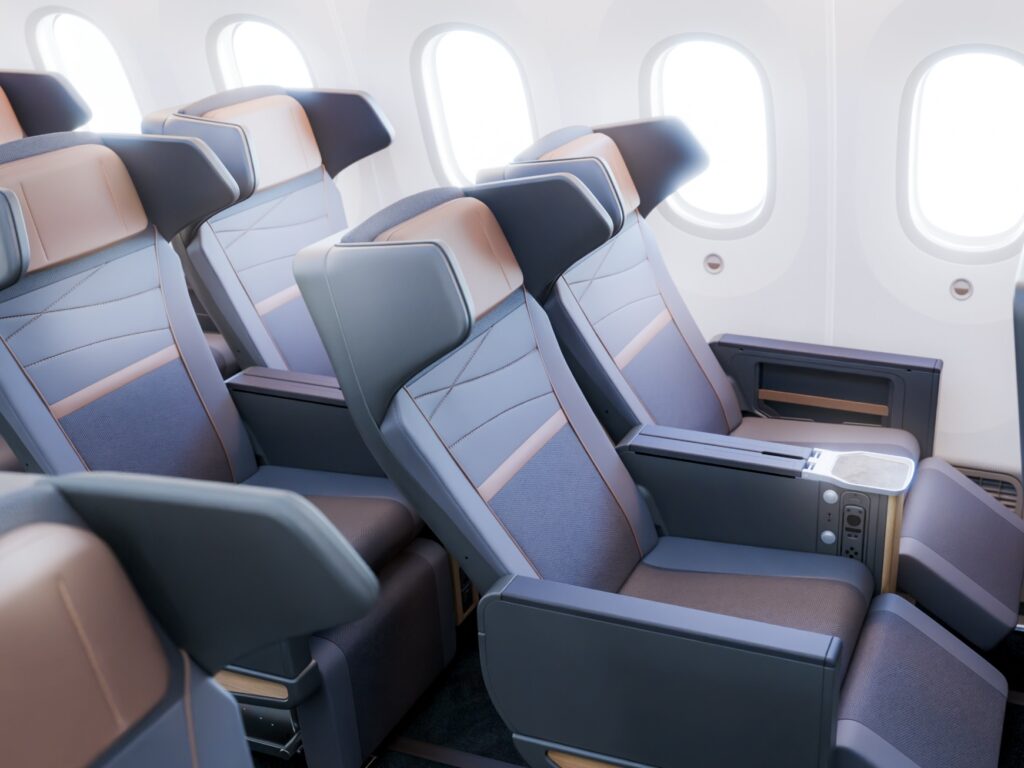
Premium Reserve is Alaska’s new premium economy cabin, sitting above the extra-legroom economy seats it currently sells as Premium Class. Seats will have 38 inches of pitch, more recline, leg and calf rests, 16-inch 4K screens, and upgraded dining.
There will be 35 Premium Reserve seats on Alaska’s 787s, 28 on Hawaiian’s A330s, and 12 on the specially configured 737-10s. The seats go on sale next summer before entering service in 2028.
ALASKA AIRLINES
The Aurora experience won’t start at the airplane, either. Suite passengers will get dedicated check-in and concierge service in Seattle, access to a separate Aurora Lounge, and upgraded onboard dining. Complimentary Starlink Wi-Fi will also be available to Atmos Rewards members.
Put it all together and Alaska is creating a pretty unusual 737, with lie-flat suites and premium economy ahead of its existing Premium Class and Main Cabin.
Hawaiian’s A330s Are Getting Rebuilt Too
Hawaiian isn’t getting the same cabin with a different logo.
Its fleet of 24 Airbus A330s will receive completely new interiors beginning in 2028, including 22 new Leihōkū Suites. They’ll have lie-flat seats with privacy doors and direct aisle access, along with 19-inch 4K screens, hotel-quality bedding, and upgraded dining.
ALASKA AIRLINES
Another 28 seats will be Premium Reserve.
Altogether, about 40% of the A330 will be premium seating, up from 30% today. The rest of the airplane is getting attention too, with new interiors throughout and upgraded entertainment with 4K screens and Bluetooth connectivity.
The Leihōkū experience will also include dedicated check-in and concierge service in Honolulu and Seattle.
Keeping Aurora and Leihōkū separate is also intentional. Alaska and Hawaiian are increasingly becoming one airline behind the scenes, but the company is still trying to preserve what makes the two brands distinct.
That extends to the food. Seattle chef Renee Erickson will develop menus for Alaska’s European flights, including London, Rome, Athens, and Paris, while James Beard Award-winning chef Brady Ishiwata Williams will handle routes to Asia. Hawaiian will continue building its menus around local chefs and ingredients.
Seattle Is Getting a 41,000-Square-Foot Lounge Complex
The premium push starts well before boarding.
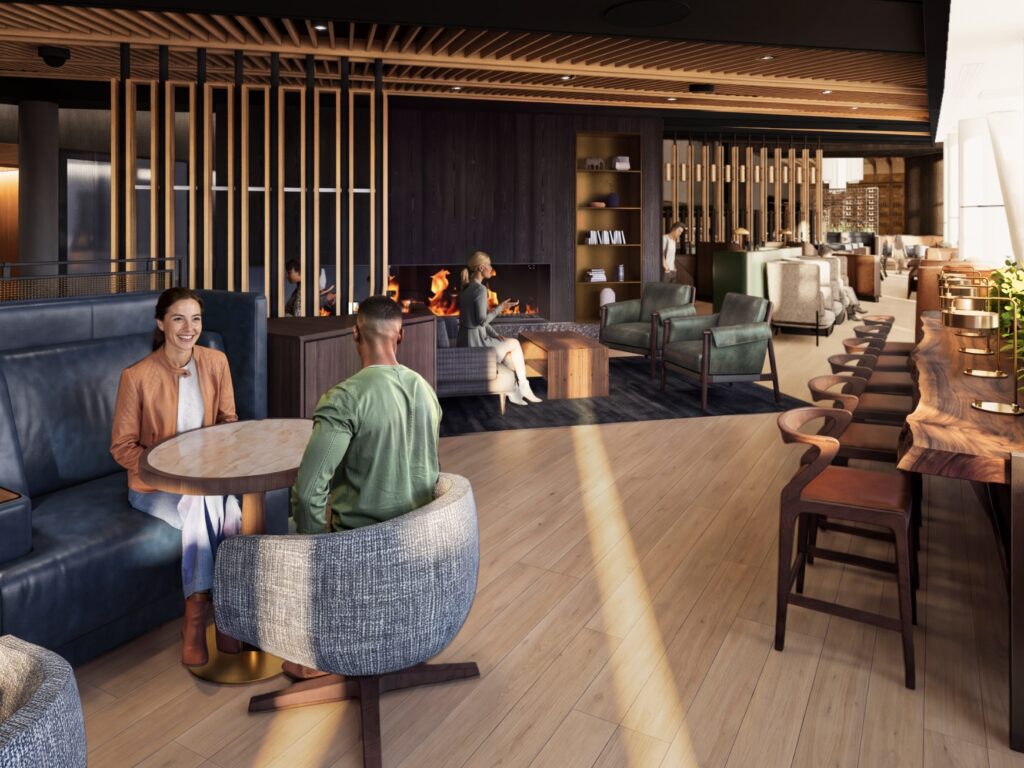
Alaska plans to open a nearly 41,000-square-foot lounge complex in Seattle’s expanded C Concourse in late 2027. The airline says it’ll be Seattle-Tacoma International Airport’s largest lounge and one of the largest in the country.
ALASKA AIRLINES
It’s actually two connected lounges.
A 500-seat Alaska Lounge will occupy the main level and follow Alaska’s existing access policies. A separate 200-seat Aurora Lounge will be reserved for Aurora Suites passengers traveling on intercontinental flights.
The complex will have an outdoor patio with a fireplace, private work pods, three bars, a pizza oven, and what Alaska calls a coffee lab.
The Aurora side goes further with private showers, wellness spaces, made-to-order food, à la carte dining, and tableside service.
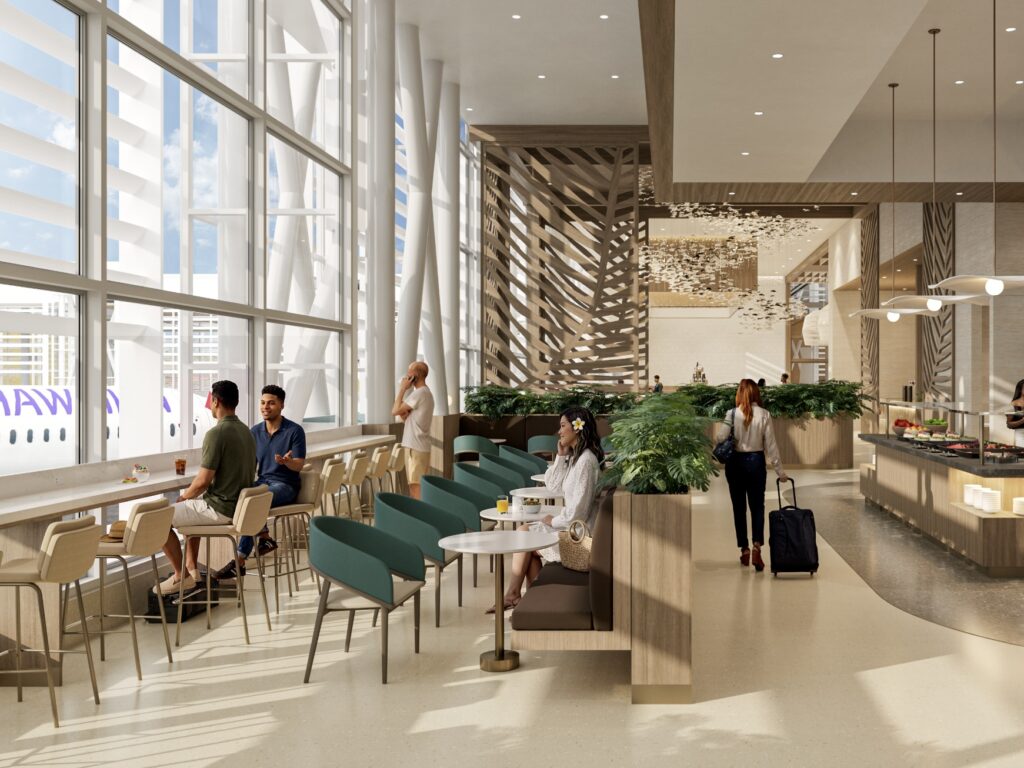
Hawaiian is getting a substantial lounge of its own. A nearly 13,000-square-foot, 200-seat lounge is scheduled to open in Honolulu in early 2028. Alaska also plans a new 14,000-square-foot lounge in San Diego that year.
ALASKA AIRLINES
All of this starts to make more sense alongside where Alaska wants to fly.
The company currently serves seven intercontinental destinations and plans to reach at least 15 by 2030. Long-haul flying is expected to grow from about 8% of capacity today to roughly 15% by then.
Premium is becoming a bigger part of the business, too. Alaska expects premium revenue to grow from 35% to more than 40% of total revenue by 2030.
Turkish Airlines is moving ahead with plans to add a lot more airplanes.
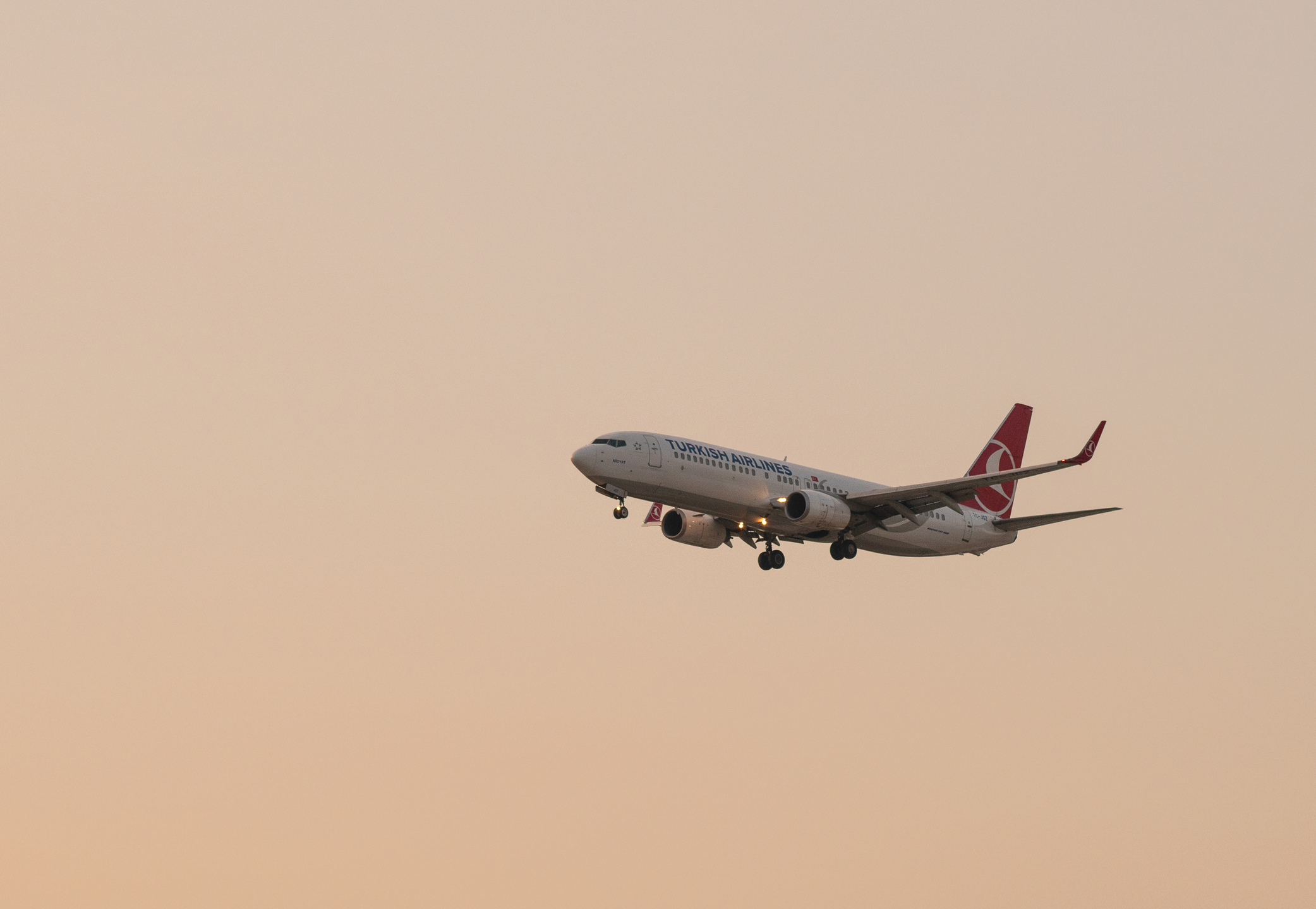
The airline finalized an order Wednesday for 100 Boeing 737-8 aircraft, with options for another 50 737 MAX jets. Turkish can also substitute some of those planes for the larger 737-10.
For passengers, the useful part isn’t necessarily the aircraft itself. It’s what Turkish could do with a fleet that continues to get much bigger.
More planes give the airline room to add flights, destinations, and seats over time. Turkish hasn’t said where these particular aircraft will fly, and some could replace older planes rather than represent entirely new capacity.
But this order is part of a much larger growth plan.
Turkish Airlines Is Building Toward More Than 800 Aircraft
The 787 order includes 35 787-9s and 15 of the larger 787-10, which Turkish plans to use to support long-haul growth. Boeing has said the 787 and 737 MAX deals together will double Turkish Airlines’ Boeing fleet.
Turkish has an even bigger target beyond Boeing. The airline wants its overall fleet to exceed 800 aircraft by 2033 while sustaining average annual growth of 6%.
The 737 MAX aircraft are intended for shorter routes, while the additional Dreamliners give Turkish more room to grow long-haul flying. That combination matters at Istanbul, where shorter flights from across the region feed Turkish’s much larger international network.
None of that guarantees more seats on a particular route or the introduction of new ones. But Turkish is planning for a substantially larger fleet, and more aircraft give it more room to add capacity.
Southwest Airlines has changed considerably over the past year and a half, from assigned seating and extra-legroom seats to bag fees. But the airline isn’t finished reshaping the guest experience.
Starlink Is Coming to Hundreds of Southwest Planes
Southwest recently began installing Starlink, and the rollout is moving quickly.
Doxey said the airline expects around 300 aircraft to have Starlink installed by the end of this year, with installations continuing into 2027.
That means the faster Wi-Fi should become much easier to find on Southwest flights over the next few months. There will still be some luck involved, though, as plenty of planes will continue offering Southwest’s existing Wi-Fi until they get Starlink.
The airline has already said it plans to start with 11 lounges, and Doxey indicated there could eventually be more. But perhaps more interesting is how far along some of those first locations already are.
Construction has started at some locations, Doxey said, while designs and mock-ups are already taking shape. He suggested that early construction work contributed to the lounge plans becoming something of a “worst-kept secret” before Southwest announced them.
He also hinted that the finished product may not look quite like what some people expect from Southwest.
“I think some people are going to be a little surprised, actually, when they say, ‘Oh, this is the Southwest lounge,’” he said.
Southwest still hasn’t revealed all 11 locations. Doxey didn’t name any additional airports, but said the choices should look “very logical” when looking at a map of Southwest’s network.
A More Premium Southwest Credit Card Is Coming
The lounges also give Southwest something new to offer current and future credit card holders.
Doxey was unusually direct about why Southwest wants one. He called the absence of a top-tier premium card a “hole” in the airline’s current credit card lineup.
For now, details such as the annual fee, other benefits, and launch date are still up in the air. But with lounge construction already underway, both pieces are getting closer.
The Boeing 737 MAX 7 Could Finally Arrive Next Year
Southwest also expects another long-awaited change to its fleet.
The FAA certified the Boeing 737 MAX 7 in August after years of delays. This finally cleared the smaller MAX variant for commercial service.
Southwest already has 27 MAX 7s that were built before certification and have been sitting in storage. Doxey said Boeing is now working to bring those aircraft up to the final approved specifications.
Southwest expects some of those planes to begin arriving around the end of this year before entering passenger service in early 2027.
International Long-Haul Flying Is Still on the Table
One much bigger potential change is less certain.
Southwest executives have repeatedly floated the possibility of eventually flying farther internationally. Doxey confirmed that the airline is still considering it, although no decision has been made.
“We haven’t decided what we’re doing with that particular item,” Doxey said. “But what we have said is that we’re absolutely considering whether that should be part of the offering that we have.”
There are still some big questions to answer, including where Southwest might fly and what aircraft it would use. For now, long-haul flying is something Southwest is considering rather than a firm plan.
But it’s another example of just how different Southwest could look a few years from now. Assigned seating and bag fees are already changing the airline people know today. Add lounges, a higher-end credit card, better Wi-Fi, and perhaps longer international flights, and Southwest starts to look different in ways that go well beyond how boarding works.
American Airlines CEO Robert Isom and CFO Devon May sat down with investors this week at Morgan Stanley’s annual Laguna Conference. The majority of the conversation centered on revenue, fuel prices, and profitability, but there were also several updates that could affect the experience of flying American over the next few years.
Here’s what stood out.
American’s Premium Push Is Still Just Getting Started
American has spent the last several years pushing its product upmarket, with upgraded lounges, more premium seats, and the launch of its new Flagship Suite.
There’s a pretty simple reason why.
Isom said just 30% of American’s seats now account for 50% of the airline’s revenue. And despite all the attention American has placed on premium cabins recently, the airline still considers itself relatively early in that transition.
By the end of the decade, American expects its number of premium seats to grow by roughly 50%.
Some of that growth is already underway. American’s first retrofitted Boeing 777-300ER entered service with a larger Flagship Suite cabin, while Isom said work on the airline’s 777-200ERs will be “moving before you know it.” Airbus A319 and A320 reconfigurations are also beginning to roll out.
The result should be considerably more premium seating across American’s fleet over the next several years, on both its domestic and international jets.
American also appears to be preparing for one of its biggest periods of lounge investment in years.
Isom said customers will see “more new lounge openings at American over the next couple of years than we’ve done in decades.”
Several lounge projects are already underway, but the comment suggests there’s plenty more happening behind the scenes.
That’s worth watching as American puts more emphasis on the experience before a flight, not just the seat onboard.
Free Wi-Fi Is Also Growing AAdvantage
American’s rollout of free Wi-Fi isn’t just about making the flight better.
Isom said AAdvantage enrollments are running at record levels, with much of that growth driven by free Wi-Fi. An AAdvantage membership is required to use the service.
More members also gives American a larger pool of customers for other parts of AAdvantage, particularly its credit card partnership with Citi.
The onboard upgrades still have some distance to go. Isom said a “significant chunk” of American’s fleet will have high-speed Starlink Wi-Fi as the airline moves through 2027. Seatback entertainment will take several years to spread across the fleet.
Some Flights Could Be Trimmed
There was one less exciting update.
Higher fuel prices are causing American to reconsider some of its planned flying. May said the airline will make adjustments to its December schedule and now expects to grow somewhat less in 2027 than it anticipated several months ago.
That doesn’t necessarily mean widespread route cuts. American still sees room to grow its network over the longer term.
But schedules could get a little thinner in the near term as American adjusts to higher fuel costs.
In the aggregate, the comments point to an American that will look different over the next several years. More premium seats and lounges are coming, Wi-Fi and seatback entertainment are spreading across the fleet, and some of that investment is already starting to show up. The immediate question is how much higher fuel prices slow the airline’s plans to grow the network around it.
Etihad Airways revealed the cabins that will debut on its Airbus A330neo fleet when the aircraft enter service in late 2027.
The airline first announced plans last year to add 15 A330neos over five years. On Monday, September 14, it shared what passengers can expect onboard while also outlining a broader investment push in its aircraft, lounges, and other parts of the travel experience.
Three Cabins, Including Four First Suites
The Airbus A330neo will feature three cabins with four first suites, 24 business class seats, and 252 economy seats.
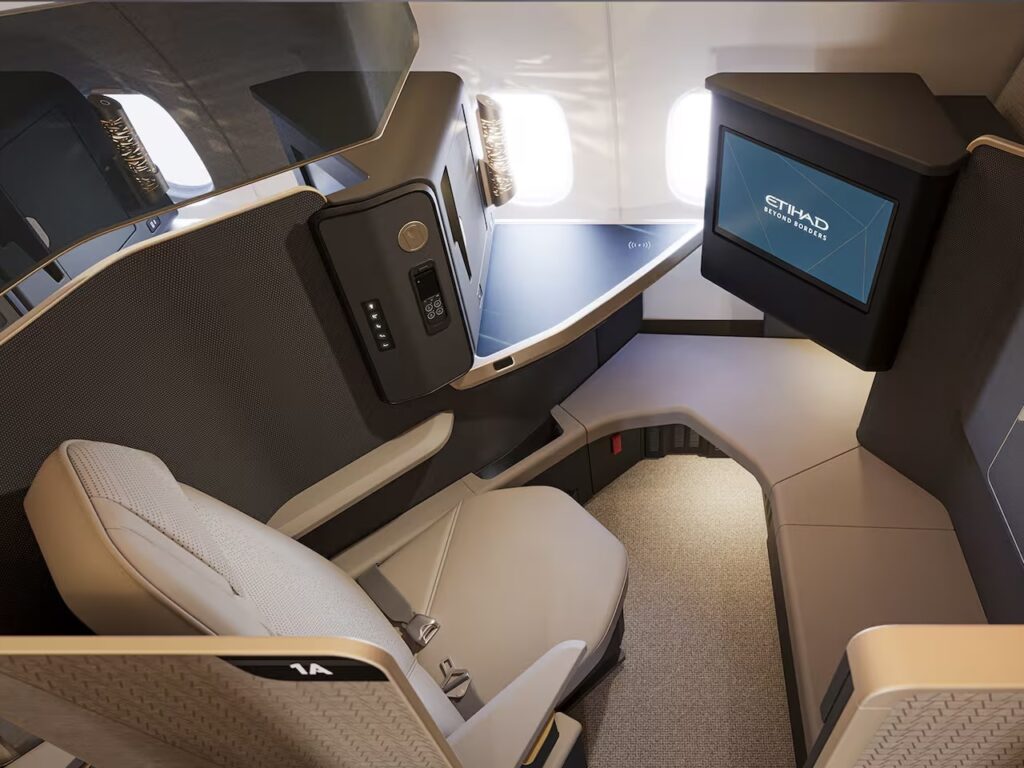
The first class cabin is the most exclusive, with just four enclosed suites. Each includes a sliding privacy door, space for a companion to dine, wireless charging, a 32-inch entertainment screen, dedicated storage, and a personal vanity.
Behind it are 24 fully lie-flat business class seats arranged in a 1-2-1 configuration, giving every passenger direct aisle access. Each seat includes a sliding privacy door, a 17.3-inch entertainment screen, wireless and wired charging, a large tray table, and additional storage.
ETIHAD
The economy cabin includes 252 seats with 13.3-inch 4K entertainment screens, USB charging, redesigned headrests, and personal device holders. Another 32 seats will be sold as Extra Legroom and will offer roughly four additional inches of pitch.
Etihad says the aircraft will primarily fly regional and medium-haul routes across Europe, Asia, and the Middle East beginning in September 2027.
First Class Is Still Part Of The Plan
While several airlines have reduced or eliminated first class over the past decade, Etihad says it plans to continue expanding the cabin through both new aircraft deliveries and retrofit programs.
The new A330 will have four first suites. That’s more than the airline’s Airbus A321LR, which has just two, but still far fewer than many of its traditional long-haul aircraft. And rather than concentrating first class on a handful of flagship jets, Etihad appears focused on offering it across more of its fleet.
Exactly how those plans will take shape is still unclear. Etihad did not say which existing aircraft types will receive updated cabins or first class as part of its retrofit program.
The Investment Goes Beyond The A330
The new cabins are only one part of a much larger investment.
Etihad says it plans to spend $20 billion on new aircraft and the broader passenger experience, including a $1 billion fleet retrofit program that will update existing aircraft over time.
The investment extends beyond aircraft interiors. The airline says it also plans to refresh lounges, onboard dining, amenities, connectivity, and other parts of the travel experience as it works toward a more consistent experience across its network.
The airline did not identify which aircraft will receive updated cabins or when those retrofits will begin. Even so, the announcement indicates that the new A330neo interiors are intended to be the starting point rather than a one-off cabin design.
American Airlines has made no secret of its interest in premium customers of late.
New planes are arriving with private business class suites, existing ones are being reconfigured with more seats up front, and the airline is investing in lounges and other parts of the experience meant to convince people to spend more when they fly.
Which makes the slow disappearance of the Airbus A321T a curious thing to watch.
For more than a decade, American has flown a small number of these unusually configured planes primarily between New York and Los Angeles and San Francisco. There are only 102 seats onboard, and 30 of them turn into beds, an almost absurd amount of space to devote to premium passengers on a narrowbody flying within the United States.
Now they’re disappearing.
TYLER GLATT / POINTS INSIDER
American’s new Airbus A321XLR is taking over more transcontinental flying, and individual A321Ts are already being pulled out to be reconfigured with much more conventional interiors. Earlier this week, yet another flew to El Salvador to begin that process.
The following day, I was sitting in business class on another A321T headed across the country to Los Angeles.
It was a good place to consider what American is replacing, and what it isn’t.
The A321T Was Never Meant to Be Normal
When American introduced the A321T in late 2013, the airline was fighting hard for premium customers flying between New York and California.
Its answer was an airplane built around them.
At the front were 10 first-class seats, each with direct aisle access and enough room to turn into a bed. Behind them were 20 more lie-flat seats in business class. Even economy was unusual, with 36 extra-legroom seats and only 36 standard ones.
It was an extravagant use of an A321, but that was the point.
TYLER GLATT / POINTS INSIDER
American wasn’t alone in lavishing attention on these routes. United and Delta had their own premium transcontinental products, and JetBlue would bring Mint into the fight. But American’s solution was particularly unusual. Nearly a third of the people onboard could go to sleep in a bed.
The result was a narrowbody that felt almost deliberately underfilled.
More than a decade later, American still wants those premium customers. But the airplane built specifically for them is another matter.
But sitting a few rows behind it made the focus on first class seem a little incomplete.
American changed its complimentary elite upgrade policy on August 25. On domestic routes with a distinct premium economy cabin, complimentary upgrades from Main Cabin now stop at premium economy rather than jumping directly to business class. More broadly, complimentary upgrades move passengers forward by one cabin.
The A321T doesn’t have premium economy. It has Main Cabin, business class, and first class, which meant my complimentary upgrade from economy could move me one cabin forward into business, but not into first.
That landed me in what may have been the more interesting cabin all along.
TYLER GLATT / POINTS INSIDER
The A321T has 20 lie-flat business class seats behind first. They gave American a sizable second cabin full of beds without requiring everyone who wanted to lie flat across the country to buy the most expensive ticket on the plane.
By 2026 standards, the seats themselves aren’t particularly cutting-edge. They’re arranged 2-2, so half the cabin lacks direct aisle access, and years of flying back and forth across the country are beginning to show.
Mine certainly had some character.
TYLER GLATT / POINTS INSIDER
A gate agent let me know before boarding that something at the seat wasn’t working correctly, though it was never entirely clear whether she meant the entertainment screen, its remote, or something else. One of the armrests had also developed a considerable amount of bounce.
Once we left New York, though, I put the seat into its lounge position and settled in. Later, it went completely flat.
There are newer and more private ways to cross the country now. But lying there, the thing that stood out about the A321T wasn’t really the seat. It was how many lie-flat seats American had been willing to install.
TYLER GLATT / POINTS INSIDER
Thirty Beds on an Airplane With 102 Seats
That’s what makes the A321T difficult to replace, even with something newer.
American’s A321XLR has plenty going for it. There are 20 Flagship Suites with direct aisle access and privacy doors, plus 12 premium economy seats. The airplane can also fly international routes that were never part of the A321T’s job.
And it carries 155 people.
The comparison says more about the A321T than it does the XLR. For all the attention paid to its first-class cabin, what really made this airplane unusual was the amount of room American was willing to devote to relatively few passengers.
That has practical consequences as these planes disappear. There will be fewer lie-flat seats on each flight. That doesn’t mean awards will suddenly cost more or upgrades will become impossible. There are too many other factors at play. But for anyone accustomed to using miles or status to get into one, there will simply be fewer places to land.
American says Flagship First will stop being sold on transcontinental routes as more XLRs enter the fleet. And unlike a traditional retirement, the A321Ts themselves aren’t necessarily going anywhere. They’re being reconfigured and returned to American’s fleet as much more ordinary A321s.
That’s perhaps the strangest part of watching them disappear. The airplanes will still be around. What made them special won’t be.
American still wants the premium customers the A321T was built to attract. It just doesn’t need an airplane quite this extravagant to get them anymore.
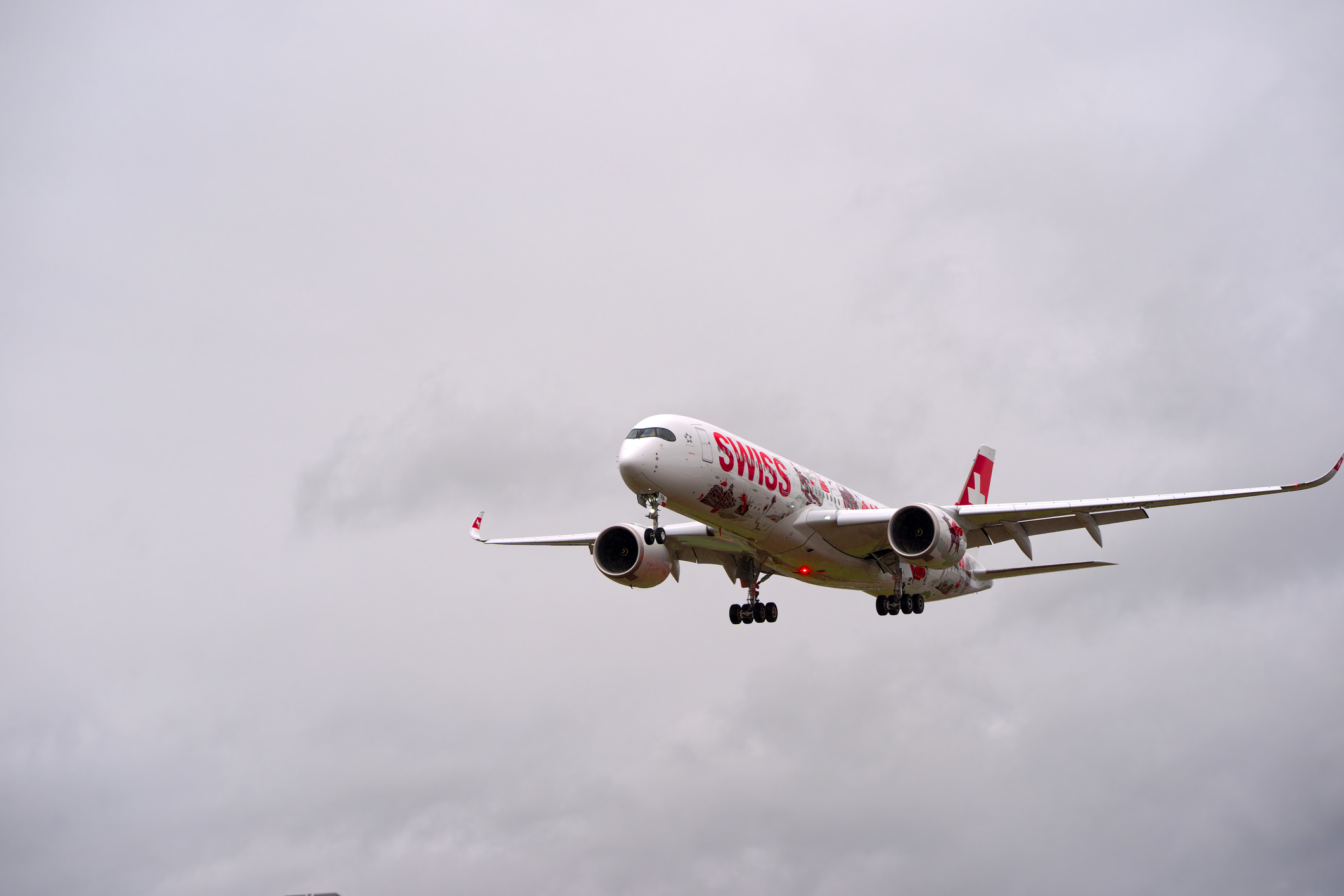
SWISS is about to have a third Airbus A350 in its fleet.
The airline announced that it expects its newest A350-900 to arrive in Zurich on Saturday, September 12, following a delivery flight from Airbus in Toulouse. The aircraft, registered HB-IFC and named Zug, is scheduled to land around 9:30 a.m. local time.
Three airplanes isn’t a huge fleet. But SWISS only has 10 A350s on order, which means 30% of them will have arrived once Zug touches down in Zurich.
SWISS is also bringing its newest cabins to some older aircraft through retrofits. The difference with the A350 is that each one arrives from the factory with the entire new SWISS Senses interior already installed.
SWISS Is Slowly Getting More of Its New Cabins
SWISS introduced the A350 in 2025 with its new SWISS Senses cabins from front to back.
There are just 243 seats onboard, starting with four first-class suites and 45 business class seats. Another 38 seats are in premium economy, followed by 156 in economy.
Every delivery puts another full set of SWISS’s newest seats into service as the airline gradually replaces some of its older long-haul aircraft. And with only 10 A350s planned, the arrival of a third is a meaningful step in what is still a relatively small fleet.
I’ve seen the new interior firsthand. SWISS showed off its first A350 before it entered service last year, and the cabins are a considerable departure from what can still be found across much of the airline’s long-haul fleet.
The changes aren’t limited to the airplane. SWISS is also updating its experience in Zurich, with two new lounges coming to Dock B in 2027. The roughly 28,000-square-foot project will include separate Business and Senator lounges.
The third A350 will get a small welcome before it reaches the airport. SWISS says the aircraft is expected to circle over Zug, the city whose name it carries, before making its final approach into Zurich.
Another A350 Becomes Bookable With Points
There’s also a practical reason to keep an eye on aircraft deliveries.
SWISS award seats can be booked through several Star Alliance loyalty programs, including United MileagePlus, Air Canada Aeroplan, and Avianca LifeMiles. That means Miles & More isn’t the only option for booking a SWISS flight with points or miles.
Each new A350 therefore puts another aircraft with SWISS’s newest first, business, premium economy, and economy cabins into the mix when searching for an award with points and miles.
Seven A350s are still to come. But with the third arriving Saturday, SWISS is getting closer to the point where its newest long-haul cabins aren’t quite as difficult to find.
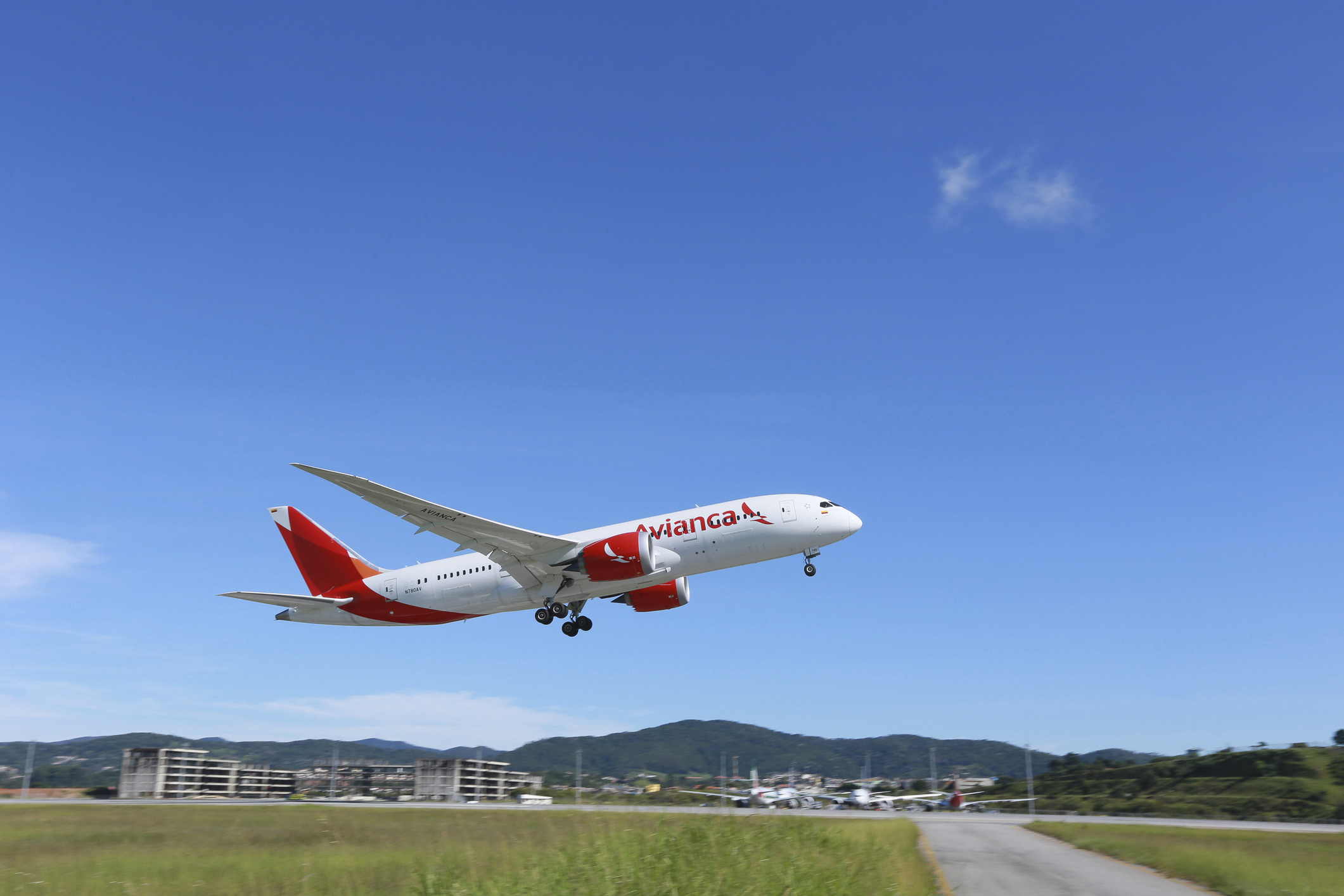
Avianca is giving its long-haul business class an overhaul.
The airline announced a series of upgrades to INSIGNIA by Avianca on September 9. New dining, amenities, and other onboard improvements are all part of the refresh.
Then, starting in 2027, Avianca plans to introduce an entirely new business class cabin to its Boeing 787s with suites offering more privacy.
The new seats are the headline, but they’re only part of what Avianca is upgrading.
New Business Class Suites Are Coming in 2027
Avianca says its new business class cabin will begin rolling out aboard Boeing 787s in 2027.
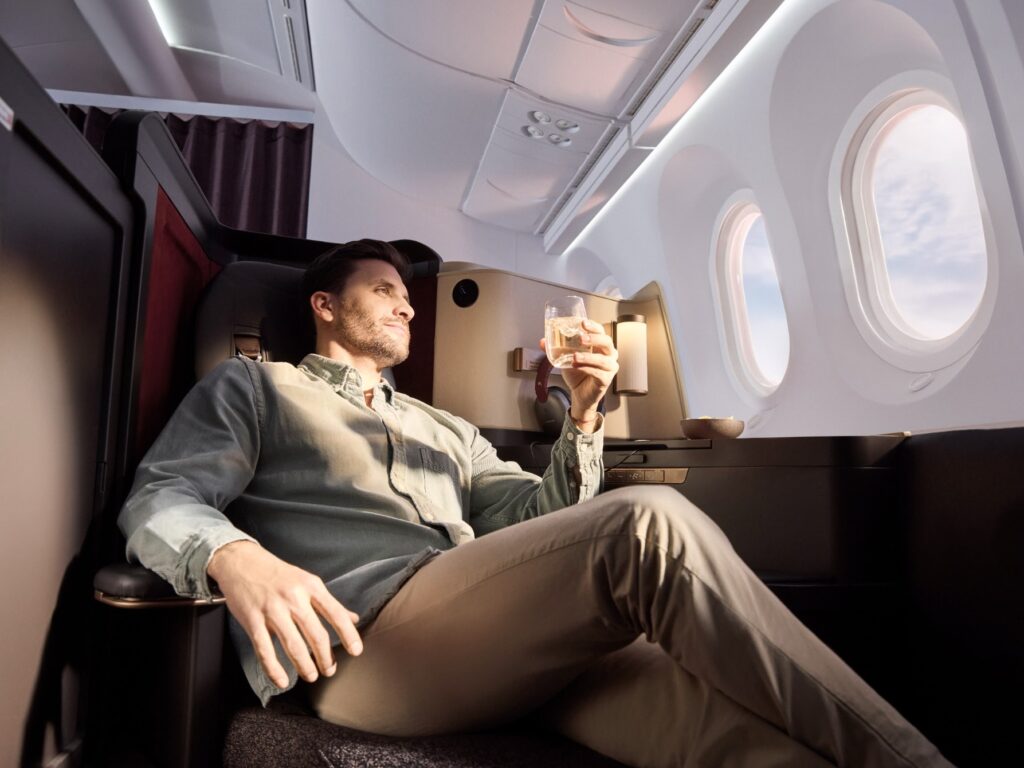
And based on the first images, this isn’t just a new cover on the same old seat. The new cabin will feature individual pods with much more privacy around each passenger, bringing Avianca closer to the enclosed, personal spaces that have become common in newer international business class cabins.
That’s a meaningful change on the flights where Avianca offers INSIGNIA. Its 787s fly to New York and across the Atlantic to Europe, where a good business class seat can turn an overnight flight into a place to eat, work, and, most importantly, get some sleep.
Avianca hasn’t shared many details yet, but we do know the first suites are scheduled to arrive next year.
AVIANCA
The Rest of Business Class Is Changing, Too
A new seat is nice, but there’s quite a bit more to a long-haul business class experience than the few square feet around it.
That’s where many of Avianca’s more immediate changes come in.
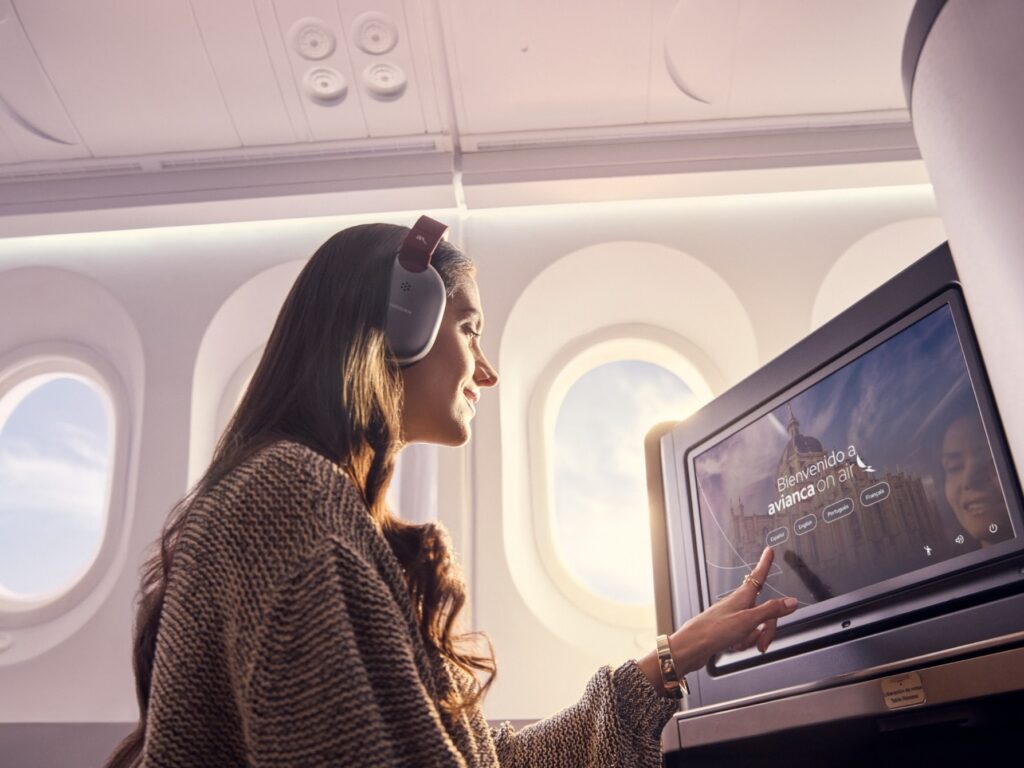
The airline is adding new noise-canceling headphones, pajamas and slippers, along with redesigned amenity kits. Meals are changing, too, with new menus from chefs Álvaro Clavijo and Rafael Buitrago that lean into Latin American flavors.
Those details aren’t nearly as flashy as a new suite, but they matter on a long flight. A lie-flat seat might be the biggest reason to book business class, but food, bedding, headphones, and service are what fill the other eight or nine hours onboard.
AVIANCA
Avianca is also putting more attention on service. More than 850 flight attendants have completed a business class training program focused on hospitality and etiquette.
So while the suites won’t start arriving until 2027, the experience around them is already getting some attention.
Avianca Wants to Be More Premium
These changes also say something about where Avianca is headed.
Avianca has spent the past several years adopting a much more stripped-down economy model on many of its flights. At the front of the cabin, though, it’s now putting more distance between the basic experience and what customers willing to pay more can get.
Avianca now offers Business Class Américas throughout its network within the Americas. It’s a much simpler product than INSIGNIA, typically using economy-style seats with the middle seat blocked rather than the beds found on the 787. That’s not nearly as exciting as a private suite, but it fits the same broader push to create a more distinct experience at the front of the plane.
The airline is also expanding onboard entertainment, gradually adding Wi-Fi, and renovating lounges, including its International Gold Lounge in San Salvador.
LifeMiles Could Make the New Suites Particularly Interesting
There’s another reason Avianca’s new 787 cabin matters.
LifeMiles are fairly easy to earn thanks to several transferable points programs, and they can be redeemed for Avianca flights. That means the new suites should eventually be bookable with miles rather than a four-figure business class fare.
How many miles they’ll cost and how easy they’ll be to book are questions for 2027.
For now, Avianca is improving the meals, amenities, and service surrounding its long-haul business class seats. Next year, the seats themselves start changing, too.
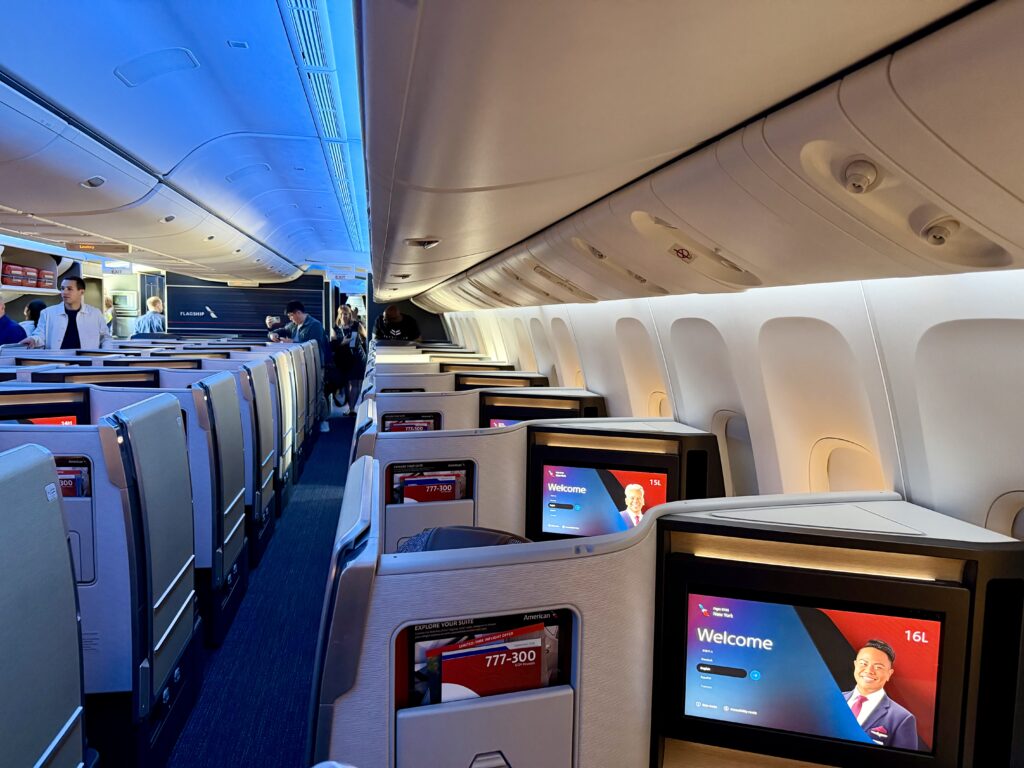
There’s a lot of business class on American Airlines’ newly retrofitted Boeing 777-300ER.
Seventy suites, to be exact.
Ahead of a special charter flight from Dallas Fort Worth (DFW) to New York (JFK) on Wednesday, American’s Chief Commercial Officer Nat Pieper described it as a “sea of business class” that seems to go on and on.
He’s not wrong.
TYLER GLATT / POINTS INSIDER
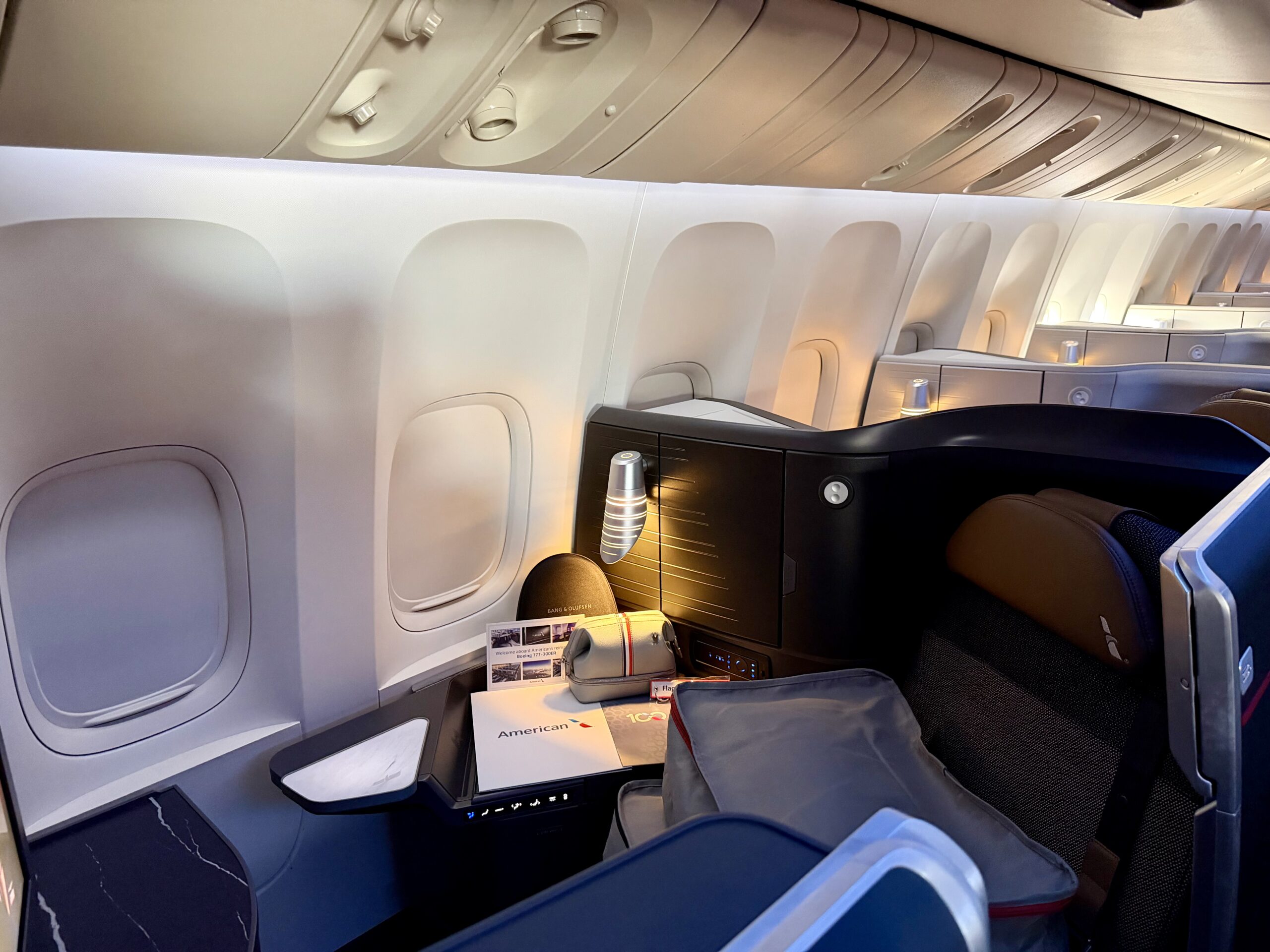
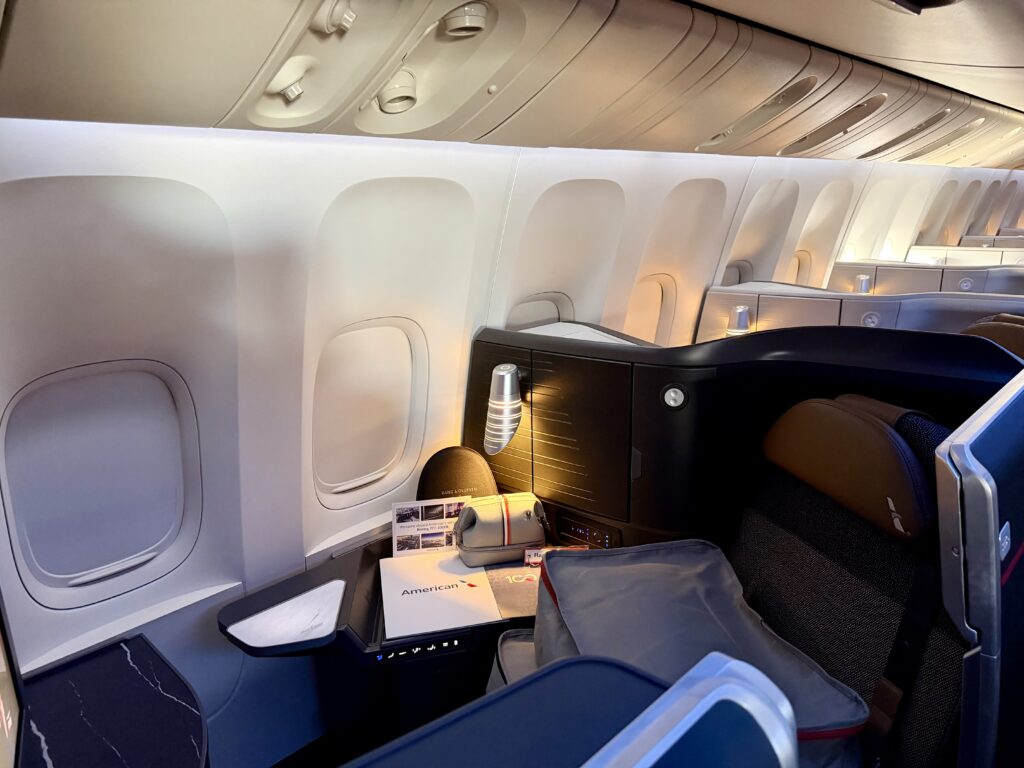
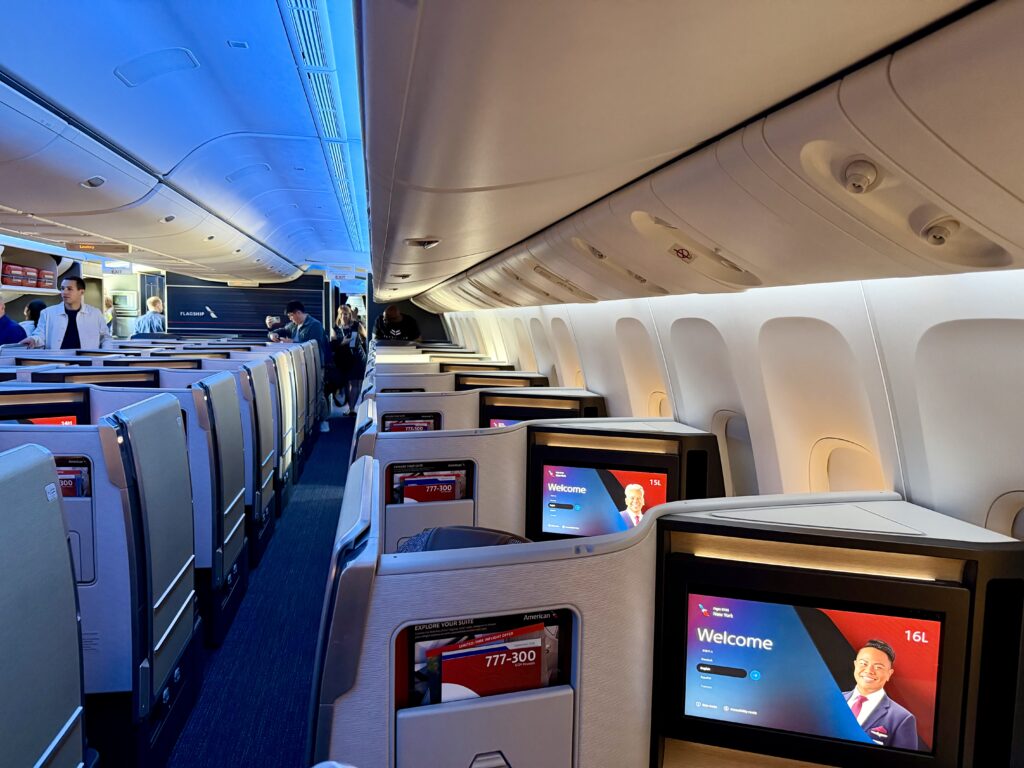
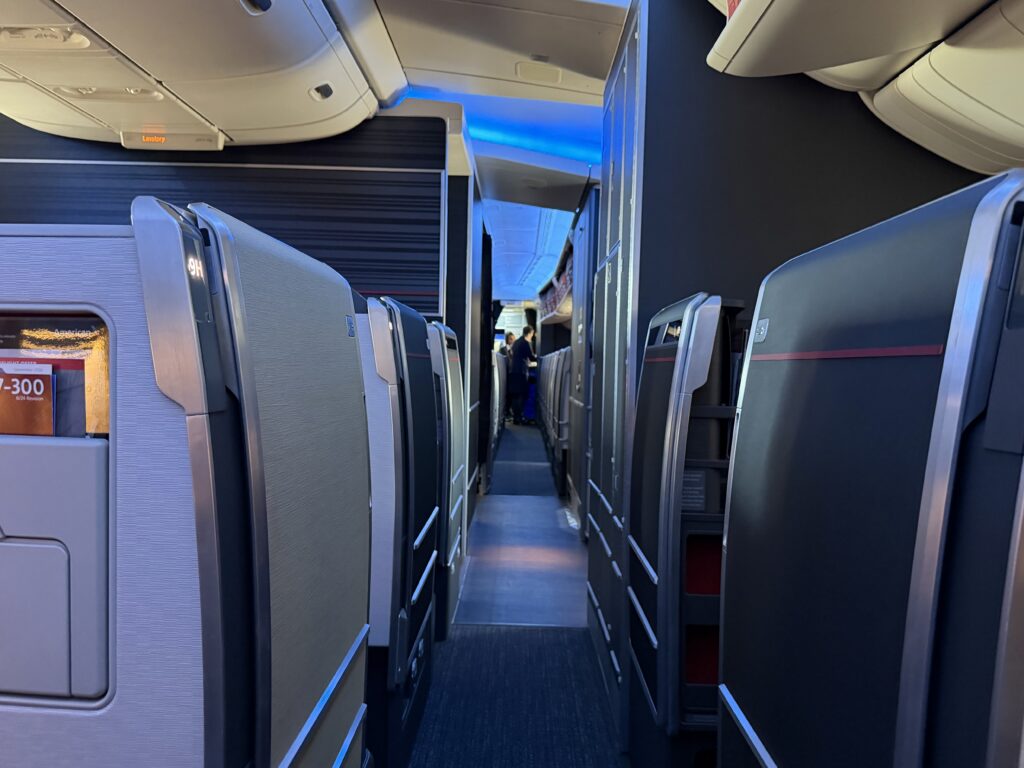
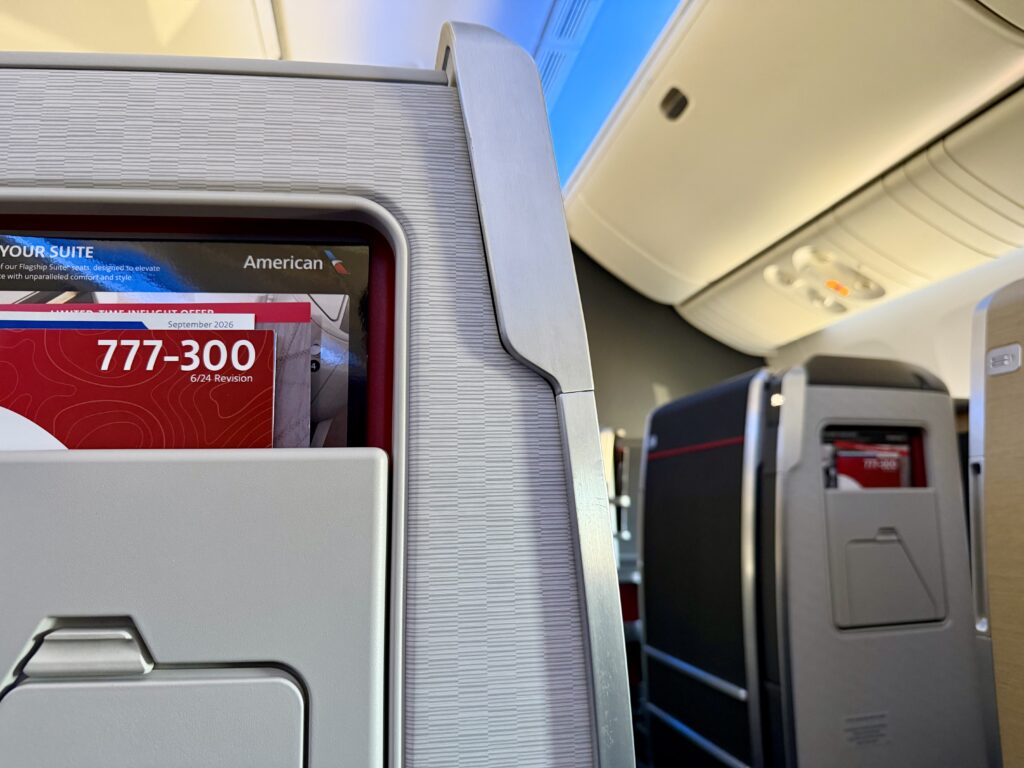
The Flagship Suite cabin stretches through a huge chunk of one of the largest passenger aircraft in American’s fleet. Add 44 Premium Economy seats, and the airline’s newly retrofitted 777-300ER has 114 seats across its two premium cabins.
TYLER GLATT / POINTS INSIDER
American didn’t start the project with 114 as some magic number.
Pieper told Points Insider that the configuration was driven in part by the physical geography of the 777 itself.
Door locations, galleys, and other fixed parts of an existing airplane helped determine where cabins could begin and end, alongside American’s desire to meet the market’s insatiable appetite for premium travel.
The result just happens to be the most premium-heavy aircraft American has ever flown.
TYLER GLATT / POINTS INSIDER
And after spending a few hours aboard the first one, it’s also an airplane that feels remarkably different from the 777 American has been flying for more than a decade.
Today, the fleet regularly crosses oceans and borders on flights to cities including London, Tokyo, São Paulo, Buenos Aires, and Sydney.
TYLER GLATT / POINTS INSIDER
American isn’t ready to move on from them.
Instead, it’s investing heavily in all 20 aircraft with the expectation that they’ll remain in the fleet for roughly another decade, if not longer.
Pieper said someone walking onto the first completed aircraft wouldn’t be able to tell that it didn’t just come off the factory floor. It’ll even have that new-car smell, he added, though perhaps the smell of an expensive new car given the amount American has invested in the project.
That sounded like the sort of thing an airline executive is supposed to say about a newly refurbished airplane. But after walking onboard, it wasn’t much of a stretch.
TYLER GLATT / POINTS INSIDER
The first impression is just how open everything feels.
The 777 is already a big airplane, but the new interior really emphasizes that size. Gone are many of the lighter surfaces of the previous cabin. They’ve been replaced by darker dividers, different shades of gray, wood finishes, and restrained red and white accents.
TYLER GLATT / POINTS INSIDER
Lighting helps.
Raphael Girardoni, American’s managing director of customer experience product and design, told Points Insider that lighting was an important part of the design and something he’s personally passionate about.
It’s noticeable throughout the Flagship Suite cabin.
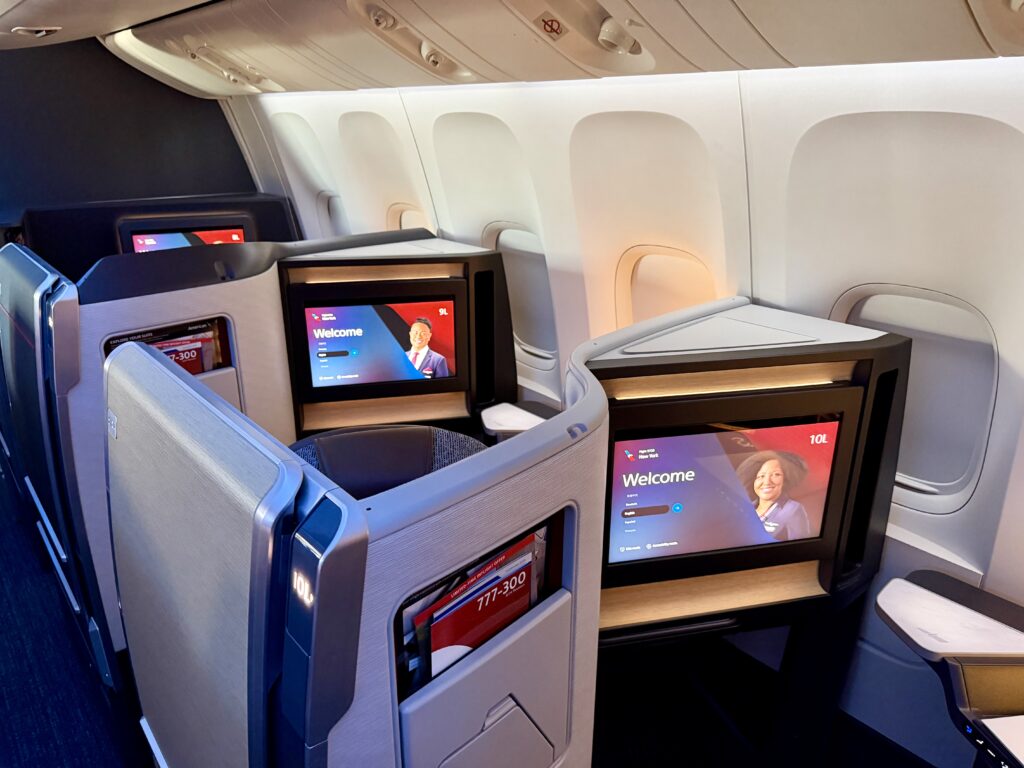
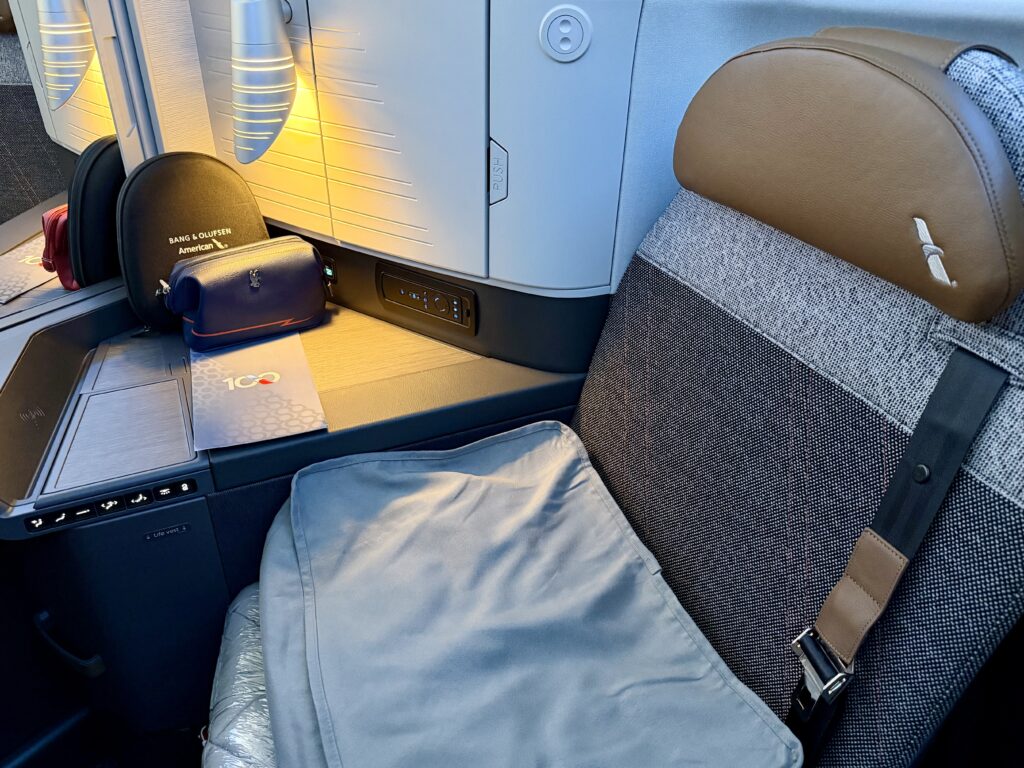
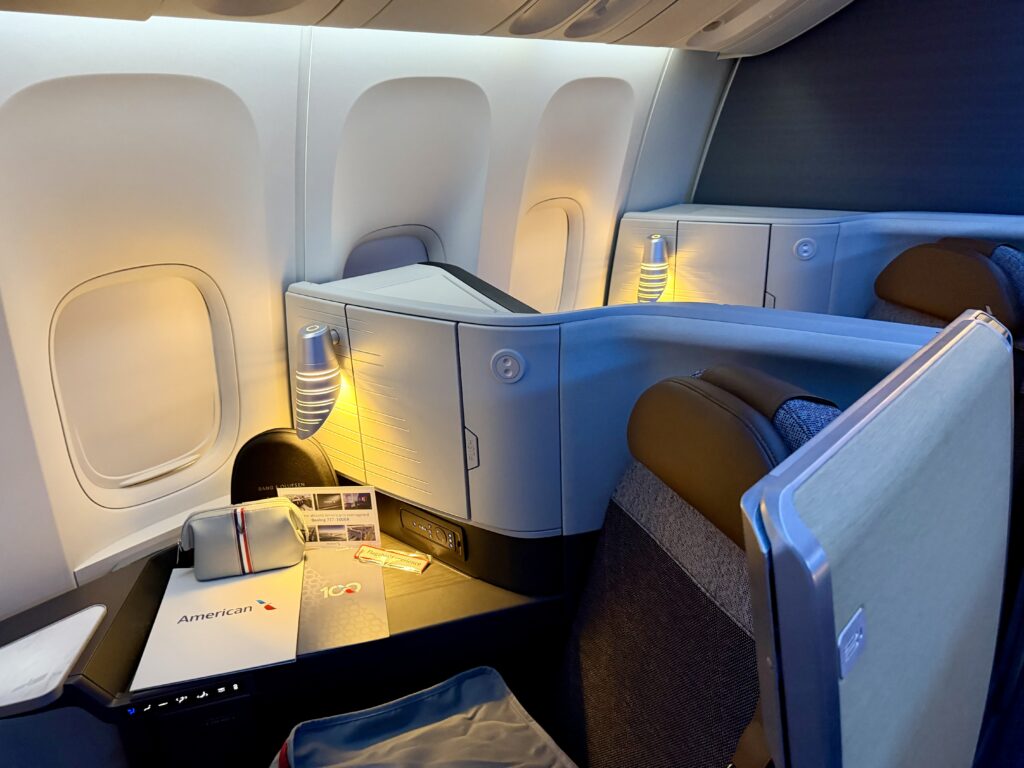
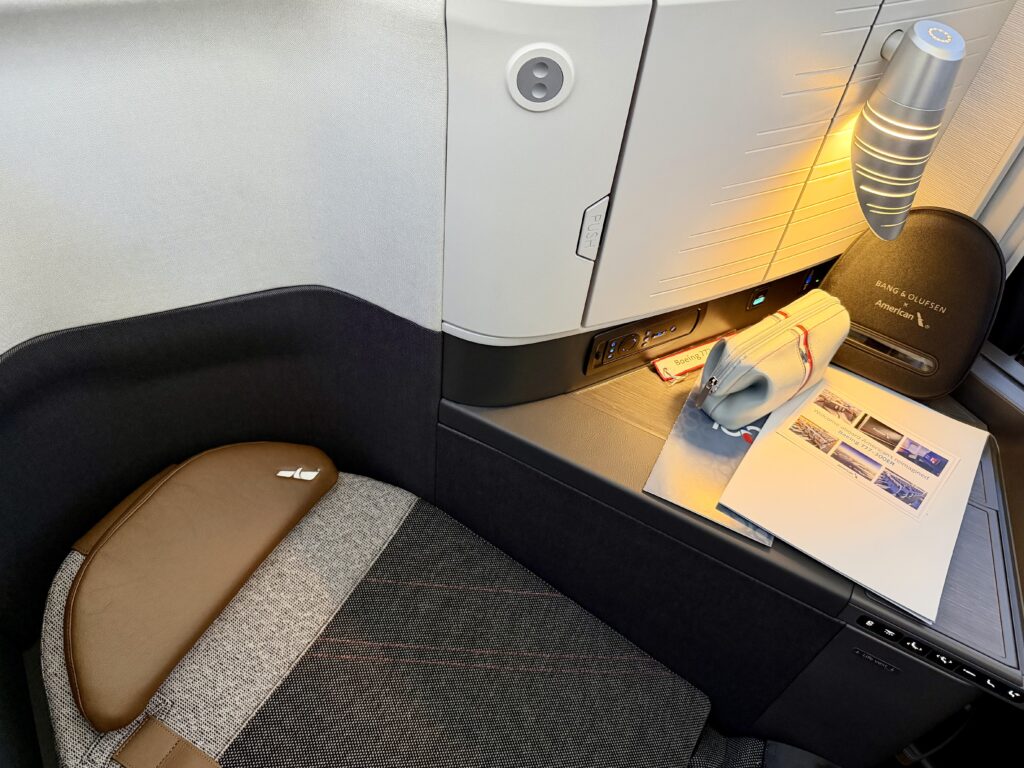
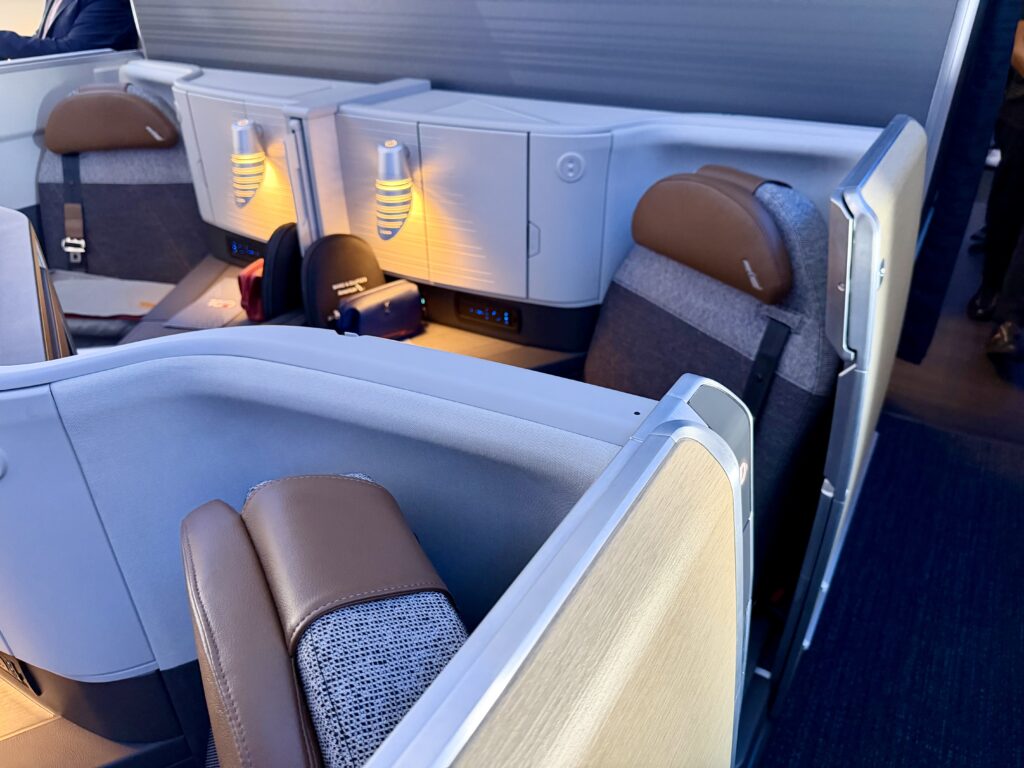
Small sconces and accent lighting illuminate the individual suites. One of the more thoughtful touches is the way the light from the sconce plays off the design surrounding a storage cubby beside the seat.
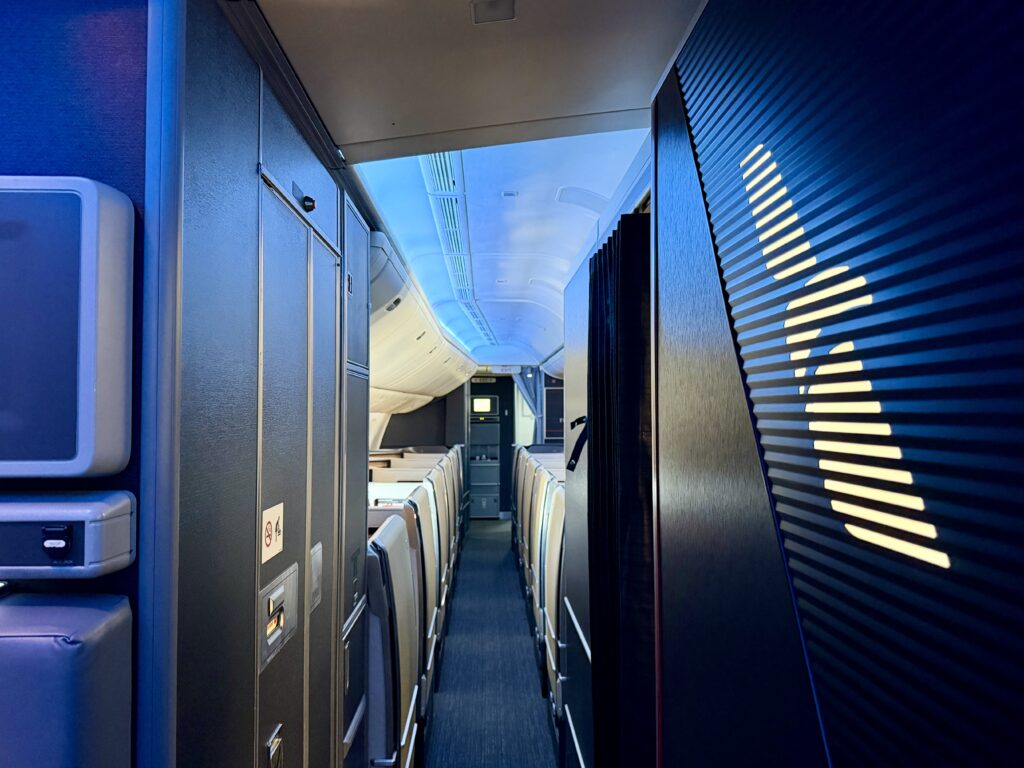
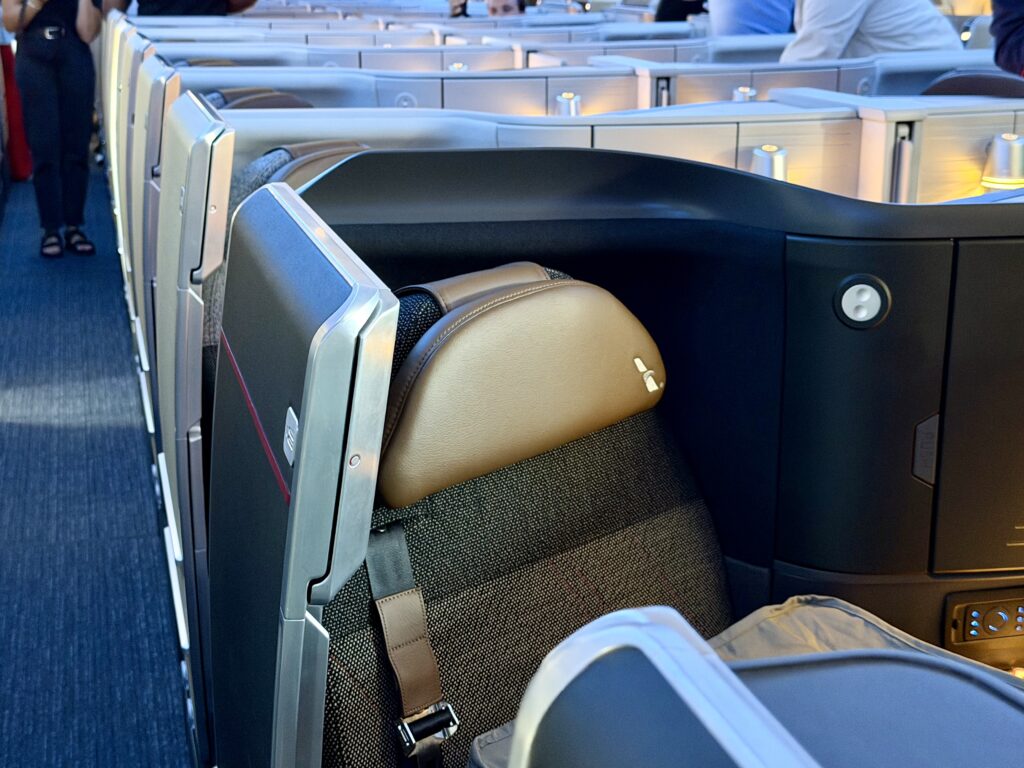
Even the cabin dividers look more considered, with darker finishes and not-so-subtle Flagship branding.
TYLER GLATT / POINTS INSIDER
Seventy Flagship Suites Upgrade the 777
Of course, the biggest upgrade is the seats up front.
American is removing the eight Flagship First seats and 52 business-class seats found on its previous 777-300ER configuration. In their place are 70 Flagship Suites, including eight larger seats that the airline calls Flagship Suite Preferred.
TYLER GLATT / POINTS INSIDER
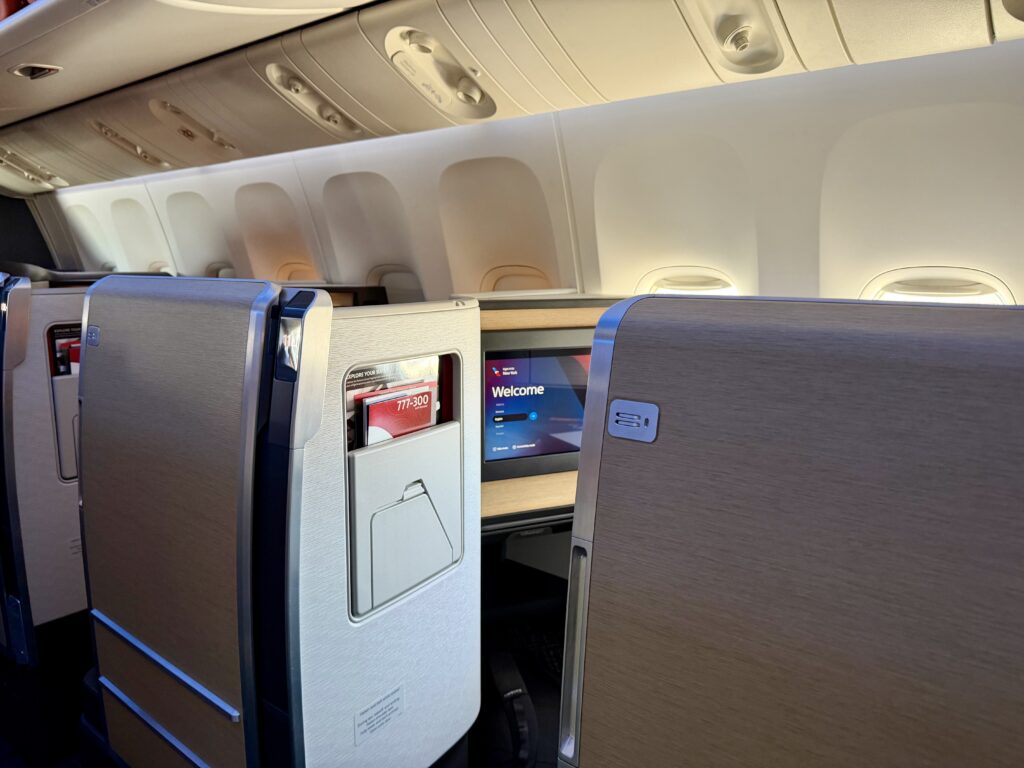
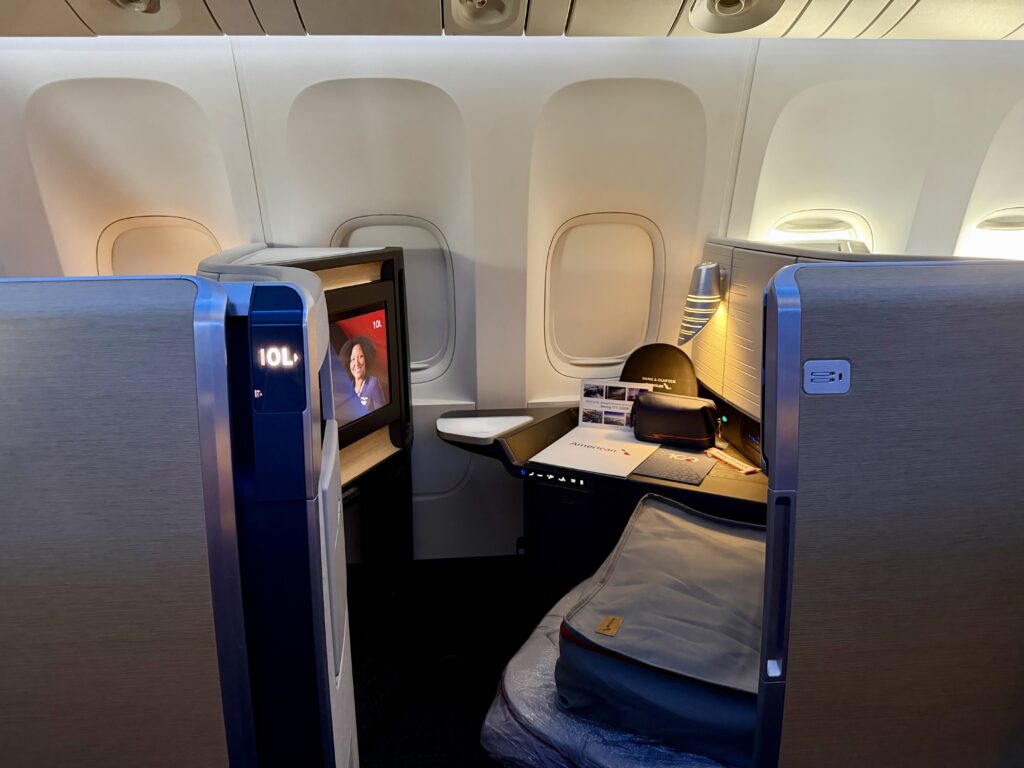
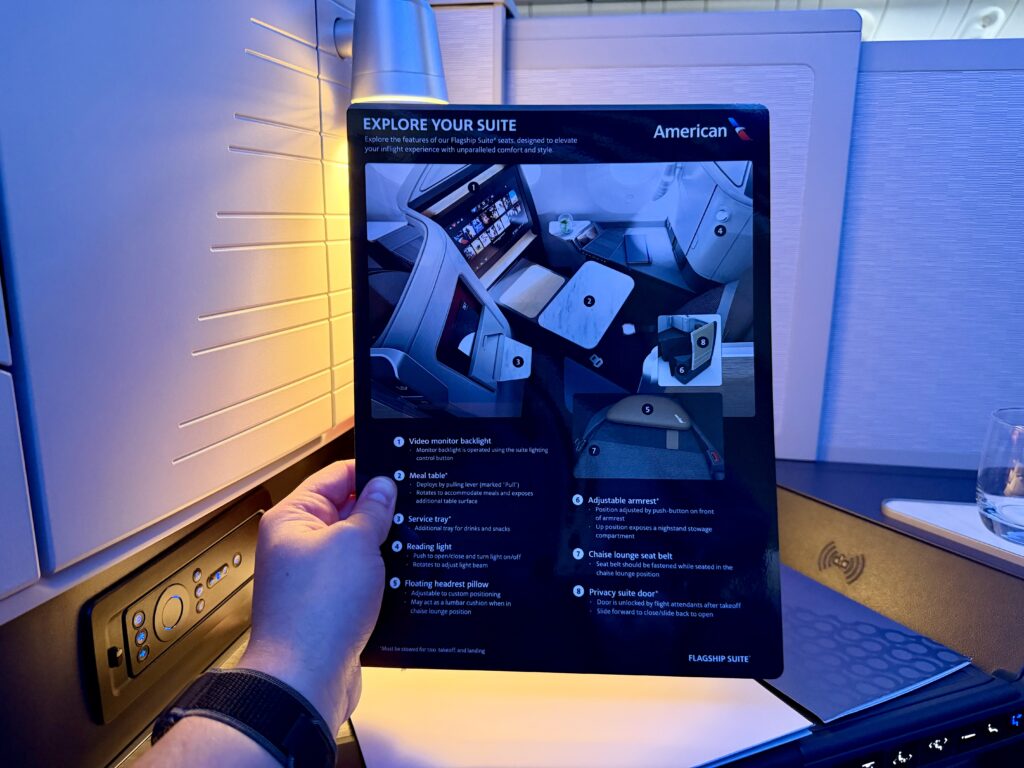
They’re the same seats American introduced on its also-premium-heavy Boeing 787-9P last year, outfitted with sliding privacy doors and direct aisle access.
TYLER GLATT / POINTS INSIDER
The sheer number of them really is a sight to behold. But what stands out most is how little of that enormous cabin is visible once you’re seated.
Even with the suite door open, I couldn’t see another passenger from my seat beyond the occasional top of someone’s head. Movable dividers between adjoining seats add yet another layer of privacy, too.
TYLER GLATT / POINTS INSIDER
There are also plenty of small touches that become more useful the longer a flight gets.
There’s wireless charging, a drink ledge, a small compartment well suited for a wallet or watch, and various other nooks for keeping things nearby rather than throwing everything into one larger storage bin.
The tray table is enormous. It slides out from beside the seat before rotating into place, leaving plenty of room for a laptop, meal, or whatever else ends up accumulating during a long flight.
The entertainment screen is similarly large and highly responsive, but doesn’t feel oversized for the space.
TYLER GLATT / POINTS INSIDER
And yes, American kept the individual air nozzles.
That’s a win.
Can American Fill 70 Business-Class Seats?
Putting 70 business-class seats on a single airplane naturally raises another question: Can American consistently fill them?
Pieper doesn’t appear particularly worried.
He said American is comfortable with the configuration and has more tools at its disposal than selling every seat outright at its initial price. Upgrade offers give the airline another way to fill otherwise empty premium seats as departure approaches.
TYLER GLATT / POINTS INSIDER
And then there are Systemwide Upgrades, one of the perks available to some of American’s most loyal customers. Those could come in handy on this kind of plane, too.
With 70 Flagship Suites to work with, there are simply more seats that could potentially clear as upgrades.
That flexibility matters when these airplanes will be flying some of American’s biggest long-haul markets for years to come.
It also helps explain the underlying strategy.
TYLER GLATT / POINTS INSIDER
Airlines have spent the past several years adding premium seats as demand for higher-end travel has soared. American is doing the same with its new 787-9Ps and Airbus A321XLRs, and the 777-300ER retrofit takes that strategy to another level.
The airline didn’t necessarily set out to hit a particular percentage of premium seats on the 777. But the combination of the aircraft’s physical layout and American’s push toward a more premium experience led it to a configuration with a whole lot of them.
Economy Feels Surprisingly Small
Walk far enough through the Flagship Suite cabin and eventually the airplane starts looking more familiar.
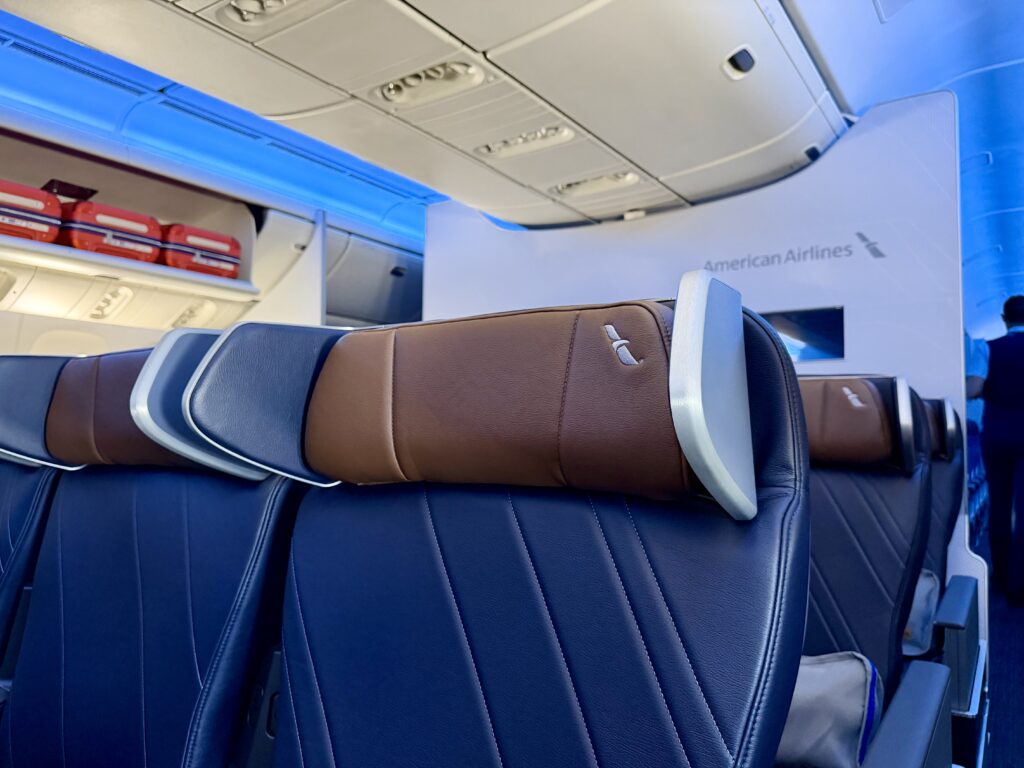
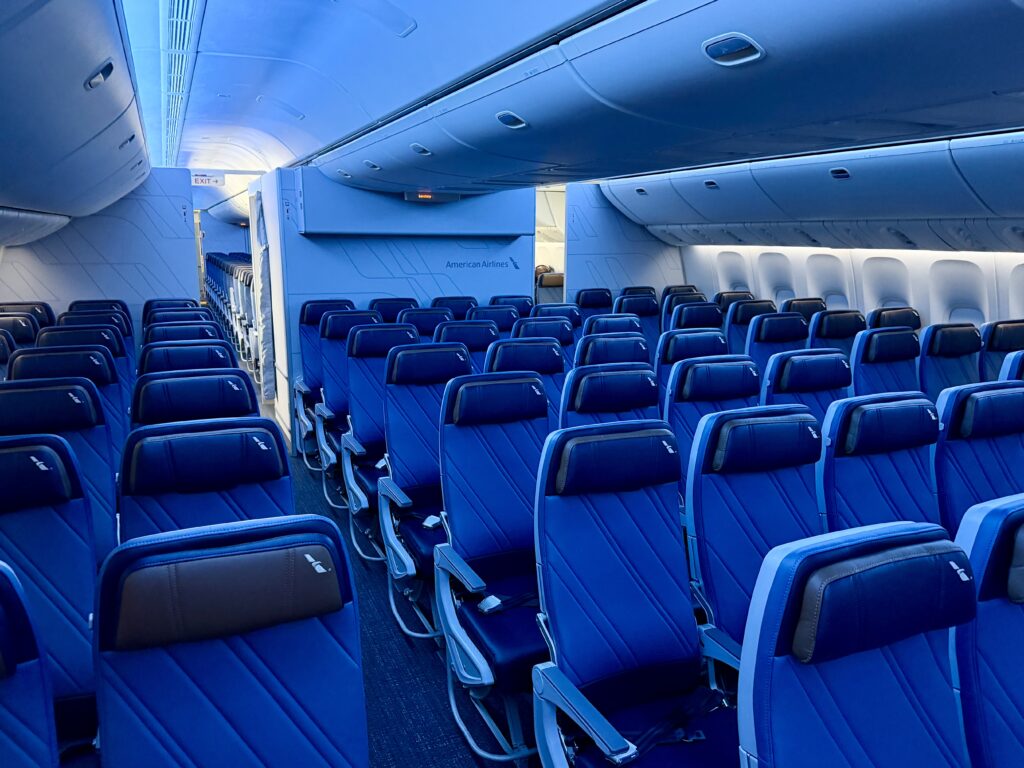
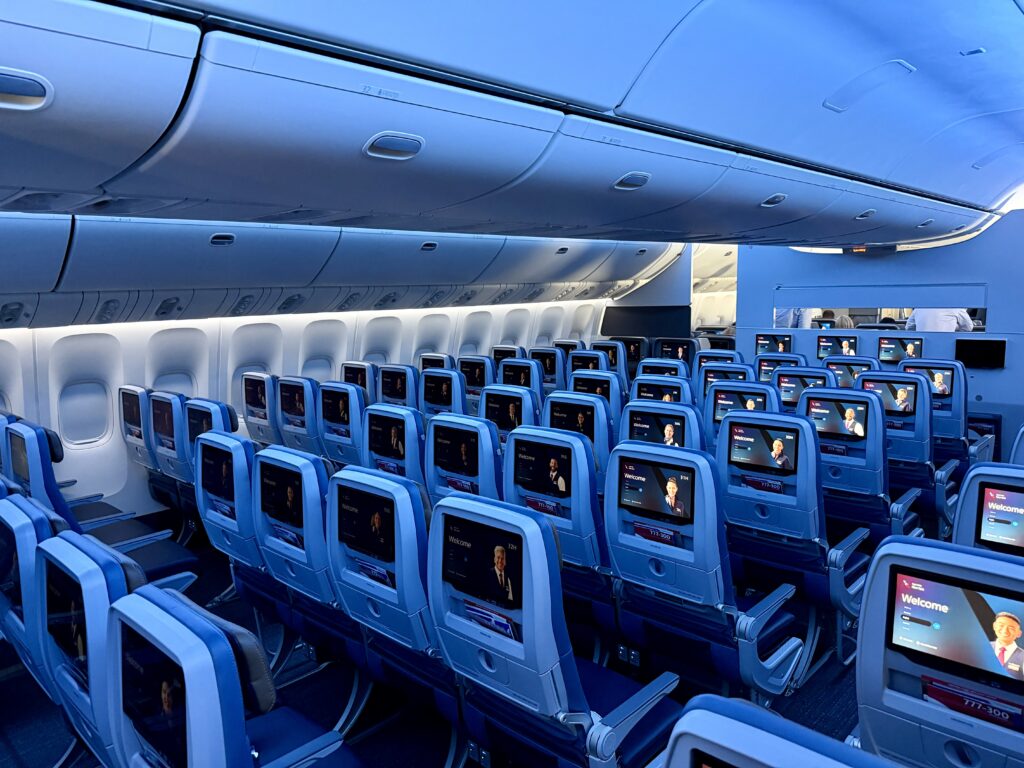
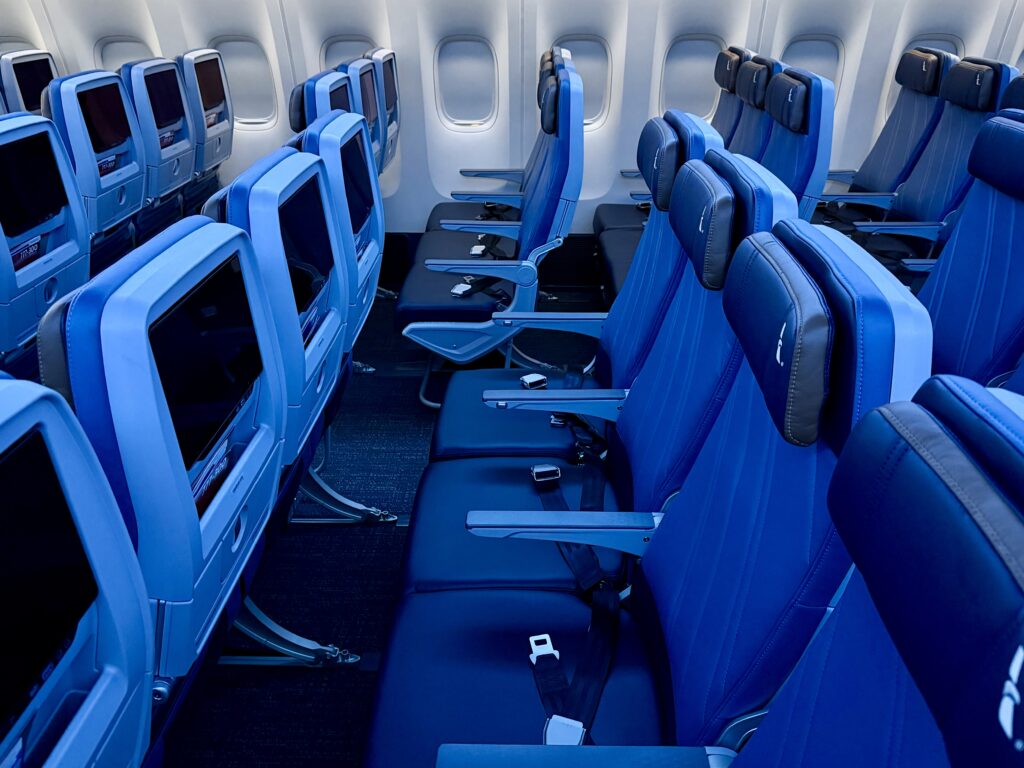
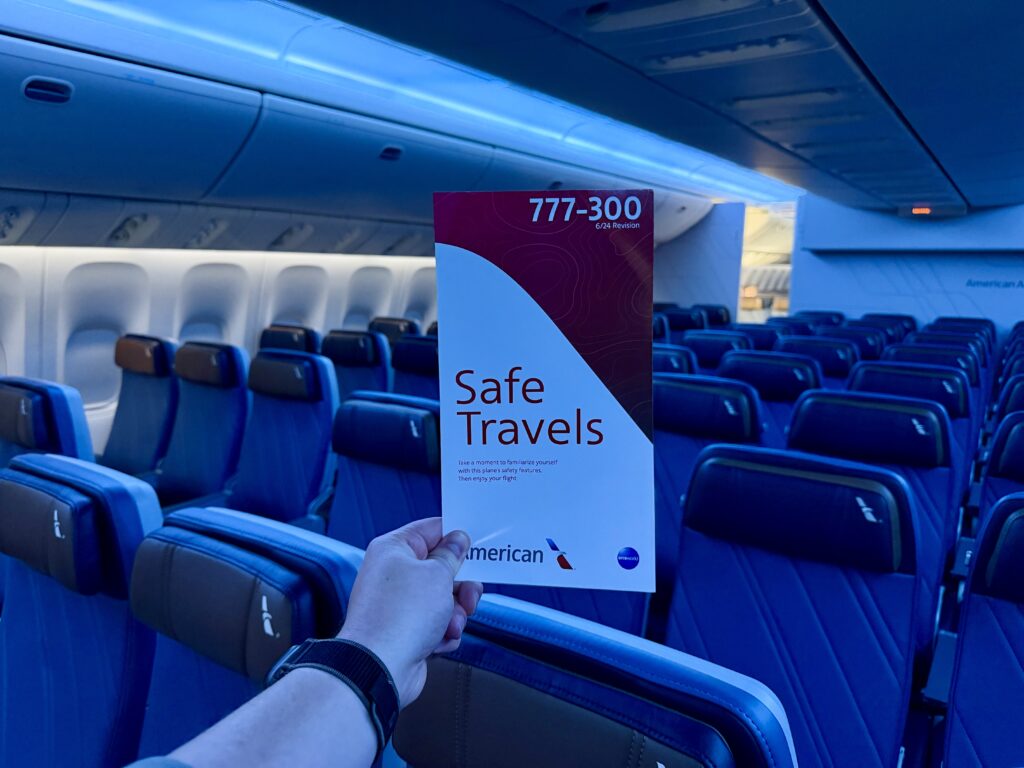
There are 44 Premium Economy seats, followed by Main Cabin Extra and standard economy.
TYLER GLATT / POINTS INSIDER
Economy itself isn’t revolutionary. But the cabin has a new lease on life.
Browns and blues replaced some of the older finishes. There are new entertainment screens, in-seat power, and the other updates expected from a modern widebody interior.
A short charter flight isn’t enough to say much about how those seats will feel after 10 or 15 hours.
TYLER GLATT / POINTS INSIDER
What’s more notable, though, is how little economy there seems to be.
For an airplane as large as a 777-300ER, the two economy sections feel surprisingly small. That’s not because American has done anything unusual within them. It’s because the majority of the airplane’s real estate comes before them.
TYLER GLATT / POINTS INSIDER
The premium cabins stretch almost to the end of the wing.
That might be the most effective way to understand just how different this configuration is. The 777-300ER can hold an enormous number of seats. American has chosen to devote a remarkable amount of that real estate to the front of the plane.
Retrofitting a 777 Isn’t the Same as Building a New One
Some things didn’t change.
The overhead bins, for example, look just like they did before. So does the view through the well-traveled windows. And when the engines spool up for takeoff, this is still very much the same 777 that has been flying for American for years.
The challenge was putting a substantially different passenger experience inside it.
TYLER GLATT / POINTS INSIDER
From a design perspective, Girardoni said there weren’t any particular challenges with bringing Flagship Suite to the 777 that stood out during the project. American was also working with a familiar product, using the same Flagship Suite seat already flying aboard its 787-9P.
But there are still operational tradeoffs.
One flight attendant aboard Wednesday’s flight mentioned that the new layout leaves crews with somewhat less room to maneuver in parts of the galley, particularly when passengers are trying to squeeze around carts. It could make things a little trickier, although she said that adapting to different aircraft and working conditions is part of the job.
Passengers give up a little space elsewhere, too. The new configuration has fewer lavatories than the 777-300ER it replaces.
TYLER GLATT / POINTS INSIDER
American expects to complete the remaining 777-300ER retrofits by the middle of 2027.
The aircraft will also get free high-speed Wi-Fi for AAdvantage members, sponsored by AT&T. That’s a meaningful upgrade for airplanes expected to spend much of their lives on long international flights.
The first retrofitted 777 already has it.
A Look at Where American Wants to Go
American describes the new 777 as more than a refurbishment.
Pieper called the aircraft an embodiment of the airline’s ambitions as American works toward what he described as becoming a premier global airline.
TYLER GLATT / POINTS INSIDER
That’s a lofty goal.
But the 777 offers a tangible look at what American thinks getting there requires.
It’s eliminating its eight-seat international first-class cabin while dramatically expanding business class. It’s adding privacy doors, better technology, more thoughtful storage, and a much more contemporary interior. And it’s making similar investments across new aircraft, existing widebodies, lounges, Wi-Fi, Flagship airport check-in, and other parts of the travel experience.
TYLER GLATT / POINTS INSIDER
The first retrofitted 777-300ER begins commercial service between New York (JFK) and Buenos Aires (EZE) on September 2.
It won’t be a novelty flying around the network for a year or two. American expects this airplane, and eventually the others like it, to spend roughly another decade flying to some of its most important destinations around the world.
The first one shows just how much American thinks it can get out of an airplane it already owns. And now it has 19 more to rebuild.
American Airlines has been preparing to say goodbye to Flagship First for years. Until now, we just didn’t know when the airline would make it official.
On September 2, American announced that Flagship First will no longer be available for purchase on its Boeing 777-300ERs for travel beginning November 19, 2026. The airline will then stop selling Flagship First on its premium transcontinental routes for travel beginning March 28, 2027.
That will bring an end to American’s dedicated first-class cabin and leave the newer Flagship Suite as the airline’s top premium product.
It’ll also mark the end of an era for U.S. airlines.
American is the last U.S. carrier to offer a true international first-class cabin, something Delta and United abandoned years ago in favor of increasingly elaborate business-class products.
Flagship First Is Disappearing From the 777-300ER
American currently offers Flagship First on two aircraft: the Boeing 777-300ER used on long-haul international routes and the Airbus A321T used primarily on premium transcontinental routes from New York (JFK) and Boston (BOS) to the West Coast.
The airline has been working toward eliminating both versions for some time.
TYLER GLATT / POINTS INSIDER
American’s 20 Boeing 777-300ERs are being retrofitted with new interiors that replace the eight-seat Flagship First cabin with a much larger business-class cabin. The work is expected to be completed by mid 2027.
The new configuration has 70 Flagship Suite seats with privacy doors, 44 Premium Economy seats, 30 Main Cabin Extra seats, and 186 standard Main Cabin seats.
The first retrofitted 777-300ER enters commercial service on September 2 between New York (JFK) and Buenos Aires (EZE) as flight AA953.
American says Flagship First will no longer be available for purchase on the 777-300ER for travel beginning November 19.
Transcontinental First Class Gets a Few More Months
Flagship First will hang around a little longer on American’s transcontinental routes.
The Airbus A321T has an unusual three-cabin configuration with Flagship First, Flagship Business, and economy. But that premium-heavy configuration is also on its way out.
American is reconfiguring the A321Ts with a more standard layout as Airbus A321XLRs take over premium transcontinental flying.
The XLR still has a premium layout, but there’s no separate first-class cabin. Instead, it has 20 Flagship Suite seats, followed by 12 Premium Economy seats and 123 seats in Main Cabin.
But the XLR’s Flagship Suite isn’t identical to the version found on American’s new Boeing 787-9P (the P stands for premium) and retrofitted 777-300ER. The XLR requires a different seat design because of its narrower cabin.
As more XLRs enter the fleet, American says Flagship First will no longer be sold on transcontinental routes for travel beginning March 28, 2027.
That means Flagship First will disappear in two stages: first from international flying this November, then from the transcontinental network next March.
Flagship Suite Becomes American’s Top Seat
American revealed plans years ago that would ultimately eliminate Flagship First as it introduced its new Flagship Suite.
What’s new is that the airline has finally put dates on the transition that’s already well underway.
TYLER GLATT / POINTS INSIDER
Once Flagship First disappears, Flagship Suite will officially take over as American’s top long-haul product.
In many ways, the change makes sense. The differences between first and business class have been shrinking for years. Today’s best business-class seats offer privacy doors, direct aisle access, better bedding, and many of the features that once helped set international first class apart.
But that doesn’t mean there won’t be some nostalgia for Flagship First. American is the last U.S. airline to offer a true international first-class cabin, and its retirement will bring that era to an end.
So for anyone hoping to experience Flagship First one last time, or for the first time, the clock is now officially ticking.