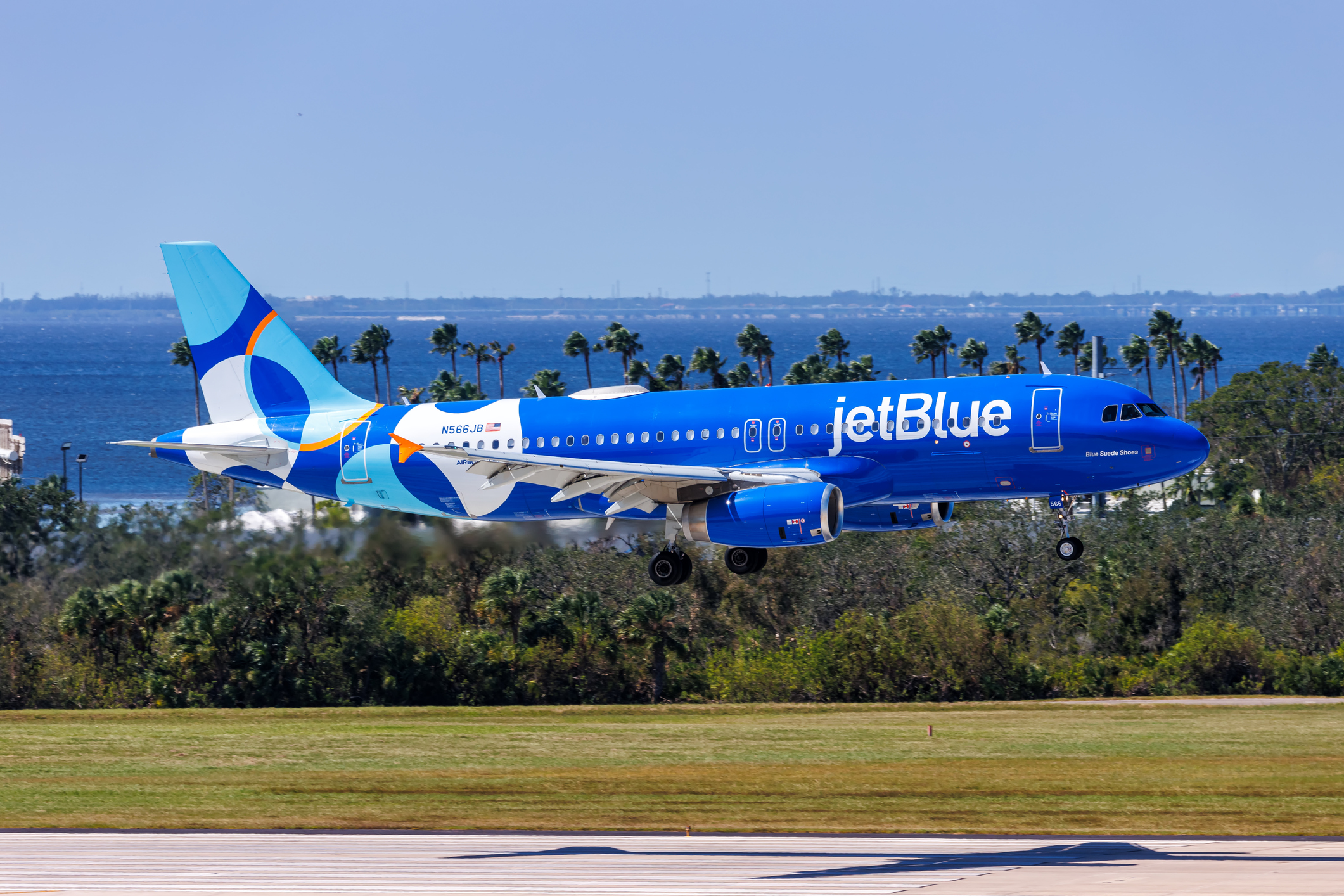
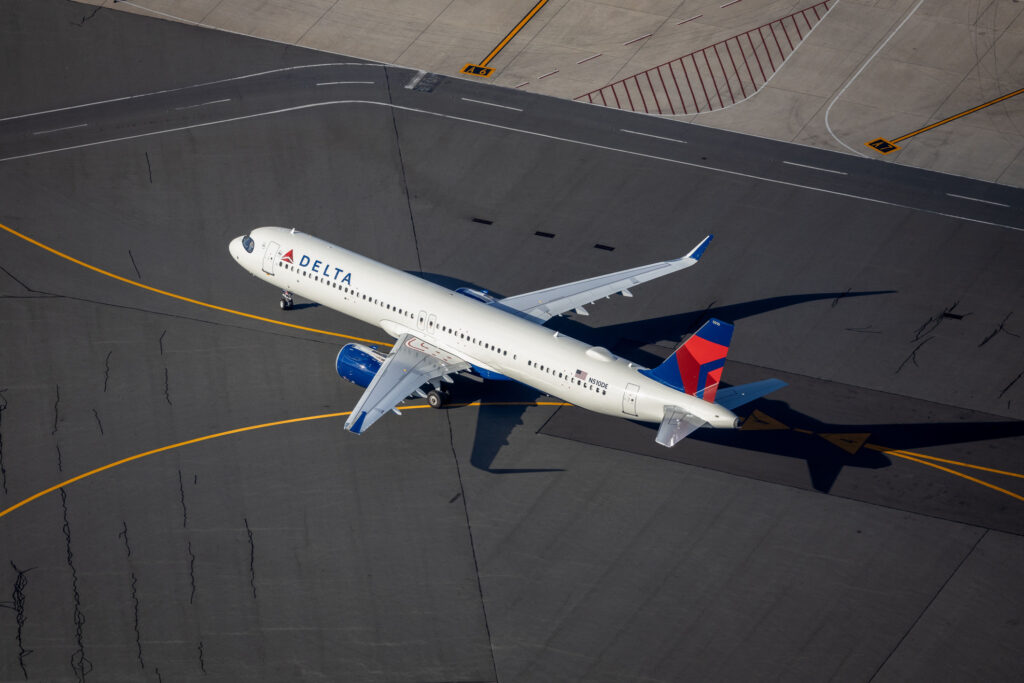
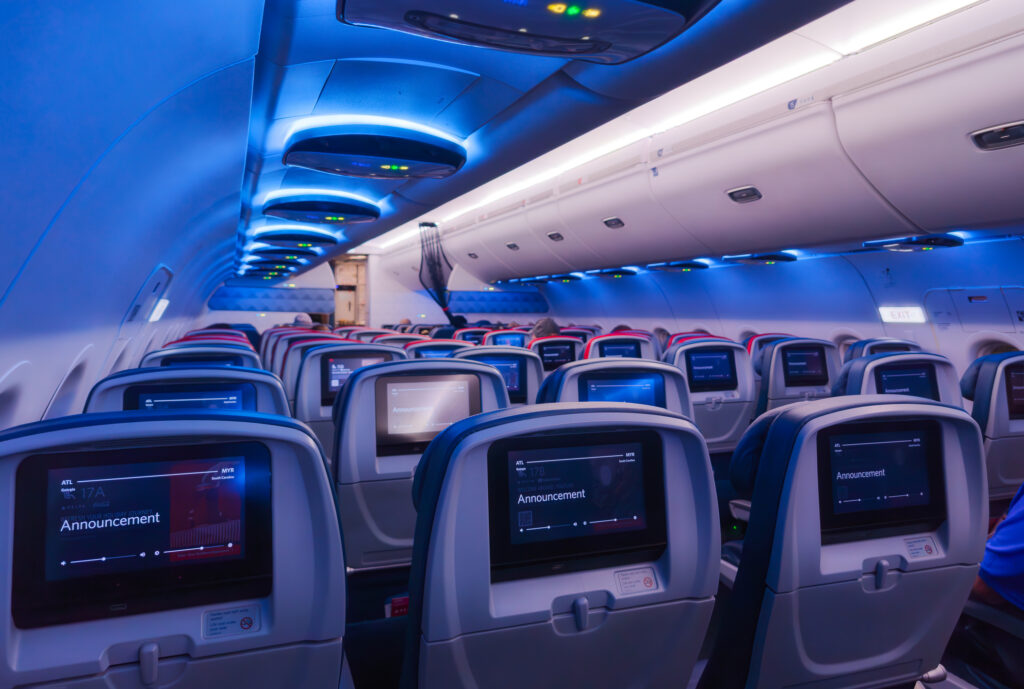
JetBlue’s new BlueFirst cabin is officially on sale. And the first flights take off on December 8, 2026.
The airline unveiled BlueFirst in September, and travelers can now book the new first class product with cash or TrueBlue points on more than 30 routes.
Where You Can Book JetBlue BlueFirst
The first BlueFirst flight is scheduled for December 8 between Boston (BOS) and Fort Lauderdale (FLL). BlueFirst service between New York LaGuardia (LGA) and Fort Lauderdale commences shortly afterward on December 12.
And additional routes will launch over the coming months, including:
Route
BlueFirst Launch
Boston (BOS) ↔ Fort Lauderdale (FLL)
December 2026
New York LaGuardia (LGA) ↔ Fort Lauderdale (FLL)
December 2026
Fort Lauderdale (FLL) ↔ Washington, D.C. (DCA)
December 2026
Boston (BOS) ↔ Austin (AUS)
January 2027
New York JFK (JFK) ↔ Cancun (CUN)
January 2027
Fort Lauderdale (FLL) ↔ Aruba (AUA)
January 2027
Fort Lauderdale (FLL) ↔ Dallas Fort Worth (DFW)
February 2027
Boston (BOS) ↔ Denver (DEN)
April 2027
BlueFirst won’t necessarily operate on every flight along these routes, since availability depends on the aircraft scheduled.
JetBlue plans to eventually offer BlueFirst throughout its network on aircraft without Mint, including flights to Latin America and the Caribbean.
Booking JetBlue BlueFirst With Points
JetBlue initially offered BlueFirst fares starting at $249 or 18,100 TrueBlue points one-way. That introductory promotion ended October 16, and prices have since increased.
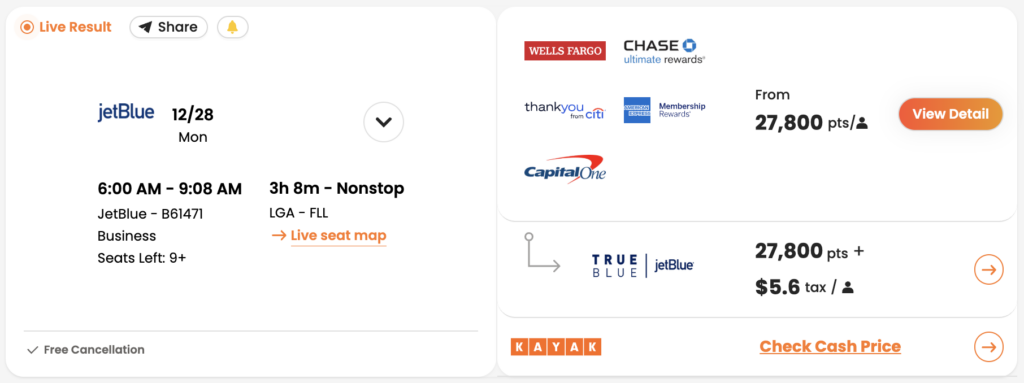
But if you missed the sale, there are still opportunities to try BlueFirst without spending a small fortune. For example, we found the following one-way fares from New York LaGuardia (LGA) to Fort Lauderdale (FLL) on December 28:
BlueFirst Base: $374 or 27,800 TrueBlue points
BlueFirst: $419 or 30,000 TrueBlue points
BlueFirst Flex: $594 or 41,400 TrueBlue points
POINTSYEAH
The three fares offer the same onboard experience, but differ in baggage allowances, seat selection, and change and cancellation policies.
Find BlueFirst Flights With PointsYeah
BlueFirst will offer JetBlue travelers a more premium experience on planes that don’t have the airline’s lie-flat Mint product. And unlike Mint, BlueFirst will eventually be available across much more of JetBlue’s network.
Worth noting: you can already find BlueFirst flights using PointsYeah. Just filter your search by business class rather than first class to see what’s available and what it costs.
Southwest Airlines is making some of its biggest changes yet to Rapid Rewards, introducing a new elite status tier, overhauling Companion Pass qualification, and allowing members to redeem points for international flights on partner carriers.
The airline announced the slew of changes during its Media Day event in Dallas on Thursday, October 15. It also shared new details about its upcoming airport lounges and plans to bring Starlink Wi-Fi to its entire fleet.
Most of the changes will take effect in 2027. Some will give members more ways to use their points, while others will make familiar benefits harder to earn, particularly for those who have relied on credit card bonuses to qualify for Companion Pass.
Here’s what’s changing.
Southwest Is Introducing Three Elite Status Tiers
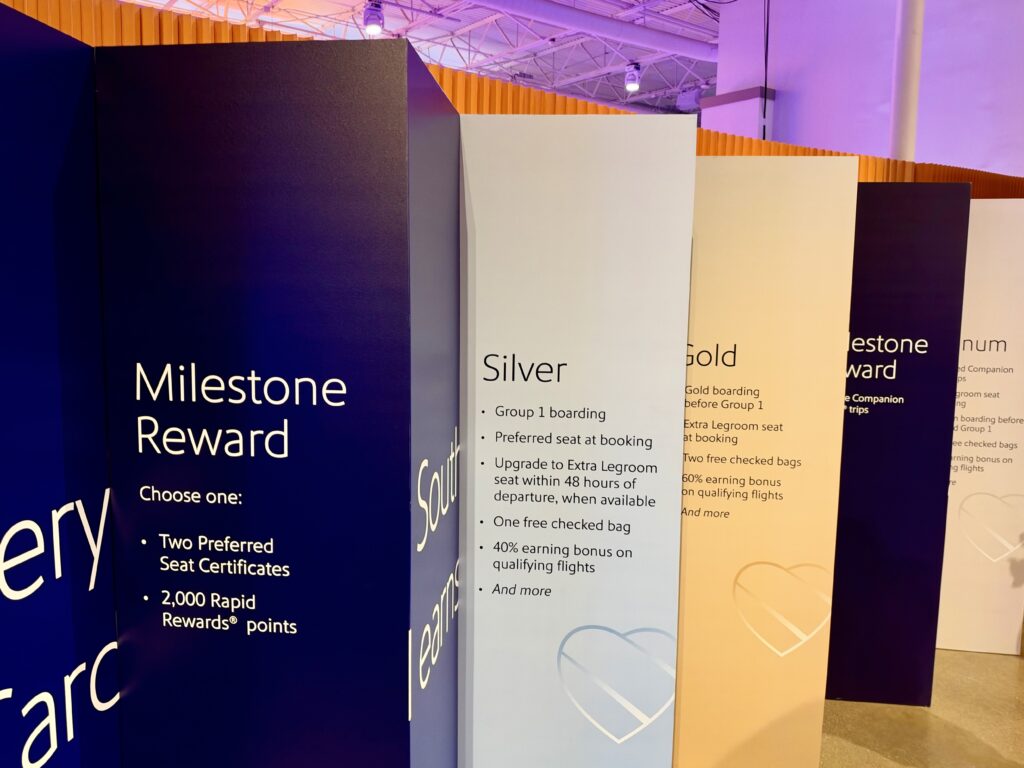
Beginning January 1, 2027, Southwest will replace its familiar A-List and A-List Preferred status levels with a new three-tier structure: Silver, Gold, and Platinum.
The names are generic by design. Executives said the familiar terminology should make Rapid Rewards easier to understand for customers coming from other airlines.
Existing A-List members will transition to Silver, while A-List Preferred members will become Gold. Platinum is an entirely new tier above Gold, offering Southwest’s most frequent flyers (or biggest spenders) additional benefits, including unlimited Companion Pass trips.
Standard or Preferred at booking; Extra Legroom within 48 hours
Any seat at booking
Any seat at booking
Boarding
Group 1
Before Group 1
Before Gold
Companion Pass
—
—
Unlimited trips
Members who qualify for A-List or A-List Preferred status in 2026 will automatically transition to Silver or Gold, respectively, on January 1, 2027. Their status will remain valid through December 31, 2027.
There are a couple of differences worth pointing out.
Silver members will earn a 40% bonus on qualifying flights, up from the 25% currently offered to A-List members. Gold members, however, will earn a 60% bonus, down from the 100% currently offered to A-List Preferred members.
Southwest is grandfathering that benefit for existing A-List Preferred members who qualify for 2027 status through their 2026 activity. They’ll retain the 100% earning bonus through December 31, 2027.
TYLER GLATT / POINTS INSIDER
Platinum is (obviously) the biggest addition. Along with unlimited Companion Pass trips, members will receive three free checked bags, a 120% flight points bonus, priority boarding ahead of Gold members, and complimentary Extra Legroom seat selection at booking.
Southwest is also introducing Milestone Rewards, which will allow members to choose benefits as they work toward higher status levels. Rewards include bonus Rapid Rewards points, seat selection certificates, and, between Gold and Platinum, three Companion Pass round trips.
Beginning January 1, 2027, all Southwest Rapid Rewards credit cards issued by Chase will earn one Tier Qualifying Point (TQP) for every dollar spent on eligible purchases, including the entry-level Plus card.
Members can also earn TQPs through qualifying Southwest flights, purchases on the Rapid Rewards debit card, Getaways by Southwest vacation bookings, and qualifying Southwest Groups bookings.
Companion Pass Is Changing, Too
Southwest is also overhauling Companion Pass.
Yep, finally. It’s a benefit the airline seemed reluctant to touch for somewhat obvious reasons, but the day has come.
Members will have two ways to unlock Companion Pass benefits:
95,000 TQPs or 75 qualifying flights: Earn three Companion Pass round trips through a Milestone Reward.
140,000 TQPs or 100 qualifying flights: Reach Platinum status and unlock unlimited Companion Pass trips.
Currently, members can earn unlimited Companion Pass trips after accumulating 135,000 Companion Pass qualifying points or completing 100 qualifying flights in a calendar year.
The flight requirement for unlimited Companion Pass isn’t changing. However, the switch to TQPs will change how members qualify through credit cards and other activities.
And here’s how.
Beginning in 2027, credit card welcome bonuses, referral bonuses, anniversary points, and bonus points earned from spending will no longer count toward Companion Pass qualification. Points earned through participating hotel and rental car partners will also be excluded.
Members will still earn redeemable Rapid Rewards points from those activities, but they won’t count toward Companion Pass.
Instead, Southwest credit cardholders will earn one TQP for every dollar spent on eligible purchases, regardless of which Southwest Chase card (or cards) they carry.
That means someone who previously earned Companion Pass through a combination of credit card welcome bonuses and spending won’t be able to follow the same strategy in the future.
Members will still be able to designate one companion at a time and change that person up to three times annually.
Already have Companion Pass? Members who earn it under the existing rules in 2026 will keep their unlimited Companion Pass trips through December 31, 2027.
Southwest will also honor existing Companion Pass promotions. Members who meet the requirements of their current offer will receive the benefits promised for that promotion’s specified period.
Southwest Points Will Soon Be Redeemable for International Partner Tickets
One of the more interesting announcements from Thursday’s event is that Rapid Rewards points will soon be useful for flights well beyond Southwest’s own network.
Beginning in spring 2027, members will be able to earn and redeem Rapid Rewards points through partnerships with Icelandair, China Airlines, and Etihad Airways.
Etihad is the newest addition to Southwest’s growing list of international airline partners.
Southwest confirmed that members will be able to redeem points for economy and premium cabin flights on these airlines. Reservations will be available through Southwest’s website, though pricing has yet to be announced.
We also heard from multiple members of Southwest’s Rapid Rewards team that more airline partners will become available for redemptions (and potentially fairly quickly).
Until now, Rapid Rewards redemptions have largely been limited to Southwest’s own flights, aside from international flights available through the More Rewards portal.
But there are still some big unknowns.
Southwest hasn’t announced how it will price partner redemptions or whether members will be able to combine Southwest flights and partner-operated flights on a single reservation.
Southwest Is Adding More Ways to Spend Points
International flights aren’t the only new redemption option coming to Rapid Rewards.
Beginning in November 2026, members will be able to redeem points for rental cars through participating partners at cars.southwest.com.
Later in 2027, Southwest will also allow members to use Rapid Rewards points to pay for seat selection, including Preferred and Extra Legroom seats.
That option will be available after booking and before check-in. Pricing will vary by flight and seat type.
Southwest Shares More About Its New Airport Lounges
The new network will be called Southwest Icon Lounges, and the first location expected to open in the fourth quarter of 2027.
Chatter at the event suggested Nashville (BNA) is a leading candidate for the first location, although Southwest hasn’t officially confirmed which lounge will open first.
Each Southwest Icon Lounge will incorporate design elements inspired by its location. Southwest says the spaces will emphasize comfort, hospitality, and local character while retaining elements of the airline’s identity.
TYLER GLATT / POINTS INSIDER
The lounge network is being developed in partnership with Chase, which already operates its own Sapphire Lounge network.
Southwest also confirmed plans to introduce a new premium Rapid Rewards credit card issued by Chase in 2027. The card will provide access to Southwest Icon Lounges.
However, the airline hasn’t announced the card’s annual fee, additional benefits, or launch date.
Another unanswered question is whether existing Chase Sapphire Reserve and Sapphire Reserve for Business cardholders will receive lounge access when flying Southwest.
It seems plausible, but when Points Insider asked representatives from both Southwest and Chase about that possibility during Media Day, neither company offered any details that would indicate which direction it’ll go.
For now, the new Southwest premium card is the only confirmed credit card access option.
Starlink Is Coming to Southwest’s Entire Fleet
Southwest is also moving ahead with plans to install Starlink, the fast (and popular) satellite internet service operated by SpaceX, across its entire fleet.
The airline expects to complete the rollout by fall 2027, which executives touted would make Southwest the first major U.S. airline to offer complimentary Starlink on every aircraft.
During Thursday’s presentation, Tony Roach, Southwest’s chief customer and brand officer, said 47 aircraft were already equipped with Starlink.
Installation is expected to accelerate in the first quarter of 2027. Southwest’s forthcoming Boeing 737 MAX 7 aircraft will also enter service with Starlink already installed.
The rollout is part of Southwest’s broader cabin modernization effort, which includes new seats, larger overhead bins, and in-seat power. Southwest expects essentially its entire fleet to have in-seat power by around October 2027.
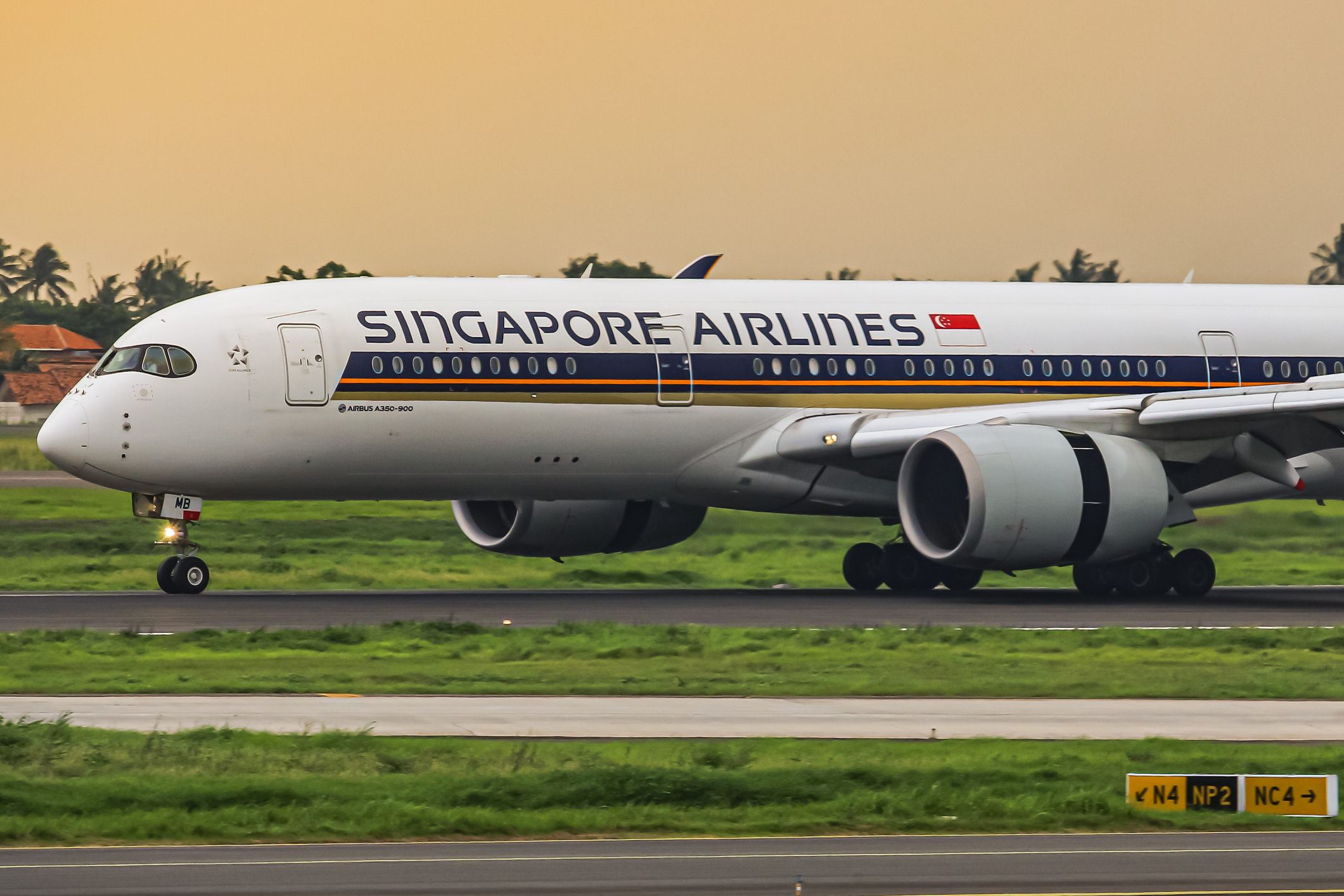
Singapore Airlines just released its latest round of Spontaneous Escapes. This month, the airline is offering 30% off select flights booked with KrisFlyer miles for travel in November 2026.
The monthly promotion covers destinations across Singapore Airlines’ network, including several routes connecting the United States with Europe and Asia.
To take advantage of the discounted rates, KrisFlyer members must book by October 31, 2026, for travel between November 1 and 30, 2026.
Discounted Singapore Airlines Flights From the U.S.
This month’s promotion includes several routes to and from the United States. Discounts are available in economy and premium economy, but not business class.
Here are the eligible routes and their discounted one-way prices:
Route
Cabin
Miles Required
New York (JFK) → Frankfurt (FRA)
Premium Economy
39,900
Frankfurt (FRA) → New York (JFK)
Premium Economy
39,900
Singapore (SIN) → San Francisco (SFO)
Premium Economy
55,300
New York (JFK) → Frankfurt (FRA)
Economy
19,250
Frankfurt (FRA) → New York (JFK)
Economy
19,250
Los Angeles (LAX) → Singapore (SIN)
Economy
30,800
Singapore (SIN) → Los Angeles (LAX)
Economy
30,800
San Francisco (SFO) → Singapore (SIN)
Economy
30,800
Singapore (SIN) → San Francisco (SFO)
Economy
30,800
Seattle (SEA) → Singapore (SIN)
Economy
30,800
Singapore (SIN) → Seattle (SEA)
Economy
30,800
Blackout dates vary by route, and not every flight during November will qualify. Singapore Airlines has published the full list of eligible flights and dates on its Spontaneous Escapes page.
What to Know Before Booking
Spontaneous Escapes discounts apply to both one-way and round-trip bookings, although all flights on a promotional round-trip ticket must fall within the eligible travel period.
Most importantly, though, bookings made under this promotion cannot be changed or canceled, even if the ticket is entirely unused.
Don’t have KrisFlyer miles? Singapore Airlines is a 1:1 transfer partner of American Express Membership Rewards, Chase Ultimate Rewards, Citi ThankYou Rewards, and Capital One miles. All four transfer at a 1:1 ratio.
Marriott Bonvoy points can also be transferred to KrisFlyer, though at a 3:1 ratio (plus a 5,000-mile bonus for every 60,000 points you transfer).
For travelers with flexible November plans, Spontaneous Escapes is a useful way to put your KrisFlyer miles to use. Just check the eligible flight numbers and blackout dates before transferring points or making a reservation.
World of Hyatt and Air Canada Aeroplan launched a new promotion that lets members earn points with both programs on the same hotel stay.
Through February 14, 2027, eligible members can earn 1.5 bonus Aeroplan points per $1 spent on qualifying Hyatt stays, on top of the World of Hyatt points they’d normally earn.
World of Hyatt members normally earn 5 base points per $1 spent on eligible hotel stays (or 2.5 points per $1 at Hyatt Studios).
With this promotion, members can earn an additional 1.5 Aeroplan points per $1 spent and collect rewards in both programs on the same stay.
For example, a qualifying $1,000 Hyatt stay would earn:
5,000 World of Hyatt base points
1,500 bonus Aeroplan points
That’s before accounting for any additional Hyatt points earned through elite status or other eligible promotions.
The offer applies to participating Hyatt properties worldwide. Stays must be completed between October 14, 2026, and February 14, 2027, after registration.
Only the room occupied by the member qualifies. Bonus Aeroplan points may take up to eight weeks to post and won’t count toward Aeroplan Status Qualifying Credits.
For travelers with upcoming Hyatt stays, this is an easy opportunity to earn additional airline points without giving up their usual World of Hyatt earnings.
Delta is making some big changes to its Delta One business class experience. And for once, the seats themselves aren’t the focus.
On October 14, Delta announced what it calls its largest overhaul of the Delta One experience in nearly 30 years. The changes include new menus, upgraded dining service, additional amenities, and more flexibility for passengers who would rather sleep than eat.
The rollout begins this fall on transoceanic Delta One flights departing Los Angeles International Airport (LAX), before expanding across the airline’s global network in early 2027.
What’s Changing in Delta One?
The biggest changes involve dining. Delta partnered with several chefs to redesign its menus, introducing dishes such as a Wagyu beef burger, roasted sea bass, braised lamb, and beef short ribs.
The airline is also refreshing its beverage selection. Blanton’s bourbon joins the menu in December, alongside an expanded Champagne Taittinger partnership and a new wine program featuring 13 wines from 11 different wineries.
Delta One passengers will also be able to preorder their entrées until 18 hours before departure, six hours later than before. The airline is introducing lighter meal options and allowing passengers on long-haul flights to skip the usual pre-arrival meal in favor of a coffee and croissant.
Other changes include:
New amenities: Updated Missoni amenity kits arrive November 3, while additional pillows and Bombas socks will be available on select flights.
More drinks: New cocktails and mocktails, plus premium Japanese sake on flights to and from Tokyo-Haneda.
Updated service: New tableware and changes to how meals are presented.
Expanded Porsche fleet: Delta plans to increase its fleet of airport vehicles from 40 to 70 across 15 airports by 2028. Porsche service is available to Delta One customers who book VIP Select.
A Continued Focus on the Premium Experience
These changes focus on Delta’s soft product (food, service, bedding, and other amenities) rather than its hard product (the physical seats and cabin).
Delta has spent years expanding its premium cabins and opening dedicated Delta One lounges. The latest investment focuses on the onboard experience.
And the rollout will begin with transoceanic flights departing Los Angeles this fall, with the rest of the Delta One network following in early 2027.
As the year winds down, United Airlines is among the first major U.S. carriers to announce changes to its loyalty program for 2027.
And some of them are pretty significant.
The airline is eliminating one of the two ways travelers can qualify for MileagePlus Premier status and increasing the requirements for Premier 1K.
The changes, announced October 13, are most consequential for frequent flyers who have traditionally qualified through a combination of Premier qualifying flights (PQF) and Premier qualifying points (PQP).
United is also changing how members receive their annual starter PQP deposits. To spoil it: The benefit will become exclusive to eligible credit cardholders. Meanwhile, the airline is increasing the number of PQP members can earn through spending on its premium United Club credit cards.
Here’s what’s changing for 2027.
United Is Eliminating Its Flight-Based Qualification Option
Currently, MileagePlus members have two ways to qualify for Premier status: earn a combination of PQF and PQP, or earn a higher number of PQP without meeting the additional flight-count requirement.
Starting January 1, 2027, United will eliminate the PQF-based qualification option. Members will instead qualify based on PQP earned through eligible flights and credit card spending.
Here’s how next year’s requirements compare to this year’s:
Premier Status
2026 PQP + PQF Requirement
2026 PQP-Only Requirement
2027 PQP Requirement
Silver
5,000 PQP + 15 PQF
6,000 PQP
6,000 PQP
Gold
10,000 PQP + 30 PQF
12,000 PQP
12,000 PQP
Platinum
15,000 PQP + 45 PQF
18,000 PQP
18,000 PQP
1K
22,000 PQP + 60 PQF
28,000 PQP
32,000 PQP
Members will still need to take at least four flights operated by United or United Express each year to qualify for Premier status.
For travelers who already qualify through PQP alone, the requirements for Silver, Gold, and Platinum aren’t changing.
Those who previously relied on the combination of flights and PQP, however, could face considerably higher requirements.
For example, a traveler who currently qualifies for Premier Gold with 30 flights and 10,000 PQP will need 12,000 PQP under the new system, regardless of how frequently they fly.
JANICE CHEN / ISTOCK
The biggest increase is at the top of the program rather than the bottom.
Premier 1K will require 32,000 PQP in 2027, up from the current PQP-only requirement of 28,000. That’s an increase of more than 14%.
For someone who previously qualified through 60 flights and 22,000 PQP, the new requirement represents an additional 10,000 PQP.
These changes apply to qualification activity in 2027, generally toward Premier status for 2028. They don’t change the requirements for members currently working toward status in 2026.
Annual Starter PQP Will Now Require a United Credit Card
United is also changing who receives its annual starter PQP deposit.
For 2026, United gave qualifying Premier members a head start on re-qualification by depositing PQP into their accounts based on their existing status level, regardless of whether they held a United credit card.
Starting in 2027, that benefit will be limited to members with an eligible United credit card.
Here’s how the deposits compare:
Premier Status
2026 Starter PQP
2027 Starter PQP
Silver
300
300
Gold
600
600
Platinum
900
900
1K
1,400
1,600
To qualify for the 2027 deposit, members must have an eligible United credit card open by December 31, 2026, and hold Premier status as of February 1, 2027. The card must remain open and in good standing when the PQP are deposited.
For Silver, Gold, and Platinum members, the deposit amounts aren’t changing. Premier 1K members will receive an additional 200 PQP.
Members without an eligible credit card, on the other hand, will lose the benefit entirely.
Starter PQP are awarded per member rather than per card, so holding multiple eligible cards won’t increase the deposit. Authorized users also aren’t independently eligible.
Members with the United Quest or United Club cards will continue receiving their existing annual card bonus PQP in addition to any starter PQP they qualify for.
CHUYN / ISTOCK
United Is Increasing Credit Card PQP Limits
United already allows MileagePlus members to earn PQP through spending on eligible cobranded credit cards.
Starting in 2027, the United Club Card and United Club Business Card will each allow cardholders to earn up to 32,000 PQP annually, an increase from the current 28,000-PQP cap.
Here’s how the major United credit cards compare:
United Credit Card
2026 PQP Limit
2027 PQP Limit
United Explorer Card
1,000
1,000
United Quest Card
18,000
18,000
United Club Card
28,000
32,000
United Business Card
4,000
4,000
United Club Business Card
28,000
32,000
The increased Club Card limits match the new Premier 1K qualification threshold.
That means cardholders can theoretically earn enough PQP through credit card spending alone to qualify for Premier 1K, provided they also complete the required four United-operated flights.
Of course, that would require a ton of spending.
The United Club cards earn 1 PQP for every $15 spent on eligible purchases. At that rate, earning 32,000 PQP entirely through purchases would require $480,000 in credit card spending, before accounting for any applicable PQP deposits.
Other eligible United cards generally earn 1 PQP for every $20 spent, subject to their respective annual limits.
For most travelers, credit card spending will supplement PQP earned from flying rather than replace it entirely.
United Is Also Moving to Dynamic PlusPoints Pricing
United’s announcement also includes a reminder about an upcoming change to PlusPoints upgrades.
As previously announced, United will introduce dynamic PlusPoints pricing for travel beginning February 1, 2027.
Rather than requiring a fixed number of PlusPoints for a particular upgrade, the cost will vary based on demand and available seats.
That means the number of PlusPoints needed to upgrade could differ depending on the flight.
All in all, though, travelers working toward Premier status in 2026 can continue under the existing qualification rules. But anyone planning to re-qualify next year will have a different set of requirements to consider.
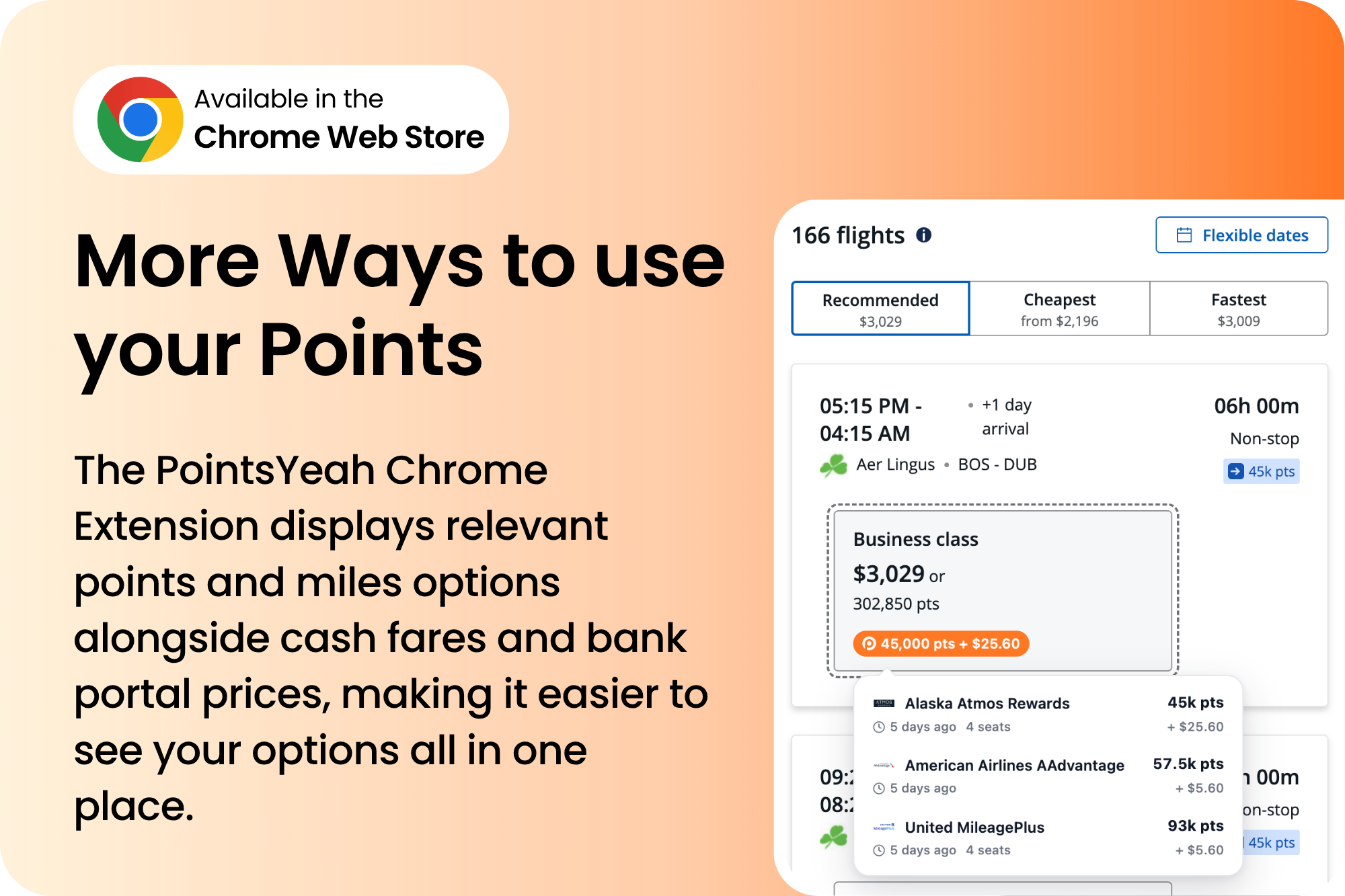
We’re excited to introduce the PointsYeah Chrome Extension, a new way to discover flights you can search with points and miles directly on the credit card portals and travel websites you already use.
Ever searched for flights through Amex Travel, Capital One Travel, Chase Travel, Citi Travel or Kayak and Expedia and wondered whether redeeming airline miles might be a better option?
Now, you can see relevant points and miles options alongside your existing flight results
Whether you’re redeeming bank points through a credit card travel portal or browsing cash fares, the PointsYeah Chrome Extension brings additional award travel options directly into your search results without changing how you normally search for flights.
The extension currently works with seven travel platforms:
Amex Travel
Capital One Travel
Capital One Business Travel
Chase Travel
Citi Travel
Expedia
Kayak
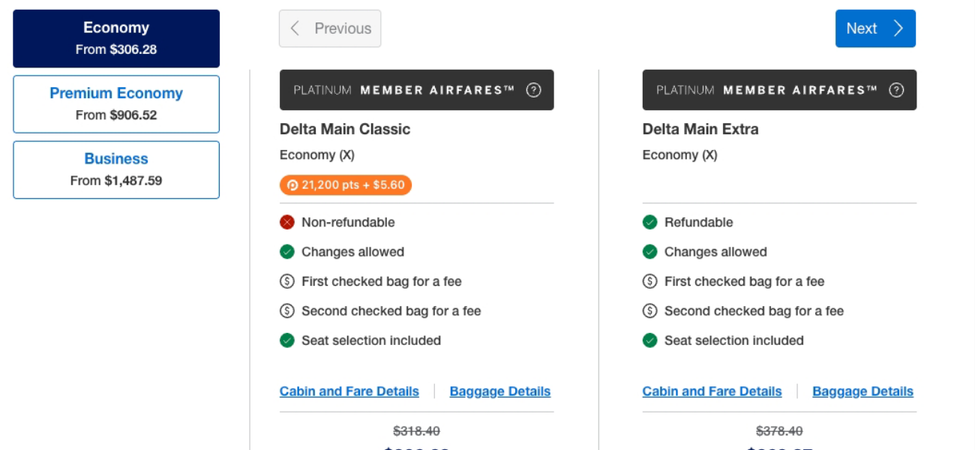
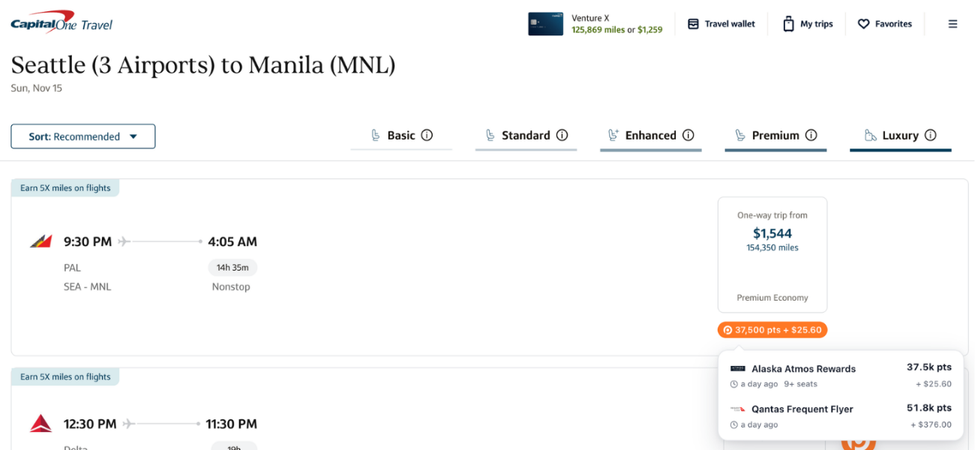
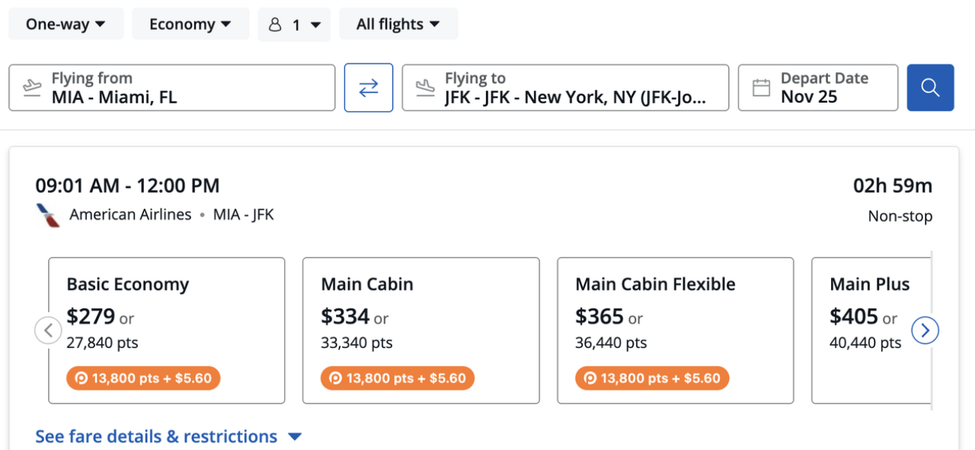
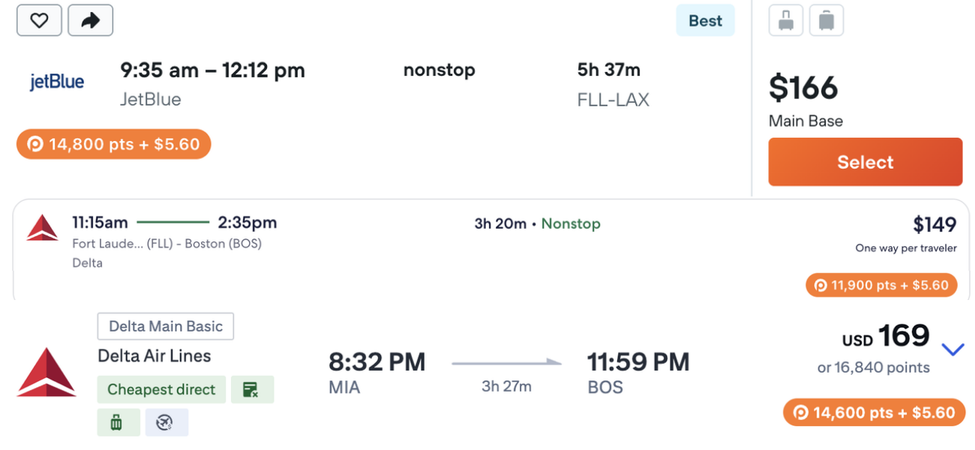
Simply search for flights on any supported website, and when PointsYeah finds a matching award flight, an orange badge appears alongside your results displaying the points price and applicable taxes and fees.
Hovering over the badge reveals more information, including which loyalty programs offer the flight, how many points or miles each requires, and how many seats are available when that information is provided.
See It in Action
See how the PointsYeah Chrome Extension brings award prices into flight searches across supported travel platforms.
Amex Travel
Discover additional points and miles options alongside flight results and fare selections within Amex Travel.
AMEX TRAVEL
Capital One Travel and Capital One Business Travel
See airline award prices alongside cash fares and Capital One miles prices.
CAPITAL ONE TRAVEL
Chase Travel
Explore airline award options while browsing flights and cabin selections via Chase Travel.
CHASE TRAVEL
Citi Travel, Kayak, and Expedia
PointsYeah also displays relevant award prices directly within flight results on these platforms: Citi Travel, Kayak, and Expedia.
KAYAK
Find Award Options That Fit Your Preferences
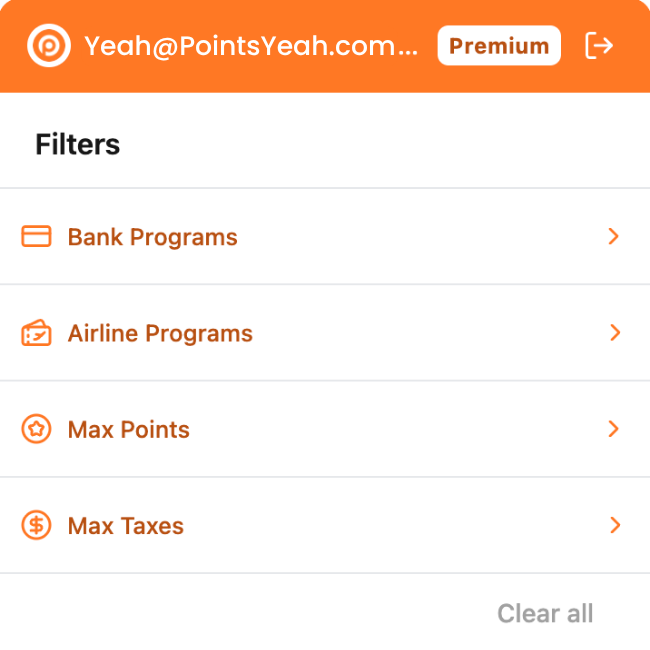
Looking for flights using a specific rewards program or trying to stay within a points budget? The PointsYeah Chrome Extension lets you narrow down award results using four filters:
Bank Programs: Filter award results by bank rewards programs.
Airline Programs: Select the airline loyalty programs you’d like to see.
Max Points: Set the maximum points or miles you’re willing to redeem.
Max Taxes: Limit results based on applicable taxes and fees.
POINTSYEAH CHROME EXTENSION
For example, you can focus on your preferred bank rewards programs or set a maximum points amount to find award opportunities within your budget.
Bring PointsYeah Wherever You Search
Ready to get started? Install the free PointsYeah Chrome Extension from the Chrome Web Store and sign in with your PointsYeah account.
Once installed, start searching for flights on supported travel websites and discover more ways to put your points and miles to work.
Airfares have climbed a lot this year, largely because airlines are paying considerably more for fuel. But travelers hoping cheaper oil will spell cheaper ticket prices might be disappointed.
Delta Air Lines CEO Ed Bastian suggested during the airline’s 2026 third-quarter earnings call on October 9 that recent fare increases could stick around, even after fuel prices return to more normal levels.
Bastian acknowledged that Delta has raised fares by roughly 20% this year to offset higher fuel costs. What surprised the airline, though, was how little resistance it encountered from customers.
Speaking about consumers’ willingness to pay more, Bastian described the response as an encouraging sign for the industry’s future.
And Delta isn’t particularly eager to give up those pricing gains when fuel becomes cheaper.
Airfares Are Up More Than 23% in a Year
The latest government figures show just how much more Americans are paying to fly.
According to the Bureau of Labor Statistics, airline fares increased 23.4% between August 2025 and August 2026, substantially outpacing the 3.4% increase in overall consumer prices during the same period.
August’s airfare index was also approximately 19% higher than in August 2019 (before the pandemic).
The increase hasn’t exactly been steady. Fares reached their highest point of 2026 so far in May before declining somewhat over the summer. Even after that retreat, August prices remained considerably higher than a year earlier.
The government’s airfare index measures changes in ticket prices rather than the average cost of a flight. It also reflects industry-wide pricing, not just Delta’s fares.
WIRESTOCK / ISTOCK
Why Cheaper Fuel Might Not Mean Cheaper Flights
Airlines have traditionally adjusted fares in response to fluctuating fuel costs. When fuel becomes more expensive, carriers try to recover those costs through higher ticket prices.
This year, the industry has also responded by limiting the number of seats available for sale.
Delta kept its capacity essentially flat during the third quarter while increasing revenue by 16%. For the final three months of the year, the airline expects capacity to grow approximately 3%, with fewer Main Cabin seats available than during the same period last year.
Other airlines have also reduced capacity, particularly on routes where profits haven’t been easy to come by.
With fewer seats available, airlines have more room to maintain higher fares.
Bastian believes the industry’s response to elevated fuel costs could have a lasting impact on pricing, even after the immediate financial pressure subsides.
Whether airlines can hold on to those gains is another question.
Competition, weakening demand, or additional capacity could eventually push fares lower. And while Delta reports that customers continue to spend (particularly higher-income households and corporations), that doesn’t necessarily reflect the financial circumstances of every traveler.
For now, though, Delta’s outlook suggests that falling fuel prices alone may not be enough to bring airfares back down.
Airlines Are Exploring Other Ways to Charge More
Another exchange during Delta’s earnings call touched on a different aspect of airline pricing.
A JPMorgan analyst raised the issue of international airlines beginning to vary fuel surcharges based on the day of the week, with higher charges on peak travel days.
Fuel surcharges are additional charges some airlines impose on tickets, including certain flights booked with miles. Unlike the underlying fare, these charges can carry over even when a passenger uses rewards to cover the ticket.
Delta Chief Commercial Officer Joe Esposito acknowledged the development and described it as a relatively new practice.
He said Delta hasn’t adopted the approach and stopped short of suggesting it would.
For travelers booking with points and miles, it’s something worth watching. Depending on how an airline structures its charges, flying on a Tuesday rather than a Sunday could affect how much cash a traveler has to pay when redeeming miles.
KIRK FISHER / ISTOCK
What Travelers Can Do About Higher Fares
There isn’t much an individual traveler can do to influence airline pricing, but flexibility can help keep costs down.
Flying a day earlier or later, considering nearby airports, or choosing a different airline can sometimes produce substantial savings.
Points and miles can also provide an alternative to increasingly expensive cash fares. Some loyalty programs closely follow cash ticket prices, while others use different pricing structures that can make certain flights considerably cheaper when booked with miles.
Of course, points aren’t always a bargain. Some redemptions require large numbers of miles, and certain international bookings carry substantial taxes and carrier-imposed surcharges.
It’s worth comparing the cash price against the points required, plus any out-of-pocket charges, before deciding how to book.
Credit cards have gotten increasingly complicated over the past few years. Annual fees are climbing, benefits are being divided into monthly or quarterly credits, and getting your money’s worth takes more time and attention than ever.
The Chase Sapphire Preferred® Card (still) takes a somewhat different approach.
With a $95 annual fee, useful earning categories, and a collection of travel benefits, it’s a relatively uncomplicated option for travelers who want to earn points without committing a small fortune to an expensive premium card.
Here are four reasons the card is worth a closer look.
A $100 Hotel Credit That Can Offset the Annual Fee
One of the Sapphire Preferred’s most useful benefits is its $100 annual Chase Travel hotel credit.
Cardholders receive up to $100 in statement credits each account anniversary year when booking hotels through Chase Travel. The credit is applied automatically, and there’s no enrollment required.
That’s enough to offset the card’s $95 annual fee.
There is a catch, though. You have to book through Chase Travel rather than directly with the hotel. Portal rates aren’t always the lowest, so it’s worth comparing prices before making a reservation.
Also, the first $100 in eligible hotel purchases each year won’t earn Chase Ultimate Rewards points.
But for someone who can make use of the credit (perhaps for a one-night airport hotel stay before an early flight or after a late arrival), it’s a relatively simple way to offset the annual fee.
Wyndham Grand Rio Mar Puerto Rico Golf & Beach Resort. WYNDHAM
A Good Card for Everyday Spending
Some travel credit cards offer excellent benefits but aren’t particularly rewarding for everyday purchases.
The Sapphire Preferred has a fairly broad set of bonus categories. Cardholders earn:
5X points on purchases through Chase Travel.
3X points on dining, including eligible takeout and delivery.
3X points at gas stations, EV charging stations, and vacation homes at select brands.
3X points on eligible online groceries and select streaming services.
2X points on other travel purchases.
1X points on everything else.
Together, these categories cover a broad range of everyday purchases without requiring cardholders to track rotating categories or activate quarterly bonuses.
Plus, Ultimate Rewards points don’t expire as long as you keep your credit card account open.
Travel insurance isn’t usually the first thing people consider when choosing a credit card, but it’s one of the Sapphire Preferred’s more valuable features.
For starters, the card offers primary rental car coverage. It provides up to $60,000 in reimbursement for covered theft and collision damage to eligible rental vehicles. That generally means you don’t have to file a claim with your personal auto insurance first.
The card also includes several protections for when travel plans go wrong:
Trip delay reimbursement: Up to $500 per covered traveler for eligible expenses when a trip is delayed more than 12 hours or requires an overnight stay.
Trip cancellation and interruption insurance: Up to $10,000 per covered traveler and $20,000 per trip for eligible prepaid, nonrefundable expenses.
Baggage delay insurance: Up to $100 per day for five days when baggage is delayed more than six hours.
There’s also lost luggage reimbursement and a new emergency evacuation and transportation benefit offering up to $100,000 in coverage for qualifying situations.
All of these protections have eligibility requirements and exclusions, but they’re useful benefits to have on a card with a $95 annual fee.
ANDRESR / ISTOCK
You’re Not Tied to One Airline or Hotel Program
One of the biggest advantages of earning Chase Ultimate Rewards points is the flexibility to decide where to use them.
Unlike an airline credit card, which earns miles in a single loyalty program, the Sapphire Preferred earns points that can be transferred to multiple airline and hotel partners.
That includes programs such as United MileagePlus, Air Canada Aeroplan, British Airways Club, and World of Hyatt.
You might use Aeroplan to book a United flight, British Airways Avios for a short American Airlines flight, or transfer points to a hotel program for an upcoming stay.
For those looking to build up their Chase Ultimate Rewards balance, the Sapphire Preferred also offers a welcome bonus for eligible new applicants.
The welcome offer can provide a substantial boost to your points balance after meeting the required spending threshold.
If you’re interested in learning more about the card, including its current welcome offer and terms (and all of its other benefits), click “Learn More” below.
For years, hotel elite status was largely the domain of frequent travelers. Spend enough nights at a hotel chain, and you could earn perks like room upgrades, late checkout, and complimentary breakfast.
That’s still one way to earn status, but it’s far from the only (and easiest) one.
Credit cards and other qualification pathways have made elite status accessible to travelers who might spend only a handful of nights in hotels each year.
And according to Hilton, status is becoming increasingly important to travelers, even beyond the benefits it provides.
In its newly released 2027 Trends Report, Hilton found that 64% of travelers with loyalty status take pride in it, while 43% view it a sign of personal success. Half of respondents also said they’re more likely to trust travel recommendations from someone with loyalty status than someone without it.
On top of that, 38% said they would take a trip specifically to earn or maintain their status.
Those findings surface an interesting (and perhaps obvious) question for hotel companies: As more travelers gain access to elite status, how do you make sure it continues to mean something?
Points Insider put that question to Hilton, along with several others about how the company is approaching its increasingly diverse loyalty membership.
Hilton Wants Status to Appeal to More Travelers
Hilton doesn’t see a conflict between making elite status more accessible and preserving its value.
“We don’t see accessibility and exclusivity as opposing forces,” Brad Anderson, Vice President, Hilton Honors Program, told Points Insider. “Our goal is to make Hilton Honors rewarding for more travelers while ensuring that we continue to deliver meaningful, differentiated value at every status tier level.”
Someone who stays at a Hilton property a few times a year has different expectations from a business traveler who spends 80 or more nights (and several thousand dollars) annually in hotels. But Hilton wants both customers to find reasons to participate in its loyalty program.
And the company isn’t shy about the role status plays in encouraging repeat business.
Hilton Rio de Janeiro Copacabana. HILTON
“Our goal for all tiers is both recognition and continued engagement,” Anderson said in response to a question about the role of lower and mid-tier status.
That means offering benefits travelers can appreciate at different levels, while giving them reasons to continue choosing Hilton.
Basic Hilton Honors membership comes with benefits like discounted member rates and access to Points & Money bookings. Silver adds perks such as Fifth Night Free on reward stays, while Gold introduces benefits like space-available room upgrades and a daily food and beverage credit at eligible U.S. properties. Diamond takes those benefits another step further.
Hilton describes Gold as the point where the value of status really takes off. And there’s a good case for that. The food and beverage credit, for example, puts a tangible dollar value on a benefit that members can use during their stays.
Of course, Gold status is also available through certain Hilton co-branded credit cards, as well as some non-Hilton American Express cards. Travelers don’t necessarily have to spend dozens of nights in hotels to receive its benefits.
In fact, someone could earn Gold without a single hotel stay, simply by holding an eligible credit card with an annual fee as low as $150. Diamond is available on a card with a $550 annual-fee card, while Silver is a perk of another with no annual fee.
For Hilton, those different paths allow the program to serve travelers with very different habits and spending levels.
Making Room for More Exclusive Benefits
At the other end of the spectrum, Hilton is also creating greater differentiation for its most frequent and highest-spending customers.
The clearest example is Diamond Reserve. This is the company’s newest and most exclusive Hilton Honors tier. It sits two levels above Gold and one above Diamond.
Unlike status levels that can be obtained through certain credit cards, Diamond Reserve requires 80 nights or 40 stays, plus $18,000 in annual eligible spending.
Benefits include a 120% points bonus, guaranteed 4 p.m. late checkout, dedicated 24/7 support, and a Confirmable Upgrade Reward that can be used to secure an upgrade of up to a one-bedroom suite at booking.
Hilton specifically pointed to Diamond Reserve when Points Insider asked how the company intends to preserve the meaning and value of elite status as access expands.
It’s one way Hilton can recognize its most frequent and highest-spending guests while keeping other status tiers accessible to a wider range of travelers.
Hilton Panama. HILTON
But Can Hilton Deliver on Those Benefits?
There’s a practical challenge to making elite status more widely available.
Some benefits, such as bonus points, are relatively straightforward to provide. Others, particularly room upgrades, depend on availability. When multiple elite members are staying at the same hotel, not everyone can receive an upgraded room.
In its 2027 Trends Report, Hilton says it delivered more than 1 million automated upgrades to Honors members during the first half of 2026.
That’s a big number, but it doesn’t tell us how often eligible members actually receive an upgrade.
Points Insider asked Hilton for additional context, including how many eligible stays or members were considered for those upgrades. The company didn’t provide those details.
Instead, Hilton pointed to changes intended to make upgrades more transparent and predictable.
Its Upgrade at Digital Check-In feature allows Gold, Diamond, and Diamond Reserve members to see complimentary and paid upgrade options in the Hilton Honors app before arriving at the hotel. Diamond Reserve members also receive a Confirmable Upgrade Reward.
“Ultimately, our goal is to make elite recognition more personal, more guaranteed and more attainable for every member who earns it,” Anderson said.
The distinction between guaranteed benefits and those subject to availability remains important, particularly as more travelers gain access to elite status.
A Broader Definition of Loyalty
One question Hilton declined to answer was how its elite membership breaks down between travelers who earn status through hotel stays and those who receive or accelerate it through credit cards.
The company confirmed that it tracks a range of membership metrics but doesn’t disclose the share of elite members qualifying through different pathways.
Without those figures, it’s difficult to determine how much the composition of Hilton’s elite membership has changed as status has become more accessible.
Hilton’s research indicates that elite status can influence not only how travelers feel about themselves but also where they spend their money and whose recommendations they trust.
And as Anderson’s responses suggest, Hilton sees status as more than a reward for its most frequent guests. It’s also a way to encourage occasional travelers to engage with the brand, while giving more frequent customers additional reasons to stay on the hamster wheel.
The question is whether Hilton can continue delivering benefits that members value as more travelers gain access to them.