Citi just added another perk to its top American Airlines credit card. And this one has nothing to do with flying.
As of October 25, 2026, Citi / AAdvantage Executive World Legend Mastercard cardholders can get up to $200 annually in dining credits through the inKind app.
The credit is split into two $100 semiannual allotments — one from January through June and another from July through December. And the good news for existing cardholders (or prospective cardholders who apply by the end of the year) is that the current $100 credit is already available through the end of 2026.
How the Credit Works
inKind is a dining platform with several thousand restaurants, bars, and cafes in its U.S. network. The new credit works a bit like a gift card you can use at participating establishments.
To use the benefit, download the inKind app and add your eligible AAdvantage Executive card. The credit will then apply automatically to qualifying purchases.
Note that primary cardmembers and authorized users share the same $100 semiannual credit, and unused credits don’t roll over to the next six-month period.
So it’s a use-it-or-lose-it type of benefit.
How We Got Here
The new dining credit comes just two months after Citi refreshed the AAdvantage Executive card in August. Those changes included renaming it a World Legend Mastercard (an upgrade from its previous World Elite Mastercard designation) and increasing its annual fee from $595 to $695.
That refresh also introduced several new benefits, including up to $500 in American Airlines Vacations credits, up to $100 in statement credits for inflight and eligible Admirals Club purchases, and an increase in annual Lyft credits from $120 to $180.
It also added 12X miles on eligible AAdvantage Hotels and AAdvantage Cars bookings, the ability to earn up to 40,000 bonus Loyalty Points, Omni Hotels Champion status with an annual free night after a qualifying stay, and complimentary Avis President’s Club status.
Unlike the August refresh, though, the new inKind benefit doesn’t come with another annual fee increase. It’s simply an additional perk for AAdvantage Executive cardholders.
Do airline miles expire? It depends on which loyalty program you’re using.
Most major U.S. airlines have eliminated mileage expiration. This means you don’t have to worry about losing your rewards just because you haven’t flown in a while. But a few programs still have expiration rules, and they’re not all the same.
Here’s how mileage expiration works across seven U.S. airline loyalty programs, including what you can do to keep your points and miles from disappearing.
American Airlines AAdvantage
American Airlines AAdvantage miles expire after 24 months without qualifying account activity.
Fortunately, keeping your miles alive is fairly easy. Earning or redeeming miles resets the clock, including through eligible partner activity (like using the AAdvantage eShopping portal, for example) or by buying, gifting, or transferring miles.
There are also two important exceptions. Members under 21 are exempt from mileage expiration until they turn 21. And if you’re the primary cardmember on an open AAdvantage co-branded credit card, your miles won’t expire under the standard 24-month rule.
United MileagePlus
United MileagePlus miles don’t expire, regardless of how long your account has been inactive.
As long as your MileagePlus account remains open and in good standing, your miles won’t go anywhere. There’s no activity requirement to keep them.
You can go years without earning or redeeming miles and still keep your balance. However, Delta can close accounts under certain circumstances, which may result in forfeiting any remaining miles.
As long as your account remains open and in good standing, there’s no mileage expiration deadline to worry about.
Like United and Delta, Southwest doesn’t require you to earn or redeem points periodically to keep them active.
However, closing your Rapid Rewards account will result in forfeiting any points you haven’t redeemed. So if you have a balance, keep the account open even if you’re not flying Southwest regularly.
That policy carried over when Alaska Airlines introduced Atmos Rewards and replaced its former Mileage Plan program.
Although accounts may be locked after extended inactivity and require identity verification to regain access, the points themselves don’t expire.
So there’s no need to earn or redeem points periodically just to keep your balance. Just make sure you can still access your account when you’re ready to use them.
Breeze Breezy Rewards
Breeze Airways is a notable exception. BreezePoints expire 24 months after they’re issued, regardless of whether you’ve had other account activity since then.
That means earning more points won’t reset the expiration date on your existing balance. Each batch of points has its own 24-month validity period, and Breeze uses your oldest points first when you redeem them.
There is one way around this: Primary cardmembers with an open Breeze Easy Visa account in good standing are exempt from points expiration. If you close the card, the points remaining in your account receive a new 24-month expiration period beginning on the closure date.
Citi’s list of ThankYou Rewards transfer partners just gained another airline.
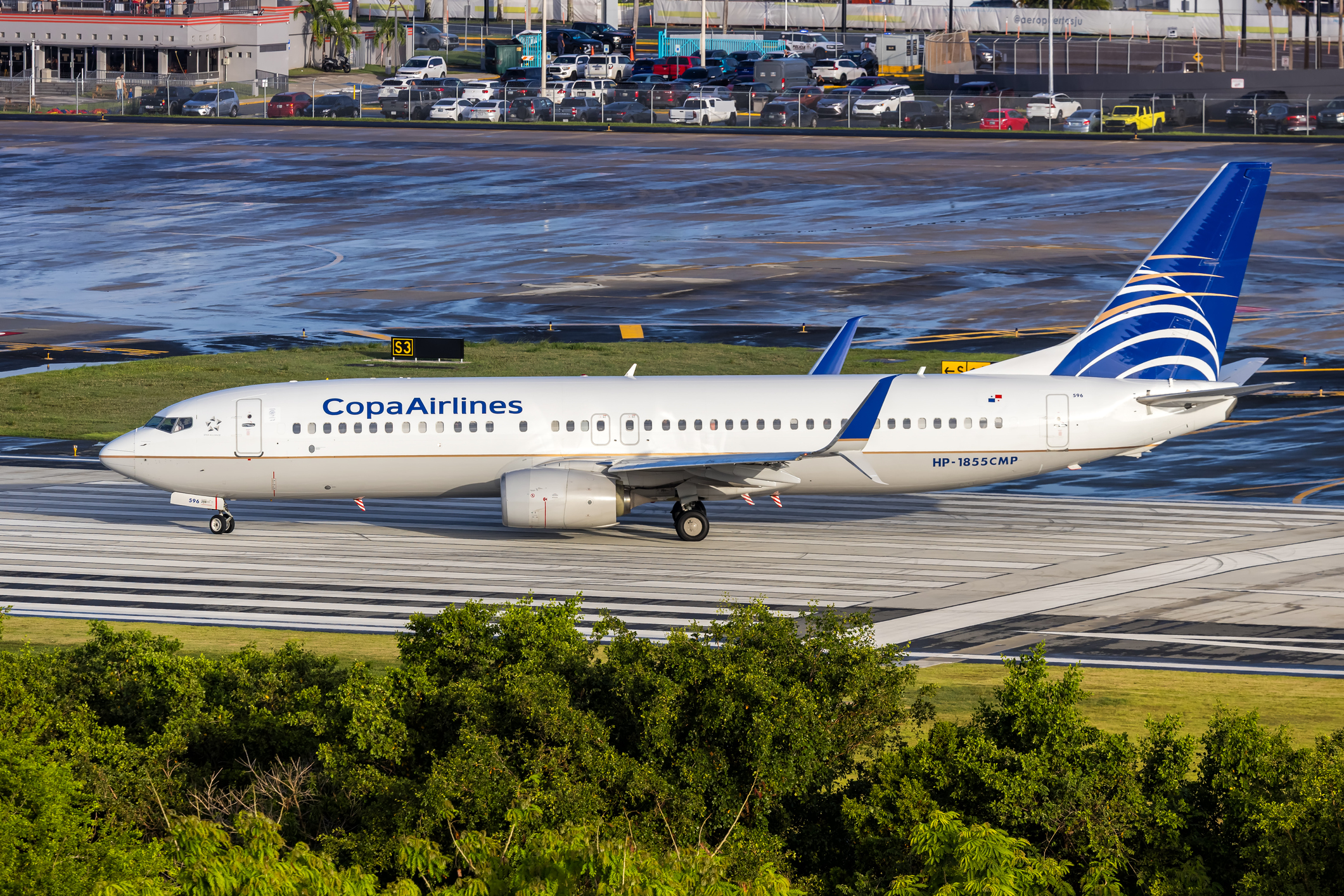
As of Sunday, October 25, Copa Airlines now appears on Citi’s Points Transfer page. And effective immediately, eligible cardholders can transfer ThankYou Points to the airline’s ConnectMiles program.
Copa is a Star Alliance carrier based in Panama City (PTY), and ConnectMiles can be used to book flights on Copa, other Star Alliance airlines, and a handful of non-alliance partners.
The program can be quirky to use, but it’s a neat addition for Citi.
How Citi–Copa Transfers Work
As with other Citi transfer partners, the transfer ratio depends on which Citi card you have.
Premium ThankYou cards — including the Citi Strata Elite, Citi Strata Premier, and Citi Prestige (no longer open to new applicants) — transfer at a 1:1 ratio. The AT&T Access More card also offers 1:1 transfers.
Citi’s no-annual-fee, points-earning cards, including the Citi Double Cash, Citi Strata, and Citi Custom Cash, transfer at a 1,000:700 ratio.
Here are a few examples of one-way Saver award rates:
North America 1 to Panama, Central America, or the Caribbean: 15,000 miles in Copa economy or 30,000 in Copa business. This region includes Florida, Texas, Georgia, and several nearby Southeastern states.
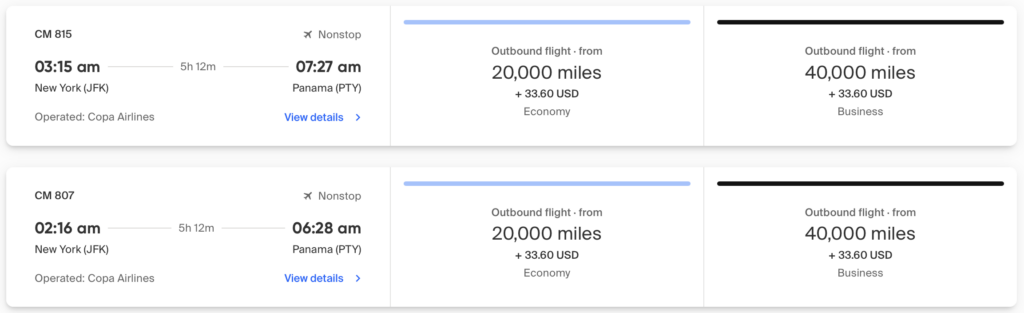
North America 2 to those same destinations: 20,000 miles in Copa economy or 40,000 in Copa business. This region covers the rest of the continental U.S. and Canada.
U.S. or Canada to Europe on Star Alliance partners: 30,000 miles in economy or 70,000 in business.
Beyond Copa’s own flights, ConnectMiles can book flights on Star Alliance carriers, including United, Avianca, ANA, Singapore Airlines, and Turkish Airlines. Non-alliance partners you can also book with miles include Emirates, Azul, GOL, and KLM.
Partner awards are generally limited to Saver availability, although Copa also offers Standard United awards. That gives you more booking options for United flights, though Standard awards cost double that of Saver awards.
One particularly notable redemption is Emirates business class from the U.S. to Dubai, which can cost 80,000 ConnectMiles one-way with relatively low taxes. However, finding available award seats is by no means easy.
All in all, though, this is a welcome addition to Citi’s transfer partner lineup, particularly for travelers looking to book Copa or other Star Alliance flights.
But as always, we’d recommend finding the award you want before transferring any points. Flights you find on other Star Alliance sites (say, United) don’t always appear on Copa’s site. Plus, other Citi airline partners may offer the same flights at different rates, so it’s worth comparing your options before initiating an irreversible transfer.
Alaska Airlines’ ski-and-snowboard perks are back for another winter.
The idea is pretty simple: fly Alaska to a participating destination, show your boarding pass, and unlock free or discounted perks on the mountain.
Alaska calls the promotion Atmos Rewards Alpine Getaways (though you might also know it as the Fly Alaska, Ski Free program). The returning offer gives Atmos Rewards members access to benefits at participating resorts throughout the 2026–2027 ski season.
How It Works
According to Alaska’s ski page, you’ll need to present your inbound boarding pass and Atmos Rewards number, either through the Alaska app or by email, at the participating resort.
Alaska doesn’t explicitly mention award tickets. However, since the terms require an inbound boarding pass rather than proof of a cash purchase, flights booked with Atmos Rewards points should qualify, too.
Offers, blackout dates, and redemption procedures vary by resort, so check the details for your destination before traveling.
Where You Can Use It
Alaska’s current list includes nine participating resorts, each offering different benefits.
Alyeska Resort (Anchorage, ANC): Ski free on arrival day.
Arctic Valley Ski Area (Anchorage, ANC): Free same-day lift ticket.
Crystal Mountain (Seattle, SEA): First Tracks access and complimentary summit coffee on select Atmos Members Days for eligible members during the 2026–2027 season.
Eaglecrest Ski Area (Juneau, JNU): Free same-day lift ticket.
Palisades Tahoe (Reno-Tahoe, RNO): Complimentary half-day lift tickets from March 1 through April 30, 2027.
Schweitzer Mountain Resort (Spokane, GEG): Ski free on arrival day.
Sun Peaks Resort (Kelowna, YLW): Ski free on arrival day or the following day.
Most participating resorts offer a free lift ticket on the day you arrive, provided you show your boarding pass and ID. Crystal Mountain and Palisades Tahoe have more specific eligibility requirements, so pay particular attention to their terms.
You can search for flights to any of these destinations using PointsYeah.
{{ search-widget mode=”flight” }}
Pack the Skis Without the Oversize Fee
There’s a baggage perk worth knowing about, too.
When flying Alaska, properly packed skis and snowboards can exceed the usual 62-inch linear size limit, up to 115 inches, without incurring an oversize baggage fee. As long as the bag weighs 50 pounds or less, you’ll pay the standard checked-bag fee.
Alaska also counts one pair of skis and poles, or one snowboard, plus a separate boot-and-helmet bag as a single checked bag. However, that additional bag can’t contain clothing or other gear.
Overweight fees still apply to bags exceeding 50 pounds, and Alaska notes that baggage policies are subject to change.
Virgin Atlantic partners with several transferable credit card points programs. On top of that, there’s (more often than not, seemingly) a transfer bonus to its Flying Club loyalty program.
At the moment, Capital One is offering a 30% transfer bonus through November 20. And there are plenty of ways a bonus like this can be useful on airlines other than Virgin Atlantic.
Most of these ways are fairly obvious (we’ll show you those), and some aren’t so obvious (we’ll show you those, too).
Just note that Capital One transfers start at 1,000 miles, with increments of 100 miles thereafter.
The Obvious Redemptions
U.S. to London on Virgin Atlantic
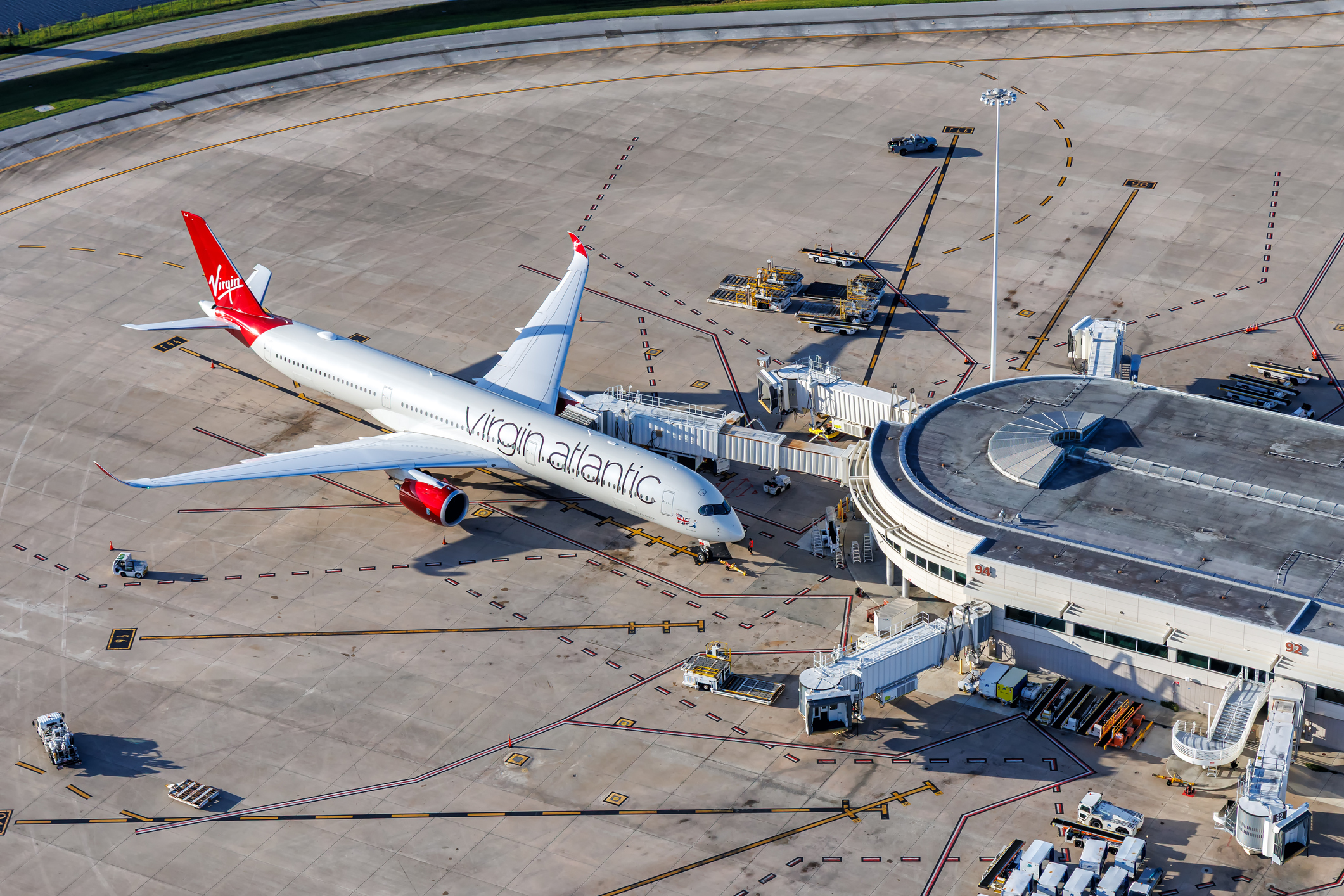
The most obvious way to use Virgin Atlantic Flying Club points is for flights operated by Virgin Atlantic itself.
Virgin Atlantic uses dynamic pricing, so award rates fluctuate based on several factors. But the lowest rates are remarkably cheap. They’re some of the lowest you’ll find between the U.S. and the U.K. (London Heathrow and Manchester), though they’re tempered by higher taxes and fees.
Particularly in economy, they really can’t get much cheaper.
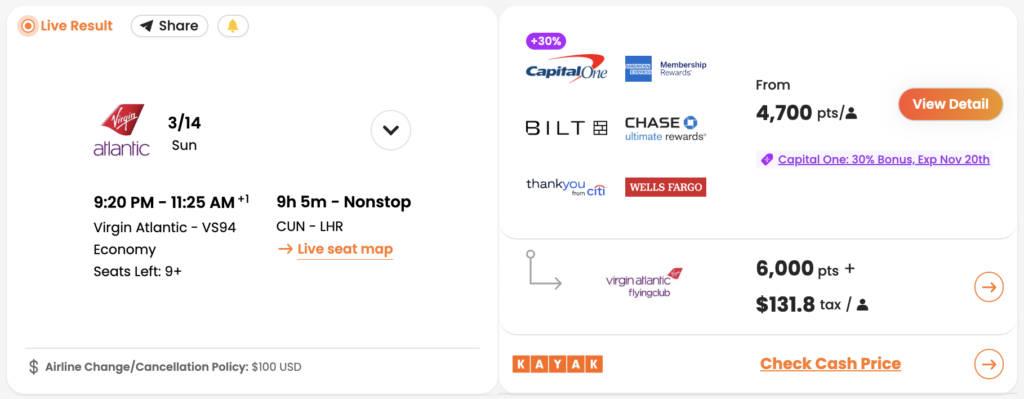
For instance, from Virgin’s East Coast gateways (New York, Boston, Washington — and even Cancun, which isn’t technically on the East Coast), you can book tickets starting at just 6,000 points each way. From the other side of the country (Los Angeles, Las Vegas, and San Francisco), you’ll see rates starting at 9,000 points.
POINTSYEAH
Book these round-trip at the lowest rates, and you’ll pay 12,000 Virgin points from the East Coast (transfer 9,300 Capital One miles with the bonus) or 18,000 points from the West Coast (13,900 Capital One miles).
The catch is the taxes and fees, which can run closer to $150 flying to the U.K. and $330 coming back.
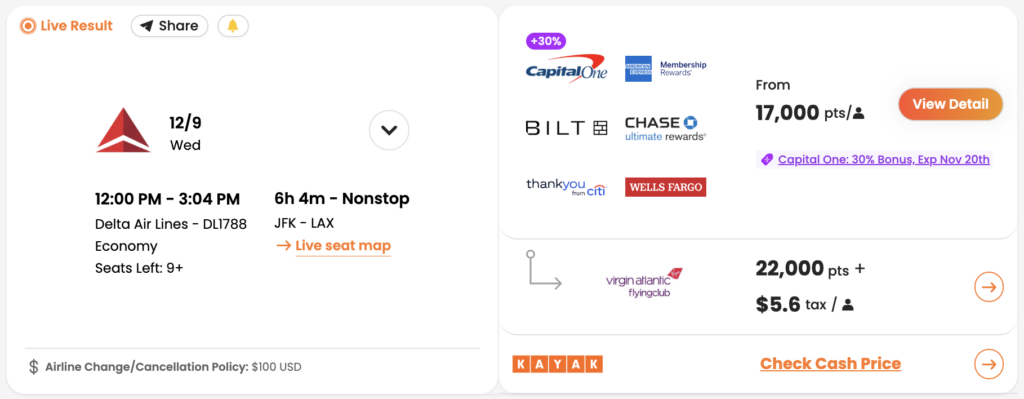
Los Angeles to New York on Delta
Both Delta and Virgin Atlantic belong to the SkyTeam airline alliance, and because of this, you can use Virgin points to book Delta flights and vice versa.
Virgin Atlantic prices Delta awards according to a distance-based chart (and on a segment-by-segment basis). With a 30% transfer bonus, these flights now require quite a few fewer Capital One miles.
One example is a round-trip, cross-country ticket between New York (JFK) and Los Angeles (LAX). If you take the nonstop in each direction, you’ll pay 44,000 Virgin points plus $5.60 in taxes each way.
That works out to about 33,900 Capital One miles with the current transfer bonus.
POINTSYEAH
This won’t always be the cheapest way to get between these two big cities, but it’s one to keep in your back pocket nonetheless.
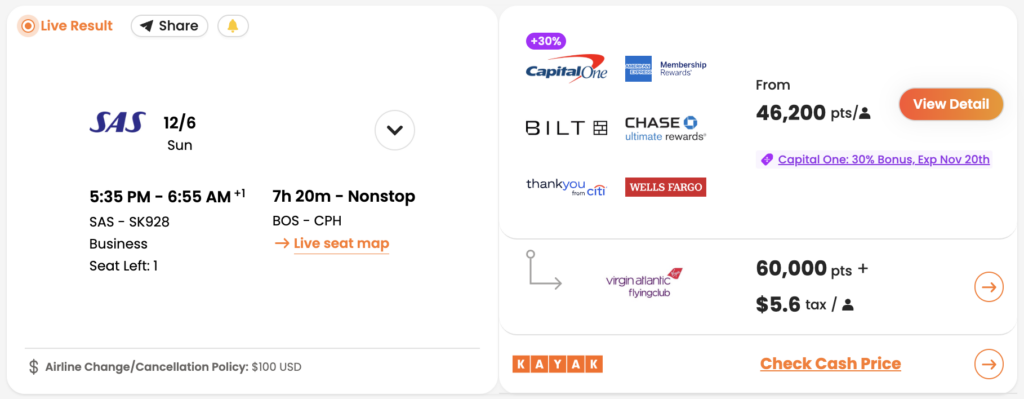
Nearly every day of the week (except Wednesdays), Scandinavian Airlines (SAS) flies between Boston (BOS) and Copenhagen (CPH).
In business class, these tickets cost 60,000 Virgin points each way, plus roughly $6 in taxes departing the U.S. or $95 departing Copenhagen. (Taxes and fees can vary if you’re flying from other Nordic countries to the U.S.)
POINTSYEAH
If you book a round-trip ticket between Boston and Copenhagen, you’ll redeem 120,000 Virgin points and pay roughly $100 in taxes and fees.
With the ongoing transfer bonus, the mileage component drops to about 92,400 Capital One miles for round-trip business class to Europe.
The Not-So-Obvious Redemptions
On the not-so-obvious side, we’ve got a few fun ways to redeem Virgin Atlantic Flying Club points that are made a little better with the 30% transfer bonus.
St. Vincent to Bridgetown on Virgin Atlantic
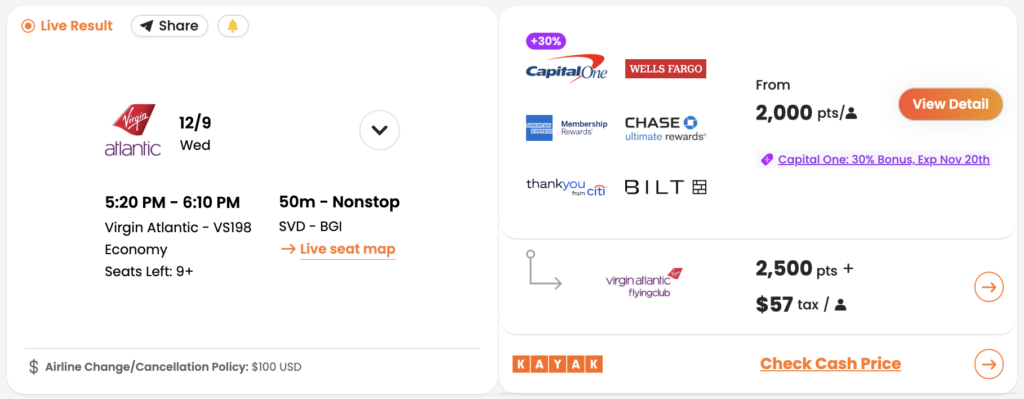
On Sundays, Wednesdays, and Fridays, Virgin Atlantic’s Airbus A330-300 makes a short, 50-minute hop between St. Vincent (SVD) and Bridgetown, Barbados (BGI).
If you’re using Flying Club points, you can only book economy, which costs 2,300 or 2,500 points plus about $50 in taxes and fees in either direction.
POINTSYEAH
These tickets don’t normally drop below $150 each way, so it’s a redemption worth keeping in mind if you’re planning an island-hopping trip around the Caribbean.
If you ended up booking a round-trip for 4,600 points total, you’d need to transfer just 3,600 Capital One miles with the current bonus.
Los Angeles to Papeete on Air France
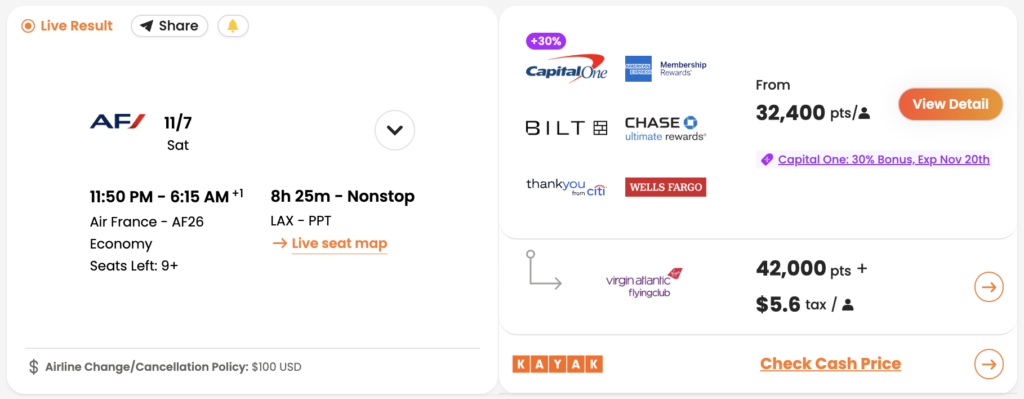
Air France flies a fifth-freedom route between Los Angeles (LAX) and Papeete, Tahiti (PPT), on Sundays, Tuesdays, and Thursdays through Saturdays using its Airbus A350-900.
Through Flying Club, you can book economy for 42,000 points each way (plus roughly $6 in taxes to Tahiti or $60 coming back).
POINTSYEAH
You can also book this flight through other programs that offer Air France award tickets. But if you book through Virgin Atlantic, you could fly round-trip from Los Angeles to Tahiti for about 64,700 Capital One miles and less than $100 in taxes with the current transfer bonus.
Toronto to Seoul on Korean Air
For this one, you might want to set a PointsYeah Points Price Alert because it’s a little hard to find unless you get lucky and stumble across availability.
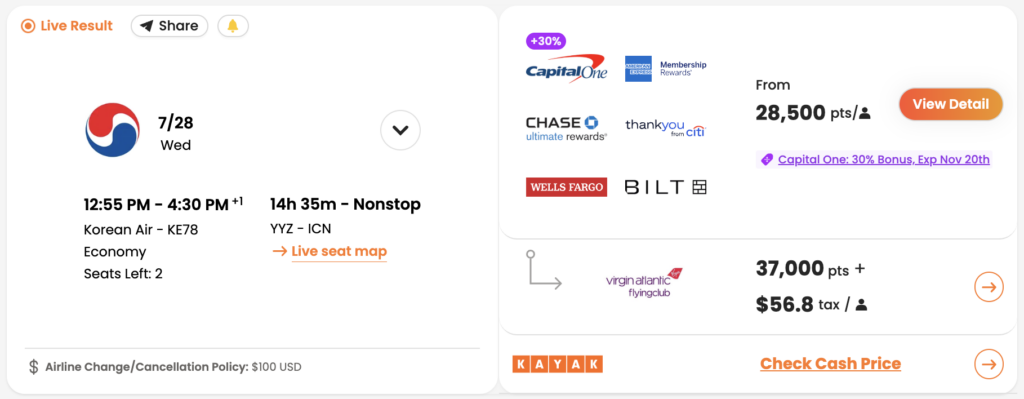
Every day, Korean Air flies its Airbus A350-900 between Toronto (YYZ) and Seoul (ICN). The trip takes roughly 15 hours each way, and Virgin Atlantic (when there’s space available) prices these awards in business class at 100,000 points per direction.
Taxes run about $56 westbound or $18 eastbound.
With the transfer bonus, you can book business class on this really long flight for about 77,000 Capital One miles each way.
Economy, though, is more widely available for 37,000 points per way (28,500 Capital One miles) plus the same taxes and fees.
POINTSYEAH
Earn More Capital One Miles With These Cards
Inspired but short on Capital One miles? Consider these two cards to boost your balance — and click “Learn More” for additional details.
You’ve been sending in questions, and this week I’m answering four of them. (Three of you also wrote in just to say you share my last name, which I appreciate, because there aren’t many of us.)
We’ve got a family of five headed to Madrid, a question about overlapping Delta and Amex benefits, my take on using points for hotels versus flights, and a quick one on Atmos credit cards.
Flying a Family to Europe on Points
A reader asks: “I have a family of 5, and we’re hoping to travel from Washington State to Madrid next May to visit family. I’m a beginner when it comes to maximizing rewards points. My husband and I both have a Chase Sapphire Preferred, but are hoping to take advantage of a welcome bonus to make our flight as affordable (dare I even say, comfortable?) as possible. Should I be looking at a general travel credit card with a good welcome bonus, or an airline credit card specific to our route? We have 3 little kids (4, 2, and 6 months) so we don’t travel frequently.”
I’d start with the number of seats you’ll have to book. Your 2-year-old needs a seat, and your youngest will still be under 2 next May, so you’re looking at four seats plus one lap infant (a baby under 2 who flies on your lap instead of in their own seat).
From there, a few things come to mind:
Account for the points you already have. If you’ve built up a decent balance of Chase Ultimate Rewards points between your two Sapphire Preferred cards, see what you can book before applying for anything else. PointsYeah is great for this, and you can filter results to show only flights bookable with Chase points.
Look for a program with reasonable lap infant pricing. Personally, I’ve been a fan of Air Canada Aeroplan for several years for this very reason. On international award tickets, a lap infant costs 2,500 points or CAD 25 each way, and you can usually add the baby online. Taxes and fees on Aeroplan awards can be reasonable, too.
Consider Atmos Rewards. This isn’t a Chase transfer partner, but Alaska Airlines’ loyalty program recently changed its lap-infant policy. On long-haul international award bookings, lap infants now cost only the applicable international taxes, although you’ll need to call to add the baby. You can also join the free Atmos Rewards “Families on the Go” community and get 20% of the points redeemed for children 12 and under back after your trip. (You can belong to only one community at a time.)
Look beyond Seattle. If you’re not finding much from Washington State, check Portland or San Francisco, too. Flying or driving to another airport to start your trip is called “positioning,” and it can open up additional options.
Don’t rule out paying cash. Sometimes the cash fare is competitive enough that using points isn’t the best deal. Depending on your card, you may be able to redeem points toward a travel portal booking or use them to offset a travel purchase.
The next question is whether another credit card would help.
Say you find flights you want to book through Aeroplan but don’t have quite enough points. You could look for a card with a welcome bonus that transfers to Aeroplan (lots do) and use it to top up your balance.
An airline-specific card could work, too, but those points generally aren’t as versatile. And depending on the ticket you book, you might not even need some of the card’s benefits (like a free checked bag, if your fare already includes one).
So, I’d start with transferable points, find the flights you want, and work backward from there. You could even consider buying the remaining points outright if the math works.
OZGYRCANKAYA / ISTOCK
Delta Reserve and Amex Platinum: Where the Benefits Overlap
A reader asks: “Is it worth having both the Delta SkyMiles Platinum Reserve and the Amex Platinum Card? There is a fair amount of crossover. If not, what would be the best balance?”
First, tally the cost. Between the Delta SkyMiles Reserve ($650) and the Amex Platinum ($895), you’re paying $1,545 in annual fees.
There’s definitely some overlap, but each card also offers benefits the other doesn’t.
Delta Sky Clubs: This is probably the biggest crossover. The Reserve gets 15 visits per Medallion Year, while the Platinum gets 10, so holding both gives you 25. The Amex Platinum requires a same-day Delta-operated flight, while the Reserve also covers flights marketed by Delta under its own flight number. Reserve cardholders can unlock unlimited visits after $75,000 in calendar-year spending.
Centurion Lounges: Both cards offer access, although the Reserve requires you to book your Delta flight with the card. The Amex Platinum doesn’t have that restriction.
Overlapping credits: Both cards offer Resy credits (up to $400 annually on the Platinum and $240 on the Reserve), along with Global Entry/TSA PreCheck credits. There’s also $200 in Uber Cash on the Platinum and $120 in rideshare credits on the Reserve. Some benefits require enrollment.
Only on the Reserve: An annual companion certificate after renewal, $2,500 in Medallion Qualification Dollars each year (a head start toward Delta status), 15% off eligible Delta award flights, a free first and second checked bag, and a $200 Delta Stays credit.
Only on the Amex Platinum: 5X points on flights booked directly with airlines, up to $600 in lodging credits, Priority Pass and access to a wider lounge network, plus credits for CLEAR+, digital entertainment, Lululemon, Walmart+, and more. Membership Rewards points can also transfer to a variety of airline (and hotel) programs, not just Delta. Some benefits require enrollment.
All that to say, there’s a case for keeping both cards, and just as much of a case for keeping one and pairing it with something else.
I’d look at which benefits you actually use, rather than trying to assign value to every credit on paper. The risk is paying for two expensive cards without getting enough out of them to justify the annual fees.
Card Points for Hotels or Flights?
A reader asks: “Do you use card points for hotel stays, or do you prefer to use points for airlines only?”
Personally, the only card points I typically use for hotel stays are those I earn through co-branded hotel cards (either from spending or a welcome bonus).
And there are plenty of reasons to keep a co-branded hotel card around, at least for brands you stay with somewhat regularly. Lots of hotel cards with annual fees offer some form of annual free night award (although some require hitting a spending threshold first).
In most cases, I find that free night is worth more than the card’s annual fee, even before factoring in benefits like complimentary elite status.
When it comes to transferable credit card points, though, I almost always use them for flights.
I’ll either transfer them to an airline loyalty program or — particularly with Capital One — book through the travel portal and then use points to cover the charge once it posts.
Here’s why.
With some exceptions, transferable points programs offer hotel and airline transfers at the same 1:1 ratio. But I generally get more mileage (and save more out of pocket) by transferring points to airlines, then paying cash for hotels or buying hotel points when they’re on sale.
For example, it’s pretty common to find Hilton or IHG points on sale for around half a cent each.
If I have a transferable credit card point worth at least 1 cent toward travel, why would I exchange it for a hotel point I could buy for half a cent?
There are exceptions, of course, but that’s generally how I approach it.
InterContinental Yokohama Pier 8. IHG
Does a Second Atmos Card Mean Another Hard Pull?
A reader asks: “If I apply for another Atmos card, will they do another hard pull from my credit report?”
Yes, I’d expect another hard inquiry.
Each Atmos card requires a separate Bank of America application, and Bank of America’s own credit guide identifies credit card applications as hard inquiries. These can temporarily lower your credit score by a few points.
Holding one Atmos card doesn’t prevent you from getting another, and you can potentially earn the welcome bonus on each.
Just keep Bank of America’s commonly reported 2/3/4 rule in mind. Generally, that means no more than two new Bank of America cards in 30 days, three in 12 months, or four in 24 months (for personal cards).
And remember, approval isn’t guaranteed. Bank of America’s pre-qualification tool uses a soft credit check, but being pre-qualified doesn’t necessarily mean you’ll be approved.
If you’re considering the Summit (a card quite a few of us on the PointsYeah team admire), you can find the current offer below.
If you’re chasing Delta Medallion Status next year, the targets aren’t going to move.
A Delta spokesperson confirmed to Points Insider that the airline doesn’t plan to change its qualification requirements, meaning MQD thresholds for the upcoming Medallion Year will remain the same.
How Many MQDs Do You Need for 2028 Status?
Delta awards Medallion Status based on the Medallion Qualification Dollars (MQDs) you earn during the previous calendar year. That means your 2027 activity will determine your status for the 2028 Medallion Year.
Here’s how much you’ll need to earn to qualify:
Medallion Tier
MQDs Needed
Silver Medallion
$5,000
Gold Medallion
$10,000
Platinum Medallion
$15,000
Diamond Medallion
$28,000
Delta has held these thresholds since its 2023 loyalty program overhaul, when it moved to MQD-only qualification and subsequently lowered its proposed requirements following pushback from members.
How You Earn MQDs Today
Under Delta’s current rules, you earn $1 MQD per $1 spent on eligible Delta-marketed flights, excluding government taxes and fees. Eligible Delta Vacations packages also earn MQDs, while Delta Main Basic (Basic Economy) fares don’t.
Select Delta SkyMiles American Express Cards offer a $2,500 annual MQD Headstart, plus additional MQDs through everyday spending.
MQDs don’t roll over, so your balance resets to zero on or about January 1 each year, regardless of how far past a status threshold you finish.
Delta Is Bucking the Trend
Delta’s biggest competitors, meanwhile, are making changes to their loyalty programs.
If you have JetBlue Mosaic status, you’ll soon have a shot at bumping to a seat up front.
In its announcement of loyalty program changes for 2027, JetBlue led with news that members at every Mosaic level (plus one companion on the same reservation) will be eligible for complimentary, space-available upgrades to BlueFirst.
That’s new territory for JetBlue, which hasn’t had a domestic first-class cabin to upgrade into until now.
Upgrades begin with the arrival of JetBlue’s first BlueFirst-equipped aircraft, with the inaugural flight scheduled for December 8, 2026.
Most of the other TrueBlue changes (there are plenty, so buckle up) take effect February 1, 2027.
How Will BlueFirst Upgrades Work?
To potentially score an upgrade, you’ll need to be booked on a Main, Main Flex, EvenMore, or EvenMore Flex fare, including award tickets booked with TrueBlue points or Cash + Points.
Main Base and EvenMore Base fares don’t qualify.
You’ll be added to the upgrade list automatically at check-in, and upgrades start clearing 60 minutes before departure.
The list is ranked by Mosaic level (Mosaic 4 first), followed by Premier Cardmembers without status. Within each group, paying with a JetBlue credit card moves you up the list, followed by purchasing an EvenMore fare and then the number of Tiles earned this year.
It’s upgrade-list voodoo if we’ve ever seen any.
Premier Cardmembers (including authorized users) are eligible even without Mosaic status, provided they pay for the flight with their JetBlue Premier Card.
A companion upgrade requires a second open seat, and reservations with three or more travelers aren’t eligible. An upgrade gets you the BlueFirst seat and onboard service, but not pre-departure perks like the larger checked bag allowance.
But if you have status or a co-branded card, you’ll get some of those perks anyway, regardless of where you’re sitting.
Move to Mint Certificates Get a New Name
Move to Mint certificates are becoming Premium Upgrade Certificates, which can confirm an upgrade to either Mint or BlueFirst. The number required varies by cabin and distance.
Starting February 1, Mosaic 2 members can select one through Perks You Pick. Mosaic 3 and 4 members will continue receiving them automatically, and Mosaic 4 members will earn two more for every additional 100 Tiles.
SPONDYLOLITHESIS / ISTOCK
New Perks for Premier Cardmembers
Primary Premier Cardmembers who reach Mosaic 3 or 4 can choose a companion statement credit of up to $500 or $1,500, respectively, toward an eligible companion’s base fare.
Premier Cardmembers with Mosaic 3 or 4 status will also earn 5X total points at grocery stores and restaurants (the card’s standard 2X plus an extra 3X) on up to $50,000 in combined purchases each calendar year.
Depending on your Mosaic level, you can also gift Tiles or Mosaic status to another member.
Perks You Pick Gets More Flexible
You’ll be able to select the same perk again at later milestones rather than choosing each option only once. Just be sure to make your selection within 60 days of reaching a milestone.
Mosaic Level
Perks You Pick Options
Premier Card Exclusives
Mosaic 1 (50 Tiles)
10,000 points, 10-Tile Bonus, 10-Tile Headstart, or one BlueHouse pass
Gift a 10-Tile Bonus
Mosaic 2 (100 Tiles)
10,000 points, 10-Tile Bonus, 10-Tile Headstart, one BlueHouse pass, or one Premium Upgrade Certificate
Gift Mosaic 1 status
Mosaic 3 (150 Tiles)
20,000 points, 20-Tile Bonus, 20-Tile Headstart, one BlueHouse pass, or one Premium Upgrade Certificate
Gift Mosaic 2 status or up to $500 companion credit
Mosaic 4 (250 Tiles)
30,000 points, 30-Tile Headstart, one BlueHouse pass, one Premium Upgrade Certificate, gift Mosaic 3 status, or gift a year of BlueHouse
Up to $1,500 companion credit
To make room for the new benefits, JetBlue is retiring Mint Suite Priority, the $99 statement credit with select JetBlue cards, FoundersCard membership, and IHG status.
You can still select and use these perks through January 31, 2027.
The Pet Fee Waiver is also leaving the menu and becoming a standard perk at Mosaic 2.
BlueFirst debuts December 8 between Boston and Fort Lauderdale, and every route JetBlue has scheduled for December touches Fort Lauderdale.
More routes will phase in through April. JetBlue plans to add BlueFirst across its non-Mint fleet, but for now, the cabin may only be available on select flights or dates.
Because Main and EvenMore award tickets are eligible for upgrades, searching for TrueBlue awards through PointsYeah is a quick way to see what those routes cost in points.
{{ search-widget mode=”flight” }}
But with four Mosaic tiers and Premier Cardmembers in the mix, the upgrade list could get pretty long on popular routes (there’s hardly an airline immune to this these days).
Naturally, that raises the question: How often will Mosaic 1 and 2 members clear an upgrade once BlueFirst is flying across more of the network?
New cardholders can earn 100,000 bonus points and a 25,000-point Global Companion Award after spending $6,000 on purchases within 90 days of account opening.
The card has a $395 annual fee and comes with a ton of benefits that can prove useful for frequent travelers, status chasers, and anyone looking to earn (and redeem) a useful airline rewards currency.
What Can You Do With Atmos Rewards Points?
Atmos Rewards is the shared loyalty program of Alaska Airlines and Hawaiian Airlines. Points are redeemable for flights on both carriers, Oneworld airlines (such as American Airlines and British Airways), and other partners.
Of all the ways to redeem Atmos Rewards points, a few stand out. These include short-haul domestic and international flights starting at 4,500 points, business class flights from the U.S. to Europe starting at 45,000 points, and more.
The Summit card’s welcome bonus could cover quite a few of those shorter flights or help unlock some of the longer, more expensive ones. Plus, the card waives partner award booking fees, which would otherwise cost $20 per person.
On the ground, points can also be transferred to hotel loyalty programs, including Marriott Bonvoy and Shangri-La Circle, or shared for free with up to 10 other Atmos Rewards members.
What Else Does the Atmos Rewards Summit Card Offer?
Beyond the welcome bonus, the Summit card has several ongoing benefits.
3X points: On eligible dining, purchases made outside the U.S., and Alaska Airlines and Hawaiian Airlines purchases. All other purchases earn 1X.
10% points bonus: On points earned from purchases if you have an eligible Bank of America or Merrill account.
Annual companion awards: A 25,000-point Global Companion Award each account anniversary, plus a 100,000-point award after $60,000 in purchases during a card anniversary year. These awards cover up to their respective point values toward a companion’s ticket when booking award travel for two on the same itinerary.
Status points: 10,000 each account anniversary, plus 1 status point for every $2 spent.
Alaska Lounge passes: Two per calendar quarter, valid at Alaska Lounges only (not partner lounges).
Wi-Fi passes: Two single-flight Alaska Airlines Wi-Fi passes per quarter.
Free checked bag and Preferred Boarding: For you and up to six guests on the same reservation when you pay for the flight with the card.
20% back on inflight purchases: Food and beverages on Alaska Airlines and Hawaiian Airlines, plus Wi-Fi on Alaska Airlines.
Up to $120 TSA PreCheck or Global Entry credit: Once every four years.
No foreign transaction fees.
One thing to keep in mind is that the lounge and Wi-Fi passes expire at the end of each quarter. They don’t roll over if you don’t use them.
Who’s Eligible for the Welcome Bonus?
You can hold more than one Atmos Rewards credit card and potentially earn the welcome bonus on each. So having the Atmos Rewards Ascent or Atmos Rewards Business card doesn’t automatically prevent you from qualifying for the Summit’s offer.
However, Bank of America’s application restrictions still apply.
The issuer is known to impose a 2/3/4 rule, which generally limits approvals to two new Bank of America cards in 30 days, three in 12 months, and four in 24 months. These limits generally apply to personal cards rather than Bank of America business cards.
As always, approval isn’t guaranteed (and the pre-qualification tool isn’t always accurate), so you’ll want to review the offer’s eligibility terms before applying.
Starting January 1, 2027, you’ll need to book at least two nights at a Fine Hotels + Resorts (FHR) property to use the up to $300 semiannual hotel credit on the American Express Platinum and Business Platinum cards.
Amex has also given the benefit a new name. What cardholders previously knew as the $600 Hotel Credit is now the $600 Lodging Credit (to reflect the addition of eligible Airbnb Luxe stays).
The new restriction brings FHR in line with The Hotel Collection (Amex’s other hotel program), which already requires a minimum two-night stay.
What the Change Means for Your Remaining 2026 Hotel Credit
If you haven’t used your July-to-December hotel credit yet, there’s still time to book a one-night FHR stay under the existing rules.
According to Amex’s terms, eligible bookings must be processed by December 31 at 11:59 p.m. Central Time to count toward the second half of 2026.
And you don’t actually need to stay at the hotel before then. Amex’s FAQ confirms that travel can take place after the credit period ends.
The newly renamed Lodging Credit still provides up to $600 per calendar year, split into two $300 credits. One is available from January through June, and the other from July through December.
To use it, you’ll need to make an eligible prepaid (“Pay Now”) booking through Amex Travel. That includes Fine Hotels + Resorts and The Hotel Collection reservations made through AmexTravel.com, the Amex Travel App, or the number on the back of your card. Eligible prepaid Airbnb Luxe stays also qualify, although those have their own booking requirements.
Now, that two-night minimum might not sound like a particularly big deal, but it makes the credit considerably less useful for shorter stays, especially at more affordable FHR properties.
Take a hotel charging $300 per night. Today, you could book a single night and have the entire room rate covered by the credit. In 2027, you’d need to book two nights for $600, leaving you with $300 to pay out of pocket.
At a $700-per-night property, the credit currently covers about 43% of a one-night stay. With a two-night minimum, it would cover just 21% of the $1,400 total.
Granted, you’re getting another night in both examples. But if you only need somewhere to stay for one night, that doesn’t necessarily do you much good.
Airbnb Luxe Is Another Way to Use the Credit
Amex and Airbnb have announced a new partnership that brings more than one million Airbnb listings to Amex Travel.
Eligible cardholders can now book these properties through AmexTravel.com or the Amex Travel App and earn Membership Rewards points on prepaid reservations. Platinum and Business Platinum cardholders earn 5X points, while most other Membership Rewards-earning cards earn 2X.
But there’s an important distinction. While more than one million Airbnb listings are available through Amex Travel, only eligible Airbnb Luxe properties qualify for the $600 Lodging Credit.
Phoenix Mountain Cabin & Spa. AIRBNB LUXE
Airbnb Luxe is a collection of high-end homes available through Airbnb. According to the company, Luxe properties account for less than 1% of its listings globally, and each undergoes an in-person walkthrough before receiving the designation.
There’s another new perk, too. Platinum and Business Platinum cardholders who book a qualifying prepaid Airbnb Luxe stay through Amex Travel can unlock up to $250 in statement credits annually toward eligible Airbnb Experiences.
Once the Luxe booking is confirmed, cardholders can use their Platinum card to purchase eligible Experiences directly through Airbnb and receive statement credits through the end of that calendar year. Experiences that redirect you to certain third-party platforms for payment aren’t eligible.
Unlike the Lodging Credit, the Experiences credit isn’t split into two semiannual periods.
Fine Hotels + Resorts Benefits Aren’t Changing
Something to keep in mind is that the new two-night requirement applies to the Lodging Credit, not necessarily to Fine Hotels + Resorts bookings in general.
Amex’s separate FHR program terms, which offers benefits such as daily breakfast for two, a $100 credit toward eligible charges, and guaranteed 4 p.m. checkout, don’t specify a minimum stay.
Put differently, you can still book a one-night FHR stay and receive the usual program benefits. You just won’t be able to use your Platinum card’s Lodging Credit toward it beginning in 2027.
The $600 annual credit, its semiannual schedule, and the prepaid booking requirement aren’t changing, either.
For cardholders who regularly use the credit on one-night FHR stays, though, this is a reduction in flexibility. And if you’ve still got a 2026 credit to use, it’s worth keeping the upcoming change in mind before making your next reservation.