Tag: Editor’s Pick

PointsYeah admin tags

  • Amex’s Newest Centurion Lounge Takes Its Cues From Amsterdam

    Amex’s Newest Centurion Lounge Takes Its Cues From Amsterdam

    American Express is bringing a Centurion Lounge to continental Europe for the first time.

    The 33rd Centurion Lounge opens Thursday, September 17, at Amsterdam Airport Schiphol (AMS). It’s in the airport’s non-Schengen zone between Concourses E and F. And the entryway is just up the stairs near the Lounge No. 50 sign.

    At nearly 6,000 square feet, Amsterdam is far from the largest Centurion Lounge in the issuer’s network. But after walking through the space ahead of its opening, it doesn’t feel quite as small as that number suggests.

    Tall ceilings and floor-to-ceiling windows bring plenty of natural light into the lounge, while the layout breaks the space into several distinct areas. There’s a dedicated coffee bar, dining area, full-service bar, and different types of seating across the lounge.
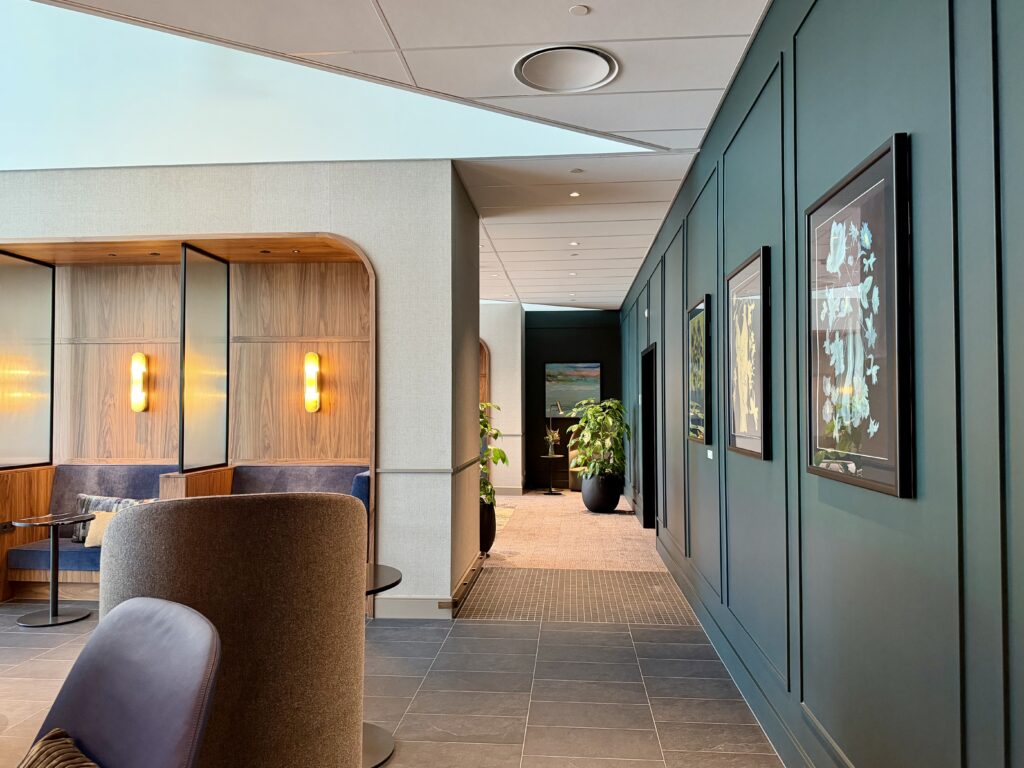
    Hallway at the Amex Centurion Lounge AMS.
    TYLER GLATT / POINTS INSIDER

    Amex also packed quite a bit of the Netherlands into the space.

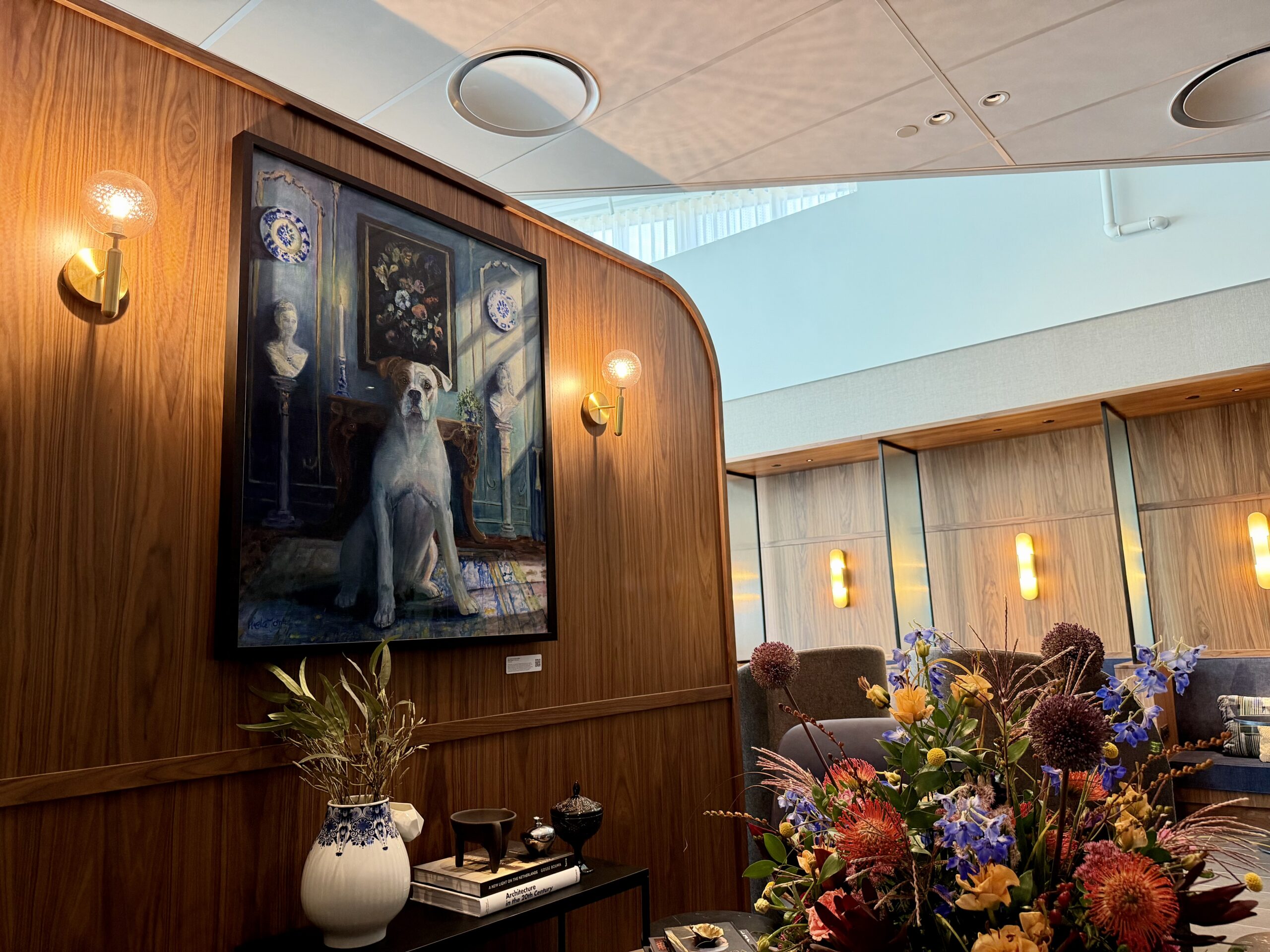
    There are deep greens and blues inspired by Amsterdam’s canals, Dutch florals, locally sourced coffee and tea, work from local artists, and a Delft-style version of Amex’s bulldog mascot.

    The goal, according to Vince Carbone, Amex’s director of global lounge design strategy, was to make the lounge distinctly Amsterdam without making the references too “on the nose.”

    That’s a pretty good description of what Amex built. It still looks and feels like a Centurion Lounge, but the Amsterdam influence is impossible to miss.

    Bringing Amsterdam Into a Centurion Lounge

    No two Centurion Lounges are designed to be exactly alike, and much of what distinguishes Amsterdam comes down to the details.

    The local references start near the entrance. A painting featuring Sir Charles Frosty Blue (Amex’s mascot, not Dutch royalty) incorporates Delftware and Dutch florals. Work from local artists lines the walls, while flowers and other references to the Dutch landscape decorate tables and shelves.
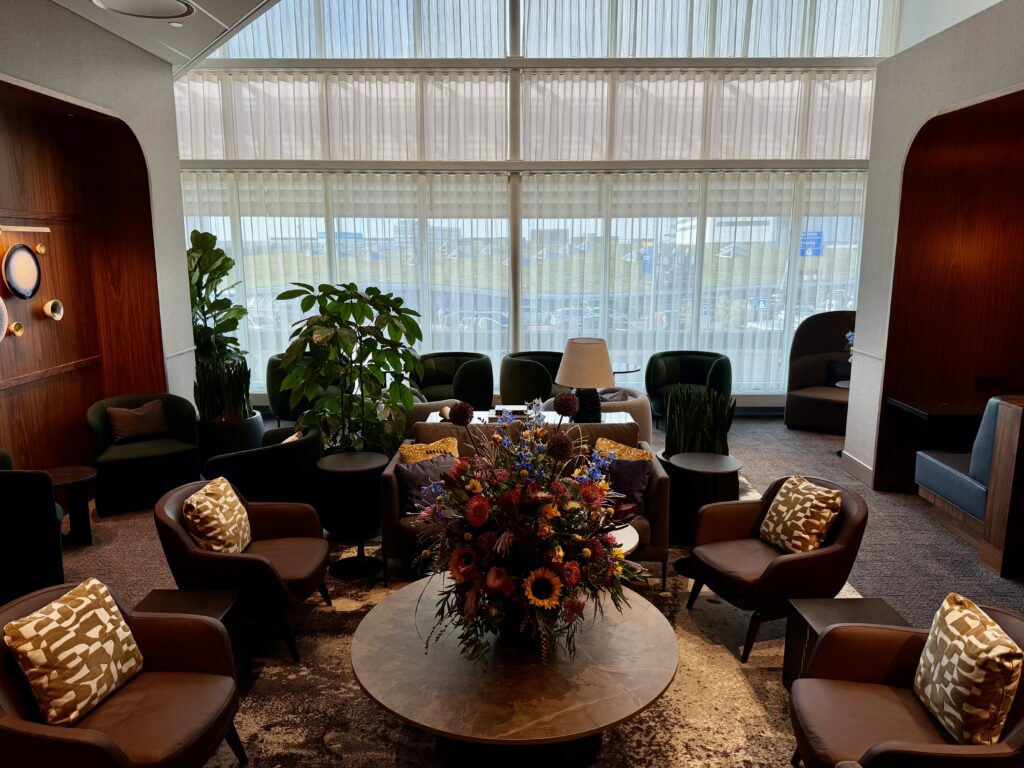
    Seating and foliage at the Amex Centurion Lounge AMS.
    TYLER GLATT / POINTS INSIDER

    Color plays an even bigger role.

    Deep greens and blues run throughout the space, inspired in large part by Amsterdam’s maze of waterways. Color blocking (which, I learned, is the practice of using distinct areas of color to define a space) also helps separate one part of the lounge from another without making each area feel disconnected.

    The ceiling is another integral part of the space, although it isn’t entirely an Amex creation. The lounge was built out of former office space, and the tall, angular ceilings were already there.

    Amex incorporated that existing architecture into the design. The triangular forms overhead add dimension, while the ceiling height and floor-to-ceiling windows help make the relatively compact lounge feel a lot more open.

    And perhaps a little more upscale.
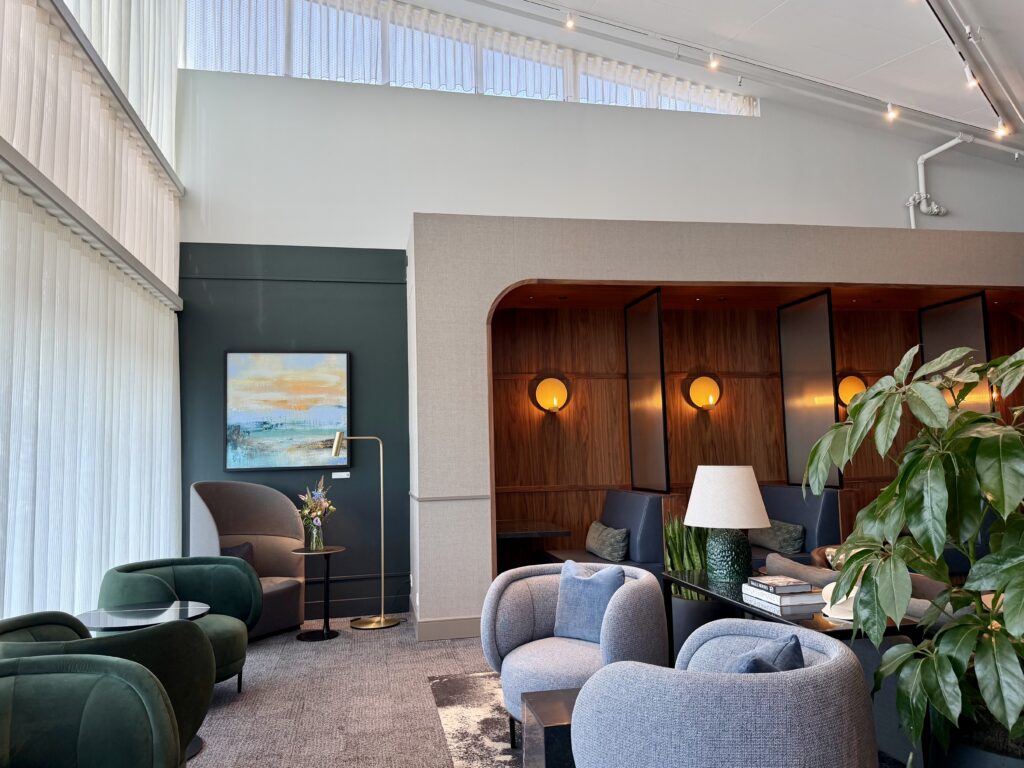
    Seating at the Amex Centurion Lounge AMS.
    TYLER GLATT / POINTS INSIDER

    Moving through the space takes you from general seating to the Blue Roast Coffee Bar, dining area, and eventually the main bar. Additional seating runs along the perimeter beside the windows.

    Then there are details that are easier to miss.

    For instance, Amex has made a habit of hiding a bulldog statue in its Centurion Lounges. Amsterdam’s version sits above the bar, rendered appropriately in Delft style.
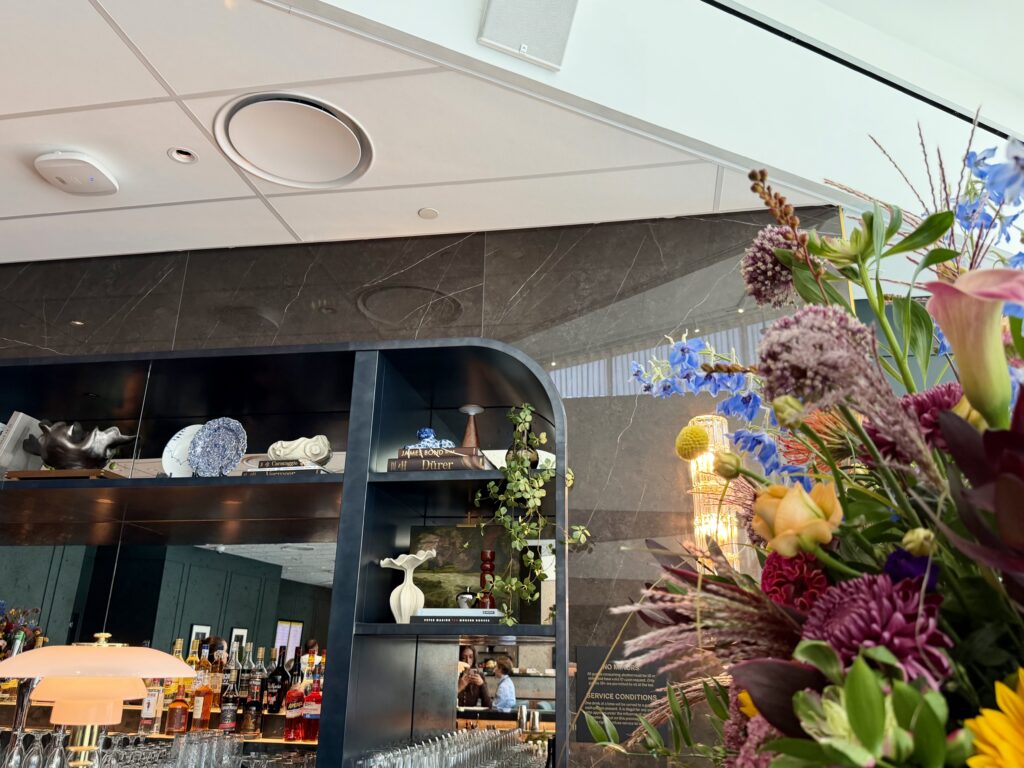
    Bar at the Amex Centurion Lounge AMS.
    TYLER GLATT / POINTS INSIDER

    Coffee Is Getting More Attention

    One of the most prominent parts of the lounge isn’t the traditional Centurion bar.

    It’s the coffee bar.

    Amsterdam is the fourth Centurion Lounge to feature Amex’s Blue Roast Coffee Bar, following Seattle, New York-JFK, and Salt Lake City. The branding carries over, but the coffee and tea are sourced locally and brewed fresh by a barista behind the counter.
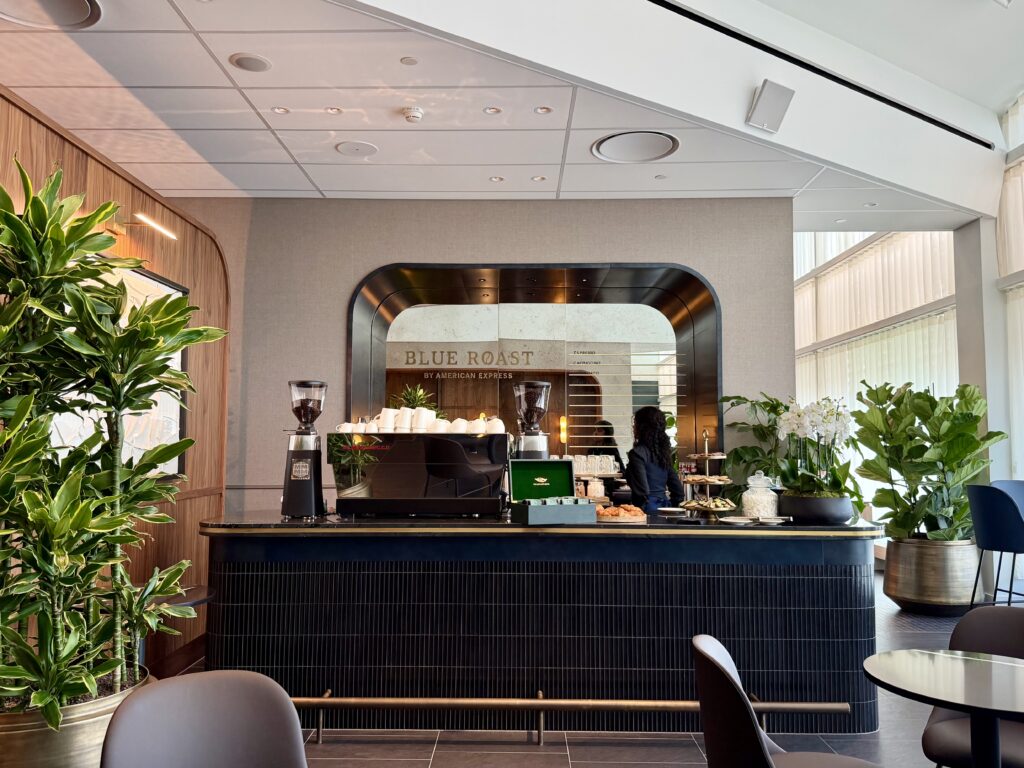
    Coffee bar at the Amex Centurion Lounge AMS.
    TYLER GLATT / POINTS INSIDER

    There’s also another reason Amex is putting more emphasis on coffee.

    The Global Lounge team said it’s seeing customers drink less alcohol and show more interest in coffee and nonalcoholic beverages. That’s beginning to influence what Amex prioritizes inside its lounges.

    The full-service bar isn’t going anywhere, and Amsterdam has one of those, too. But Blue Roast gets its own dedicated space rather than feeling like an extension of the dining area.
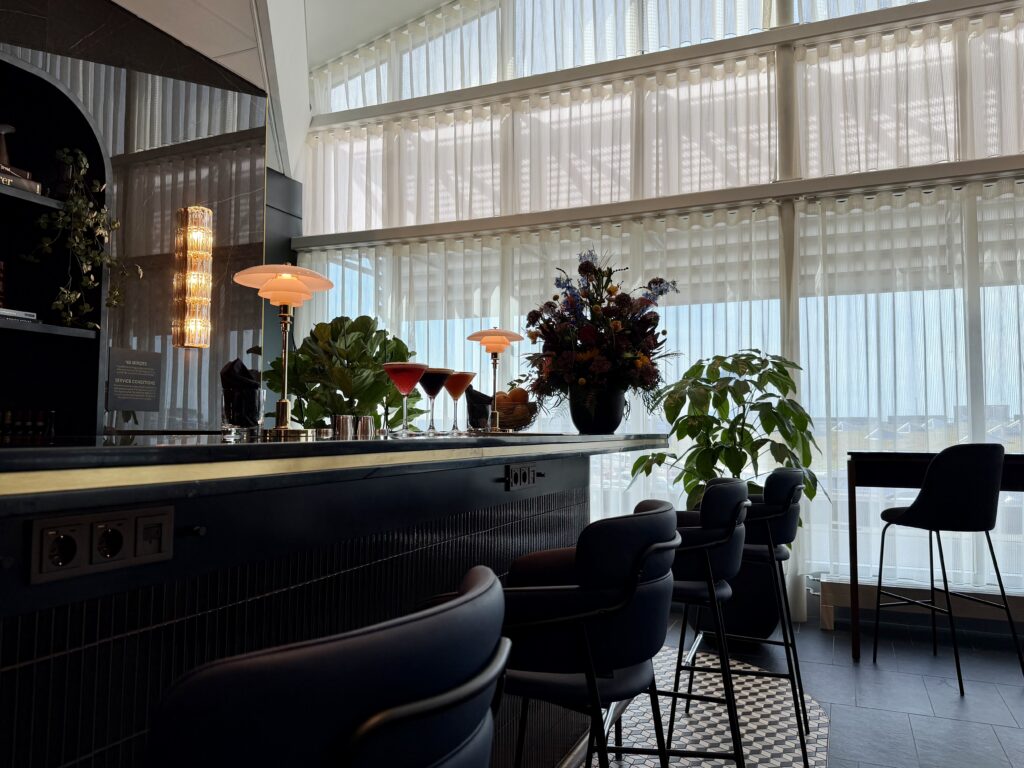
    Bar at the Amex Centurion Lounge AMS.
    TYLER GLATT / POINTS INSIDER

    Food is another important part of the Centurion Lounge experience. Amex even went so far as to call it a main draw.

    The Amsterdam menu mixes global and European flavors with Dutch staples, like bitterballen. Amex also mentioned herring and eel as examples of regional European dishes that will be served, although it wasn’t clear when or how often those will appear once the lounge opens.

    Some dishes are expected to rotate roughly every three weeks, while other staples will stay.

    Like the design itself, the food gives Amex another way to make the lounge feel connected to Amsterdam without changing the basic Centurion Lounge formula.
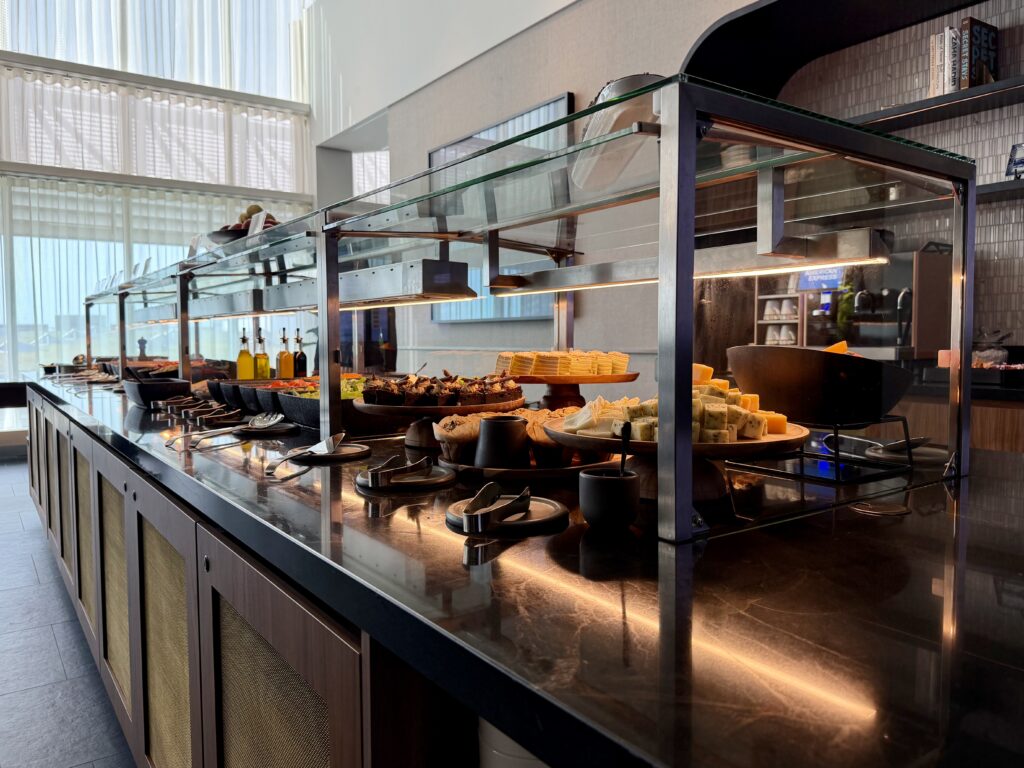
    Buffet at the Amex Centurion Lounge AMS.
    TYLER GLATT / POINTS INSIDER

    Making the Most of 6,000 Square Feet

    The Amsterdam lounge is noticeably smaller than some of the newer Centurion Lounges Amex has opened in the U.S.

    There’s a fairly simple reason for that. Airport real estate doesn’t grow on trees. And Amex’s team isn’t shy about saying that lounge development often comes down to what space an airport can make available.
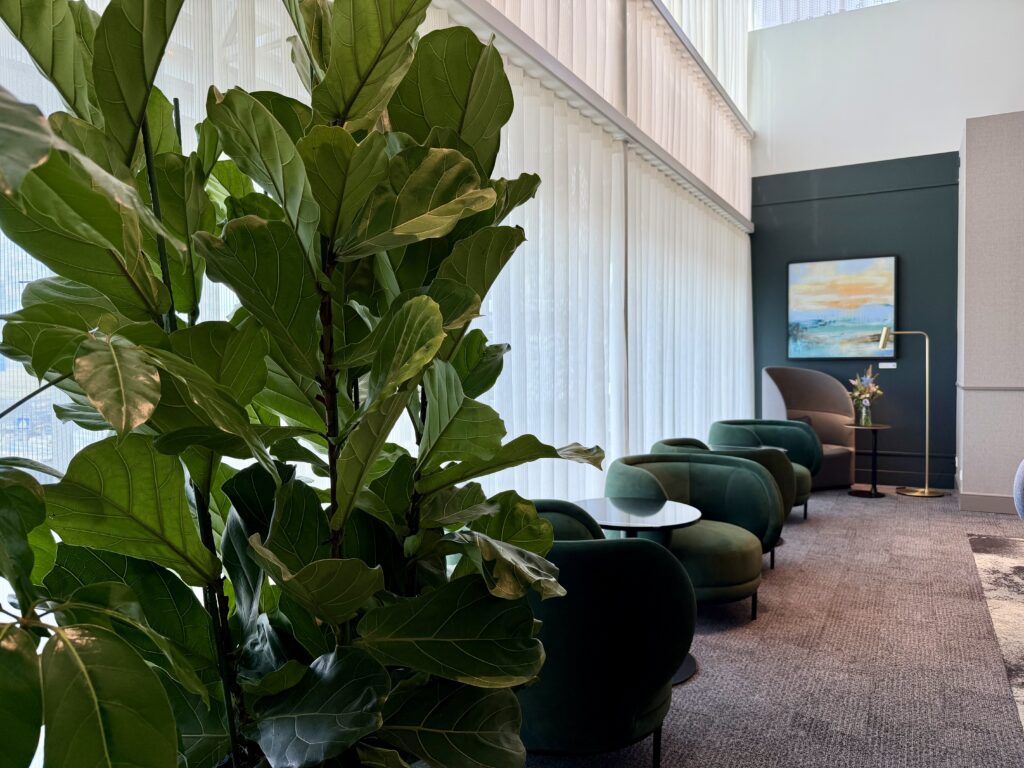
    Seating and foliage at the Amex Centurion Lounge AMS.
    TYLER GLATT / POINTS INSIDER

    At Schiphol, space is particularly hard to come by.

    The existing architecture ended up working in Amex’s favor. Instead of one large seating area, the lounge progresses through smaller spaces for seating, coffee, dining, and the main bar. Combined with the tall ceilings and natural light, the layout keeps the footprint from feeling compressed.

    Patrick McGinley, Amex’s director and design and construction program manager for Centurion Lounges, said the finished product turned out better than he originally expected.
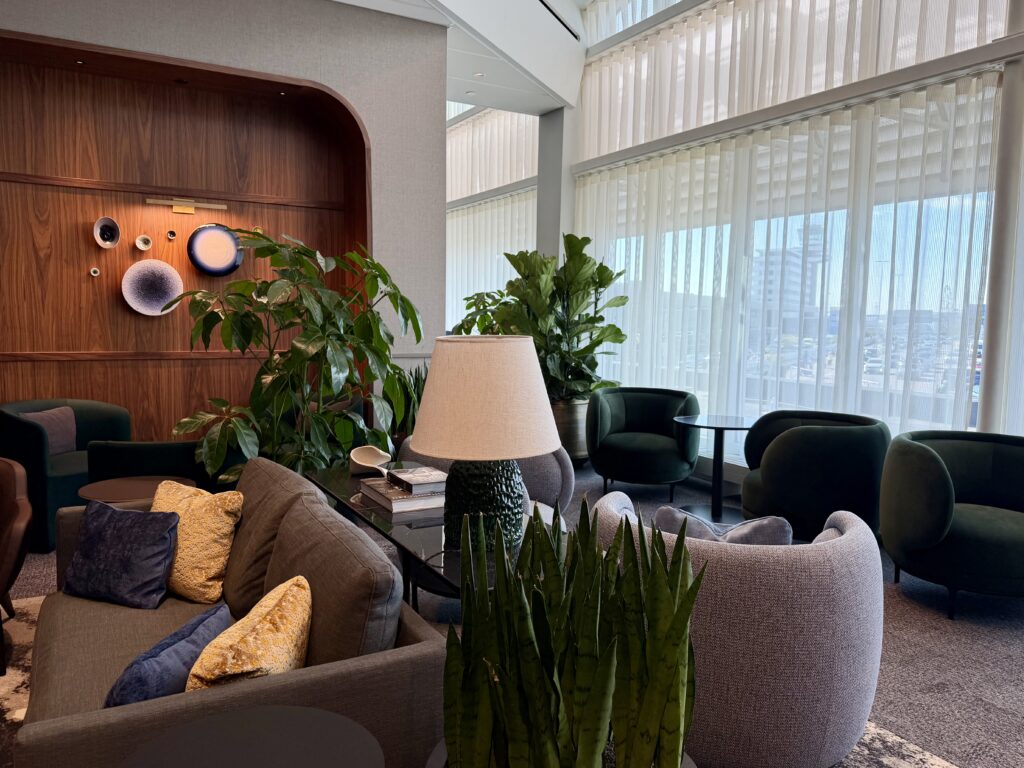
    Seating and foliage at the Amex Centurion Lounge AMS.
    TYLER GLATT / POINTS INSIDER

    Amex worked closely with Schiphol and Dutch partners to get the lounge built, and indicated that it expects to stay in touch with the airport if opportunities for additional space come along later.

    There’s nothing more concrete than that for now. But even ahead of the official opening, Amex isn’t ready to close the loop on what the lounge could eventually become.

    Why Amsterdam Makes Sense for Amex

    The opening is also another step in taking a Centurion Lounge network that has historically been concentrated in the U.S. farther abroad.

    Members of Amex’s Global Lounge team pointed to growth in the company’s international business and demand for lounges in more parts of the world.

    Schiphol is important both for people beginning trips in the Netherlands and for those passing through one of Europe’s biggest connecting hubs. Amex expects the lounge to draw a mix of U.S. and international Platinum Card Members, without a necessarily particular tilt toward either group.
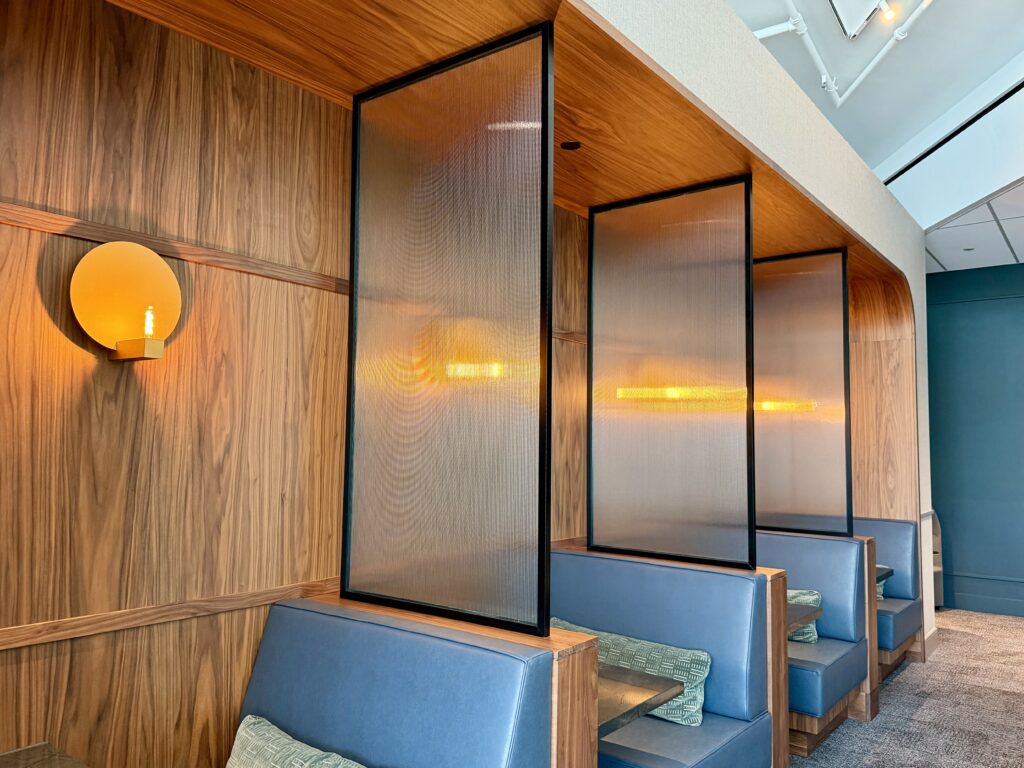
    Seating at the Amex Centurion Lounge AMS.
    TYLER GLATT / POINTS INSIDER

    There’s also a notable network effect from the U.S.

    Several major U.S. gateways with nonstop service to Amsterdam already have Centurion Lounges. Platinum Card Members have access to a much broader collection of lounges around the world through the American Express Global Lounge Collection, but Amsterdam extends Amex’s own Centurion brand farther along those trips.

    Someone leaving a U.S. gateway with a Centurion Lounge, such as Atlanta or New York-JFK, can now see that same Centurion logo again while passing through Schiphol, just as they can in London, Tokyo, and elsewhere.

    And at 33 locations, the network is pretty substantial in its own right. The Centurion Lounge footprint rivals or even exceeds the proprietary lounge networks of some airlines.

    But that doesn’t mean Amex is about to start opening lounges across Europe or the rest of the world at the same pace it has in the U.S.
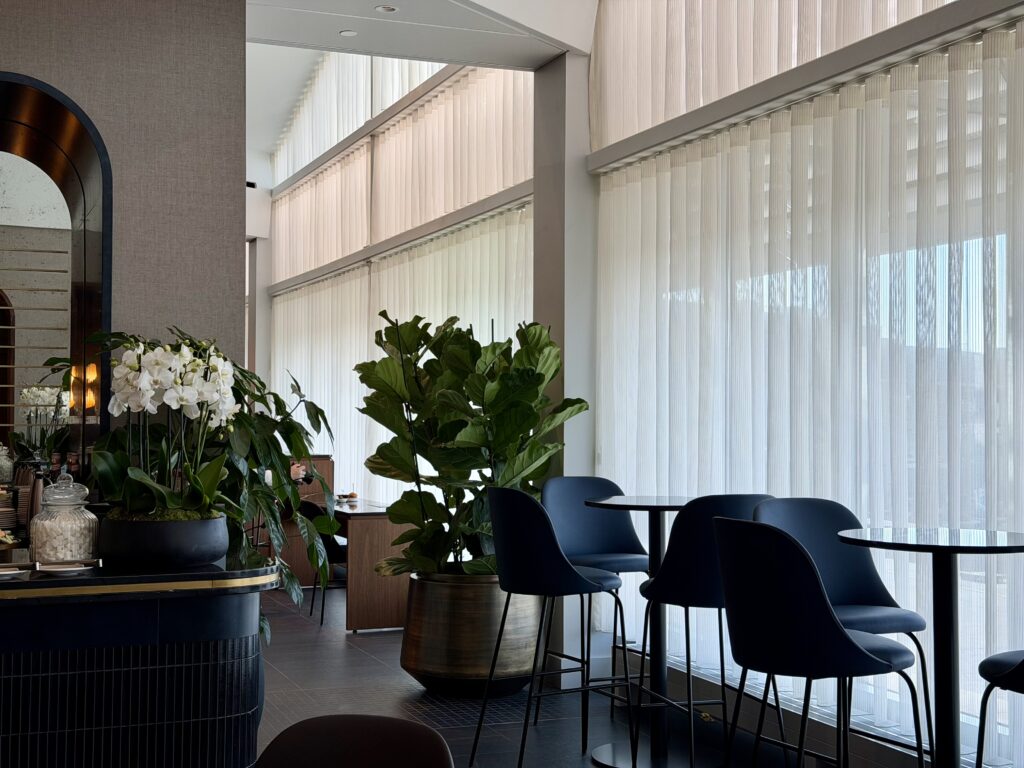
    Seating at the Amex Centurion Lounge AMS.
    TYLER GLATT / POINTS INSIDER

    The Global Lounge team was pretty careful on that point. International growth has made additional markets attractive, and there’s demand to put lounges in more places. Over the long term, some additional balance between the domestic and international network makes sense, but Amex isn’t looking to swing too far in either direction.

    Expansion isn’t the only focus, either. Lounges in Boston, Newark, and a Sidecar location in Charlotte are on the way, but Amex is also reinvesting in existing locations. Dallas Fort Worth, one of the older outposts in the Centurion network, is getting a revamped and larger lounge as part of that effort.

    That mix of new locations and updates to existing ones is shaping the network as it grows. And Amsterdam just happens to be the newest piece and the first in continental Europe.
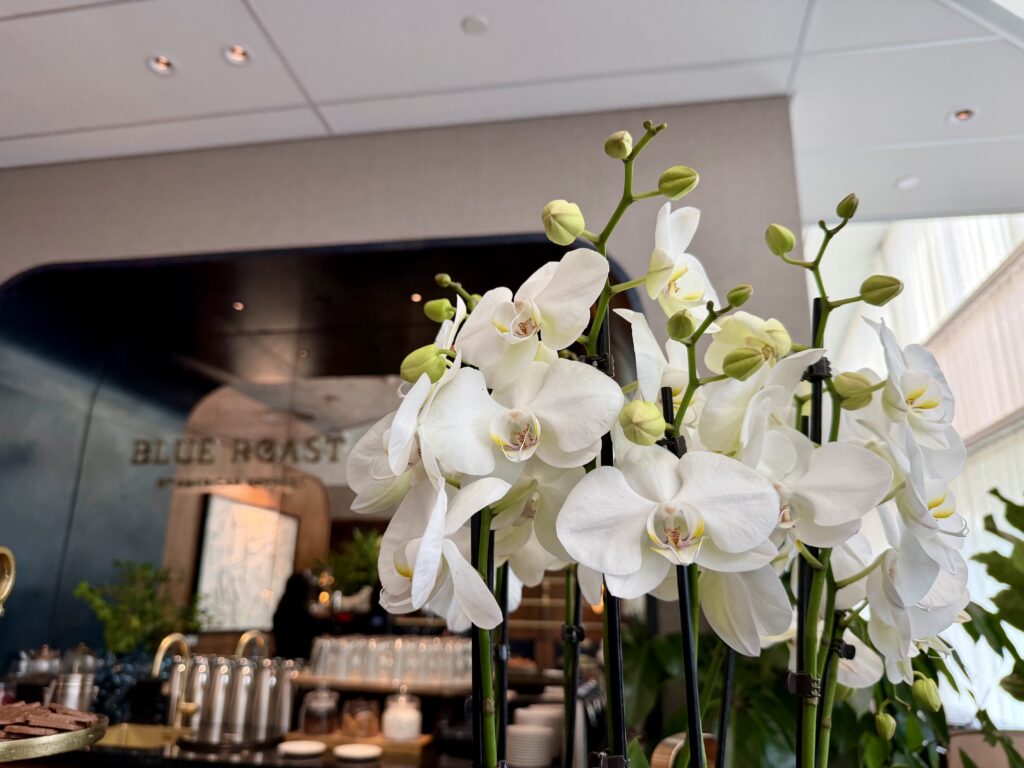
    Foliage at the Amex Centurion Lounge AMS.
    TYLER GLATT / POINTS INSIDER

    But for all the significance Amex places on the opening, the lounge itself isn’t trying particularly hard to make a statement about it. It’s still recognizably a Centurion Lounge. The Amsterdam part comes through in the colors, artwork, coffee, food, and little details scattered around the space.

    It’s distinctly Amsterdam, without being too on the nose.

  • Planning Fall and Winter Travel With Points? Here’s What to Do Now

    Planning Fall and Winter Travel With Points? Here’s What to Do Now

    Thanksgiving, Christmas, ski season, and that point in winter when somewhere warm starts sounding really good all have a way of feeling far away until suddenly they’re not.

    Now’s a good time to see what the options look like.

    That doesn’t mean there’s a magic deadline for booking. A flight that costs a ton of miles today could cost less next week. It could also cost more, and sometimes a great option pops up at the last minute. Award prices change, and there’s no reliable way to predict exactly when the best price will appear.

    But waiting isn’t the only option.

    Depending on the airline and the type of award, it may be possible to book a flight that works now and change it later if something better comes along. And if nothing looks good today, there are ways to keep an eye on the trip without searching for the same flights over and over.

    Here’s where to start.

    Start With the Trips You Know You’re Taking

    Thanksgiving with the family is a very different trip from a January ski weekend or escaping somewhere warm in February.

    For a holiday, wedding, or another event already on the calendar, start by looking at the options now. Someone who needs to fly the Wednesday before Thanksgiving and return Sunday has much less flexibility than someone who wants to spend a few days on a beach sometime this winter.

    Look at both the cash price and the number of points or miles required. That gives you a baseline, even if you’re not ready to book right this minute.

    More flexible trips open up more possibilities. A ski trip might work over several weekends. A warm-weather getaway might work in January or February. Try moving the dates, checking nearby airports, or looking at another weekend.

    PointsYeah makes it easy to scope out your options without starting a new search every time.

    {{ search-widget mode=”flight-hotel” }}

    And if the destination isn’t set either, let what’s available offer some inspiration.

    PointsYeah’s Daydream Explorer shows destinations that can be booked with points from a selected airport. Instead of searching for one place at a time, it can answer questions like, “Where could I go for a long weekend in January to escape the cold?” or “Where can I fly with my points for a ski trip this winter?”

    More on This: How to Use Daydream Explorer

    Found an Award? Check the Cancellation Rules

    Finding a flight that works doesn’t necessarily mean the search has to end.

    Some airline loyalty programs allow award tickets to be changed or canceled without a fee. That can make it possible to book a workable option now while keeping an eye out for something cheaper or more convenient.

    American Airlines is a good example. AAdvantage doesn’t charge change fees on award tickets, although changing to a more expensive award means paying the difference. American also allows eligible awards to be canceled before departure with the miles reinstated at no charge.

    Say a Christmas trip costs 25,000 miles today. A few weeks later, the same flight becomes available for 18,000 miles.

    Depending on the itinerary, it may be possible to change the ticket or cancel and rebook at the lower price.

    The trip stays the same, but 7,000 miles go back into the account.

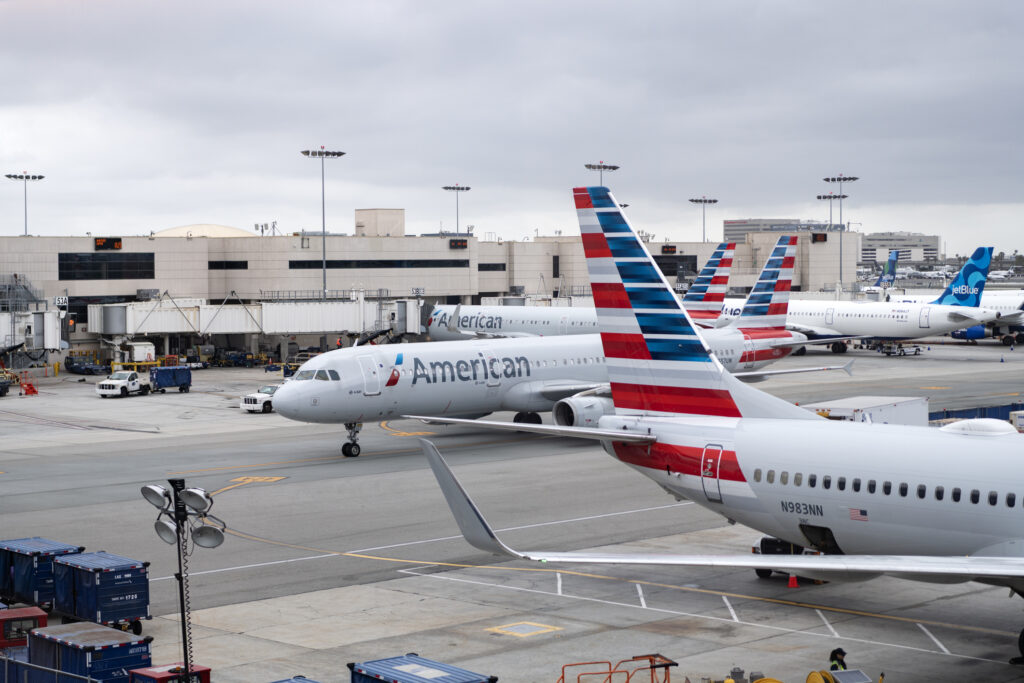
    Miami, Florida, USA - April 29, 2025: American airline. American airlines group plane departure in airport. Airport terminal. Plane arrival American airline. Departure and arrival airport terminal.
    PHOTOSVIT / ISTOCK

    But this is something to check before booking, because every loyalty program has its own rules.

    Delta, for example, treats Basic award tickets differently. Basic awards originating in the U.S. or Canada aren’t refundable after the 24-hour risk-free cancellation period, and changing or canceling one comes with a fee assessed in miles.

    Other programs have their own policies, and certain bookings can have additional restrictions.

    That flexibility can be especially useful for winter trips that aren’t completely settled. Maybe the ski weekend depends on snow conditions, or a warm-weather getaway could move by a few days. If that’s part of the plan, check the rules before booking rather than assuming an award can be changed later.

    Don’t Like the Price? Track It

    Sometimes there isn’t anything worth booking yet.

    Maybe the Christmas flight costs far more miles than expected. Maybe there’s nothing available for the ski weekend. Or maybe the only flight to somewhere warm leaves at 5 a.m. and connects twice.

    Waiting can make sense in those situations. But it doesn’t have to mean running the same search every few days.

    A PointsYeah Points Price Alert can track a trip and send an alert if the points price changes or something new becomes available.

    There’s no guarantee a better option will appear, but the alert can do the checking in the background.

    Keep an eye on the cash fare, too. If an award still costs more miles than expected but the cash ticket drops to a comfortable price, paying cash may make more sense.
    Points and miles are another way to pay for a trip. They don’t have to be used every time.
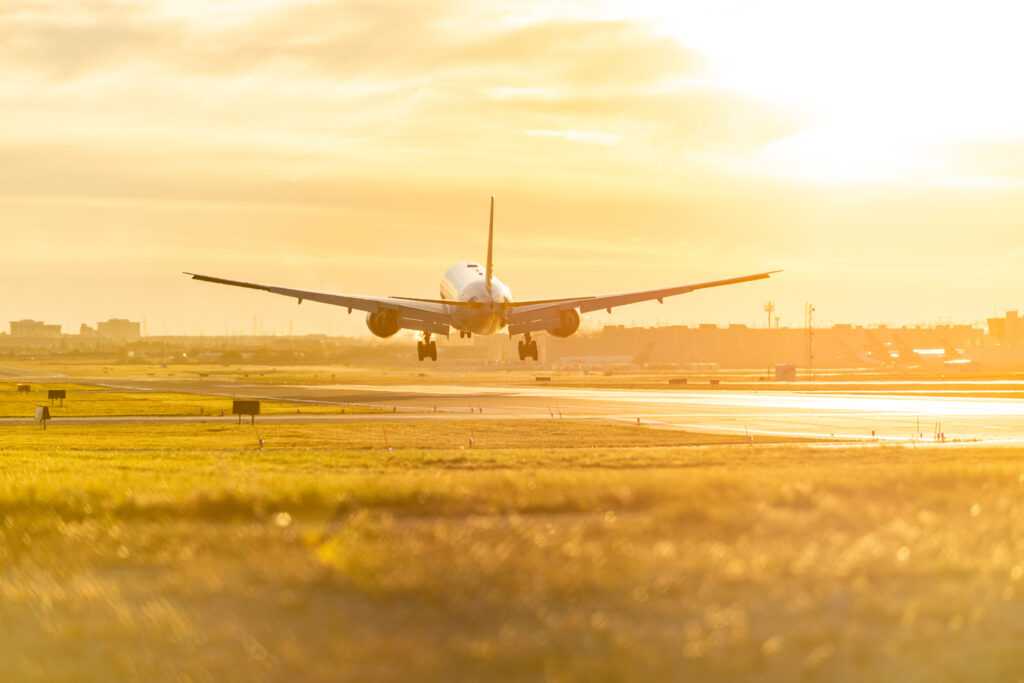
    Airplane preparing to land on the runway in Pearson International airport at dusk, Toronto,Canada.
    DORADALTON / ISTOCK

    Check the Hotel Before You Book the Flight

    A great flight deal can become a much less appealing trip once the hotel search begins.

    That’s especially important for fall and winter trips. College football games, parents’ weekends, Christmas markets, holiday events, ski season, and long weekends can make hotel rooms unusually expensive on certain dates.

    A cheap flight to a ski destination, for example, isn’t nearly as exciting if every hotel nearby costs $700 a night.

    Before booking a discretionary trip, check the hotel rates alongside the flights.

    The hotel might change which weekend makes the most sense. It can also change where points are most useful.

    For example, a reasonably priced cash flight paired with an expensive ski resort might be a good opportunity to save the airline miles and use hotel points instead. If hotel rooms at a warm-weather destination are inexpensive but flights are costly, the opposite might make more sense.

    There’s no need to pay for every part of a trip the same way. Points can cover the parts where they’re most useful, and cash can cover the rest.

    More on This: How to Search for Award Hotels with PointsYeah

    Know What the Options Look Like Now

    A Thanksgiving trip, Christmas vacation, ski weekend, and February escape don’t need to be planned the same way.

    Some trips come with dates that can’t move. Others might have an entire season to work with.

    Start with the trips already on the calendar and check both points and cash prices. For a more flexible getaway, see what happens when the dates or destination change. And before booking an award that might need to move, find out what the change and cancellation rules allow.

    If nothing works yet, that’s useful information, too. Set an alert and keep looking without having to start from scratch every few days.

    There’s no way to know today whether the best fall or winter award will appear tomorrow, next month, or a few days before departure. But knowing what the options look like now leaves plenty of time to decide whether to book, wait, or change the trip entirely.

  • American Rebuilt Its Boeing 777-300ER Around Its Premium Ambitions

    American Rebuilt Its Boeing 777-300ER Around Its Premium Ambitions

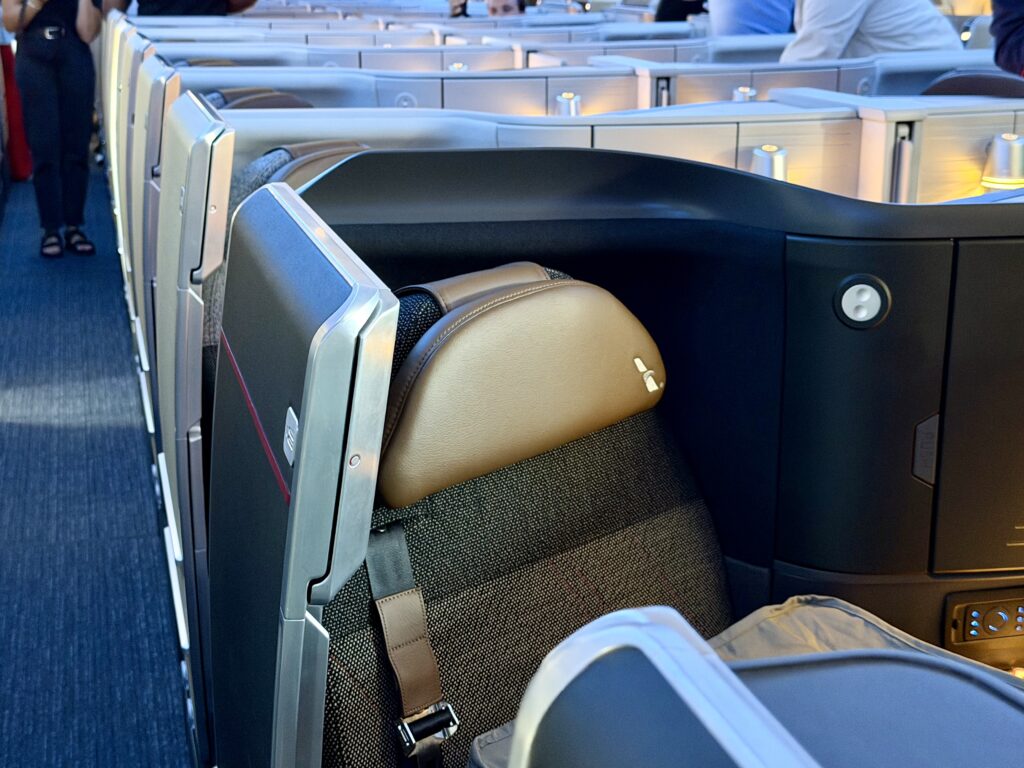
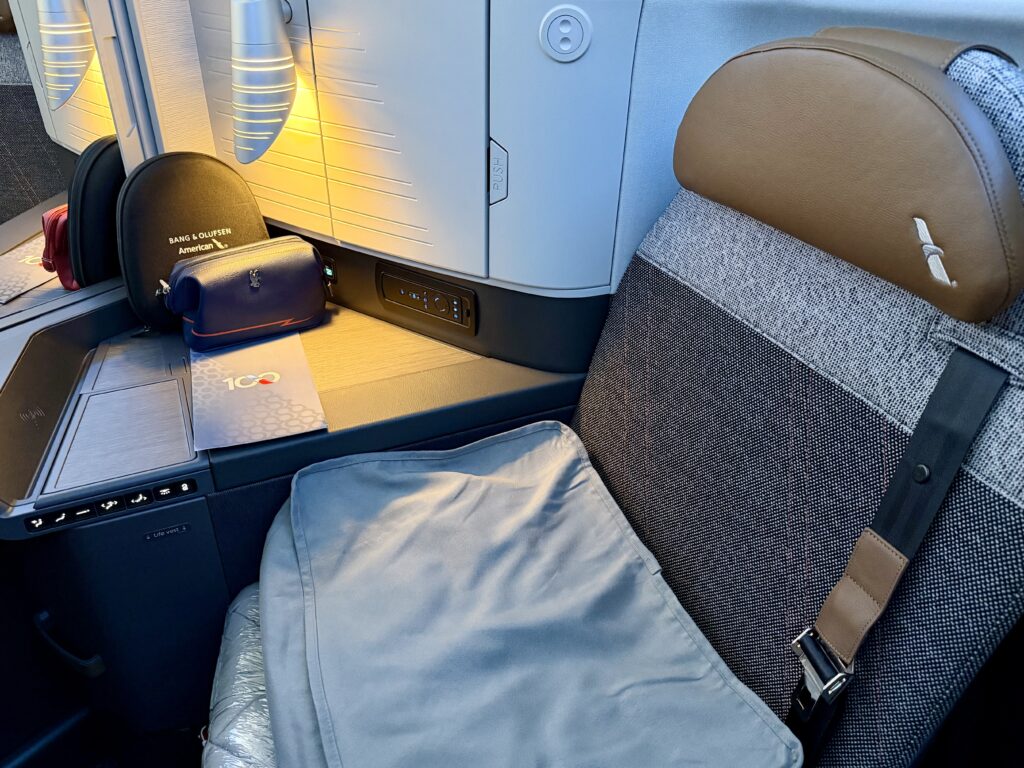
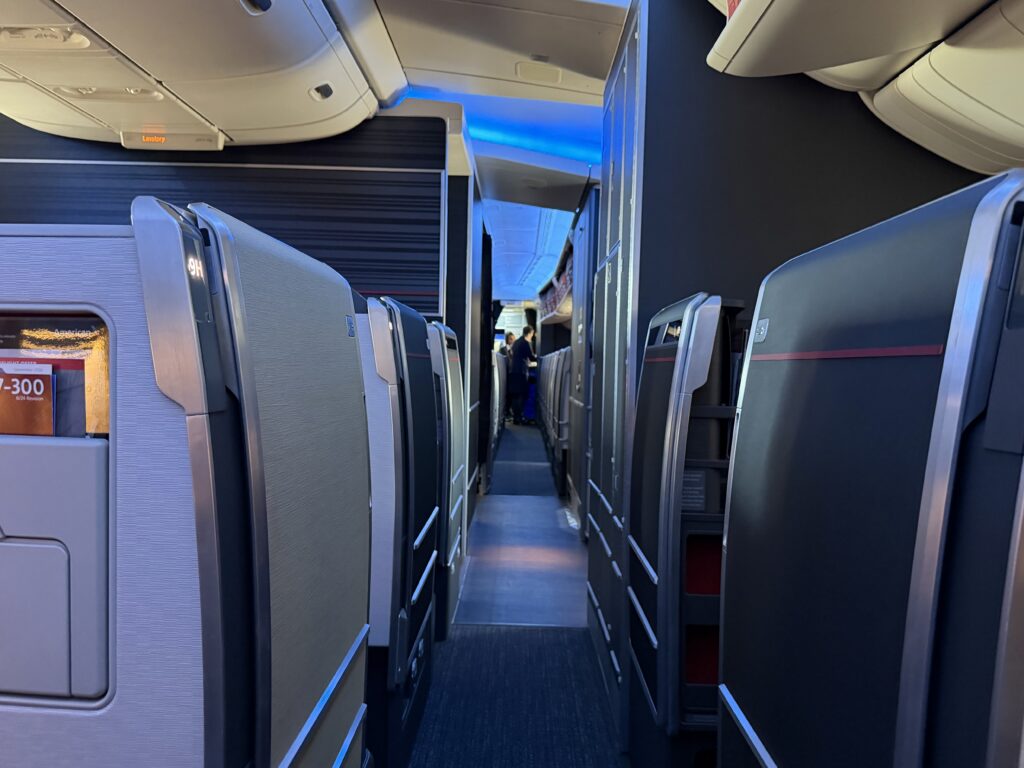
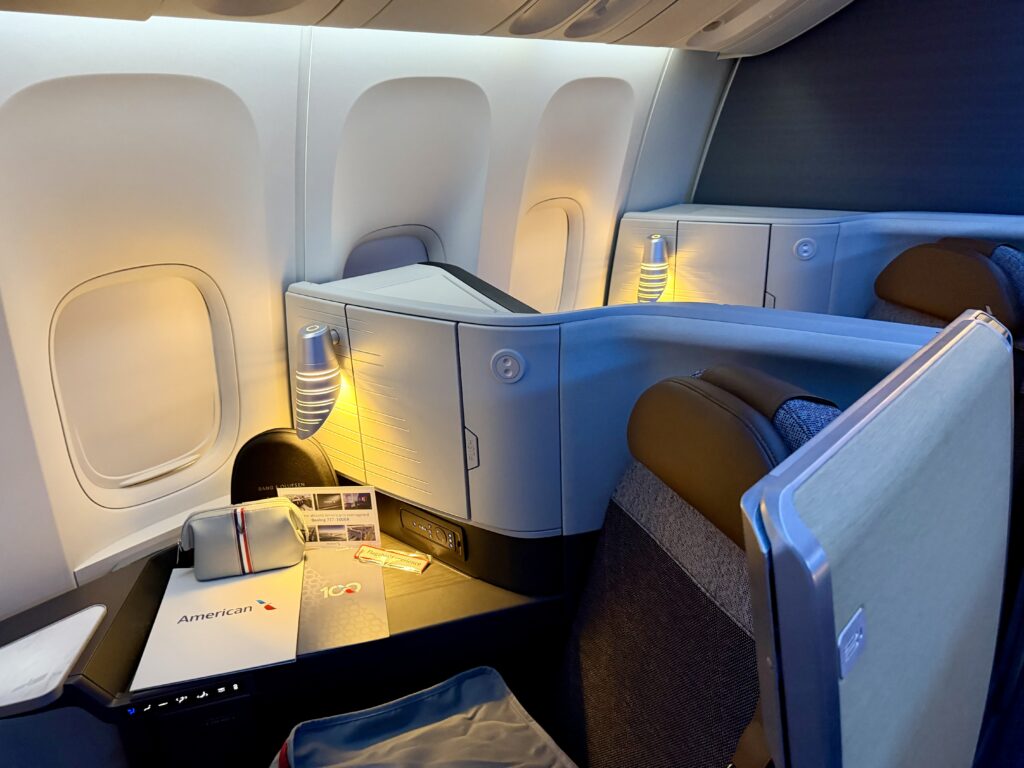
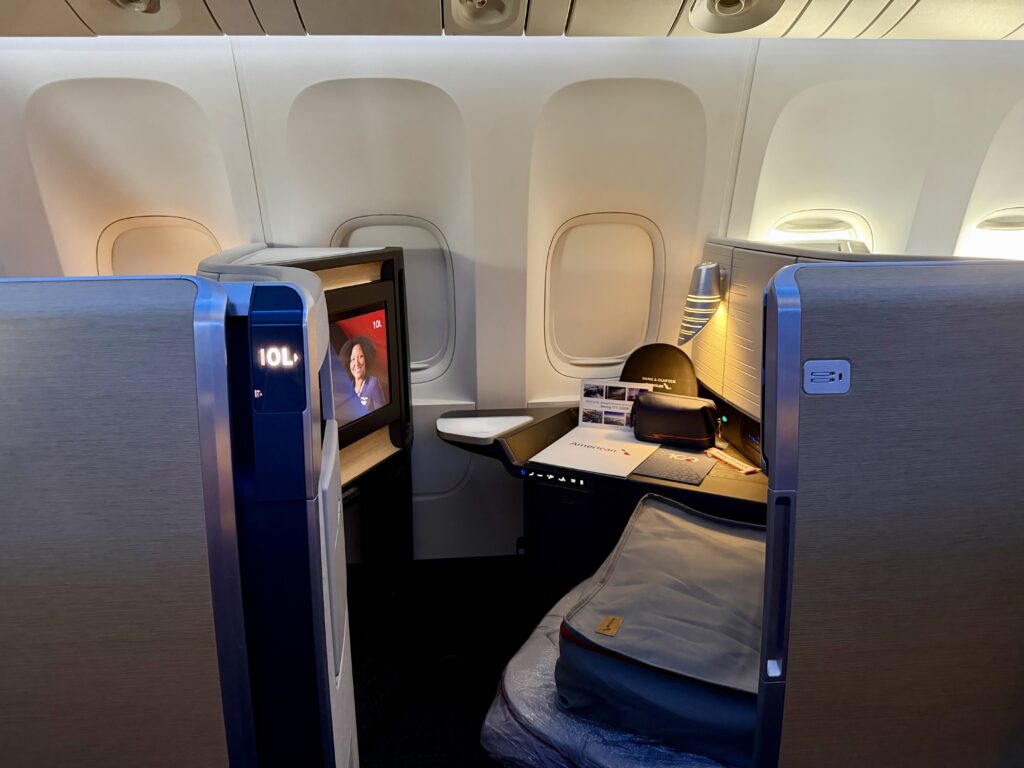
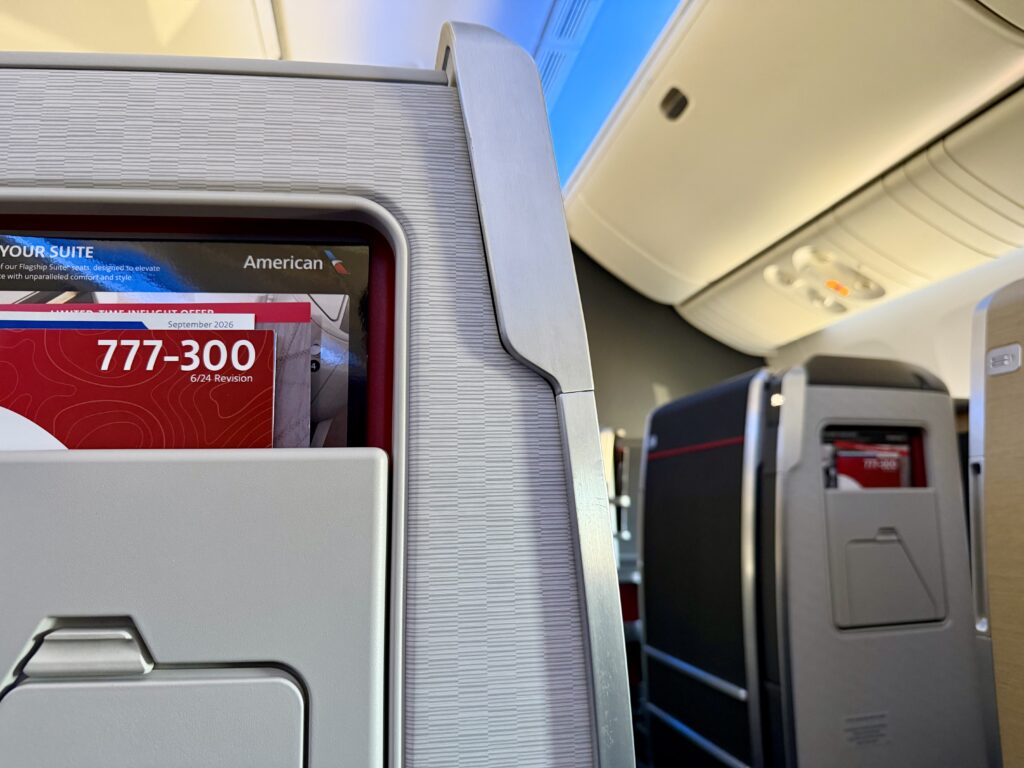
    There’s a lot of business class on American Airlines’ newly retrofitted Boeing 777-300ER.

    Seventy suites, to be exact.

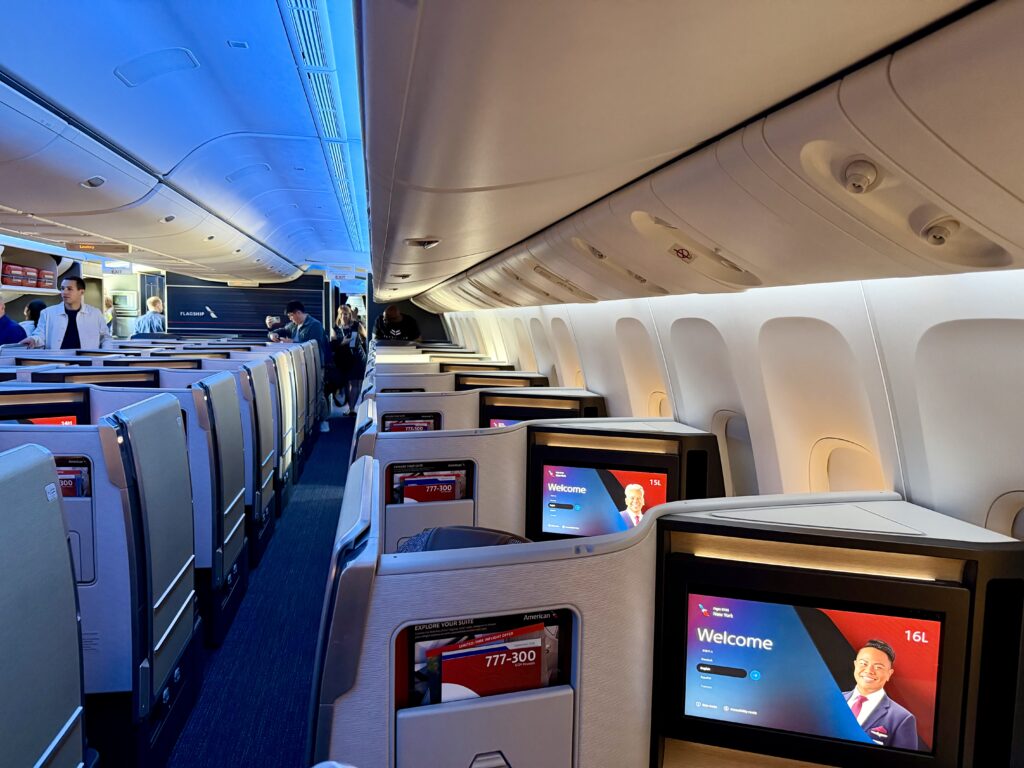
    Ahead of a special charter flight from Dallas Fort Worth (DFW) to New York (JFK) on Wednesday, American’s Chief Commercial Officer Nat Pieper described it as a “sea of business class” that seems to go on and on.

    He’s not wrong.

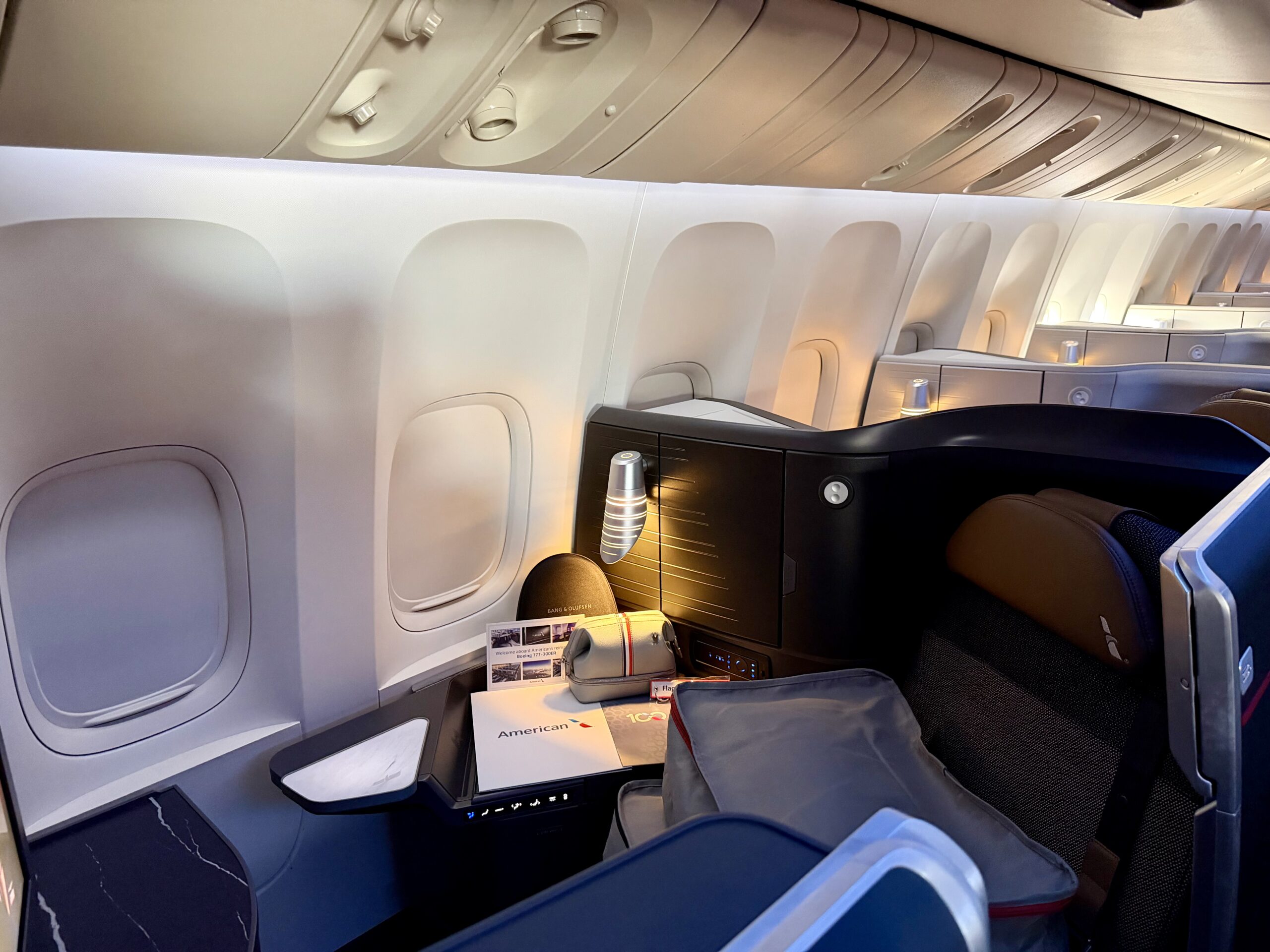
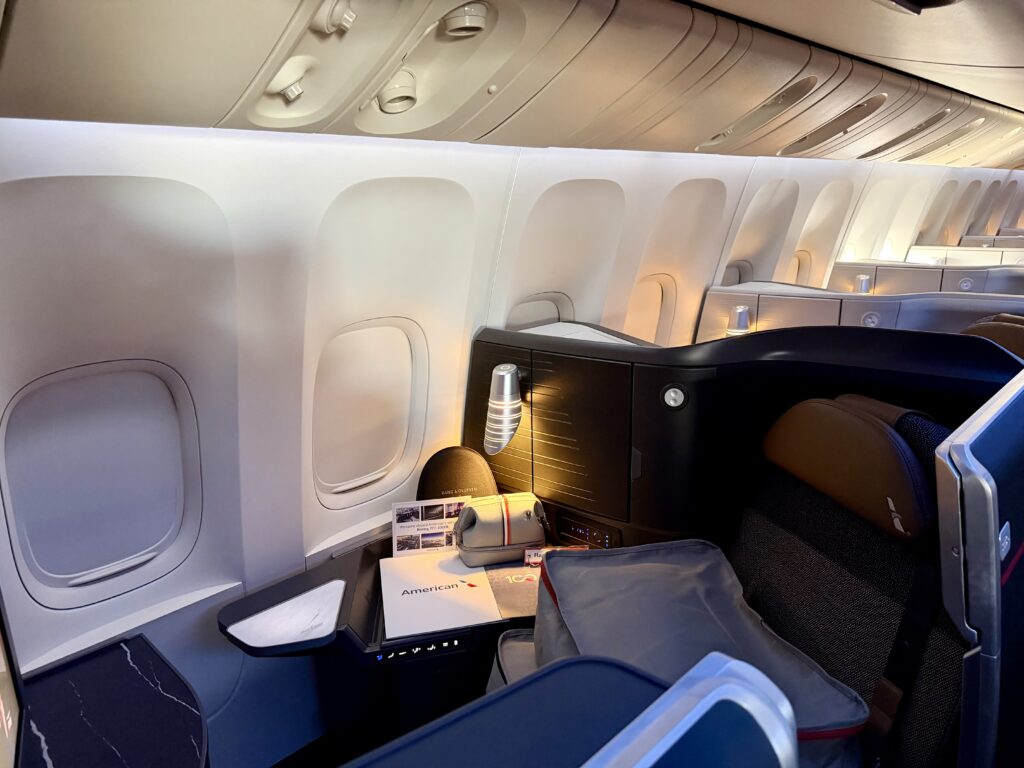
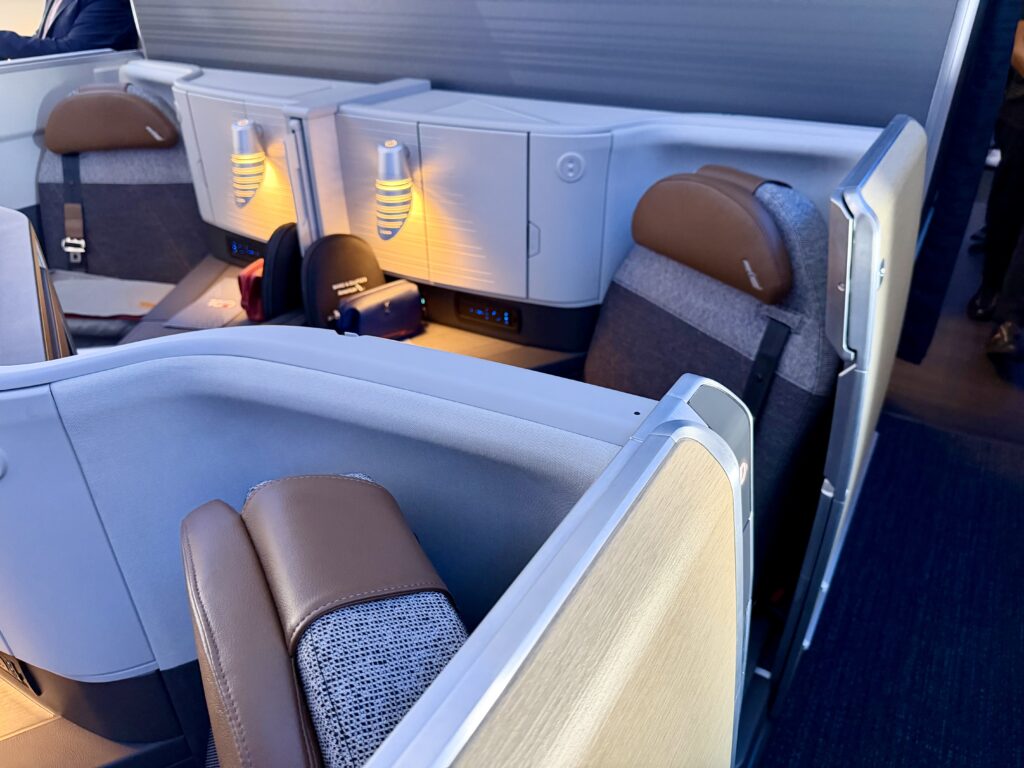
    Business class on the retrofitted AA 777-300ER.
    TYLER GLATT / POINTS INSIDER

    The Flagship Suite cabin stretches through a huge chunk of one of the largest passenger aircraft in American’s fleet. Add 44 Premium Economy seats, and the airline’s newly retrofitted 777-300ER has 114 seats across its two premium cabins.

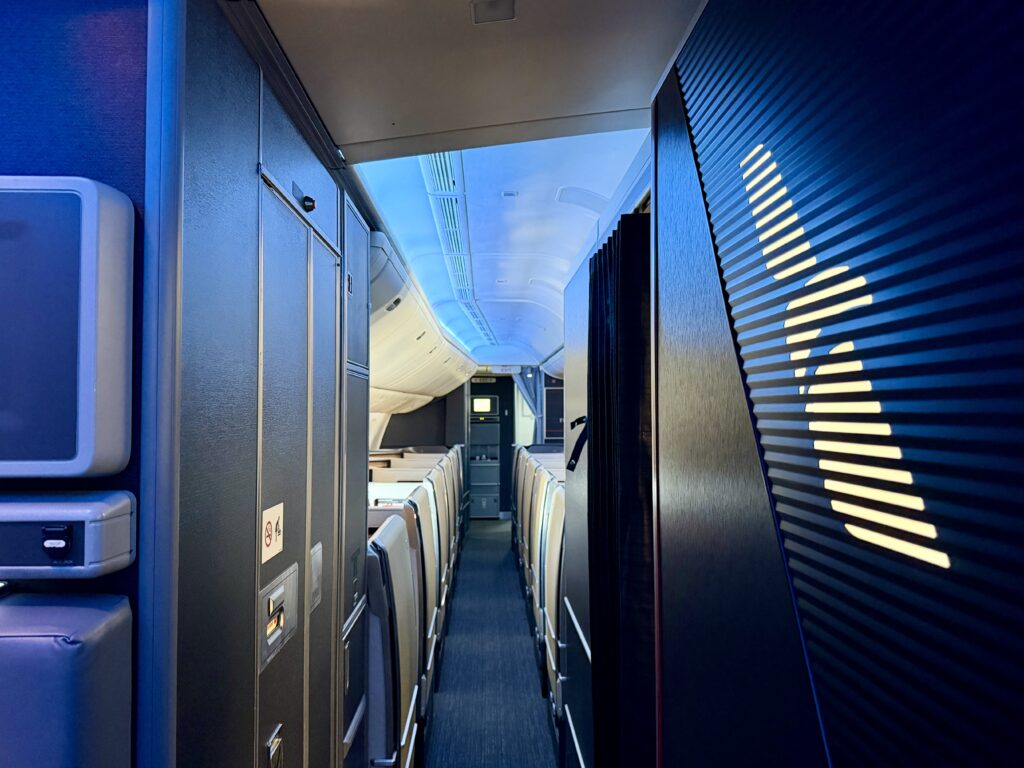
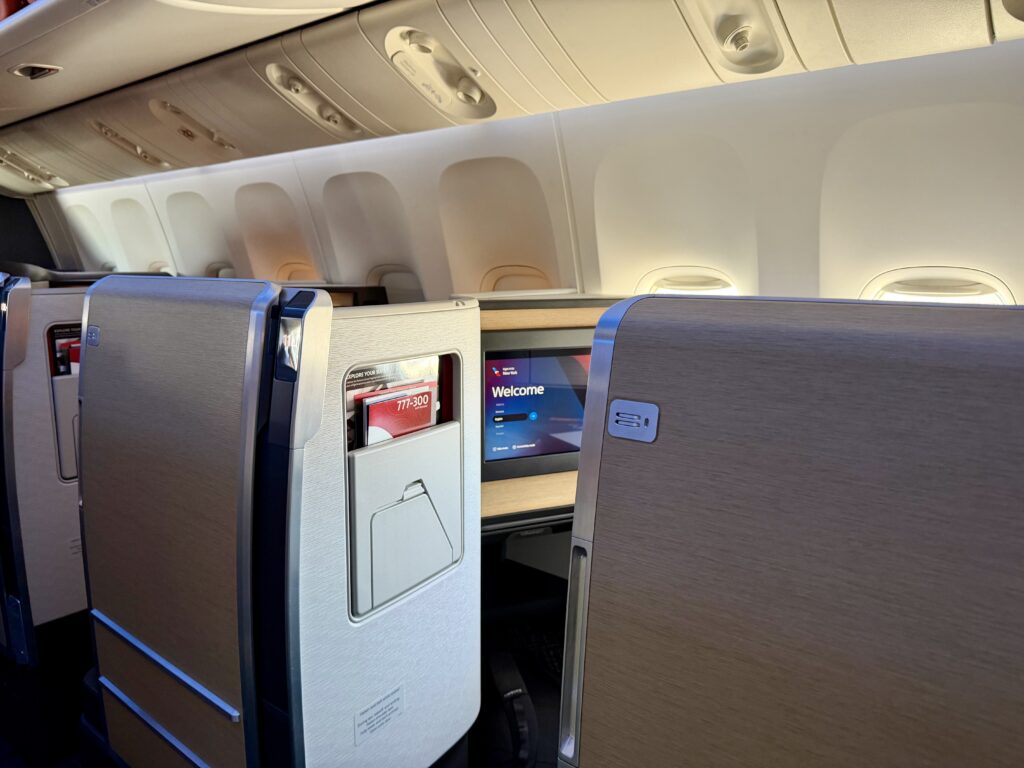
    Business class on the retrofitted AA 777-300ER.
    TYLER GLATT / POINTS INSIDER

    American didn’t start the project with 114 as some magic number.

    Pieper told Points Insider that the configuration was driven in part by the physical geography of the 777 itself.

    Door locations, galleys, and other fixed parts of an existing airplane helped determine where cabins could begin and end, alongside American’s desire to meet the market’s insatiable appetite for premium travel.

    The result just happens to be the most premium-heavy aircraft American has ever flown.

    Business class on the retrofitted AA 777-300ER.
    TYLER GLATT / POINTS INSIDER

    And after spending a few hours aboard the first one, it’s also an airplane that feels remarkably different from the 777 American has been flying for more than a decade.

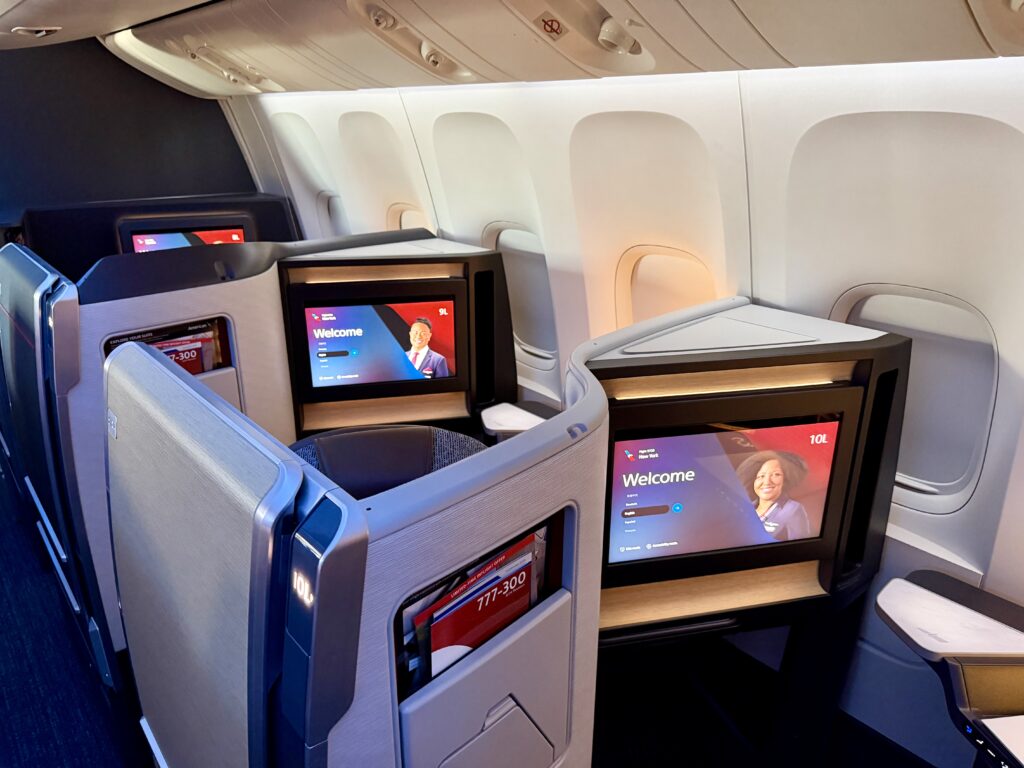
    Business class on the retrofitted AA 777-300ER.
    TYLER GLATT / POINTS INSIDER

    An Old Airplane That Feels New Again

    American’s Boeing 777-300ERs aren’t new.

    The airline took delivery of its first one in late 2012, and the aircraft have spent years flying some of American’s most important long-haul routes.

    Today, the fleet regularly crosses oceans and borders on flights to cities including London, Tokyo, São Paulo, Buenos Aires, and Sydney.

    Business class on the retrofitted AA 777-300ER.
    TYLER GLATT / POINTS INSIDER

    American isn’t ready to move on from them.

    Instead, it’s investing heavily in all 20 aircraft with the expectation that they’ll remain in the fleet for roughly another decade, if not longer.

    Pieper said someone walking onto the first completed aircraft wouldn’t be able to tell that it didn’t just come off the factory floor. It’ll even have that new-car smell, he added, though perhaps the smell of an expensive new car given the amount American has invested in the project.

    That sounded like the sort of thing an airline executive is supposed to say about a newly refurbished airplane. But after walking onboard, it wasn’t much of a stretch.

    Business class on the retrofitted AA 777-300ER.
    TYLER GLATT / POINTS INSIDER

    The first impression is just how open everything feels.

    The 777 is already a big airplane, but the new interior really emphasizes that size. Gone are many of the lighter surfaces of the previous cabin. They’ve been replaced by darker dividers, different shades of gray, wood finishes, and restrained red and white accents.

    Business class on the retrofitted AA 777-300ER.
    TYLER GLATT / POINTS INSIDER

    Lighting helps.

    Raphael Girardoni, American’s managing director of customer experience product and design, told Points Insider that lighting was an important part of the design and something he’s personally passionate about.

    It’s noticeable throughout the Flagship Suite cabin.

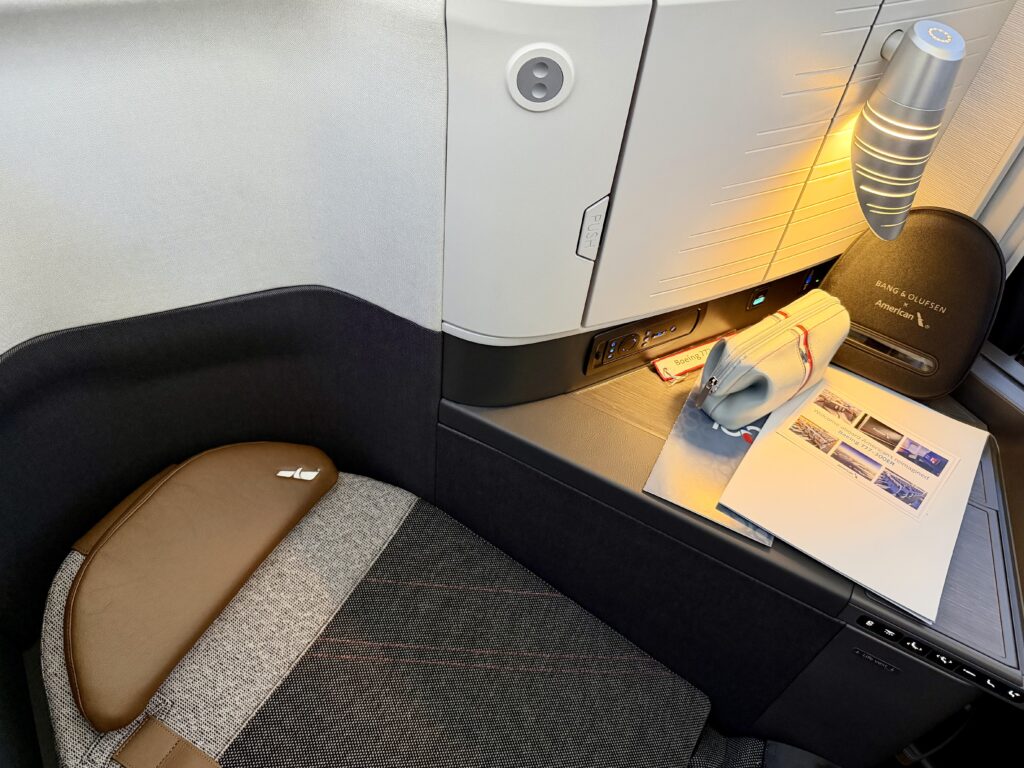
    Small sconces and accent lighting illuminate the individual suites. One of the more thoughtful touches is the way the light from the sconce plays off the design surrounding a storage cubby beside the seat.

    Even the cabin dividers look more considered, with darker finishes and not-so-subtle Flagship branding.

    Business class on the retrofitted AA 777-300ER.
    TYLER GLATT / POINTS INSIDER

    Seventy Flagship Suites Upgrade the 777

    Of course, the biggest upgrade is the seats up front.

    American is removing the eight Flagship First seats and 52 business-class seats found on its previous 777-300ER configuration. In their place are 70 Flagship Suites, including eight larger seats that the airline calls Flagship Suite Preferred.

    Business class on the retrofitted AA 777-300ER.
    TYLER GLATT / POINTS INSIDER

    They’re the same seats American introduced on its also-premium-heavy Boeing 787-9P last year, outfitted with sliding privacy doors and direct aisle access.

    Business class on the retrofitted AA 777-300ER.
    TYLER GLATT / POINTS INSIDER

    The sheer number of them really is a sight to behold. But what stands out most is how little of that enormous cabin is visible once you’re seated.

    Even with the suite door open, I couldn’t see another passenger from my seat beyond the occasional top of someone’s head. Movable dividers between adjoining seats add yet another layer of privacy, too.

    Business class on the retrofitted AA 777-300ER.
    TYLER GLATT / POINTS INSIDER

    There are also plenty of small touches that become more useful the longer a flight gets.

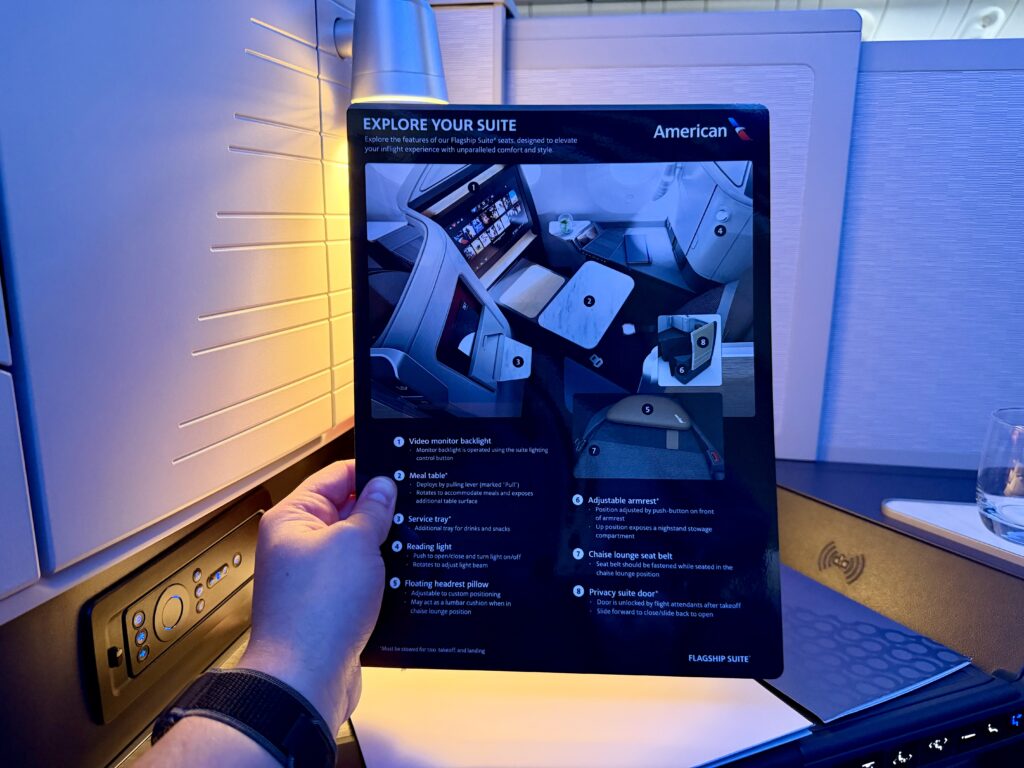
    There’s wireless charging, a drink ledge, a small compartment well suited for a wallet or watch, and various other nooks for keeping things nearby rather than throwing everything into one larger storage bin.

    The tray table is enormous. It slides out from beside the seat before rotating into place, leaving plenty of room for a laptop, meal, or whatever else ends up accumulating during a long flight.

    The entertainment screen is similarly large and highly responsive, but doesn’t feel oversized for the space.

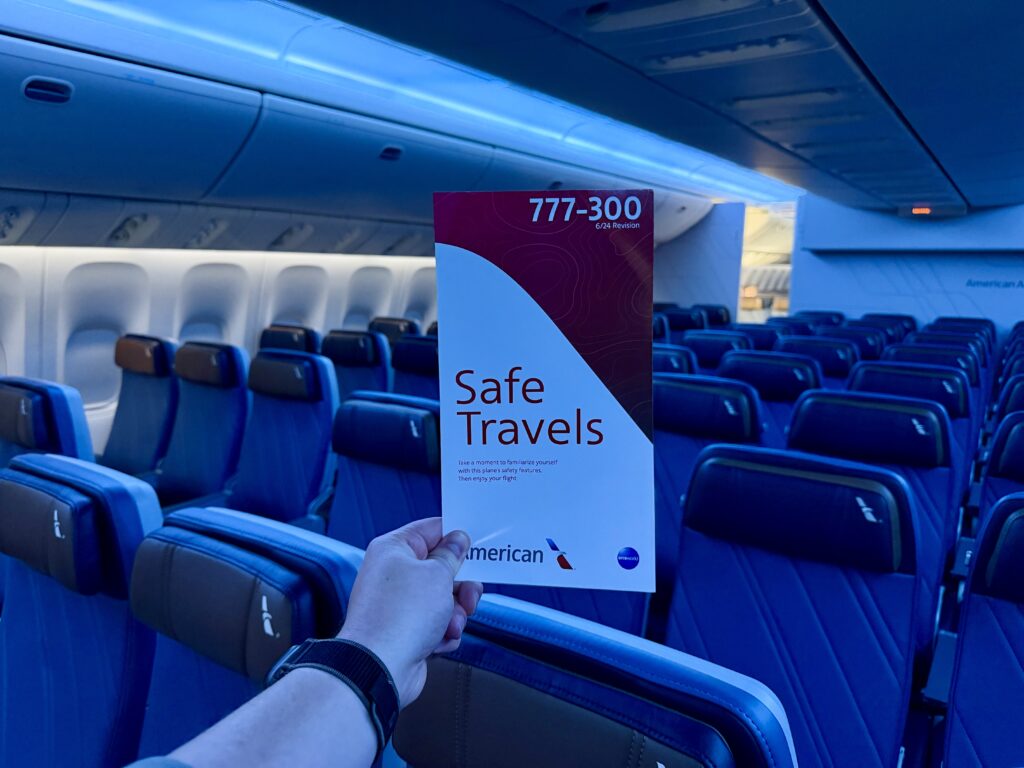
    Business class pamphlet on the retrofitted AA 777-300ER.
    TYLER GLATT / POINTS INSIDER

    And yes, American kept the individual air nozzles.

    That’s a win.

    Can American Fill 70 Business-Class Seats?

    Putting 70 business-class seats on a single airplane naturally raises another question: Can American consistently fill them?

    Pieper doesn’t appear particularly worried.

    He said American is comfortable with the configuration and has more tools at its disposal than selling every seat outright at its initial price. Upgrade offers give the airline another way to fill otherwise empty premium seats as departure approaches.

    Business class on the retrofitted AA 777-300ER.
    TYLER GLATT / POINTS INSIDER

    And then there are Systemwide Upgrades, one of the perks available to some of American’s most loyal customers. Those could come in handy on this kind of plane, too.

    With 70 Flagship Suites to work with, there are simply more seats that could potentially clear as upgrades.

    That flexibility matters when these airplanes will be flying some of American’s biggest long-haul markets for years to come.

    It also helps explain the underlying strategy.

    Business class on the retrofitted AA 777-300ER.
    TYLER GLATT / POINTS INSIDER

    Airlines have spent the past several years adding premium seats as demand for higher-end travel has soared. American is doing the same with its new 787-9Ps and Airbus A321XLRs, and the 777-300ER retrofit takes that strategy to another level.

    The airline didn’t necessarily set out to hit a particular percentage of premium seats on the 777. But the combination of the aircraft’s physical layout and American’s push toward a more premium experience led it to a configuration with a whole lot of them.

    Economy Feels Surprisingly Small

    Walk far enough through the Flagship Suite cabin and eventually the airplane starts looking more familiar.

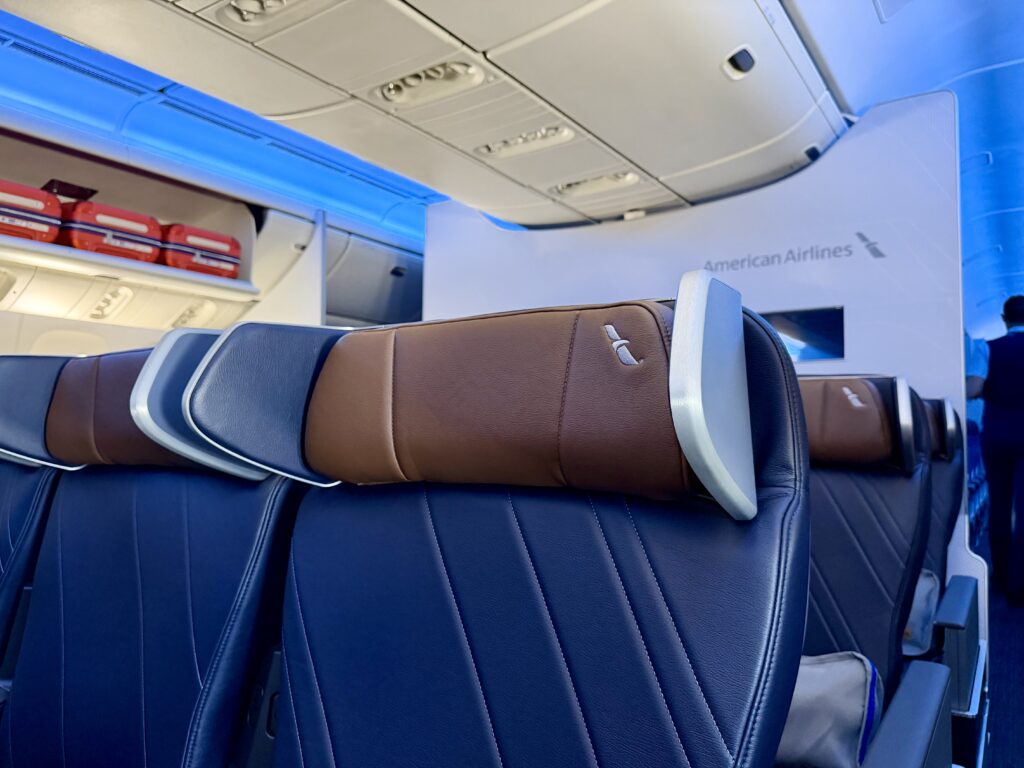
    There are 44 Premium Economy seats, followed by Main Cabin Extra and standard economy.

    Premium economy on the retrofitted AA 777-300ER.
    TYLER GLATT / POINTS INSIDER

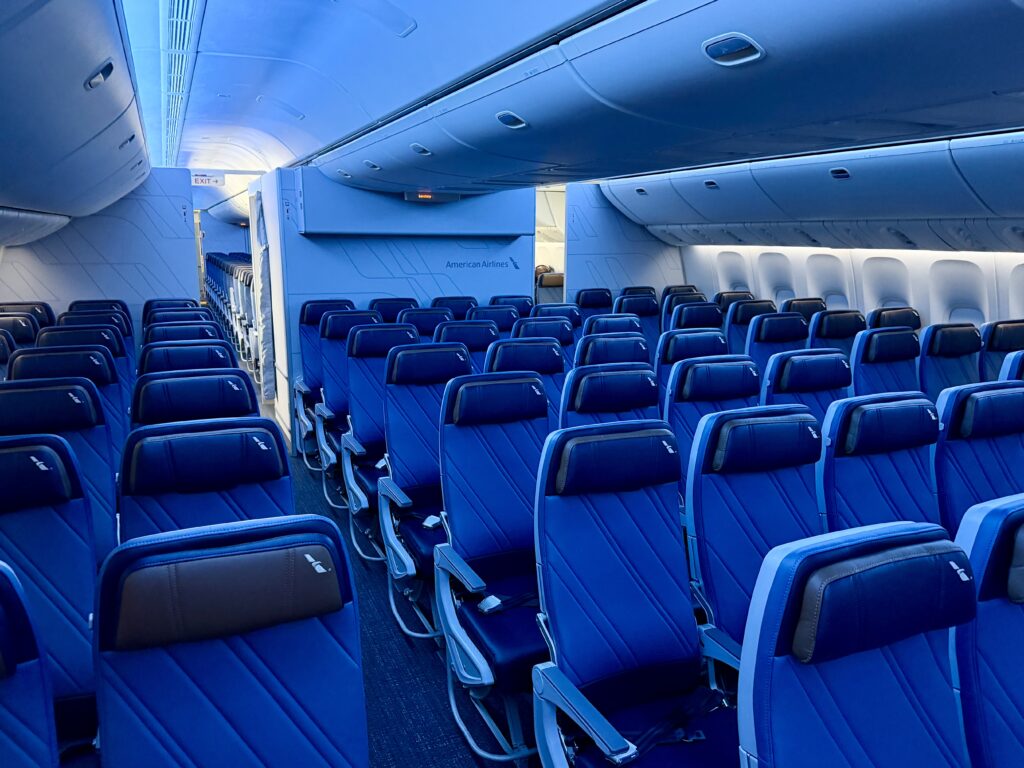
    Economy itself isn’t revolutionary. But the cabin has a new lease on life.

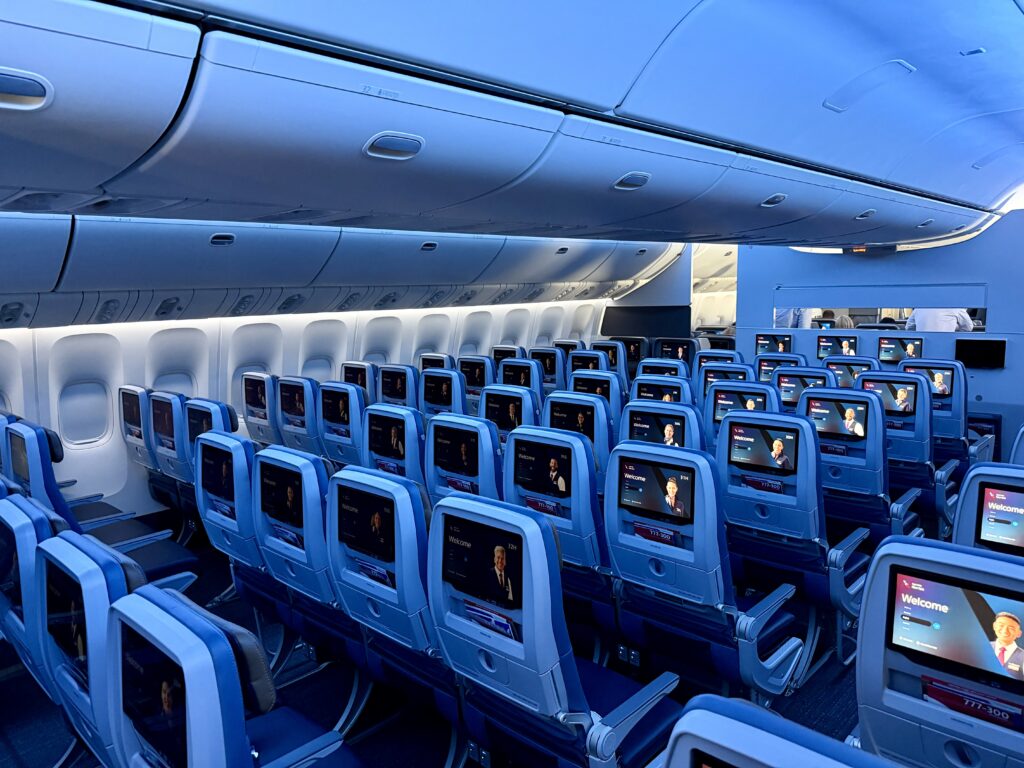
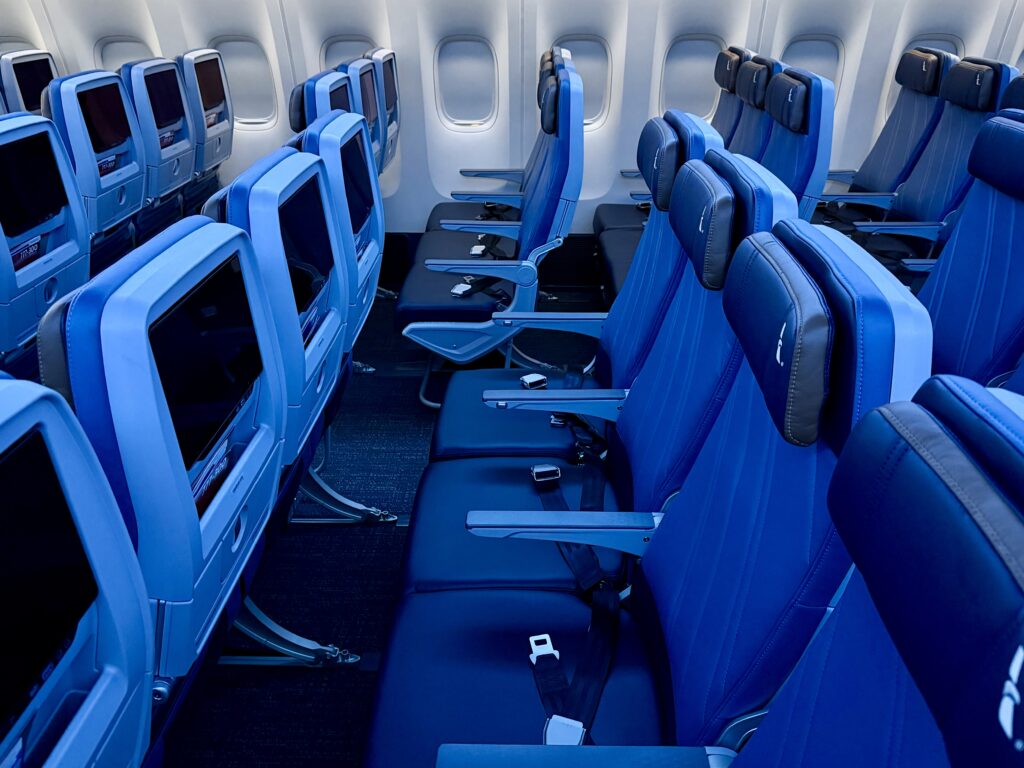
    Browns and blues replaced some of the older finishes. There are new entertainment screens, in-seat power, and the other updates expected from a modern widebody interior.

    A short charter flight isn’t enough to say much about how those seats will feel after 10 or 15 hours.

    Economy on the retrofitted AA 777-300ER
    TYLER GLATT / POINTS INSIDER

    What’s more notable, though, is how little economy there seems to be.

    For an airplane as large as a 777-300ER, the two economy sections feel surprisingly small. That’s not because American has done anything unusual within them. It’s because the majority of the airplane’s real estate comes before them.

    Economy on the retrofitted AA 777-300ER
    TYLER GLATT / POINTS INSIDER

    The premium cabins stretch almost to the end of the wing.

    That might be the most effective way to understand just how different this configuration is. The 777-300ER can hold an enormous number of seats. American has chosen to devote a remarkable amount of that real estate to the front of the plane.

    Retrofitting a 777 Isn’t the Same as Building a New One

    Some things didn’t change.

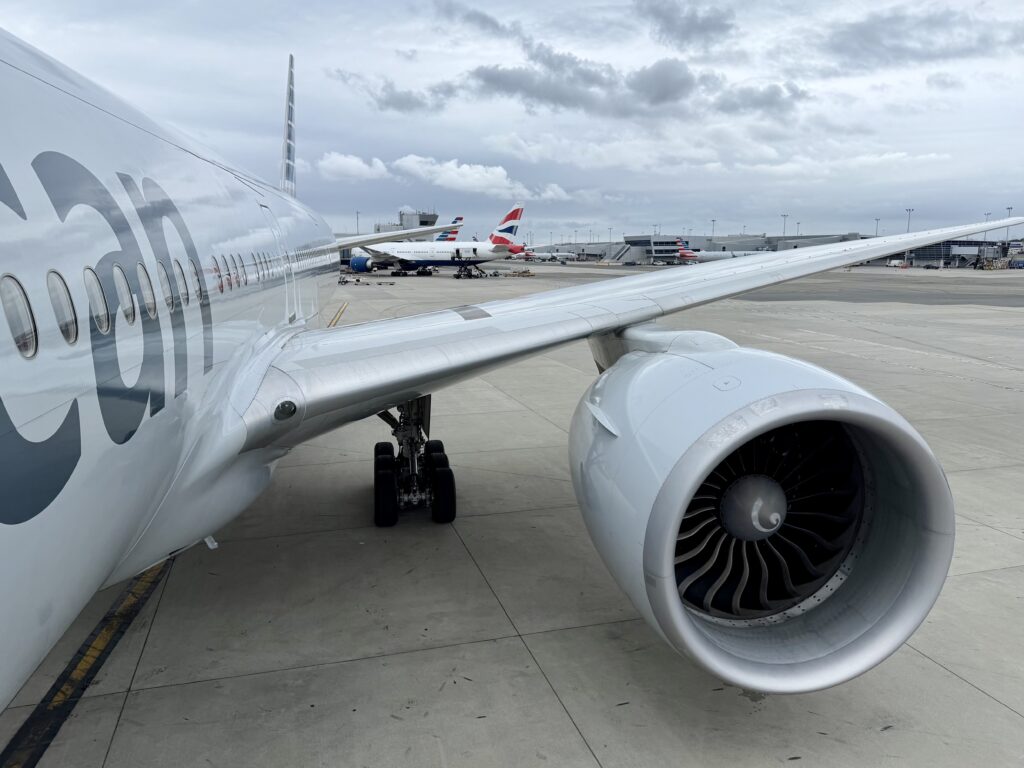
    The overhead bins, for example, look just like they did before. So does the view through the well-traveled windows. And when the engines spool up for takeoff, this is still very much the same 777 that has been flying for American for years.

    The challenge was putting a substantially different passenger experience inside it.

    Economy on the retrofitted AA 777-300ER
    TYLER GLATT / POINTS INSIDER

    From a design perspective, Girardoni said there weren’t any particular challenges with bringing Flagship Suite to the 777 that stood out during the project. American was also working with a familiar product, using the same Flagship Suite seat already flying aboard its 787-9P.

    But there are still operational tradeoffs.

    One flight attendant aboard Wednesday’s flight mentioned that the new layout leaves crews with somewhat less room to maneuver in parts of the galley, particularly when passengers are trying to squeeze around carts. It could make things a little trickier, although she said that adapting to different aircraft and working conditions is part of the job.

    Passengers give up a little space elsewhere, too. The new configuration has fewer lavatories than the 777-300ER it replaces.

    Economy cabin on the AA 777-300ER.
    TYLER GLATT / POINTS INSIDER

    American expects to complete the remaining 777-300ER retrofits by the middle of 2027.

    The aircraft will also get free high-speed Wi-Fi for AAdvantage members, sponsored by AT&T. That’s a meaningful upgrade for airplanes expected to spend much of their lives on long international flights.

    The first retrofitted 777 already has it.

    A Look at Where American Wants to Go

    American describes the new 777 as more than a refurbishment.

    Pieper called the aircraft an embodiment of the airline’s ambitions as American works toward what he described as becoming a premier global airline.

    Wing view of retrofitted AA 777-300ER.
    TYLER GLATT / POINTS INSIDER

    That’s a lofty goal.

    But the 777 offers a tangible look at what American thinks getting there requires.

    It’s eliminating its eight-seat international first-class cabin while dramatically expanding business class. It’s adding privacy doors, better technology, more thoughtful storage, and a much more contemporary interior. And it’s making similar investments across new aircraft, existing widebodies, lounges, Wi-Fi, Flagship airport check-in, and other parts of the travel experience.

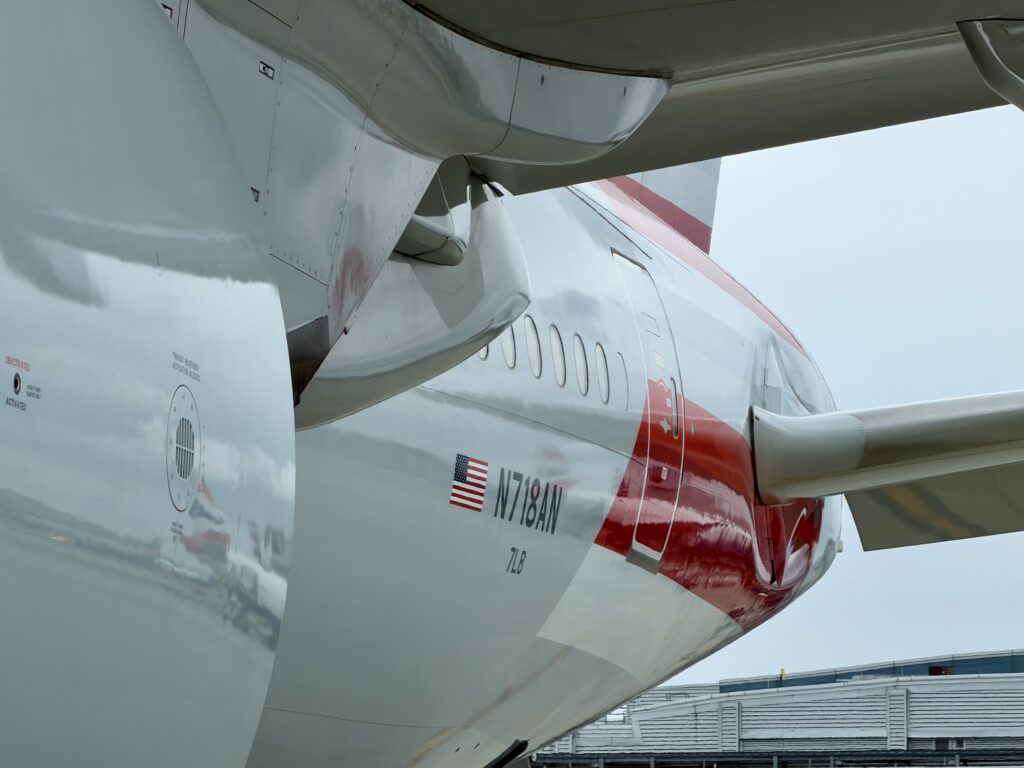
    Exterior of retrofitted AA 777-300ER.
    TYLER GLATT / POINTS INSIDER

    The first retrofitted 777-300ER begins commercial service between New York (JFK) and Buenos Aires (EZE) on September 2.

    It won’t be a novelty flying around the network for a year or two. American expects this airplane, and eventually the others like it, to spend roughly another decade flying to some of its most important destinations around the world.

    The first one shows just how much American thinks it can get out of an airplane it already owns. And now it has 19 more to rebuild.

  • Southwest Is Going Premium With Airport Lounges and a New Credit Card

    Southwest Is Going Premium With Airport Lounges and a New Credit Card

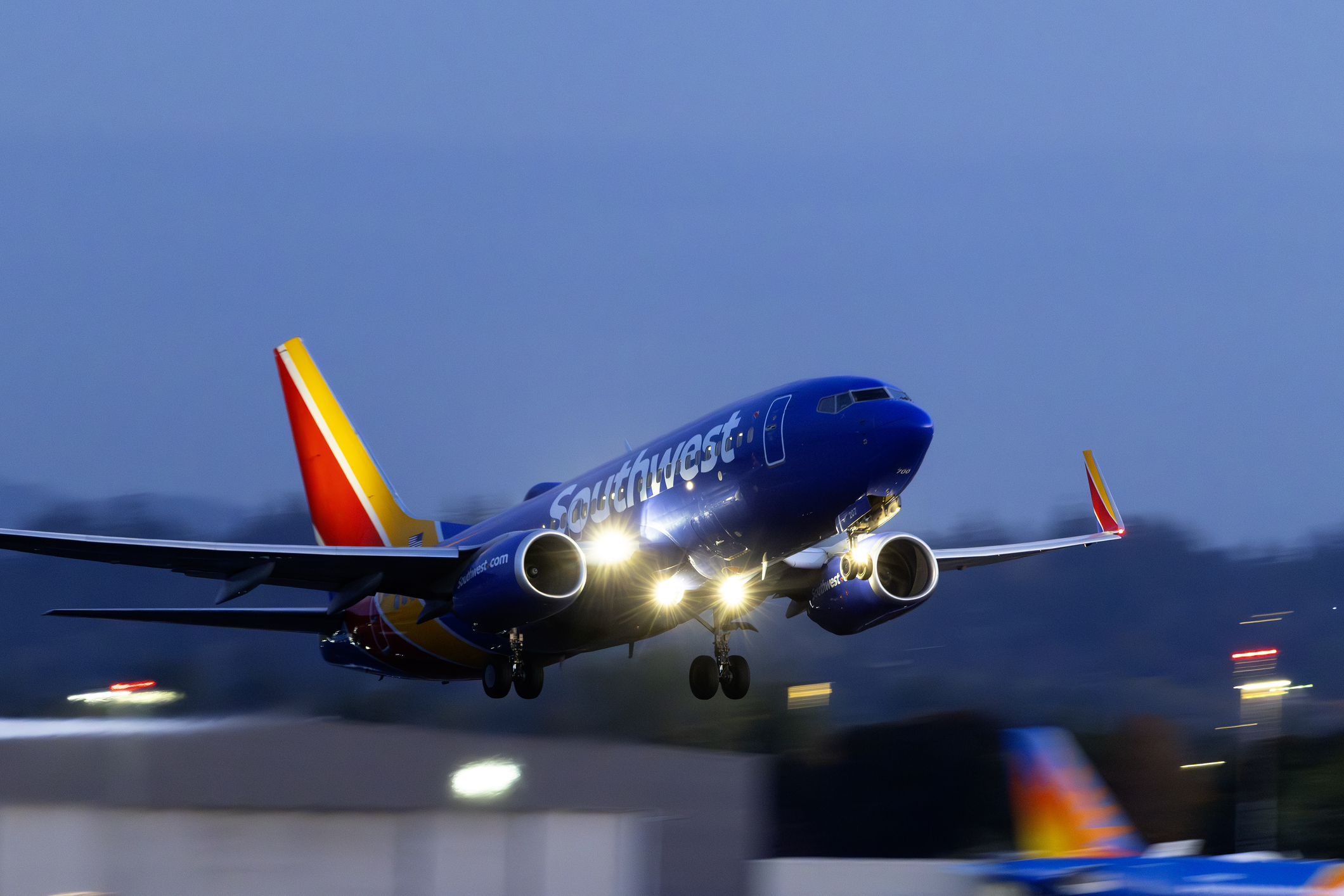
    Southwest Airlines is getting into the airport lounge business for the first time, and a new premium credit card is coming with it.

    The airline announced Wednesday that it plans to build a network of Southwest-branded lounges in partnership with Chase. The first four locations are expected to open in late 2027.

    And Southwest isn’t stopping there.

    The airline says at least seven additional lounges are planned over the following several years. This will put its initial network at 11 or more locations.

    It goes without saying that these developments are another massive shift for Southwest, which has changed a lot about its experience in recent years. The airline has introduced assigned seating and extra-legroom seats, ended its long-standing two-free-checked-bags policy for most customers, and increasingly added products aimed at customers willing to pay more for their trip.

    Now, that experience will extend into the airport.

    Southwest’s First Lounges Are Coming to 4 Airports

    Construction is already underway on Southwest’s first four lounges at:

    • Austin-Bergstrom International Airport (AUS)
    • Baltimore/Washington International Thurgood Marshall Airport (BWI)
    • Daniel K. Inouye International Airport (HNL)
    • Nashville International Airport (BNA)

    Southwest expects to begin welcoming guests in late 2027, though it hasn’t provided opening dates for the individual locations.

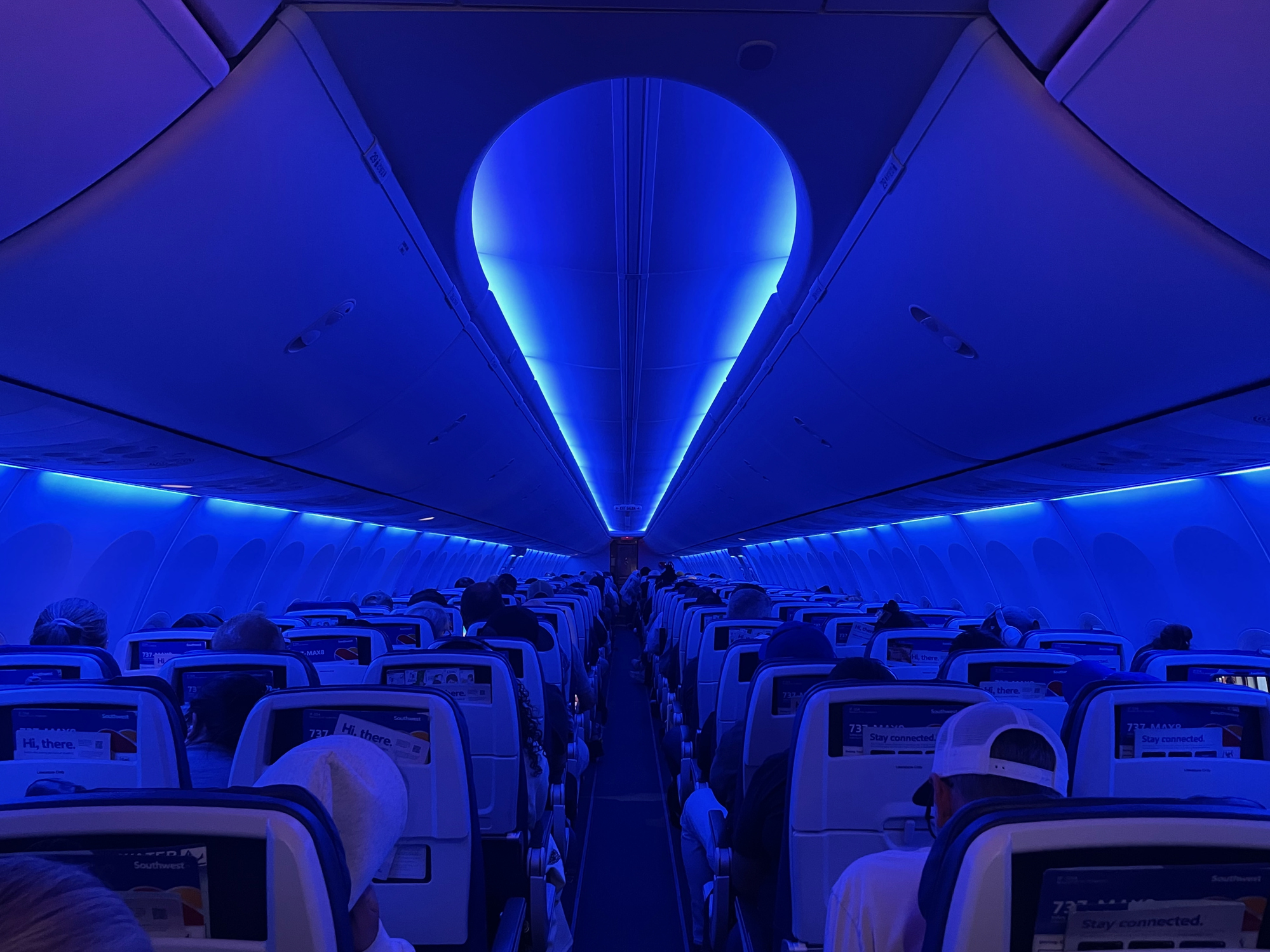
    Denver, Colorado, USA - June 7, 2025: Passengers on a Southwest Airlines Boeing 737-MAX8 aircraft settle in during a flight from Denver International Airport (DEN) to Washington Dulles International Airport (IAD) in Virginia.
    JOHN CHASE / ISTOCK

    The airline is working with Chase on the lounges and plans to draw on the bank’s existing Chase Sapphire Lounge network. Southwest says the spaces will combine its own approach to hospitality with locally inspired dining, more sophisticated design, and amenities and travel benefits already found in Chase’s lounges.

    For now, that’s about as specific as Southwest is getting.

    The airline hasn’t revealed the size or exact location of the first lounges, what amenities each will offer, or where the next seven or more locations will be. We don’t have renderings yet, either.

    The initial airport choices do offer a sense of where Southwest is starting. Austin, Baltimore, Honolulu, and Nashville are all significant Southwest markets.

    And with at least 11 lounges now in the pipeline, this is intended to become a network rather than a handful of experiments.

    A New Premium Southwest Credit Card Is Coming, Too

    Southwest will also introduce a new premium Rapid Rewards credit card from Chase in 2027. The card is slated to provide access to the new lounges.

    That’s just about all we know about the card for now.

    Southwest hasn’t announced its annual fee, welcome offer, other benefits, or exactly how lounge access will work. We also don’t yet know whether there will be other ways to enter the lounges, including for customers with certain Southwest tickets or elite status.

    There are also some interesting questions about how the Southwest and Chase lounge networks will overlap.

    Southwest hasn’t said whether Chase Sapphire Reserve cardholders will receive access to Southwest lounges or whether holders of the new Southwest card will have any access to Chase Sapphire Lounges.

    Those details will come later. But the new card and lounge network indicate that Southwest is continuing its push to offer more to customers willing to pay for a premium experience.

  • JetBlue Built Another Lounge. The More Interesting Part Is Why

    JetBlue Built Another Lounge. The More Interesting Part Is Why

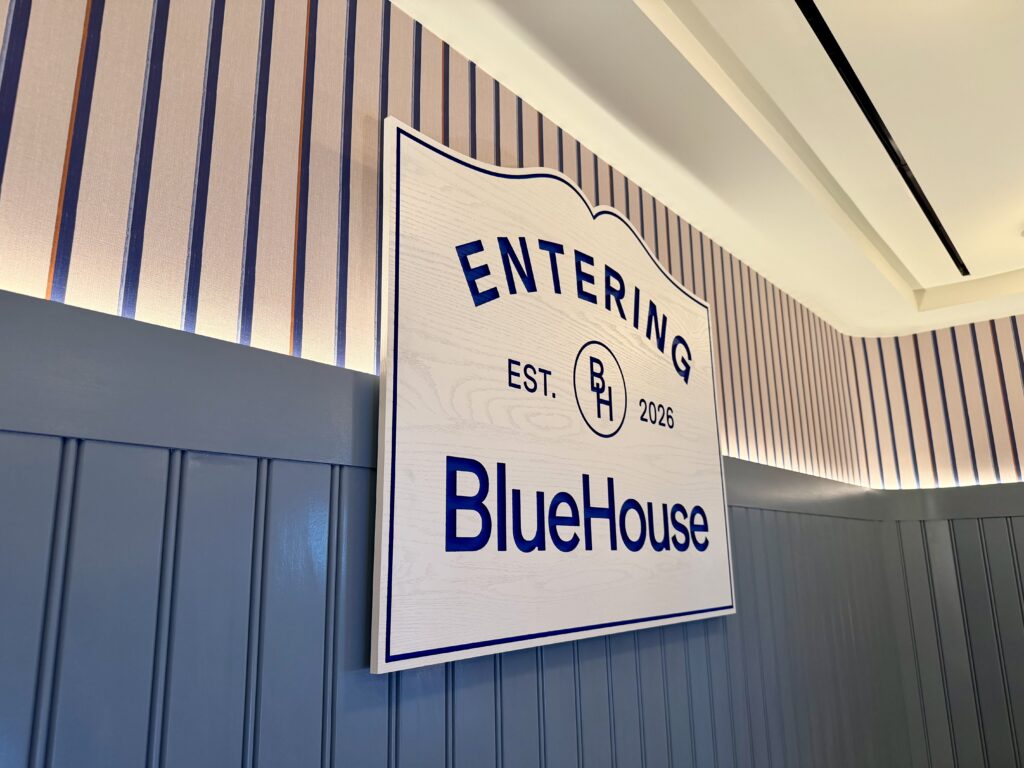
    We were supposed to get inside JetBlue’s new BlueHouse lounge at Boston Logan International Airport a little earlier Monday morning.

    Instead, the doors stayed closed while a few last things were straightened, adjusted, and made picture-perfect. Reporters and photographers waited outside for the first look.

    That seemed appropriate for an airport lounge years in the making and just three days away from greeting its first real passengers.

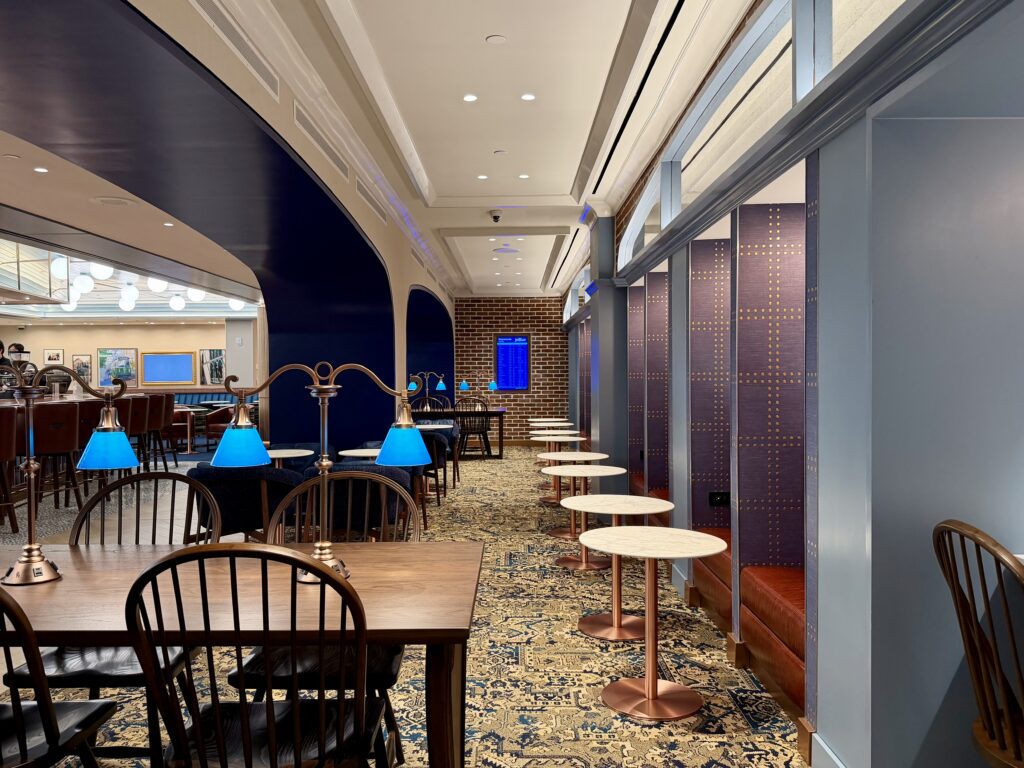
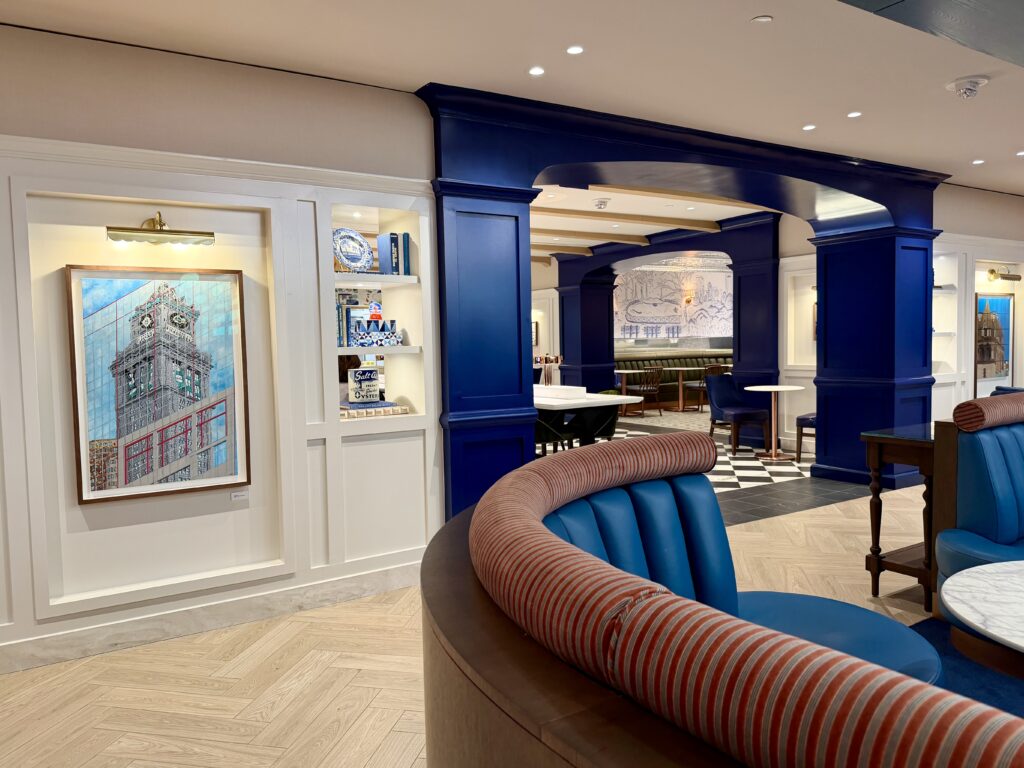
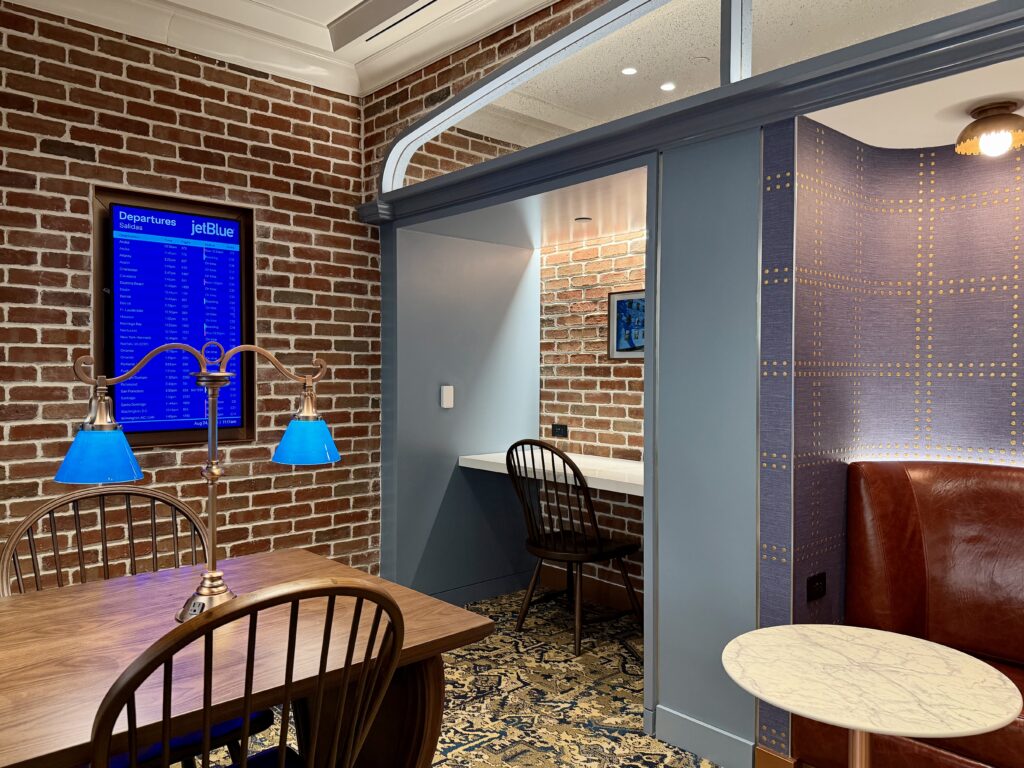
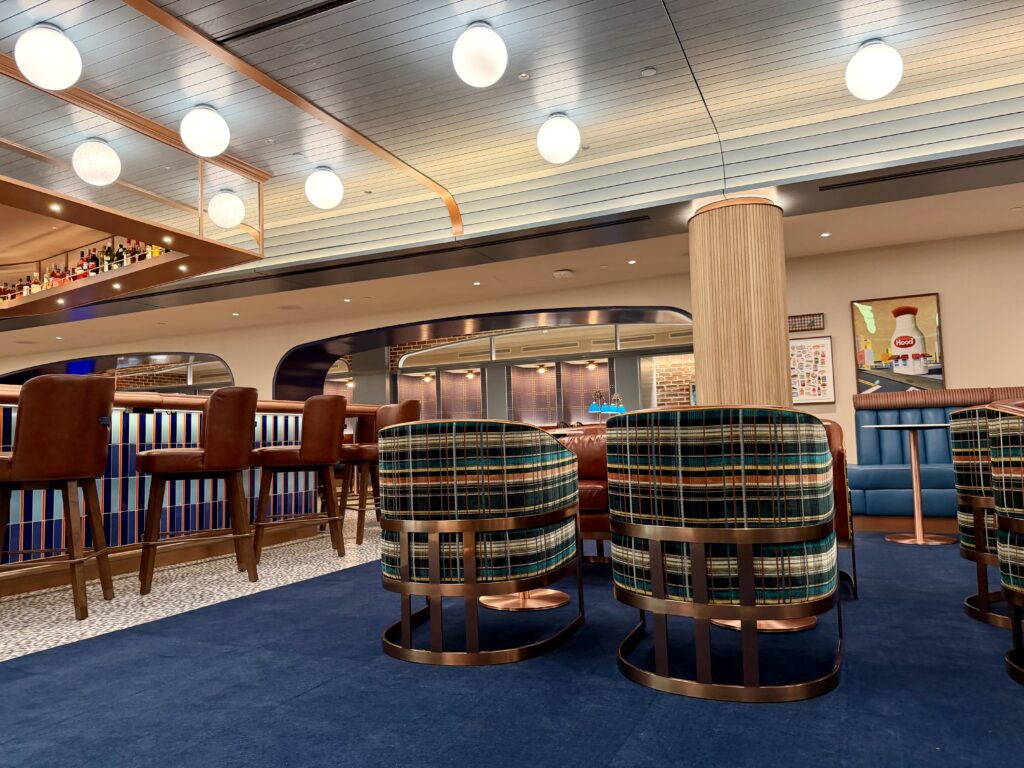
    Interior of JetBlue BlueHouse Boston.

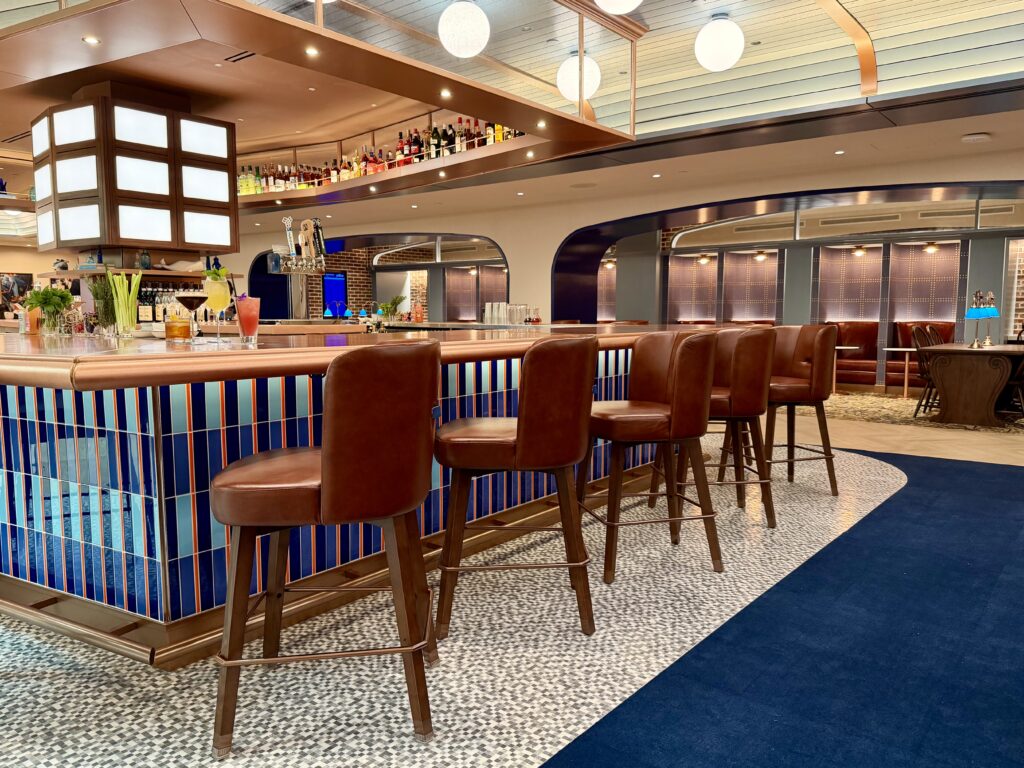
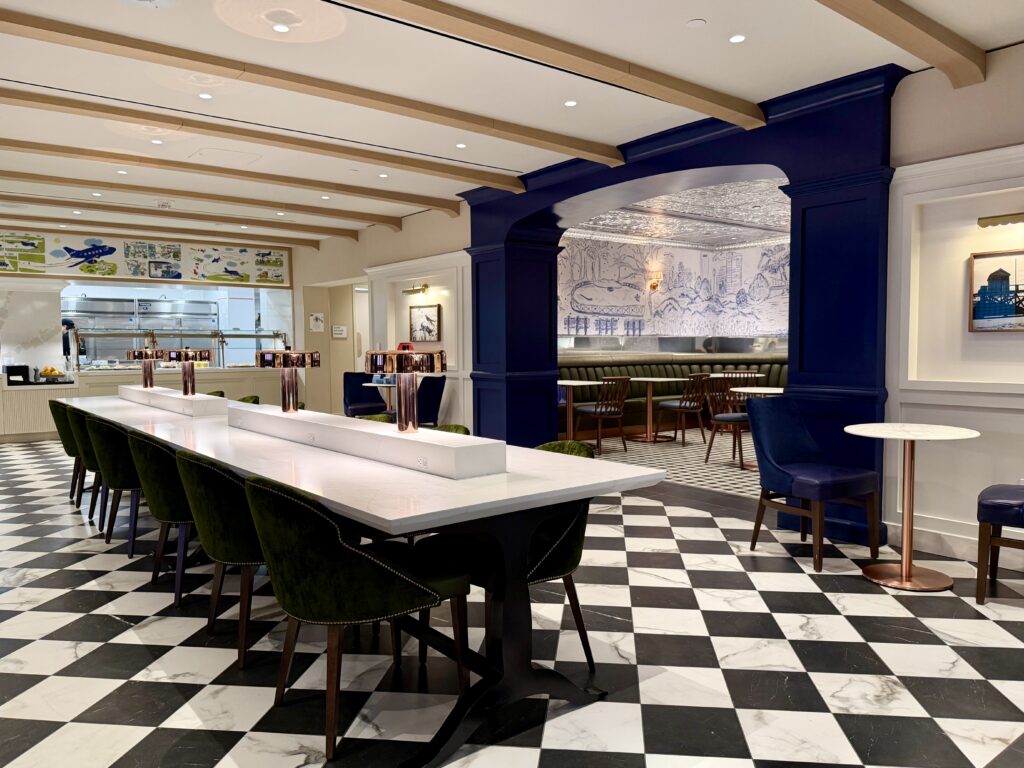
    Once inside, everything was exactly where it belonged. The bar was clean, the food display was impressive, and the chairs sat exactly where someone had decided they should sit.

    JetBlue employees and executives guided the group around the room, pointing out big and small details while cameras captured a version of BlueHouse Boston that probably won’t exist for very long after it opens Thursday.

    That’s one of the stranger parts about previewing an airport lounge.

    Interior of JetBlue BlueHouse Boston.

    You can inspect the food, sit in the chairs, count the outlets, and document just about every square inch. What you can’t know is whether the kitchen keeps up when the lounge nears capacity, whether the quiet corners stay quiet, or whether anyone can find somewhere to sit on a busy afternoon.

    Calling any of that a review would be a stretch. But a nearly empty lounge says plenty of other things.

    For roughly the first 25 years of its existence, JetBlue didn’t have an airport lounge. In the last year, it’s opened two, and standing inside the second one makes it fairly obvious that the most interesting thing about it isn’t simply what JetBlue built in Boston.

    It’s why an airline that went so long without lounges decided it could no longer live without them.

    More on This: JetBlue BlueHouse Lounges: What to Know Before You Visit

    A BlueHouse That Doesn’t Look Like the Other BlueHouse

    JetBlue’s two BlueHouse lounges don’t have a ton in common.

    That’s by design.

    Ciara Cordasco, manager of product design at JetBlue and someone who worked on designing both lounges, said the lone thread connecting the two is the color blue.

    Stephanie Evans Greene, JetBlue’s senior vice president of marketing and brand, described Boston as a “love letter” to the city. JetBlue used the same language when it opened New York, but the idea gave designers plenty of freedom to decide what a love letter to Boston should actually look like.

    Some of those interpretations are unmistakable.

    Interior of JetBlue BlueHouse Boston.

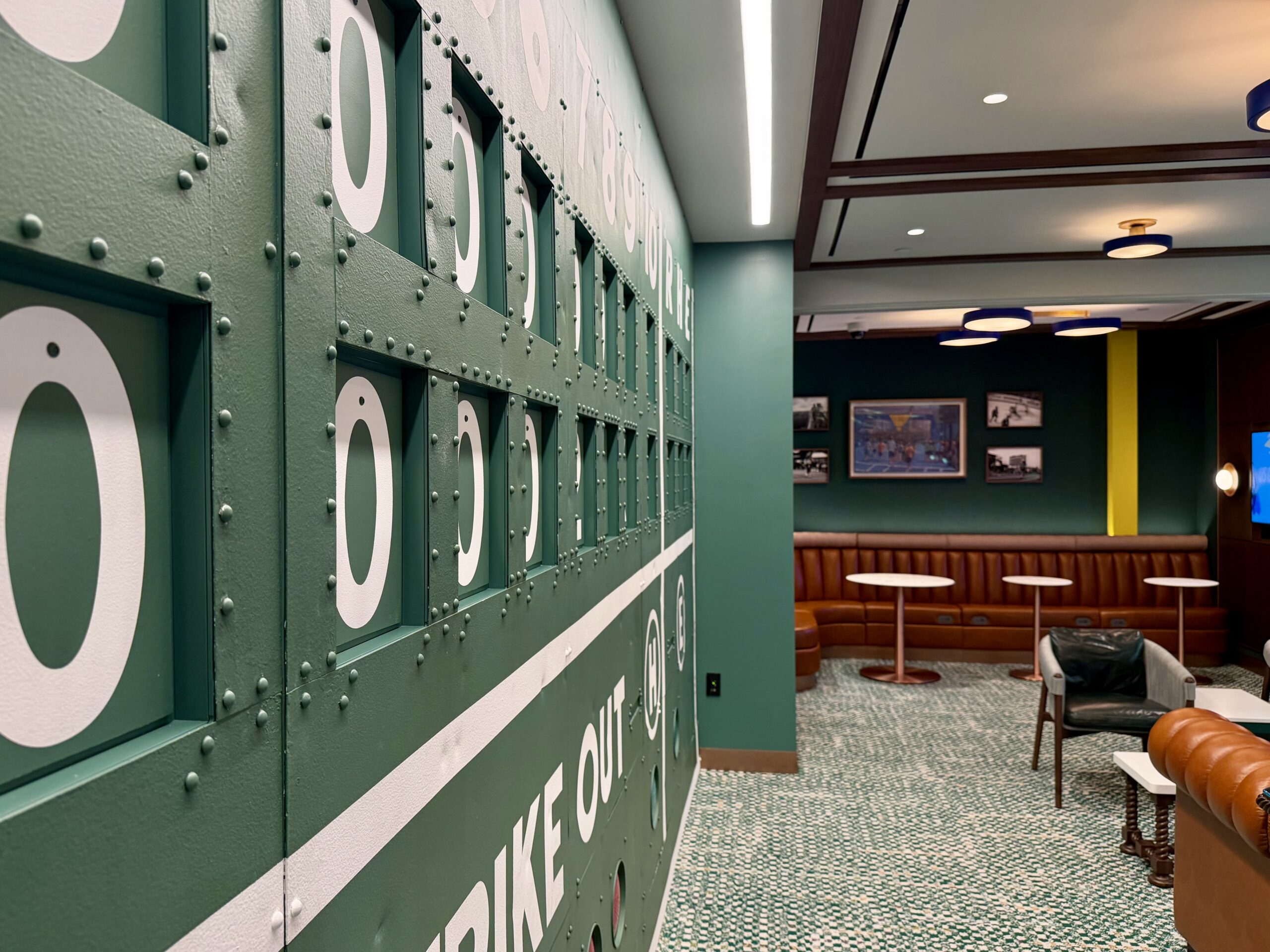
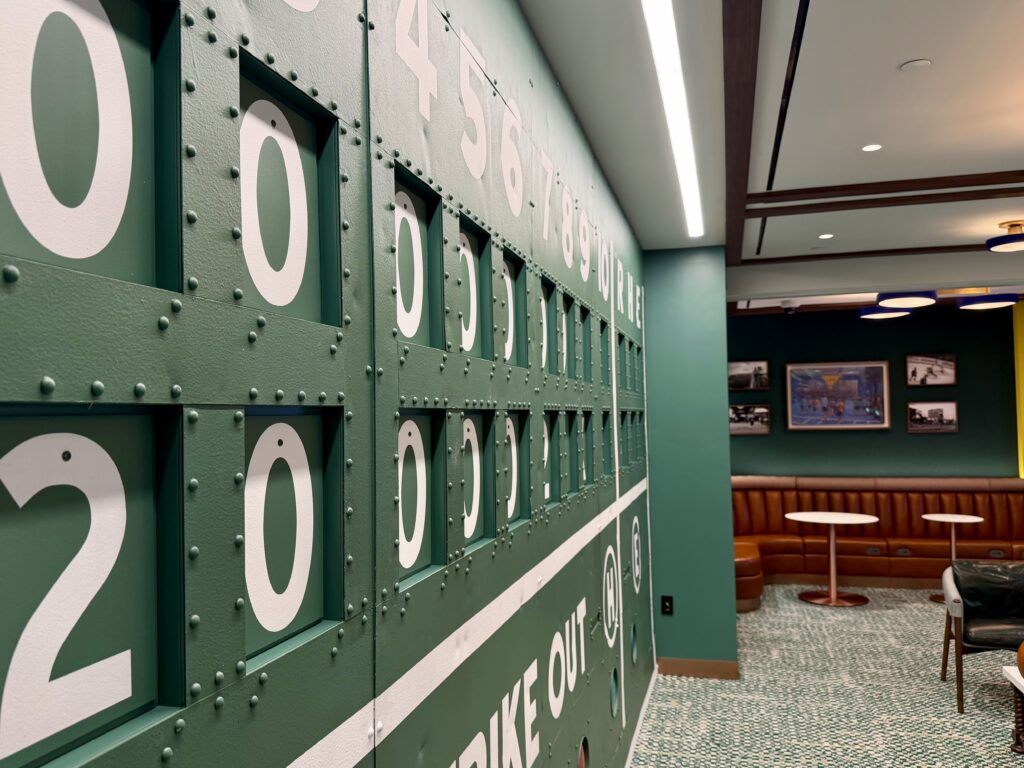
    The Dugout borrows from Fenway Park’s Green Monster, baseball dents and all. Tables elsewhere were meant to look like near-replicas of those at the Boston Public Library. Local sports teams contributed memorabilia and photography, and tucked among it all is a trading card featuring JetBlue President Marty St. George, an Easter egg Evans Greene pointed out to me after the formal tour.

    Hanging that wasn’t St. George’s idea.

    Interior of JetBlue BlueHouse Boston.

    One of my favorite little details is right out front. There’s a peephole near the big blue door, and if you look through it, you’ll find Paul Revere riding an Embraer E190.

    I asked Cordasco where that idea came from. At some point during the design process, she said, the question became, “What’s the wildest thing we could do?”

    Apparently, this was it.

    There’s a reason the Boston references are fairly easy to recognize. At JFK, JetBlue found that some of the artwork left passengers asking a pretty basic question about what, exactly, they were looking at. St. George said they made a point of avoiding that in Boston, and I also learned he had a big hand in deciding what deserved space on the walls.

    The result feels cozy for a lounge without true windows. Wood and copper finishes run through much of the space, orange accents break up all the blue, and the seating is divided into enough nooks and smaller arrangements that the nearly 12,000-square-foot lounge doesn’t feel like one enormous room

    But not every lesson the airline took from New York was about design.

    Interior of JetBlue BlueHouse Boston.

    When I asked Ed Pouthier, JetBlue’s vice president of loyalty and personalization, about the airline’s biggest takeaway from operating its first lounge, he didn’t hesitate. It was the food. Others agreed.

    JFK doesn’t have a full kitchen yet, and customers haven’t exactly been shy about telling JetBlue what they think about that.

    Boston does.

    Interior of JetBlue BlueHouse Boston.

    That gives the airline considerably more room to play with the menu. Food will rotate seasonally, lobster rolls are among the local staples, although only in the afternoon, and George Howell Coffee is available both from self-service machines and made to order.

    Work on Boston began around the same time as New York, so this isn’t BlueHouse 2.0. This new lounge wasn’t designed after JetBlue had months to figure out everything it liked and didn’t like about JFK.

    But by the time Boston opens at 5 a.m. Thursday, the airline has something it didn’t have when either project began.

    It knows what happens when passengers start coming through the doors.

    The Strange Business of Becoming More Premium

    The more interesting change at JetBlue is bigger than what’s being served for lunch near Gate C23.

    JetBlue built much of its reputation by making the ordinary flying experience less ordinary. Seatback televisions weren’t exclusively for passengers at the front of the airplane, and neither were snacks people wanted to eat. At its core, the basic proposition wasn’t that JetBlue could make premium travel more luxurious. It was that sitting in economy didn’t have to feel quite so much like sitting in economy.

    Airport lounges work a little differently.

    Interior of JetBlue BlueHouse Boston.

    By design, not everyone gets through the door. BlueHouse is still primarily a perk for some of JetBlue’s highest-value customers, although the airline is widening the ways other passengers can pay to get inside.

    The lounges aren’t happening in isolation, either.

    Mint already gives JetBlue a premium cabin on transcontinental and transatlantic routes, along with other markets where the airline has to put its best foot forward. JetBlue now has two BlueHouse lounges and a premium credit card that Pouthier told me continues to outperform expectations. Later this year, the airline also plans to begin rolling out BlueFirst and bring domestic first class to aircraft that have historically offered only variations of economy.

    JetBlue could have gone in another direction and spent this chapter doubling down on the economy experience that made the airline unusual in the first place.

    Instead, it’s building considerably more above it.

    Interior of JetBlue BlueHouse Boston.

    Pouthier put the direction far more plainly than I would’ve expected Monday. JetBlue, he said, is “on the cusp of becoming a premium airline.”

    American, Delta, and United have had decades longer to build the premium ecosystems JetBlue is now trying to create. That’s something Pouthier acknowledged. But he sees an opportunity for JetBlue to approach premium differently, including through what he described as “affordable luxury.”

    JetBlue also has some interest in doing premium differently. BlueHouse has its quirks, and Pouthier hinted that BlueFirst will come with some JetBlue-like “twists” of its own.

    That’s a pretty remarkable change of pace for an airline that didn’t have a lounge or premium credit card at all until last year.

    St. George didn’t pretend getting BlueHouse from an idea to an actual lounge had been easy. He described the process as painful at times, but said the result was more than worth it.

    JetBlue’s own JetForward plan (the broader strategy it has been using to reshape the airline) makes the connection fairly explicit. Lounges sit alongside domestic first class and the premium card among the product and perk enhancements JetBlue says are intended to improve customer retention and acquisition.

    BlueHouse isn’t simply another amenity JetBlue decided it needed to check off a list. It’s one piece of the airline JetBlue is trying to become.

    Interior of JetBlue BlueHouse Boston.

    I’ve been fortunate enough to see a lot of airport lounges, both at media previews like this one and the decidedly less pristine way most people experience them as passengers. A fancy bar, expensive coffee, handcrafted cocktails, comfortable furniture, and a few references to the city outside increasingly feel like the price of admission in a newly built or remodeled lounge.

    JetBlue has all of those things in Boston, which is why some of the details that serve absolutely no practical purpose are more interesting to me.

    Nobody needed to put Paul Revere on an E190.

    It doesn’t make the lounge more functional, and nobody is going to book a JetBlue flight because they can peer through a hole in the wall and see it. Someone internally simply asked what the wildest thing they could do was and got permission to do it.

    That’s pretty cool.

    But when I asked Evans Greene what she thought made the lounge particularly JetBlue in ways travelers might overlook, she credited something that isn’t part of the design at all.

    The people working in it.

    Evans Greene said JetBlue has been particularly deliberate about selecting the crew members who work in BlueHouse because the interactions travelers have once they’re inside can be among the most memorable parts of the experience. The bar, furniture, and artwork create a sense of place, but the people ultimately have a lot to do with whether it feels like the airline whose branding is on the door.

    That’s harder to photograph than a lounge-sized replica of the Green Monster.

    When the Lounge Stops Looking Like This

    For now, BlueHouse Boston is still pristine. JetBlue spent roughly a year and a half transforming what had been an airport food court into a lounge capable of holding 200 people.

    On Thursday, it gets turned over to the passengers.

    Interior of JetBlue BlueHouse Boston.

    They’ll move the chairs, probably spill a coffee or two, and quickly figure out which seats everyone wants and which ones they don’t. The kitchen will get tested in a way a room full of media members never could. Some people will notice the tiny Dunkin’ figurine tucked away inside and some won’t. Someone will almost certainly read the message hidden in the mail slot on the front door and head straight for the candy closet.

    Pouthier has told me on more than one occasion that there’s one thing he particularly doesn’t want to see at a JetBlue lounge, and that’s a line. Modern air travel already gives travelers enough reasons to be stressed, and his view is that getting into a lounge, and the experience once you’re inside, shouldn’t become another one.

    Whether BlueHouse can deliver on that is something Monday morning couldn’t explain. That starts Thursday, when the cameras are gone and JetBlue no longer gets to call the shots on where every chair or coffee cup belongs.

    The interesting part isn’t whether JetBlue can build a nice lounge. Boston is proof that JFK wasn’t a fluke.

    Now JetBlue gets to find out whether it can become a more premium airline without losing the things that made it JetBlue in the first place.

  • How to Convert Credit Card Points to Airline Miles

    How to Convert Credit Card Points to Airline Miles

    One of the biggest advantages of earning rewards through a travel credit card is the flexibility you have when it’s time to book travel.

    Unlike airline miles, many credit card points can be transferred to multiple airline loyalty programs. Instead of being locked into a single airline, you can choose the program that best suits your trip.

    If you’ve never transferred credit card points before, the process is easier than you might think. And once you understand which airline partners your bank works with, transferring your points usually takes only a few minutes.

    Here’s how to convert your credit card points into airline miles.

    Before You Transfer Your Points

    Before transferring a single point, it’s a good idea to search for the award flight you want.

    Credit card point transfers are one-way. Once your points become airline miles, you can’t transfer them back to your credit card rewards program.

    That’s why it’s usually best to:

    • Search for your award flight first.
    • Confirm that seats are available.
    • Compare the cash price with the points required.
    • Transfer only the number of points you need to complete your booking.

    PointsYeah makes this process much easier by showing live award availability across supported airline programs.

    Search results also identify which transferable credit card currencies can be used for a particular redemption and highlight any applicable transfer bonuses.

    Young woman standing with phone near the airport window waiting for the flight
    ROSSHELEN / ISTOCK

    American Express Membership Rewards

    American Express airline transfer partners

    American Express Membership Rewards points are transferable to the following airline loyalty programs.

    {{ transfer-partner-table bank=”Amex” type=”airline” }}

    Most Amex transfers process instantly, though transfer times can vary by the airline.

    One important exception involves transfers to U.S.-based airline programs such as Delta SkyMiles and JetBlue TrueBlue. American Express charges an excise tax offset fee of 0.06 cents per point transferred (up to a maximum of $99) for these transfers.

    While you can use Membership Rewards points to cover the fee at checkout, you’re generally better off paying it with your American Express card and saving your points for travel.

    How to transfer American Express Membership Rewards

    1. Sign in to your American Express account.
    2. Open Rewards & Benefits, then select Transfer Points.
    3. Choose your airline loyalty program and link your account if necessary.
    4. Enter the number of Membership Rewards points you’d like to transfer.
    5. Review the information and confirm your transfer.

    Bilt Rewards

    Bilt airline transfer partners

    Bilt Rewards Points are transferable to the following airline loyalty programs.

    {{ transfer-partner-table bank=”Bilt” type=”airline” }}

    Most Bilt transfers process instantly, though transfer times can vary by the airline.

    How to transfer Bilt Rewards

    1. Sign in to your Bilt account.
    2. Select the Rewards tab.
    3. Tap Transfer.
    4. Choose your airline partner.
    5. Enter the number of points to transfer and confirm.

    Capital One Miles

    Capital One airline transfer partners

    Capital One Miles are transferable to the following airline loyalty programs.

    {{ transfer-partner-table bank=”Capital One” type=”airline” }}

    Most Capital One transfers process instantly, though transfer times can vary by the airline.

    How to transfer Capital One Miles

    1. Sign in to your Capital One account.
    2. Select View Rewards.
    3. Choose Transfer Rewards.
    4. Select your airline partner.
    5. Enter the number of miles you’d like to transfer and confirm.

    Chase Ultimate Rewards

    Chase airline transfer partners

    Chase Ultimate Rewards points are transferable to the following airline loyalty programs.

    {{ transfer-partner-table bank=”Chase” type=”airline” }}

    Most Chase transfers process instantly, though transfer times can vary by the airline.

    How to transfer Chase Ultimate Rewards

    1. Sign in to your Chase account.
    2. Open Ultimate Rewards.
    3. Select Transfer Points to Partners.
    4. Choose your airline loyalty program.
    5. Enter the number of points you’d like to transfer and confirm.

    Citi ThankYou Rewards

    Citi airline transfer partners

    Citi ThankYou Rewards points are transferable to the following airline loyalty programs.

    {{ transfer-partner-table bank=”Citi” type=”airline” }}

    Note: Transfer ratios vary depending on your Citi ThankYou-earning card. Be sure to confirm the transfer ratio that applies to your account before transferring points.

    Most Citi transfers process instantly, though transfer times can vary by the airline.

    How to transfer Citi ThankYou Rewards

    1. Sign in to ThankYou.com.
    2. Select Points Transfer.
    3. Choose your airline partner.
    4. Enter the number of ThankYou points you’d like to transfer.
    5. Confirm your transfer.

    U.S. Bank Altitude Rewards

    U.S. Bank airline transfer partners

    U.S. Bank Altitude Rewards points are transferable to the following airline loyalty programs.

    {{ transfer-partner-table bank=”US Bank” type=”airline” }}

    Most U.S. Bank transfers process instantly, though transfer times can vary by the airline.

    How to transfer U.S. Bank Altitude Rewards

    1. Sign in to your U.S. Bank account.
    2. Open your rewards dashboard.
    3. Select Transfer Points.
    4. Choose your airline loyalty program.
    5. Enter the number of points to transfer and confirm.

    Wells Fargo Rewards

    Wells Fargo airline transfer partners

    Wells Fargo Rewards points are transferable to the following airline loyalty programs.

    {{ transfer-partner-table bank=”WF” type=”airline” }}

    Most Wells Fargo transfers process instantly, though transfer times can vary by the airline.

    How to transfer Wells Fargo Rewards

    1. Sign in to your Wells Fargo account.
    2. Select Wells Fargo Rewards.
    3. Tap See All Options, then Rewards Points Transfer.
    4. Choose your airline partner.
    5. Enter the number of points you’d like to transfer.
    6. Review the information and submit your transfer.

    Things to Know Before You Transfer

    Transfers are usually final

    In most cases, transfers from a credit card rewards program to an airline loyalty account can’t be reversed.

    Before transferring your points, make sure you’ve found the award flight you want, and you’re ready to complete the booking.

    People using devices to plan trips, check in to hotels and flights, stay connected to family and office. Freelance business concept
    POIKE / ISTOCK

    Transfer times can vary

    Most transfers happen within minutes, but not every airline processes transfers at the same speed.

    Occasionally, transfers may take several hours or even a few days. And your first transfer to a particular airline loyalty program may also take longer than subsequent transfers, especially if your loyalty account hasn’t been linked before.

    While delays are relatively uncommon, they’re worth keeping in mind if you’re booking an award with limited availability.

    Transfer bonuses can stretch your points further

    Banks periodically offer transfer bonuses that increase the number of airline miles you receive from the same number of credit card points.

    For example, a 25% transfer bonus means 10,000 transferable credit card points become 12,500 airline miles instead of the usual 10,000.

    Before transferring your points, check our Current Credit Card Transfer Bonuses guide to see whether an active promotion could help you receive more airline miles.