Evergreen content that teaches readers how points, miles, loyalty programs, and award travel work. Educational articles explain concepts, processes, and strategies rather than covering current events.
I had some time to kill at the Philadelphia airport recently and started noticing the lines.
The regular TSA security line was long. PreCheck had a few people waiting. The separate Touchless ID lane had absolutely nobody at all.
A couple of minutes after collecting my belongings from security, I watched a separate American Airlines flight board. Plenty of passengers were still waiting when Groups 7 and 8 were called, followed by Group 9.
Joining AAdvantage (American’s free loyalty program) would have put some of them in Group 6 and possibly saved them from gate-checking their bags.
Neither observation was particularly groundbreaking. But they got me thinking about the small things that can make a trip easier without buying a better seat or having airline status.
Some take a few minutes to set up. Others are just useful habits to have when something goes wrong.
Here are five that can make a difference.
Join the Airline’s Loyalty Program
There doesn’t need to be much loyalty involved in joining a loyalty program.
American is a good example. AAdvantage members board in Group 6. Nonmembers flying in Main Cabin board in Groups 7 or 8, while basic economy passengers without another form of priority board in Group 9.
Signing up is free.
Moving up a boarding group or two isn’t going to transform a trip, but it can mean getting on the plane before overhead bin space starts disappearing. And it’s an easy benefit to get even if you only fly American more than once or twice a year.
AAdvantage members get access to free onboard Wi-Fi, too.
SERHIL IVASHCHUK / ISTOCK
Having an account also keeps reservations in one place, saves information such as a Known Traveler Number (KTN), and makes sure miles from a flight don’t disappear into nowhere.
Not every airline gives members an earlier boarding group just for signing up, so this isn’t a reason to open a dozen loyalty accounts tonight. But when booking a flight, it’s worth seeing what joining the airline’s program gets beyond miles.
Sometimes there’s a useful perk hiding behind a free signup.
The difference between the security lines at Philadelphia was hard to miss.
TSA PreCheck doesn’t guarantee a short wait. I’ve certainly stood in some long PreCheck lines. But it does offer dedicated lanes at participating airports and a less cumbersome screening process, like leaving shoes on and laptops in bags.
New enrollment currently starts as low as $76.75, depending on the provider. Renewals can start at $58.75, depending on the method.
Global Entry is another option, particularly for international trips. It costs $120, includes TSA PreCheck benefits, and adds expedited processing when returning to the U.S.
Before paying for either, check the credit cards already in the wallet. Plenty of travel cards (typically ones with annual fees) reimburse the application fee for TSA PreCheck or Global Entry. Enroll, charge the fee to an eligible card, and the reimbursement typically comes back as a statement credit.
GREGGORY DISALVO / ISTOCK
PreCheck can also unlock an even easier option at some airports.
TSA PreCheck Touchless ID uses facial comparison technology for identity verification and has dedicated lanes. I’ve increasingly found those lines shorter than PreCheck itself. At PHL that day, nobody was waiting.
Eligible PreCheck members with a valid passport can opt in through participating airlines. With an airline, that means adding a Known Traveler Number and passport information to the profile, then opting in either there or during check-in. A Touchless ID indicator on the boarding pass shows when it’s ready to use.
American, Alaska, Delta, Hawaiian, Southwest, and United currently participate.
Touchless ID isn’t everywhere yet. But after doing the work to get PreCheck, it’s worth checking whether there’s an even shorter line available.
Download the Airline App Before Something Goes Wrong
Airline apps aren’t particularly exciting when everything is running on time.
They’re considerably more useful when a flight isn’t.
Most handle the basics, including boarding passes, gate changes, delay notifications, and bag tracking. But they’re more helpful during a disruption.
When a flight gets canceled, the instinct is often to head straight for a customer-service desk or call the airline, only to hear that “higher than normal call volume” message. Everyone else is doing the same thing.
Depending on the airline, the app may already offer rebooking options while the line at the airport is still growing. Meal or hotel vouchers may show up there, too.
That doesn’t mean an app can fix every problem. Sometimes an agent really is necessary. But it’s much easier to find out with the app already downloaded, logged in, and connected to the reservation.
A flight cancellation is a bad time to discover the password doesn’t work.
Know What Else Is Flying That Day
When I really need to be somewhere, I like to know what comes after my flight.
That doesn’t require memorizing the day’s schedule. A quick look can answer the important questions. Is there another nonstop that afternoon? Does another airline fly the route? Would a connection still get there in time?
That information becomes much more useful when the original flight starts slipping.
Instead of starting from scratch after a cancellation, there’s already some idea of what to ask for or look at next. If there’s a 3 p.m. flight that still gets there before dinner, that’s worth knowing before joining the line at the airport.
The same applies to trips booked with points. A quick PointsYeah search can show other award options around the same time or day, including flights available through different loyalty programs.
{{ search-widget mode=”flight-hotel” }}
Availability can disappear quickly during a disruption, so none of this guarantees a seat. The point is knowing where to look before everyone else on the flight starts looking, too.
Keep Some Points and Miles Around for When Things Go Sideways
Some of my most useful points redemptions are the ones I never end up using.
I needed to get to Boston recently, and my JetBlue flight kept getting delayed. At some point, another delay could have meant not getting there when I needed to.
American had another flight leaving later that day, and there was award availability. So I booked it with AAdvantage miles.
I didn’t particularly want to take that flight. It was there in case JetBlue never went anywhere.
The cancellation terms on the American award gave me enough flexibility to hold onto the backup while I waited to see what happened. JetBlue eventually got moving, so I canceled the American flight and got the miles back.
SHUNYU FAN / ISTOCK
This is something to be careful with, though. Cancellation rules vary, it’s always worth checking the terms before booking something that may need to be canceled fairly close to departure.
But it’s a good example of why having some miles available can be useful beyond planning the next vacation.
The same goes for hotels. A cancellation, missed connection, or bad weather can unexpectedly create the need for a room near an airport, sometimes at an ugly last-minute price. Hotel points can cover the night instead. Transferable points can be even more useful because they provide options across several airline and hotel programs.
There doesn’t need to be a giant balance sitting around indefinitely. But using every point down to zero can leave fewer options when a trip goes sideways.
Points are usually the fun part of planning a trip. Sometimes they’re just a very useful Plan B.
None of these will prevent a delay, guarantee an empty security line, or make boarding particularly glamorous.
But that’s what struck me at PHL. Some people were waiting in a long security line while another had nobody in it. Others were boarding later than they needed to because they hadn’t joined a free airline program.
Flying comes with plenty of hassles that can’t be avoided. It makes sense to skip the ones that can.
Sometimes the flight you want doesn’t leave from your home airport.
Maybe there’s no award availability from where you live, but plenty from an airport a short flight away. Or maybe starting somewhere else gets you a nonstop flight or costs fewer points.
A positioning flight is a separate flight booked to get to the airport where the trip actually begins.
For example, say someone lives in Raleigh (RDU) and finds a business-class award to Europe from Washington Dulles (IAD). They could book a separate flight to Washington, then begin the international itinerary from there.
That first flight is the positioning flight.
Why Book a Positioning Flight?
Positioning gives you more airports to work with when searching for flights.
Award availability can vary considerably depending on where a trip starts. A flight that isn’t available from a home airport might be available from another city, sometimes for fewer points or with a better itinerary.
And positioning doesn’t always require another flight. If another airport is within driving distance, driving works too. In some places, a train might be an option.
The idea is the same: getting to the airport where the itinerary you want begins.
What to Know Before Booking a Positioning Flight
The biggest thing to remember is that positioning flights are usually booked separately from the main itinerary.
That means making the connection is your responsibility. If the positioning flight is delayed and the next flight is missed, the airline operating the main itinerary generally isn’t obligated to rebook it.
A few things can make positioning less risky:
Leave plenty of time. For an important international flight, arriving the night before may make sense.
Be careful with checked bags. Bags may need to be collected and checked again before the next flight.
Consider the entire cost. Factor in the positioning flight, hotel, transportation, parking, and other expenses before deciding whether the better award is worth it.
Have a backup plan. Know what other options exist if the positioning flight is delayed or canceled.
Are Positioning Flights Worth It?
Sometimes.
If getting to another airport requires a short flight or drive and opens up a much better itinerary, positioning can be worth the extra step.
Other times, the additional cost and risk outweigh whatever the alternative itinerary saves.
But knowing to search from other airports can open up options that aren’t obvious when looking only from home. Just leave enough room between separate itineraries that a good award doesn’t turn into a missed flight.
Airline elite status usually takes time to earn. A status match can provide a shortcut.
Someone who already has elite status with one airline may be able to use it to get status with another, rather than starting from scratch. That can be useful when switching airlines, moving somewhere served better by a different carrier, or expecting to fly another airline more often.
How Airline Status Matches Work
At its simplest, a status match starts with proof of existing elite status. An airline looks at that status and determines whether it qualifies for a corresponding tier in its own loyalty program.
Many public status matches work as a trial and challenge. An airline grants elite status for a limited period, then sets requirements to keep it longer.
Those requirements might include a certain amount of flying, spending, or both. Complete them during the specified period and the status gets extended. Otherwise, the temporary status expires.
JON TETZLAFF / ISTOCK
Not every opportunity is published, though.
Some airlines don’t advertise a status match online but may still consider requests from elite members of other airlines. In those cases, contacting the loyalty program directly and asking about a match is the easiest path forward.
There’s also a paid route. Some airlines work with third-party companies to let eligible members pay for a match, avoiding the flying or spending challenge that often comes with a public offer.
U.S. Airline Status Matches
Most of the largest U.S. airlines have a public status match or challenge program. Applications can be made directly with the airline.
Opportunities also exist outside the U.S. Some international airlines publish status matches, while others may consider requests even without advertising one.
Paid Airline Status Matches
For some airlines, there’s another option.
StatusMatch works with select loyalty programs to offer paid matches. An eligible member provides proof of existing status, selects the available match, and pays the applicable fee.
This can eliminate the challenge portion of the process, although each offer has its own eligibility requirements, price, status tiers, and terms.
Here are some of the paid status matches currently available:
PointsYeah may earn a commission when someone uses an eligible paid status-match offer above.
When a Status Match Makes Sense
Timing matters more than simply having another elite status.
If an upcoming stretch of trips will be on a different airline, a status match can provide benefits right away instead of waiting to earn them from scratch. It can also make sense when switching which airline gets most of the business, particularly if the alternative is spending months flying without status.
But there’s little reason to request a match just because one is available. Before applying, check how long the status will last, what it takes to extend it, and whether there are limits on how often the opportunity can be used.
A status match is most useful when there’s a plan for the status once it arrives.
You booked a flight with miles, but now your plans have changed. Or maybe the trip is still on, but you found the same flight for fewer miles.
Can you cancel the award and get your miles back?
Usually, the answer is yes.
Most airline loyalty programs let members cancel award tickets and get their miles back. But whether that’s free, how close to departure it can be done, and what happens to any taxes and fees depends on the program.
Here’s what to know.
What Happens When You Cancel an Award Ticket?
When you cancel an eligible award ticket, the miles are typically returned or redeposited into the loyalty account they came from.
That’s different from what happens with many nonrefundable cash tickets, where canceling can leave you with a credit toward future travel or perhaps empty-handed.
With an award, you’re usually getting the airline’s loyalty currency back so you can use it again. But before canceling, there are four things to double-check:
Whether your miles will be returned
Whether there’s a cancellation or redeposit fee
What happens to the taxes and fees you paid
How long you have to cancel before departure
The answers depend on the loyalty program you used to book and sometimes the type of award you purchased.
The rules vary even among the major U.S. airlines. Some let you cancel most awards and get your miles back for free, while others have different rules for certain types of tickets.
Program
What to Know
Official Policy
American AAdvantage
Cancel before the first flight departs and your miles can be reinstated for free.
Most awards originating in the U.S. or Canada can be canceled without a redeposit fee. Delta Basic awards have different rules and can carry a fee in miles.
Cancel before the no-show deadline and the points are returned. On some fares, failing to cancel at least 10 minutes before departure can mean forfeiting the points.
Policies can change, and additional restrictions may apply. Check the airline’s current terms before canceling.
International Airline Award Cancellation Policies
Cancellation fees are more common among international loyalty programs, and some programs charge substantially more than others.
Program
What to Know
Official Policy
Air Canada Aeroplan
Cancel up to two hours before departure. Online cancellation fees range from C$0 to C$150 depending on the reward fare, while Contact Centre fees can be higher.
Cancel more than 24 hours before departure and your points are returned. The fee is £70 for UK-originating trips or $100 (or the local equivalent) for trips originating elsewhere.
This isn’t an exhaustive list. Other programs have their own deadlines, fees, and restrictions, so it’s worth checking the rules before making any changes.
The Program You Booked Through Matters
This is especially important with partner airlines.
The cancellation policy comes from the loyalty program whose miles or points were used, not necessarily the airline operating the flight.
For example, a United flight booked with Air Canada Aeroplan points is an Aeroplan award. If it’s canceled, Aeroplan’s rules apply.
That can be worth considering before booking, too. The same flight might be available through more than one loyalty program, but the cost to cancel it later could be very different.
What If the Award Gets Cheaper After You Book?
Cancellation policies aren’t only useful when plans change. Award prices change, too.
If the same flight later costs fewer miles, it may be possible to rebook at the lower price and get the difference back.
Before canceling anything, make sure the lower-priced award is still available and check whether the airline allows the existing ticket to be changed instead. That’s especially important with partner awards because a canceled seat isn’t guaranteed to return to award inventory.
American Airlines, for example, lets eligible AAdvantage awards be changed online. If the replacement costs fewer miles, the difference is returned without having to cancel the trip and start over.
Check the Rules Before You Cancel
For most award tickets, canceling doesn’t mean losing the miles. But the details can make a big difference.
Check the deadline, any redeposit fee, and what happens to the taxes and fees before making a change. And if the goal is simply to take advantage of a lower award price, see whether the existing ticket can be changed first.
Thanksgiving, Christmas, ski season, and that point in winter when somewhere warm starts sounding really good all have a way of feeling far away until suddenly they’re not.
Now’s a good time to see what the options look like.
That doesn’t mean there’s a magic deadline for booking. A flight that costs a ton of miles today could cost less next week. It could also cost more, and sometimes a great option pops up at the last minute. Award prices change, and there’s no reliable way to predict exactly when the best price will appear.
But waiting isn’t the only option.
Depending on the airline and the type of award, it may be possible to book a flight that works now and change it later if something better comes along. And if nothing looks good today, there are ways to keep an eye on the trip without searching for the same flights over and over.
Here’s where to start.
Start With the Trips You Know You’re Taking
Thanksgiving with the family is a very different trip from a January ski weekend or escaping somewhere warm in February.
For a holiday, wedding, or another event already on the calendar, start by looking at the options now. Someone who needs to fly the Wednesday before Thanksgiving and return Sunday has much less flexibility than someone who wants to spend a few days on a beach sometime this winter.
Look at both the cash price and the number of points or miles required. That gives you a baseline, even if you’re not ready to book right this minute.
More flexible trips open up more possibilities. A ski trip might work over several weekends. A warm-weather getaway might work in January or February. Try moving the dates, checking nearby airports, or looking at another weekend.
PointsYeah makes it easy to scope out your options without starting a new search every time.
{{ search-widget mode=”flight-hotel” }}
And if the destination isn’t set either, let what’s available offer some inspiration.
PointsYeah’s Daydream Explorer shows destinations that can be booked with points from a selected airport. Instead of searching for one place at a time, it can answer questions like, “Where could I go for a long weekend in January to escape the cold?” or “Where can I fly with my points for a ski trip this winter?”
Finding a flight that works doesn’t necessarily mean the search has to end.
Some airline loyalty programs allow award tickets to be changed or canceled without a fee. That can make it possible to book a workable option now while keeping an eye out for something cheaper or more convenient.
American Airlines is a good example. AAdvantage doesn’t charge change fees on award tickets, although changing to a more expensive award means paying the difference. American also allows eligible awards to be canceled before departure with the miles reinstated at no charge.
Say a Christmas trip costs 25,000 miles today. A few weeks later, the same flight becomes available for 18,000 miles.
The trip stays the same, but 7,000 miles go back into the account.
PHOTOSVIT / ISTOCK
But this is something to check before booking, because every loyalty program has its own rules.
Delta, for example, treats Basic award tickets differently. Basic awards originating in the U.S. or Canada aren’t refundable after the 24-hour risk-free cancellation period, and changing or canceling one comes with a fee assessed in miles.
Other programs have their own policies, and certain bookings can have additional restrictions.
That flexibility can be especially useful for winter trips that aren’t completely settled. Maybe the ski weekend depends on snow conditions, or a warm-weather getaway could move by a few days. If that’s part of the plan, check the rules before booking rather than assuming an award can be changed later.
Don’t Like the Price? Track It
Sometimes there isn’t anything worth booking yet.
Maybe the Christmas flight costs far more miles than expected. Maybe there’s nothing available for the ski weekend. Or maybe the only flight to somewhere warm leaves at 5 a.m. and connects twice.
Waiting can make sense in those situations. But it doesn’t have to mean running the same search every few days.
A PointsYeah Points Price Alert can track a trip and send an alert if the points price changes or something new becomes available.
There’s no guarantee a better option will appear, but the alert can do the checking in the background.
Keep an eye on the cash fare, too. If an award still costs more miles than expected but the cash ticket drops to a comfortable price, paying cash may make more sense.
Points and miles are another way to pay for a trip. They don’t have to be used every time.
DORADALTON / ISTOCK
Check the Hotel Before You Book the Flight
A great flight deal can become a much less appealing trip once the hotel search begins.
That’s especially important for fall and winter trips. College football games, parents’ weekends, Christmas markets, holiday events, ski season, and long weekends can make hotel rooms unusually expensive on certain dates.
A cheap flight to a ski destination, for example, isn’t nearly as exciting if every hotel nearby costs $700 a night.
Before booking a discretionary trip, check the hotel rates alongside the flights.
The hotel might change which weekend makes the most sense. It can also change where points are most useful.
For example, a reasonably priced cash flight paired with an expensive ski resort might be a good opportunity to save the airline miles and use hotel points instead. If hotel rooms at a warm-weather destination are inexpensive but flights are costly, the opposite might make more sense.
There’s no need to pay for every part of a trip the same way. Points can cover the parts where they’re most useful, and cash can cover the rest.
A Thanksgiving trip, Christmas vacation, ski weekend, and February escape don’t need to be planned the same way.
Some trips come with dates that can’t move. Others might have an entire season to work with.
Start with the trips already on the calendar and check both points and cash prices. For a more flexible getaway, see what happens when the dates or destination change. And before booking an award that might need to move, find out what the change and cancellation rules allow.
If nothing works yet, that’s useful information, too. Set an alert and keep looking without having to start from scratch every few days.
There’s no way to know today whether the best fall or winter award will appear tomorrow, next month, or a few days before departure. But knowing what the options look like now leaves plenty of time to decide whether to book, wait, or change the trip entirely.
If you’ve spent any time reading about points and miles, you’ve probably seen some enormous numbers.
Earn 75,000 points. Earn 100,000 points. Earn 150,000 points. Apply for this card. Transfer points here. Book this business class seat that normally costs $8,000.
Some of that can be useful. But it can also make getting started much harder than it needs to be.
If you want to use points to travel more or spend less on the trips you’re already taking, you don’t need to begin by figuring out which credit card has the biggest welcome offer. You don’t need to become a frequent flyer, either.
You should, however, start with the trip itself.
Where do you want to go? Who do you want to visit? Which trips are getting too expensive? What would you do if airfare or hotels cost a little less?
Once you know what you want points to accomplish, you can figure out which rewards could help you do it and how to earn them.
That’s a points strategy.
And it can be a lot simpler than the internet makes it look.
What Does Traveling With Points Mean?
Airlines and hotel companies have loyalty programs that are free to join. American Airlines has AAdvantage, United Airlines has MileagePlus, Marriott has Bonvoy, Hyatt has World of Hyatt, and so on.
Each program has its own rewards currency that’s called some variation of points or miles. And once you have enough, you can use those rewards to book travel instead of paying the full cash price.
OZGYRCANKAYA / ISTOCK
Say you want to visit family and the round-trip flight costs $500. You might find that the same trip can also be booked for 20,000 airline miles plus $5.60 in taxes.
You have a choice. Pay $500 or use miles and keep most of that cash in your pocket.
The ticket booked with miles is called an award ticket. Hotels work much the same way. A room selling for $300 might also be available for 25,000 hotel points.
That’s the foundation of points travel. You’re earning another type of currency that can be used to pay for some of your travel.
And despite the name, you do not need to be a frequent flyer to participate in a frequent flyer program.
You can join an airline loyalty program even if you fly once or twice a year. You don’t need elite status, and you don’t have to regularly fly an airline to earn its miles.
Plenty of miles are earned without going anywhere.
You Don’t Have to Travel to Earn Points
Flying can earn airline miles, and hotel stays can earn hotel points. But those are just two ways rewards make their way into your accounts.
Airlines and hotels have partnerships that let you earn points through things you may already be doing.
Shopping portals are a good example. Instead of going directly to a retailer’s website, you start at an airline’s shopping portal and click through to the same store. If the retailer is participating, your purchase can earn airline miles in addition to whatever rewards you were already getting from the purchase.
Airlines also have dining programs that can award miles when you eat at participating restaurants. There are promotions, rental car partnerships, hotel offers, and plenty of other opportunities to pick up rewards along the way.
Credit cards are another way to earn them.
MILORAD KRAVIC / ISTOCK
Some cards earn rewards with a particular airline or hotel company. A Marriott card earns Marriott Bonvoy points, for example, while an airline card earns miles in that airline’s program.
Other cards earn rewards through programs run by banks such as American Express, Capital One, Chase, and Citi. Those points can work differently because you may have more than one way to use them.
We’ll get to that.
For now, know that you don’t need to choose between flying constantly and opening credit cards. Points can come from travel, everyday spending, shopping, dining, promotions, and other parts of the loyalty ecosystem.
The more important question is which points make sense for you to earn.
Start With Where You Want to Go
Before applying for a new credit card, signing up for every loyalty program you can find, or chasing a particular kind of point, think about your travel.
What would you like points to help you do?
Maybe you want to fly to see your kids more often, but tickets routinely cost $500. Maybe you’re trying to take a family of four to Europe next summer. Perhaps you mostly take road trips, and hotels are the expense you’d most like to reduce.
Or maybe there isn’t one big trip. You’d just like to take another weekend away every once in a while without every trip putting a dent in the monthly budget.
Those goals can lead to very different strategies.
PYORSKY / ISTOCK
Imagine you visit family three times per year and airfare typically costs $500 round trip. That’s $1,500 per person each year for a trip you already know you want to take.
If those flights can sometimes be booked for a reasonable number of miles instead, you’ve found a job for points. Your goal isn’t to accumulate a million miles or recreate somebody else’s business class trip from Instagram. It’s to make those family visits less expensive.
Someone trying to take four people to Europe has a different problem. So does someone whose biggest travel expense is hotels.
Figure out the travel first. Then work backward.
Don’t Let Someone Else Pick Your Points Strategy
This is where it’s worth being skeptical of some of what you read online.
There are excellent websites, newsletters, and creators covering points and miles. There are also a lot of headlines telling you that a 100,000-point credit card offer is incredible and that you should apply before it disappears.
Sometimes it is a very good offer.
But a big number doesn’t tell you whether those points will help with the trips you want to take.
Credit cards are part of the points ecosystem, and you’ll find information about them on PointsYeah, too. But it’s also important to understand the incentives at work. Websites can earn money when readers apply for cards through their links, which is worth remembering when every new offer starts to sound like something you can’t afford to miss.
That doesn’t mean you should ignore the experts. It means their strategy doesn’t automatically need to become yours.
A 100,000-point offer could be nearly useless for your travel. A much less exciting opportunity to earn rewards that repeatedly save you $500 on trips to see family could be far more valuable.
Start with your game, not theirs.
Look at How You Travel Now and How You Want to Travel
The rewards you’re earning today may not line up with the travel you want to do tomorrow.
Suppose you tend to fly Frontier or Allegiant because they’re inexpensive from your home airport. There’s nothing wrong with that. Sometimes buying the cheap ticket is exactly the right move.
But what happens when you want to visit somewhere those airlines don’t fly?
Say you want to visit family in Wilmington, North Carolina. If the airline whose rewards you’ve been collecting doesn’t serve Wilmington, those points aren’t going to solve that particular problem.
SEAN PAVONE / ISTOCK
The same mismatch can happen with hotels.
You might put most of your everyday spending on a Marriott credit card and have a large balance of Marriott Bonvoy points. That’s useful if hotel stays are a major part of your travel.
But what if what you really want to do is fly more, and you tend to stay with family once you arrive?
You’re earning plenty of rewards. They’re just not necessarily helping with the expense that’s keeping you from taking more trips.
That doesn’t make Frontier miles or Marriott points bad rewards. It means every reward currency has things it’s useful for and things it can’t do.
Think about the places you visit today and the places you’d like to visit. Which airlines can get you there? Which ones serve your home airport? Do you spend more on flights or hotels? Are there trips you keep putting off because one part of them is especially expensive?
You’re beginning to identify which rewards might fit your travel.
Having More Than One Option Can Help
You don’t need to collect points with every airline and hotel program.
Spreading a few thousand points across a dozen accounts can leave you with a lot of balances that aren’t large enough to book much of anything.
But being locked into one corner of the travel world has its own drawbacks.
ANYABERKUT / ISTOCK
If all of your rewards are hotel points, they can’t do much when airfare is keeping you home. If all of your miles sit with one airline, you’re relying on that airline to serve the places you want to go and offer flights that work when you need them.
This is one reason some credit card rewards are useful.
Instead of earning points that immediately belong to one airline or hotel company, certain cards earn rewards that stay within the bank’s own rewards program. Depending on the program, you may later be able to move those points to one of several participating airline or hotel loyalty programs.
Suppose you have 50,000 points with a credit card rewards program. Months later, you’re planning a trip and find a flight that can be booked for 20,000 miles through one of that program’s airline partners.
You may be able to move 20,000 of your credit card points into the airline’s loyalty program and then use the resulting miles to book the flight.
Until you do that, the points haven’t been committed to that particular airline.
You’ll often hear these called transferable points. You may also see the term flexible points, which simply means the rewards give you multiple potential ways to use them rather than tying you to one airline or hotel from the beginning.
That can be useful if your trips don’t all follow the same pattern. The airline that gets you to your parents might be completely different from the one that works for your summer vacation.
You don’t need transferable points to travel with rewards. They’re one tool that can give you more choices.
Once you’ve thought about the travel you want to take, see what you’re already working with.
You may have more rewards than you realize.
Check any airline loyalty programs you’ve joined in the past, even if you don’t fly often. Look at hotel accounts you’ve used. Then check the rewards section of the credit cards already in your wallet.
Make a simple list. It might look like this:
15,000 American Airlines AAdvantage miles
55,000 Marriott Bonvoy points
40,000 points with a credit card rewards program
Don’t worry about assigning a dollar value to every balance. You’re trying to answer two simpler questions.
MSTUDIOIMAGES / ISTOCK
What do I have, and can any of it help with the travel I want to take?
If your goal is flying to see family, the airline miles may be immediately relevant. The Marriott points could be useful for another trip but may not help much if you stay with family when you visit. The credit card points could create additional options depending on the program.
And if you discover that you have almost nothing, that’s fine.
Starting with zero and knowing where you want to go can be more useful than starting with 100,000 points you don’t know what to do with.
PointsYeah’s My Wallet can also help you keep track of rewards in one place, including balances you’ve entered manually and supported accounts you connect.
You know the kinds of trips you want to take. You know which travel expenses you’d like points to help cover, and you’ve taken stock of the rewards you already have.
What’s missing?
Maybe you want to visit family three times a year and have learned that a certain type of airline mile could help with those flights. Perhaps you want to take a bigger trip next summer and would rather have rewards that give you several airline options. Or maybe you’ve spent years accumulating hotel points when airfare is the part of travel you’d really like help paying for.
Now you have a reason to decide what you want to earn next.
MARTIN DM / ISTOCK
That could mean earning miles on flights you’re already taking, clicking through a shopping portal before a purchase, joining a dining program, or watching for promotions.
It could also mean deciding that a credit card makes sense.
A welcome offer can provide a large number of rewards after you meet its requirements, and spending on the card can continue earning points afterward. But by this point in the process, you’re not choosing a card because 100,000 POINTS sounded impressive.
You’re asking whether those 100,000 points can help with your travel.
A credit card can be a useful earning tool. It isn’t the strategy by itself.
Then See What Your Points Can Do
Eventually, all of this needs to turn into a trip.
Airlines let you search their websites for flights that can be booked with miles, just as you’d search for a ticket you were buying with cash. Hotels let you search for rooms that can be booked with points.
These are called award searches.
You could go to each airline or hotel website individually. The challenge is that one trip can sometimes be booked through several loyalty programs, each with its own points price and rules.
This is where PointsYeah can make the process easier.
With a PointsYeah flight search, you enter where you’re leaving from, where you want to go, and when you’d like to travel. PointsYeah searches the supported airline loyalty programs and shows you available options that can be booked with points or miles.
Think of it as the points version of searching for a flight with cash.
If you wanted to fly from Raleigh-Durham (RDU) to New York, for example, you’d enter Raleigh-Durham as your starting point, New York as your destination, and your travel date. The results show which supported loyalty programs have options and how many points or miles they require.
You don’t need to understand every program that appears on the screen. Start by seeing what’s possible.
If you don’t know where you want to go yet, Daydream Explorer starts from a different question. Tell it where you’re leaving from and explore destinations you could reach with points. That’s useful when the goal is something broad like “We want to go somewhere warm in February” rather than “We need to be in Hawaii on June 12.”
Maybe the ticket costs $500 in cash, but you find an option for 20,000 miles plus $5.60 in taxes. If spending $500 is what’s making you hesitate to take the trip, those miles can be extremely useful.
On another weekend, the same route might cost $150 while the airline still wants 20,000 miles. You might decide to spend the $150 and keep the miles for the next expensive trip.
This is where points advice can get unnecessarily mathematical.
You’ll see websites assign monetary values to different kinds of points and calculate whether a redemption produces a certain number of cents per point. That can be useful for comparing options, but it doesn’t need to dictate whether a redemption makes sense for you.
If using points means you can make a trip you otherwise wouldn’t take, that matters. If cash is cheap and you’d rather save the points, that matters too.
Look at what you’d otherwise pay, what the award costs, what you have available, and which resource you’d rather spend.
DRAZEN ZIGIC / ISTOCK
And don’t assume points need to cover the entire trip.
Maybe you have enough miles for two of the four tickets your family needs. Perhaps you pay cash for a cheap flight out and use miles when the return is expensive. You could buy the airfare and use hotel points once you arrive.
Sometimes points will save you hundreds or thousands of dollars. Sometimes paying cash will make more sense.
Both can be part of the same strategy.
Your Points Strategy Is Yours
The deeper you get into points and miles, the more opinions you’ll encounter.
Someone will tell you which credit card you need. Someone else will tell you which airline program has the “best” redemptions. You’ll see people flying business class around the world and others squeezing every possible mile out of shopping portals, promotions, and credit card spending.
There’s plenty to learn from all of them.
But they don’t necessarily want to take the same trips you do.
If your goal is to fly to see your kids more often, build around that. If you want to take your family to Europe, start there. If you’d like to take more weekend trips but don’t particularly care where you go, that’s something you can build around too.
Figure out which rewards can help with the travel you want to take. See what you already have. Then decide how you want to earn what’s missing, whether that’s through flying, shopping, credit cards, or some combination over time.
The goal isn’t to become an expert at points. It’s to make points useful for the way you want to travel.
Every so often, airlines and hotels put their points and miles on sale.
If you’ve ever come across one of those promotions, you may have wondered why anyone would spend money buying points instead of simply paying for the trip.
The answer depends on what you’re trying to book.
Most of the time, buying points isn’t necessary. But every now and then, purchasing points or miles can lower the cost of your trip or unlock a flight or hotel that would otherwise cost much more.
Here’s when buying points and miles can make sense, and when it’s probably better to keep your wallet in your pocket.
How Buying Points and Miles Works
Most airline and hotel loyalty programs let members purchase points or miles directly through their websites, though the transaction is often processed by a third party such as Points.com.
Instead of earning points by flying, staying at a hotel, or spending on a travel credit card, you’re just buying the points or miles you need.
Sometimes you’ll pay the standard price. Other times, loyalty programs run limited-time promotions that offer bonus points or discounts, making those purchases much more attractive.
Buying points doesn’t automatically save you money, though. Whether it’s a good deal depends entirely on how you plan to use them.
That’s why the first question shouldn’t be, “Are points on sale?”
It should be, “What am I trying to book?”
MSTUDIOIMAGES / ISTOCK
Search First. Buy Second.
Before purchasing points, make sure the flight or hotel you want is available.
Award availability can change quickly, and buying points before confirming you can use them could leave you with a balance you weren’t planning to keep.
A better approach looks like this:
Find the flight or hotel you want.
Compare the cash price with the points price.
Calculate what it would cost to buy any points you’re missing.
If buying points costs less than paying cash, it may be worth it.
In other words, buy points for a trip you’re ready to book, not simply because they’re on sale.
PointsYeah makes this process easier by showing live award availability across supported airline and hotel loyalty programs, allowing you to compare your options before deciding whether buying points is worth it.
Buying points isn’t something you’ll do for every trip, but there are a few situations where it can be worth considering.
You’ve already found the award you want
This is one of the best reasons to buy points.
Imagine a hotel stay costs $400 if you pay cash.
The same stay is available for 15,000 points, and buying those points during a promotion costs $300.
In that case, purchasing the points saves you money while booking the same stay.
How cool is that?
You’re only a few points short
Sometimes you’re on the cusp of a redemption.
If you already have most of the points needed for a flight or hotel stay, buying the remaining amount can be less expensive than paying cash for the entire reservation.
There’s a promotion worth taking advantage of
Airline and hotel loyalty programs regularly offer bonus points or discounts when purchasing points.
A promotion by itself isn’t a reason to buy points, but it can improve the math if you’ve already found the redemption you want.
When You Probably Shouldn’t Buy Points
Buying points isn’t always a good deal. In fact, there are plenty of situations where paying cash or using another redemption option is the better choice.
You may want to skip buying points if:
You don’t have a specific trip in mind.
You haven’t confirmed award availability.
You’re buying simply because there’s a sale.
The cash price is already competitive.
You’d need to buy far more points than you actually plan to use.
If you’re not ready to book, it’s usually better to keep your money in your pocket. Once you’ve found the trip you’re ready to book, you can compare the cost of buying points with your other booking options and decide which makes the most sense.
FG TRADE LATIN / ISTOCK
Check Current Promotions
Airline and hotel loyalty programs regularly offer bonus points or discounts when you buy points. Purchasing during one of these promotions will usually get you a better rate than buying at the standard price.
Once you’ve decided buying points makes sense for your trip, the next question is whether there’s a promotion available.
If you’ve ever searched online for ways to use your credit card points, you’ve probably come across advice like, “Transfer your points to an airline partner instead.”
That sounds straightforward enough.
But if you’ve never done it before, it’s also a fair question to ask: What’s an airline partner, and why would I transfer my points there instead of just using them through my credit card?
The answer is pretty simple.
What Is a Credit Card Transfer Partner?
A transfer partner is an airline or hotel loyalty program that accepts transfers from an eligible credit card rewards program.
Think of your credit card points as one currency and airline miles as another. A transfer partner is what allows you to exchange one for the other.
For example, if you have Chase Ultimate Rewards points, you can transfer them to programs like United MileagePlus or Air Canada Aeroplan.
Once the transfer is complete, your Chase points become airline miles in that program. And they’re yours to use when you’re ready to book a flight.
The same idea applies to hotels. Lots of credit card rewards programs also let you transfer points to participating hotel loyalty programs.
LORDHENRIVOTON / ISTOCK
Why Do Credit Card Transfer Partners Matter?
Transfer partners matter because they give you choices in how you redeem your rewards. And who doesn’t like choices?
Imagine you’re planning a trip to London.
You might assume you need to redeem your credit card points through your bank’s travel portal. But if your points can be transferred instead, you may have several different airline loyalty programs that can book the same trip.
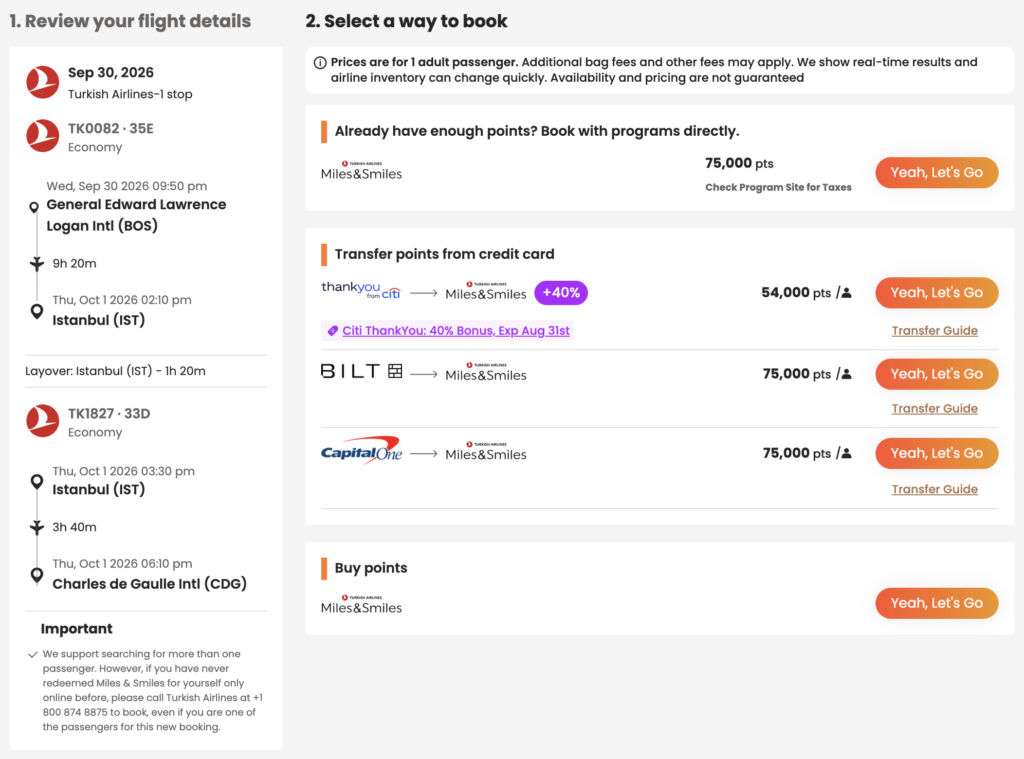
In some cases, transferring your points may require fewer points than booking through your bank’s travel portal. If a credit card transfer bonus is available, that number could be even lower.
Having transfer partners gives you more ways to use your points instead of relying on other redemption options, such as booking through your bank’s travel portal, covering purchases on your credit card statement, or redeeming points for gift cards.
Not Every Credit Card Has the Same Transfer Partners
Each credit card rewards program has its own list of airline and hotel transfer partners.
For example, Chase Ultimate Rewards includes United MileagePlus as a transfer partner, while American Express Membership Rewards partners with Delta SkyMiles.
Capital One Miles, Citi ThankYou Rewards, Bilt Rewards, U.S. Bank Altitude Rewards, and Wells Fargo Rewards all have their own mix of airline and hotel partners.
One of the most important things to remember is that transferring points is a one-way transaction.
Once your credit card points become airline miles or hotel points, you can’t transfer them back. That’s why it’s always a good idea to search for the award you want before transferring your points.
Once you’ve found the flight or hotel you want, you can identify the appropriate transfer partner, check for any available transfer bonuses, and transfer only the points you need to complete your booking.
If you’ve ever seen an offer like “Transfer your points and get 25% more Flying Blue miles,” you might have wondered what that actually means in the simplest of terms.
That’s a credit card transfer bonus.
Instead of receiving the normal number of airline miles or hotel points when you transfer rewards, a transfer bonus gives you a little something extra for making the same transfer.
Here’s how transfer bonuses work, when they can be useful, and how to keep track of current offers.
What Is a Credit Card Transfer Bonus?
A credit card transfer bonus is a limited-time promotion that increases the number of airline miles or hotel points you receive when transferring rewards from an eligible credit card program.
For example, imagine you transfer 10,000 Chase Ultimate Rewards points to Air France-KLM Flying Blue.
Under normal circumstances, 10,000 Chase Ultimate Rewards points become 10,000 Flying Blue miles.
During a 25% transfer bonus, those same 10,000 Chase Ultimate Rewards points become 12,500 Flying Blue miles.
SJO / ISTOCK
You’re transferring the same number of credit card points. The transfer bonus simply gives you more airline miles or hotel points once the transfer is complete.
Those extra miles or points may not sound like much at first, but they can reduce the number of credit card points needed for a trip. And those savings can add up over time.
Which Credit Card Programs Offer Transfer Bonuses?
Transfer bonuses are most commonly offered by flexible rewards programs (credit card rewards that can be transferred to multiple airline and hotel loyalty programs).
These often include:
American Express Membership Rewards
Bilt Rewards (typically on the first of the month as part of Rent Day promotions)
Capital One Miles
Chase Ultimate Rewards
Citi ThankYou Rewards
Each program runs promotions throughout the year, and the participating airline or hotel partners can vary from one offer to the next.
MILORAD KRAVIC / ISTOCK
How to Find Current Transfer Bonuses
Transfer bonuses come and go throughout the year, and each bank runs promotions on its own schedule.
Understandably, keeping track of them across multiple rewards programs can quickly become a chore.
PointsYeah keeps an up-to-date list of current credit card transfer bonuses. This makes it easy to see which bank programs and airline or hotel partners are currently offering promotions.
Even better, when you’re searching for award flights with PointsYeah, eligible transfer bonuses are automatically factored into your search results. That means you can compare your options without having to calculate the bonus yourself.
POINTSYEAH
Should You Transfer Points During a Bonus?
Not necessarily.
A transfer bonus can make an award booking more attractive, but it doesn’t automatically mean you should transfer your points.
Before you do anything with your credit card points, it’s worth considering a few things:
Is the award flight or hotel actually available?
Does transferring points cost less than paying cash?
Are you ready to book?
These questions matter because point transfers can’t be reversed. Once your credit card points become airline miles or hotel points, you can’t transfer them back.
Put differently, a transfer bonus is best viewed as an opportunity and not a reason to book a trip. If you’ve already found the award you want, a bonus can help your points go a little further. If you haven’t, it’s usually better to keep your points where they are until you’re ready to book.
One of the biggest advantages of earning rewards through a travel credit card is the flexibility you have when it’s time to book travel.
Unlike airline miles, many credit card points can be transferred to multiple airline loyalty programs. Instead of being locked into a single airline, you can choose the program that best suits your trip.
If you’ve never transferred credit card points before, the process is easier than you might think. And once you understand which airline partners your bank works with, transferring your points usually takes only a few minutes.
Here’s how to convert your credit card points into airline miles.
Credit card point transfers are one-way. Once your points become airline miles, you can’t transfer them back to your credit card rewards program.
That’s why it’s usually best to:
Search for your award flight first.
Confirm that seats are available.
Compare the cash price with the points required.
Transfer only the number of points you need to complete your booking.
PointsYeah makes this process much easier by showing live award availability across supported airline programs.
Search results also identify which transferable credit card currencies can be used for a particular redemption and highlight any applicable transfer bonuses.
ROSSHELEN / ISTOCK
American Express Membership Rewards
American Express airline transfer partners
American Express Membership Rewards points are transferable to the following airline loyalty programs.
Most Amex transfers process instantly, though transfer times can vary by the airline.
One important exception involves transfers to U.S.-based airline programs such as Delta SkyMiles and JetBlue TrueBlue. American Express charges an excise tax offset fee of 0.06 cents per point transferred (up to a maximum of $99) for these transfers.
While you can use Membership Rewards points to cover the fee at checkout, you’re generally better off paying it with your American Express card and saving your points for travel.
How to transfer American Express Membership Rewards
Sign in to your American Express account.
Open Rewards & Benefits, then select Transfer Points.
Choose your airline loyalty program and link your account if necessary.
Enter the number of Membership Rewards points you’d like to transfer.
Review the information and confirm your transfer.
Bilt Rewards
Bilt airline transfer partners
Bilt Rewards Points are transferable to the following airline loyalty programs.
Note: Transfer ratios vary depending on your Citi ThankYou-earning card. Be sure to confirm the transfer ratio that applies to your account before transferring points.
Most Citi transfers process instantly, though transfer times can vary by the airline.
How to transfer Citi ThankYou Rewards
Sign in to ThankYou.com.
Select PointsTransfer.
Choose your airline partner.
Enter the number of ThankYou points you’d like to transfer.
Confirm your transfer.
U.S. Bank Altitude Rewards
U.S. Bank airline transfer partners
U.S. Bank Altitude Rewards points are transferable to the following airline loyalty programs.
Most Wells Fargo transfers process instantly, though transfer times can vary by the airline.
How to transfer Wells Fargo Rewards
Sign in to your Wells Fargo account.
Select Wells Fargo Rewards.
Tap See All Options, then Rewards Points Transfer.
Choose your airline partner.
Enter the number of points you’d like to transfer.
Review the information and submit your transfer.
Things to Know Before You Transfer
Transfers are usually final
In most cases, transfers from a credit card rewards program to an airline loyalty account can’t be reversed.
Before transferring your points, make sure you’ve found the award flight you want, and you’re ready to complete the booking.
POIKE / ISTOCK
Transfer times can vary
Most transfers happen within minutes, but not every airline processes transfers at the same speed.
Occasionally, transfers may take several hours or even a few days. And your first transfer to a particular airline loyalty program may also take longer than subsequent transfers, especially if your loyalty account hasn’t been linked before.
While delays are relatively uncommon, they’re worth keeping in mind if you’re booking an award with limited availability.
Transfer bonuses can stretch your points further
Banks periodically offer transfer bonuses that increase the number of airline miles you receive from the same number of credit card points.
For example, a 25% transfer bonus means 10,000 transferable credit card points become 12,500 airline miles instead of the usual 10,000.
Before transferring your points, check our Current Credit Card Transfer Bonuses guide to see whether an active promotion could help you receive more airline miles.