JetBlue is getting ready to launch its take on first class. And now we know more about what the experience will look like.
The airline revealed new details Tuesday about BlueFirst, its domestic first-class product. The first aircraft with BlueFirst will take off later this year, and tickets will become available to book sometime this fall.
Where BlueFirst will fly first is still a mystery. But JetBlue says initial routes and more details about booking availability will be announced later this year.
What to Expect From JetBlue BlueFirst
BlueFirst will feature a fairly traditional domestic first-class layout, with seats arranged 2-2 in the first few rows of the plane. They’ll offer five inches of recline and up to seven inches more legroom than JetBlue’s standard Main seats.
Each seat will have a 13.3-inch entertainment screen with Bluetooth connectivity, plus USB-A, USB-C, and standard power outlets. Free inflight Fly-Fi isn’t going anywhere.
But as JetBlue executives told Points Insider at the recent opening of the airline’s Boston BlueHouse, the goal isn’t to copy what everyone else is doing in first class.
JetBlue sees an opportunity to put its own spin on the experience while sticking to what executives described as “affordable luxury.”
SPONDYLOLITHESIS / ISTOCK
The seat itself doesn’t stray far from the domestic first-class formula. Some of JetBlue’s more interesting twists come with the service.
BlueFirst customers will be able to order food and drinks from the seatback screen. A new “Mixologist Mode” will even let passengers build a cocktail by choosing a spirit, mixer, and flavorings before sending the order to the crew.
On flights of at least 899 miles, meals will include an entrée, side, and dessert served in a bento-inspired box. Premium snacks will be available on every flight, while passengers on overnight flights will get a blanket and snooze kit.
“Domestic first class has become easy to predict. We think it’s time for a fresh take,” JetBlue CEO Joanna Geraghty said. “Customers are increasingly looking for more premium experiences, and BlueFirst gives them an elevated experience that feels distinctly JetBlue.”
BlueFirst also comes with the more familiar first-class perks, including Group 1 boarding, dedicated overhead bin space, priority check-in and baggage delivery, two free checked bags, and expedited security lanes at more than 30 airports.
JetBlue will share more about Mosaic perks for BlueFirst closer to its arrival.
Another Piece of JetBlue’s Premium Push
BlueFirst isn’t meant to replace Mint. Instead, it fills a big hole by giving JetBlue a bona fide premium cabin on routes where it doesn’t offer lie-flat seats.
Passengers will be able to book BlueFirst on routes not served by a Mint-equipped aircraft.
It’s also the latest piece of a much bigger shift for the airline. JetBlue now has BlueHouse lounges in New York (JFK) and Boston (BOS). And BlueFirst brings that premium push onto more of its airplanes.
We still don’t know where BlueFirst will debut or, more importantly, how much it will cost.
And the price may ultimately tell us just as much about whether JetBlue can deliver on its vision of “affordable luxury” as the cocktails and bigger seats do.
JetBlue was a late arrival to the airport lounge scene.
While other major U.S. airlines spent years building out lounge networks, JetBlue focused primarily on the experience onboard. That changed in December 2025, when the airline opened its first BlueHouse lounge at New York (JFK).
Boston (BOS) followed in August 2026.
The network is still small, but BlueHouse gives eligible JetBlue travelers a dedicated place to eat, grab a drink, work, or relax before a flight.
Here’s where to find JetBlue’s BlueHouse lounges, who can get in, and what to know before visiting.
TYLER GLATT / POINTS INSIDER
Where Can You Find JetBlue BlueHouse Lounges?
JetBlue currently operates two BlueHouse lounges, located in its two largest markets.
Airport
Location
New York (JFK)
Terminal 5 near Gate 526
Boston (BOS)
Terminal C near Gate C23
A third location could eventually follow.
JetBlue has publicly said it’s exploring a BlueHouse lounge at Fort Lauderdale (FLL), one of its largest focus cities and an important gateway to the Caribbean and Latin America. For now, though, the airline hasn’t confirmed plans to build one.
Travelers departing on a confirmed Mint or Mint Flex fare.
Additional guests cost $39 each.
Don’t check any of those boxes? You’re not out of luck.
There are also several ways to purchase access. Eligible Mosaic members and JetBlue Plus and Business cardholders can purchase one-time passes for $59 or $79, depending on how they qualify.
Passes are subject to availability and may not be sold when the lounge is busy.
The most important restriction is that “Base” fares aren’t eligible for BlueHouse access, even if the traveler would otherwise qualify. That includes Main Base, EvenMore Base, and Mint Base fares.
What Can You Expect Inside a JetBlue Lounge?
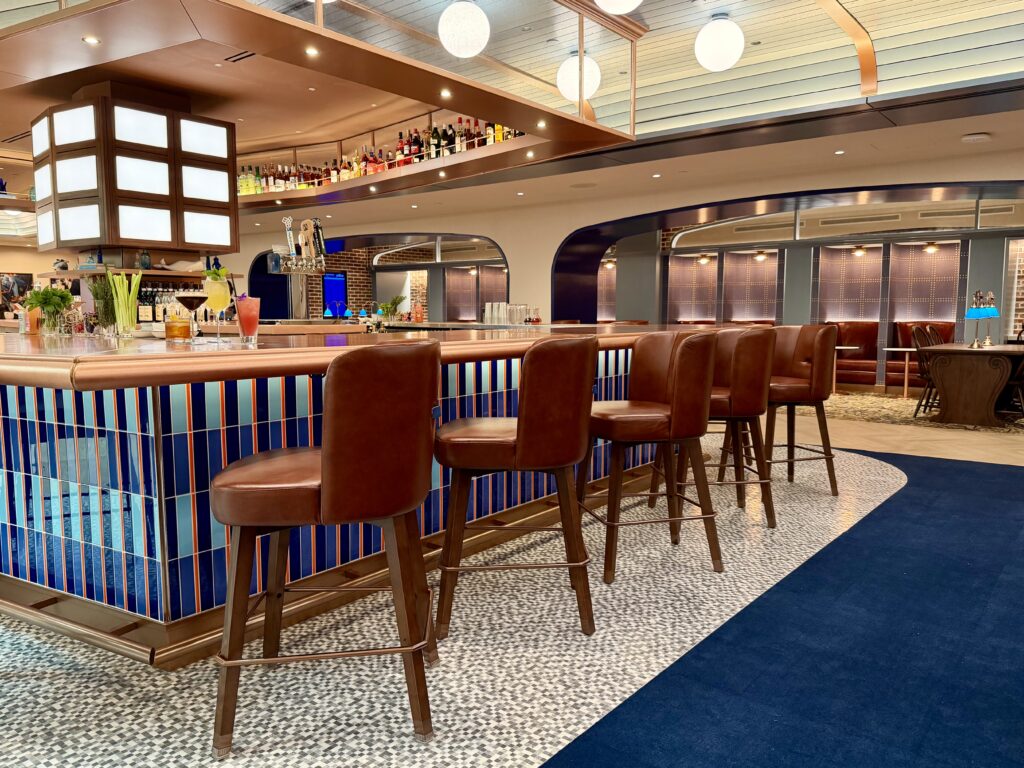
BlueHouse doesn’t reinvent the airport lounge. It just feels more like JetBlue.
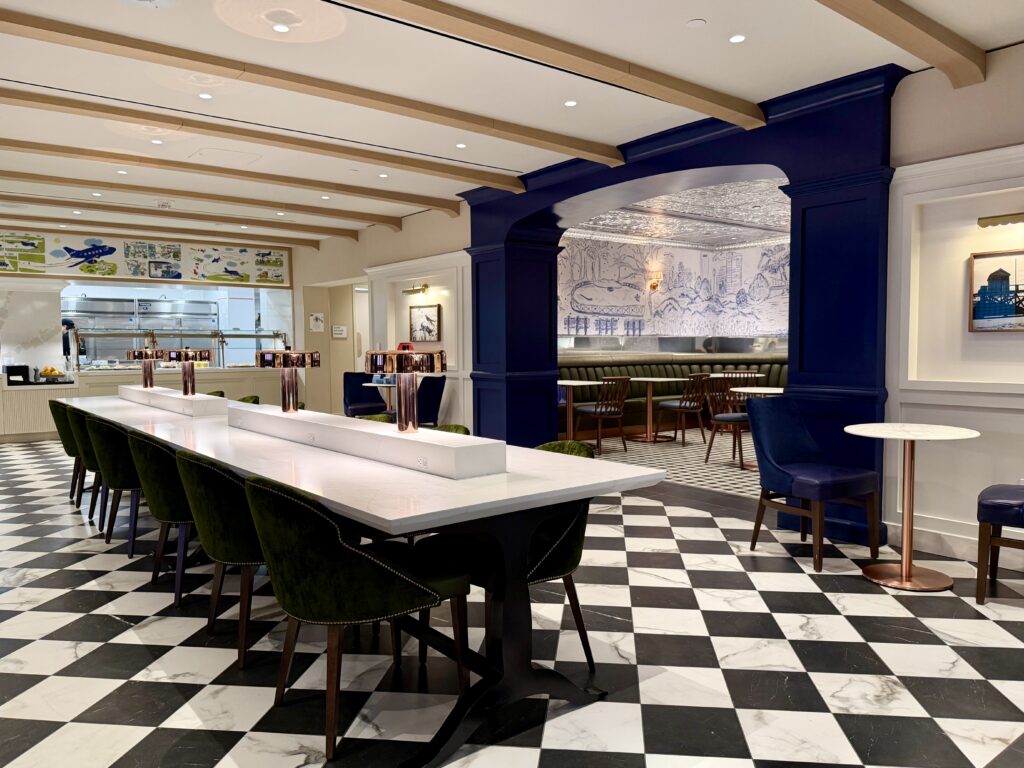
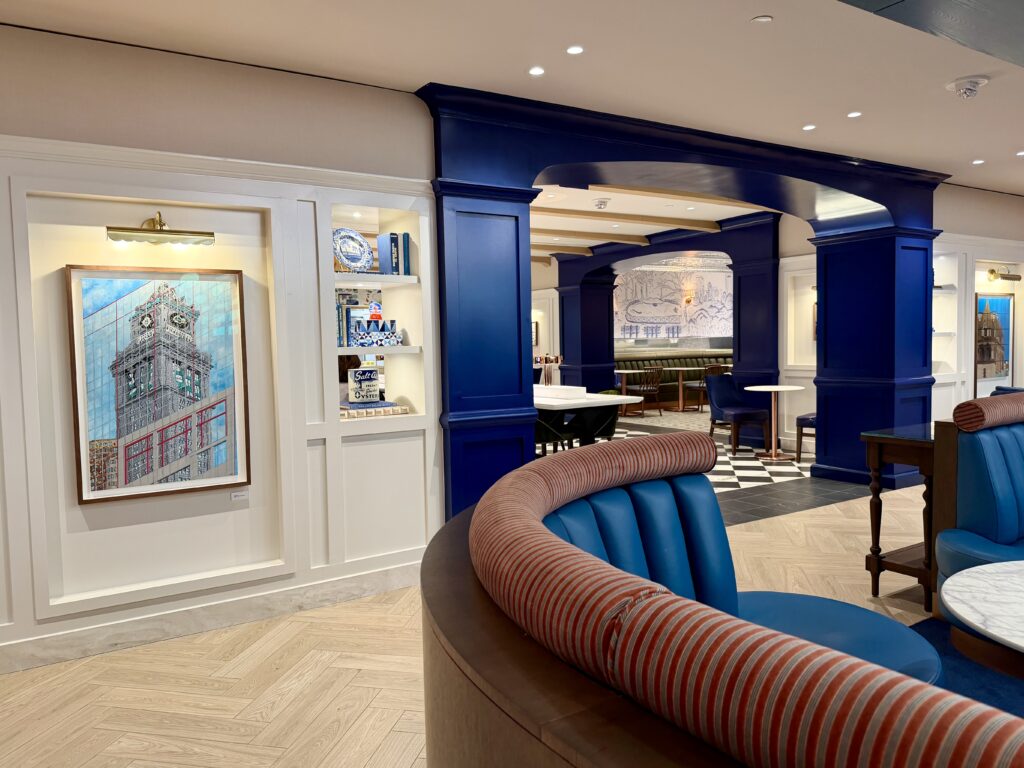
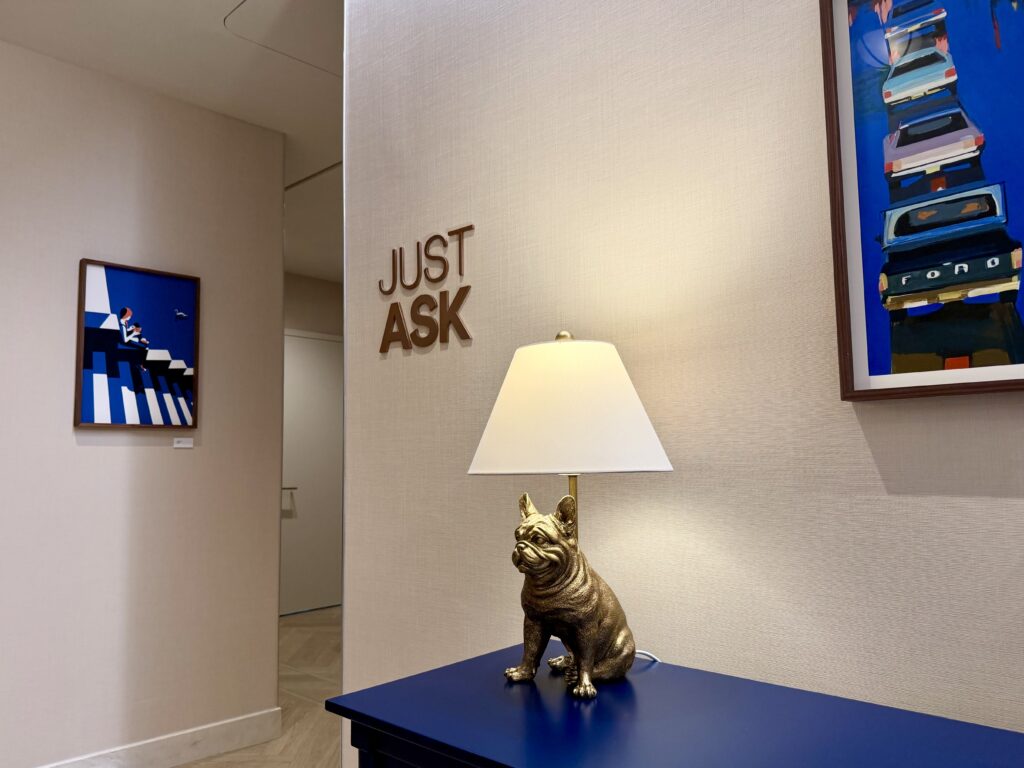
Rather than making both locations identical, JetBlue incorporates local artwork, design, food, and drinks into each lounge.
New York (JFK) is designed to feel a bit like a stylish New York apartment, with local touches that include coffee from Joe Coffee, cocktails developed with Please Don’t Tell, and beer from The Greats of Craft. Boston (BOS) takes the same hometown approach in a very different direction, with New England-inspired design, George Howell Coffee, and a full-service kitchen serving rotating menus.
JFK also offers hot food, although its current setup is more grab-and-go until the lounge gets a kitchen of its own.
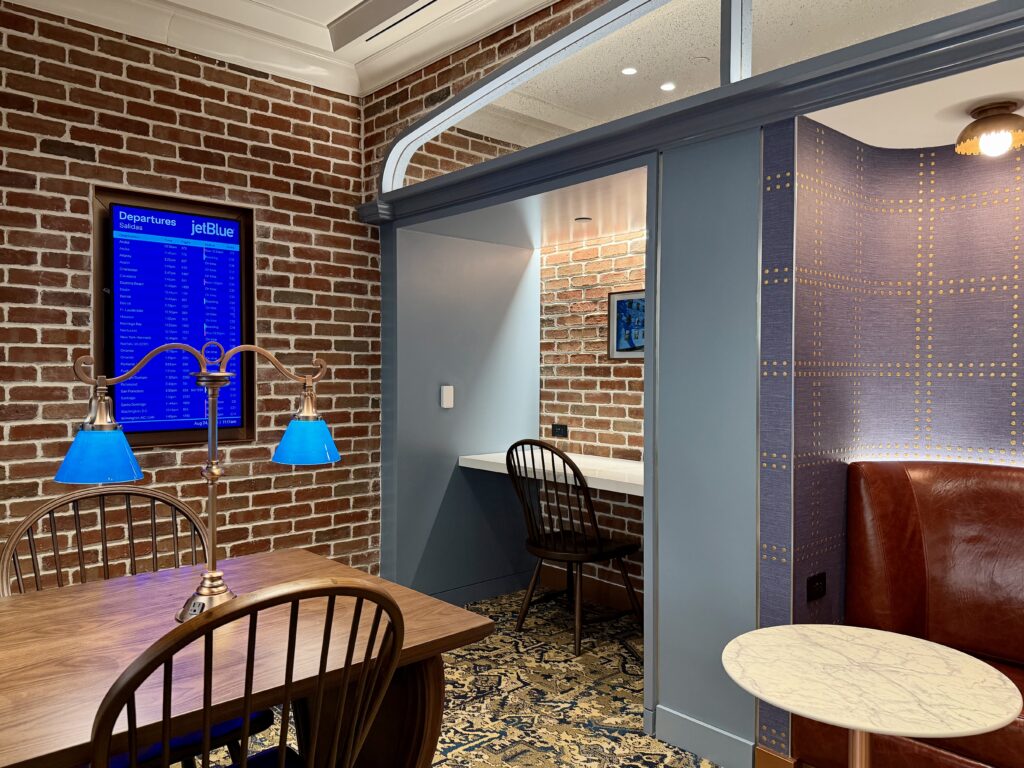
Beyond that, the basics are familiar. Expect complimentary food and drinks, Wi-Fi, power outlets, and a mix of spaces for working or relaxing before a flight.
TYLER GLATT / POINTS INSIDER
A Few Things to Know Before You Go
A few rules are worth knowing before heading to BlueHouse:
Bring a government-issued photo ID and a same-day boarding pass for an eligible JetBlue-operated flight.
Access is generally limited to three hours before departure. Different rules apply when connecting between JetBlue-operated flights.
You’ll need access to the terminal where the lounge is located. JetBlue doesn’t issue gate passes solely for visiting BlueHouse.
Entry may be limited when a lounge reaches capacity.
Amenities vary between locations.
Because access policies can change, it’s worth confirming the latest rules with JetBlue before a trip if BlueHouse access is important to your plans.
We were supposed to get inside JetBlue’s new BlueHouse lounge at Boston Logan International Airport a little earlier Monday morning.
Instead, the doors stayed closed while a few last things were straightened, adjusted, and made picture-perfect. Reporters and photographers waited outside for the first look.
That seemed appropriate for an airport lounge years in the making and just three days away from greeting its first real passengers.
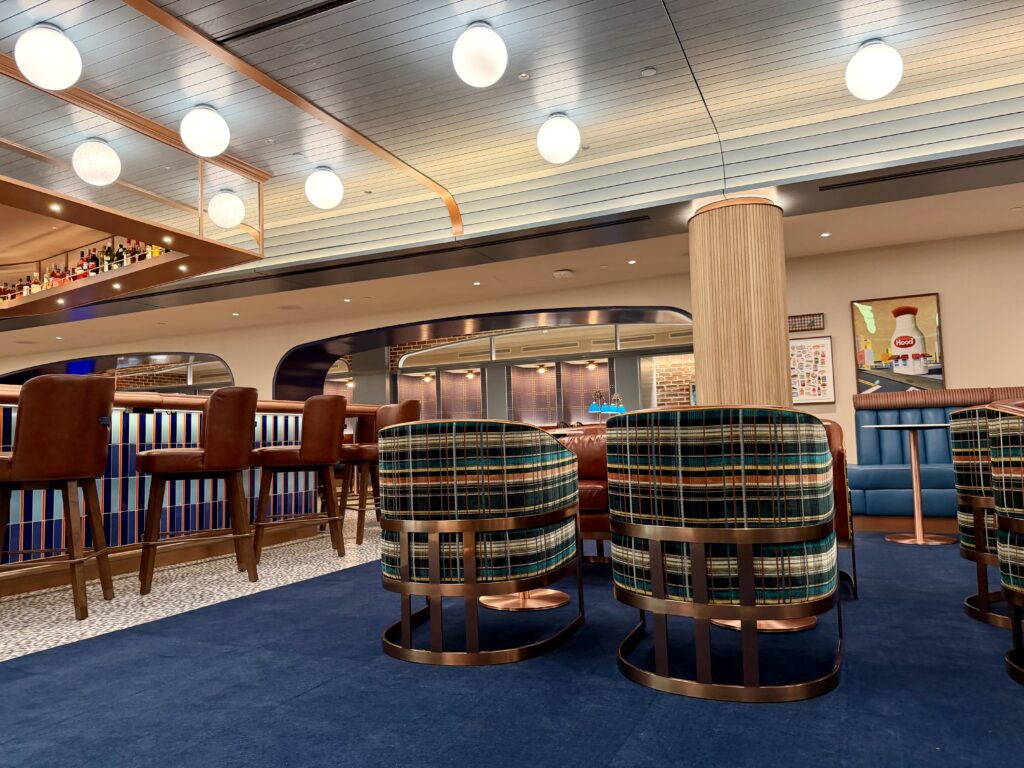
Once inside, everything was exactly where it belonged. The bar was clean, the food display was impressive, and the chairs sat exactly where someone had decided they should sit.
JetBlue employees and executives guided the group around the room, pointing out big and small details while cameras captured a version of BlueHouse Boston that probably won’t exist for very long after it opens Thursday.
That’s one of the stranger parts about previewing an airport lounge.
You can inspect the food, sit in the chairs, count the outlets, and document just about every square inch. What you can’t know is whether the kitchen keeps up when the lounge nears capacity, whether the quiet corners stay quiet, or whether anyone can find somewhere to sit on a busy afternoon.
Calling any of that a review would be a stretch. But a nearly empty lounge says plenty of other things.
For roughly the first 25 years of its existence, JetBlue didn’t have an airport lounge. In the last year, it’s opened two, and standing inside the second one makes it fairly obvious that the most interesting thing about it isn’t simply what JetBlue built in Boston.
It’s why an airline that went so long without lounges decided it could no longer live without them.
A BlueHouse That Doesn’t Look Like the Other BlueHouse
JetBlue’s two BlueHouse lounges don’t have a ton in common.
That’s by design.
Ciara Cordasco, manager of product design at JetBlue and someone who worked on designing both lounges, said the lone thread connecting the two is the color blue.
Stephanie Evans Greene, JetBlue’s senior vice president of marketing and brand, described Boston as a “love letter” to the city. JetBlue used the same language when it opened New York, but the idea gave designers plenty of freedom to decide what a love letter to Boston should actually look like.
Some of those interpretations are unmistakable.
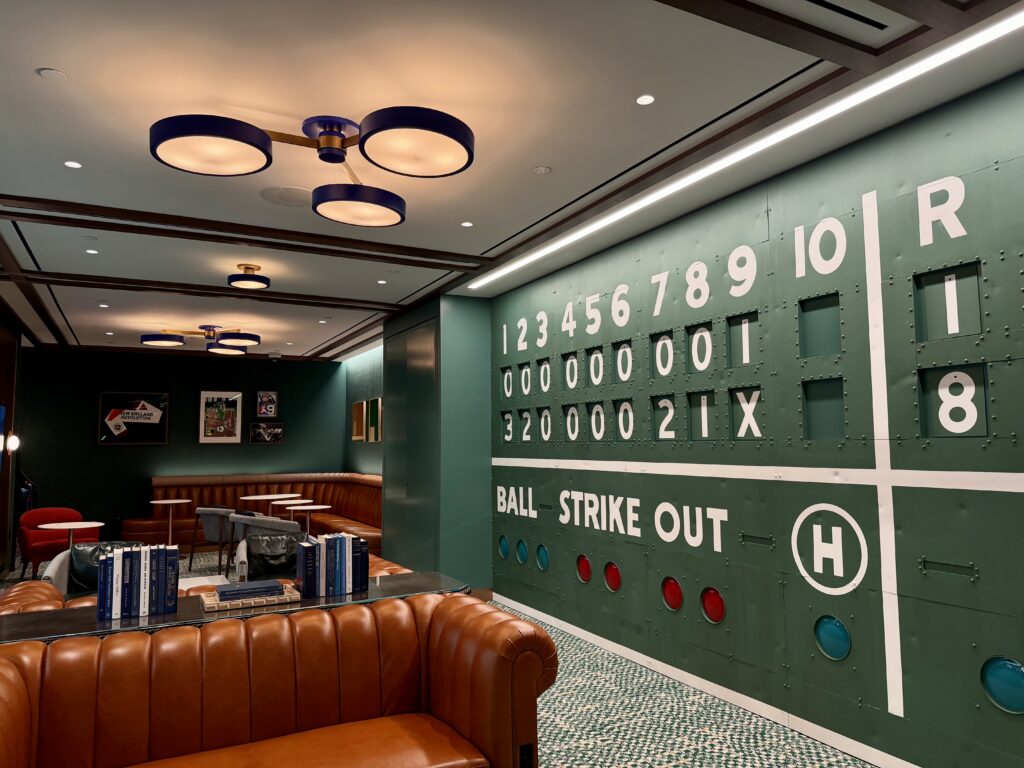
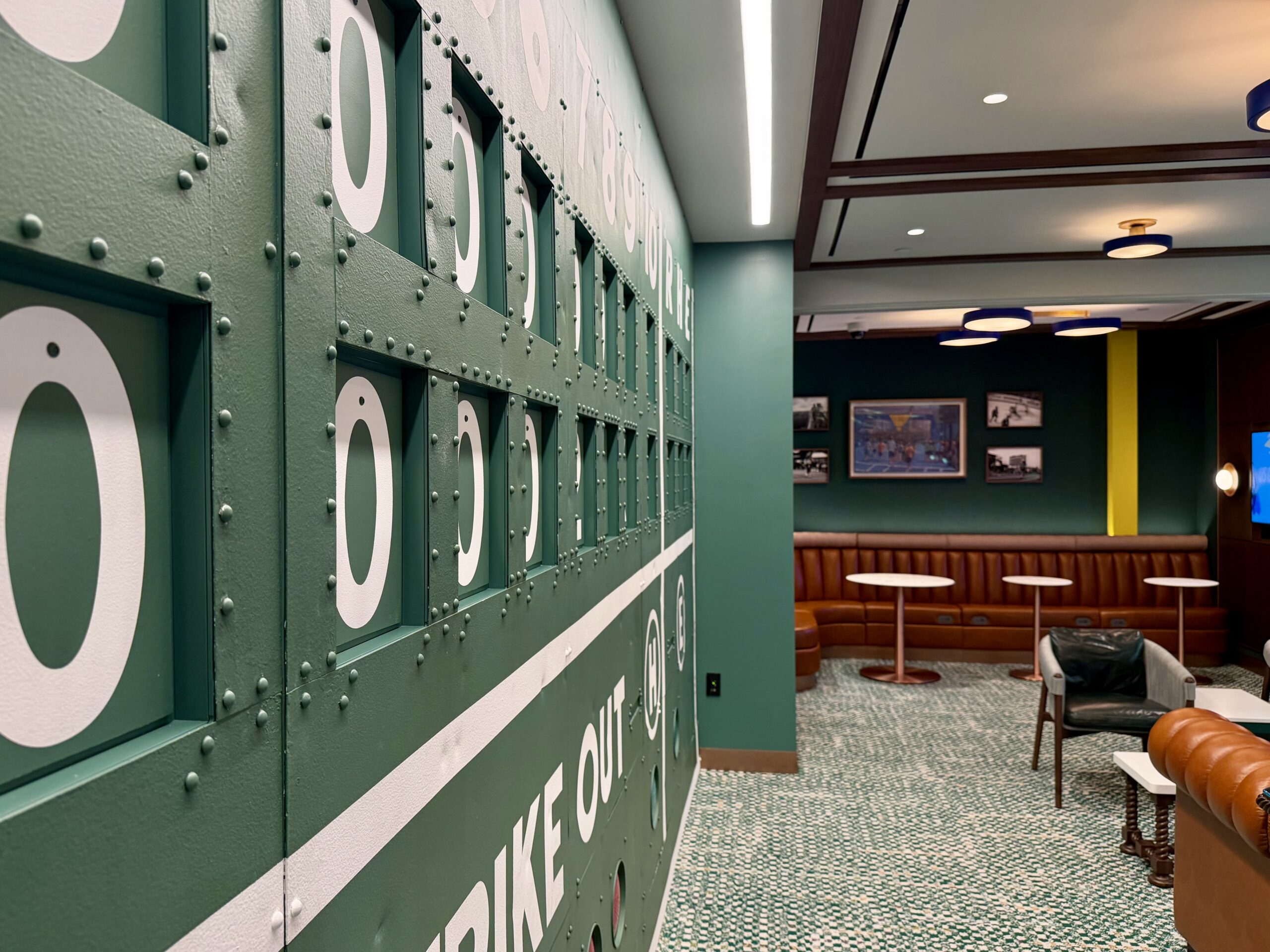
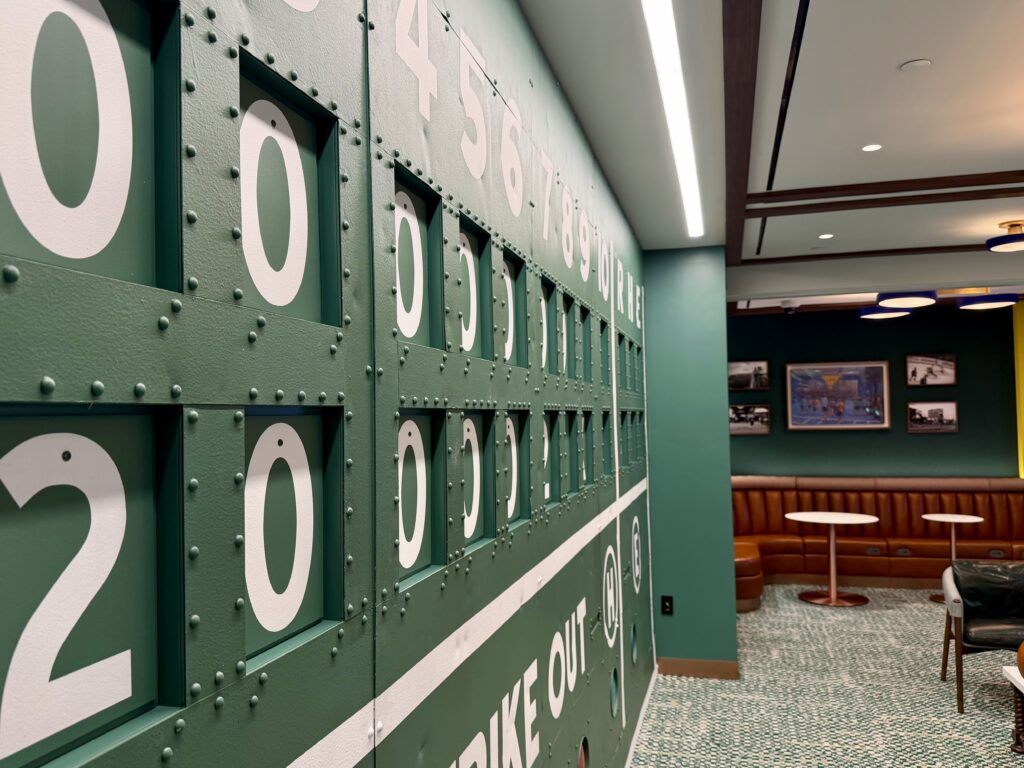
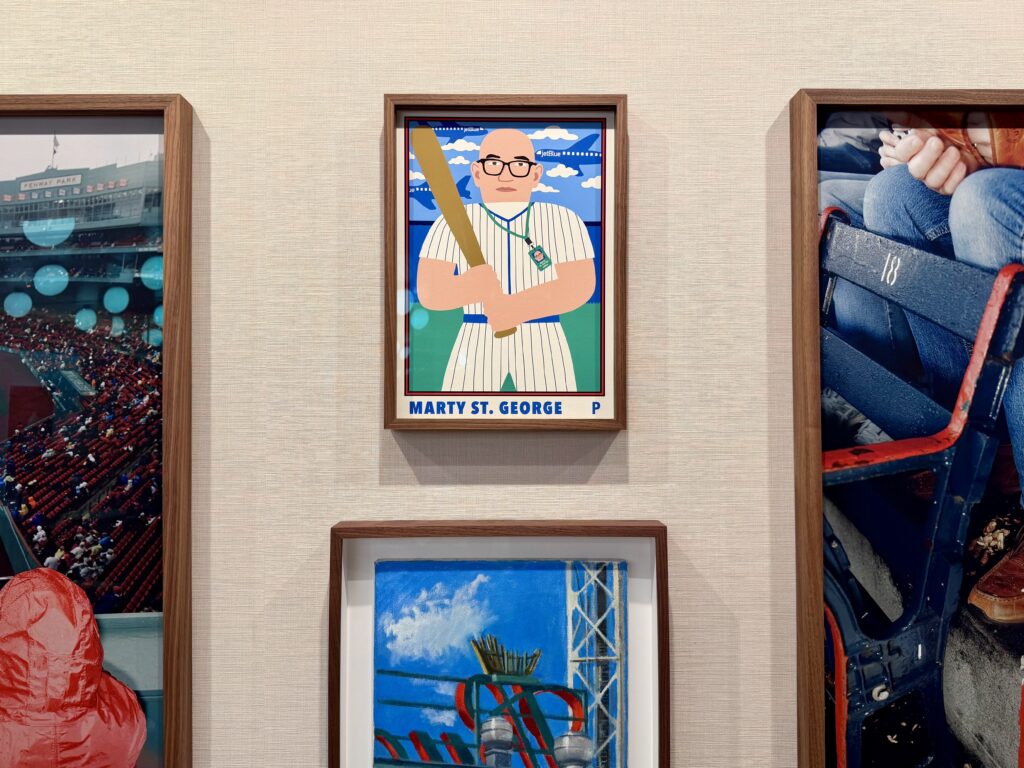
The Dugout borrows from Fenway Park’s Green Monster, baseball dents and all. Tables elsewhere were meant to look like near-replicas of those at the Boston Public Library. Local sports teams contributed memorabilia and photography, and tucked among it all is a trading card featuring JetBlue President Marty St. George, an Easter egg Evans Greene pointed out to me after the formal tour.
Hanging that wasn’t St. George’s idea.
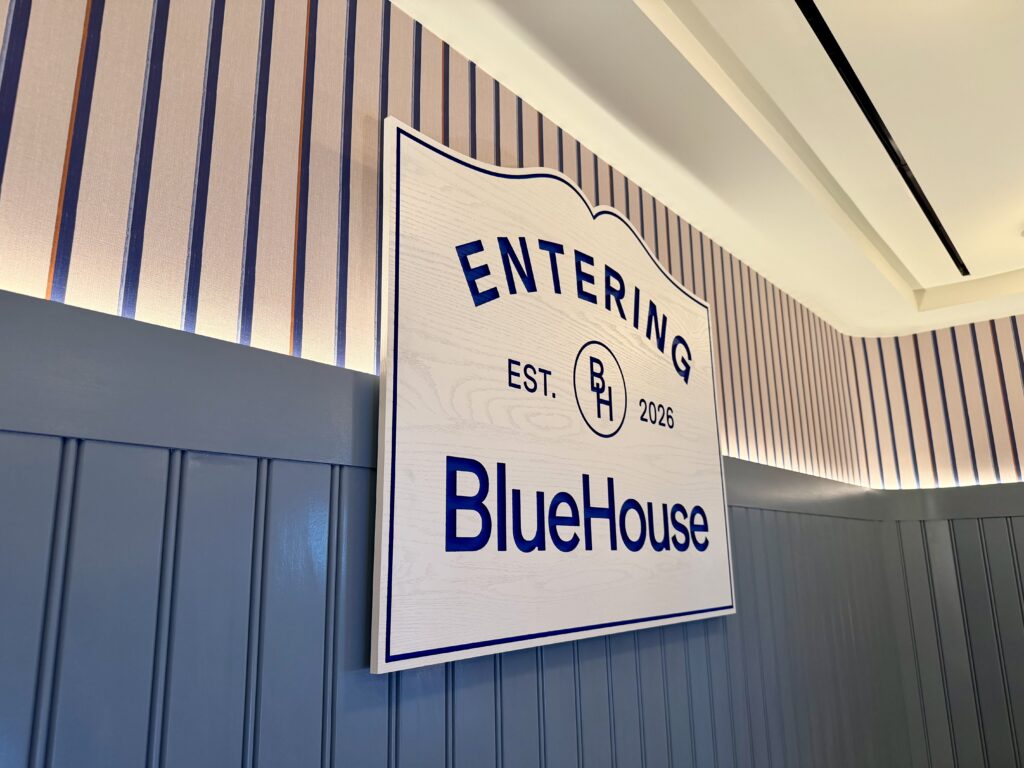
One of my favorite little details is right out front. There’s a peephole near the big blue door, and if you look through it, you’ll find Paul Revere riding an Embraer E190.
I asked Cordasco where that idea came from. At some point during the design process, she said, the question became, “What’s the wildest thing we could do?”
Apparently, this was it.
There’s a reason the Boston references are fairly easy to recognize. At JFK, JetBlue found that some of the artwork left passengers asking a pretty basic question about what, exactly, they were looking at. St. George said they made a point of avoiding that in Boston, and I also learned he had a big hand in deciding what deserved space on the walls.
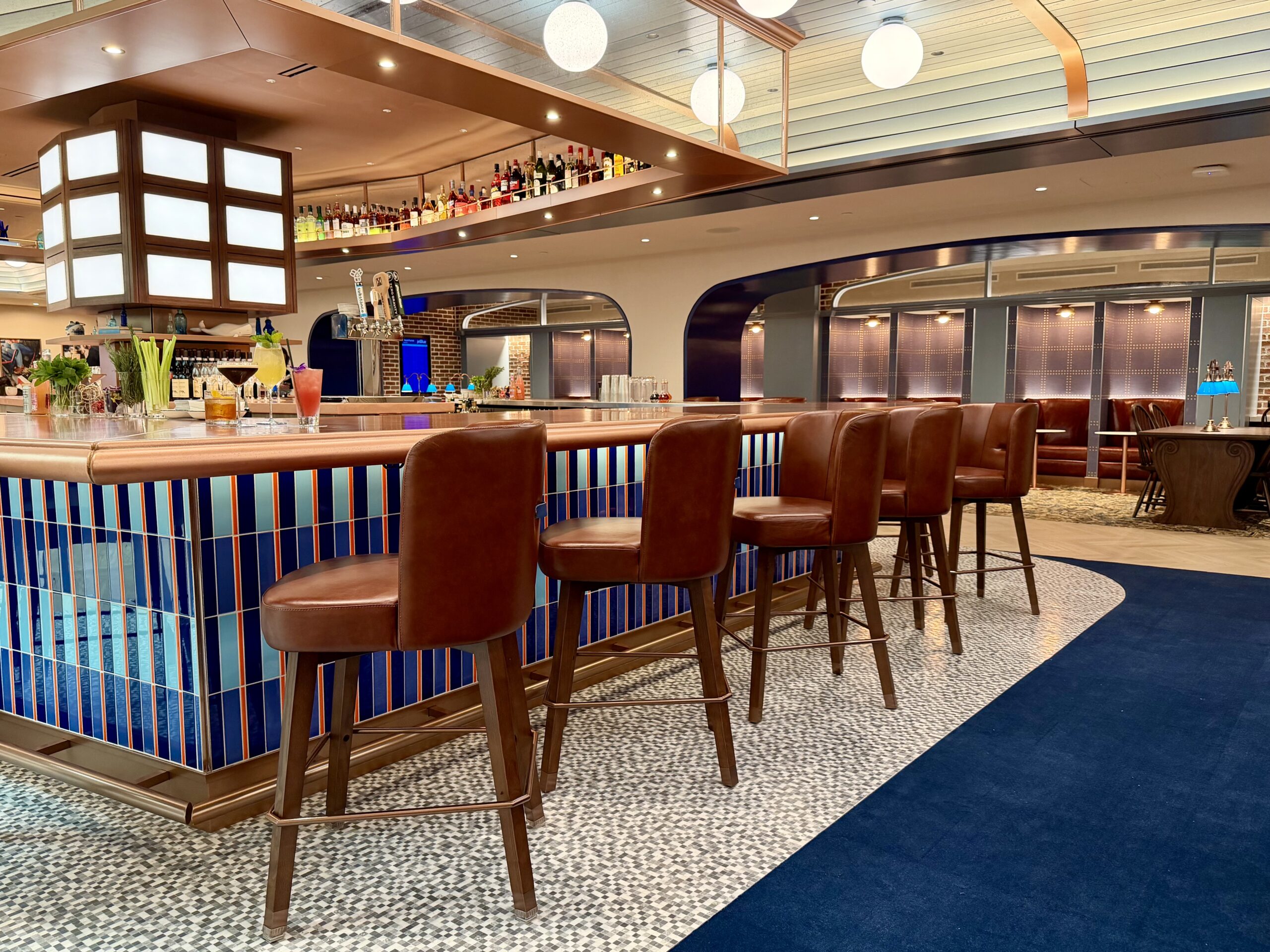
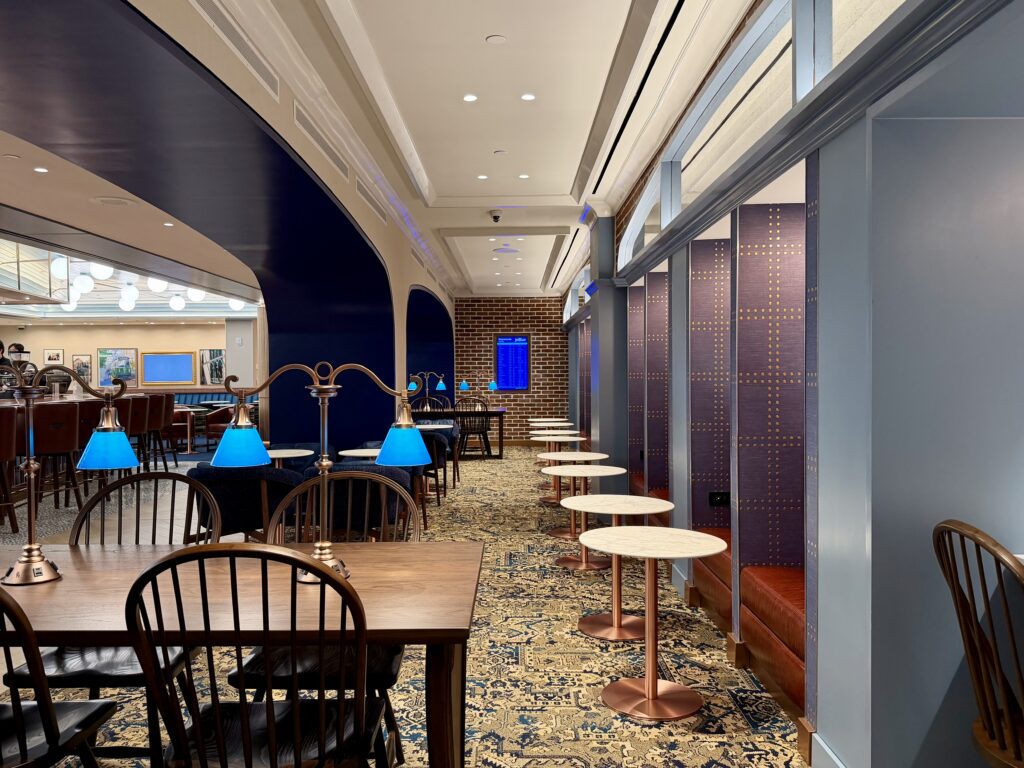
The result feels cozy for a lounge without true windows. Wood and copper finishes run through much of the space, orange accents break up all the blue, and the seating is divided into enough nooks and smaller arrangements that the nearly 12,000-square-foot lounge doesn’t feel like one enormous room
But not every lesson the airline took from New York was about design.
When I asked Ed Pouthier, JetBlue’s vice president of loyalty and personalization, about the airline’s biggest takeaway from operating its first lounge, he didn’t hesitate. It was the food. Others agreed.
JFK doesn’t have a full kitchen yet, and customers haven’t exactly been shy about telling JetBlue what they think about that.
Boston does.
That gives the airline considerably more room to play with the menu. Food will rotate seasonally, lobster rolls are among the local staples, although only in the afternoon, and George Howell Coffee is available both from self-service machines and made to order.
Work on Boston began around the same time as New York, so this isn’t BlueHouse 2.0. This new lounge wasn’t designed after JetBlue had months to figure out everything it liked and didn’t like about JFK.
But by the time Boston opens at 5 a.m. Thursday, the airline has something it didn’t have when either project began.
It knows what happens when passengers start coming through the doors.
The Strange Business of Becoming More Premium
The more interesting change at JetBlue is bigger than what’s being served for lunch near Gate C23.
JetBlue built much of its reputation by making the ordinary flying experience less ordinary. Seatback televisions weren’t exclusively for passengers at the front of the airplane, and neither were snacks people wanted to eat. At its core, the basic proposition wasn’t that JetBlue could make premium travel more luxurious. It was that sitting in economy didn’t have to feel quite so much like sitting in economy.
Airport lounges work a little differently.
By design, not everyone gets through the door. BlueHouse is still primarily a perk for some of JetBlue’s highest-value customers, although the airline is widening the ways other passengers can pay to get inside.
The lounges aren’t happening in isolation, either.
Mint already gives JetBlue a premium cabin on transcontinental and transatlantic routes, along with other markets where the airline has to put its best foot forward. JetBlue now has two BlueHouse lounges and a premium credit card that Pouthier told me continues to outperform expectations. Later this year, the airline also plans to begin rolling out BlueFirst and bring domestic first class to aircraft that have historically offered only variations of economy.
JetBlue could have gone in another direction and spent this chapter doubling down on the economy experience that made the airline unusual in the first place.
Instead, it’s building considerably more above it.
Pouthier put the direction far more plainly than I would’ve expected Monday. JetBlue, he said, is “on the cusp of becoming a premium airline.”
American, Delta, and United have had decades longer to build the premium ecosystems JetBlue is now trying to create. That’s something Pouthier acknowledged. But he sees an opportunity for JetBlue to approach premium differently, including through what he described as “affordable luxury.”
JetBlue also has some interest in doing premium differently. BlueHouse has its quirks, and Pouthier hinted that BlueFirst will come with some JetBlue-like “twists” of its own.
That’s a pretty remarkable change of pace for an airline that didn’t have a lounge or premium credit card at all until last year.
St. George didn’t pretend getting BlueHouse from an idea to an actual lounge had been easy. He described the process as painful at times, but said the result was more than worth it.
JetBlue’s own JetForward plan (the broader strategy it has been using to reshape the airline) makes the connection fairly explicit. Lounges sit alongside domestic first class and the premium card among the product and perk enhancements JetBlue says are intended to improve customer retention and acquisition.
BlueHouse isn’t simply another amenity JetBlue decided it needed to check off a list. It’s one piece of the airline JetBlue is trying to become.
I’ve been fortunate enough to see a lot of airport lounges, both at media previews like this one and the decidedly less pristine way most people experience them as passengers. A fancy bar, expensive coffee, handcrafted cocktails, comfortable furniture, and a few references to the city outside increasingly feel like the price of admission in a newly built or remodeled lounge.
JetBlue has all of those things in Boston, which is why some of the details that serve absolutely no practical purpose are more interesting to me.
Nobody needed to put Paul Revere on an E190.
It doesn’t make the lounge more functional, and nobody is going to book a JetBlue flight because they can peer through a hole in the wall and see it. Someone internally simply asked what the wildest thing they could do was and got permission to do it.
That’s pretty cool.
But when I asked Evans Greene what she thought made the lounge particularly JetBlue in ways travelers might overlook, she credited something that isn’t part of the design at all.
The people working in it.
Evans Greene said JetBlue has been particularly deliberate about selecting the crew members who work in BlueHouse because the interactions travelers have once they’re inside can be among the most memorable parts of the experience. The bar, furniture, and artwork create a sense of place, but the people ultimately have a lot to do with whether it feels like the airline whose branding is on the door.
That’s harder to photograph than a lounge-sized replica of the Green Monster.
When the Lounge Stops Looking Like This
For now, BlueHouse Boston is still pristine. JetBlue spent roughly a year and a half transforming what had been an airport food court into a lounge capable of holding 200 people.
On Thursday, it gets turned over to the passengers.
They’ll move the chairs, probably spill a coffee or two, and quickly figure out which seats everyone wants and which ones they don’t. The kitchen will get tested in a way a room full of media members never could. Some people will notice the tiny Dunkin’ figurine tucked away inside and some won’t. Someone will almost certainly read the message hidden in the mail slot on the front door and head straight for the candy closet.
Pouthier has told me on more than one occasion that there’s one thing he particularly doesn’t want to see at a JetBlue lounge, and that’s a line. Modern air travel already gives travelers enough reasons to be stressed, and his view is that getting into a lounge, and the experience once you’re inside, shouldn’t become another one.
Whether BlueHouse can deliver on that is something Monday morning couldn’t explain. That starts Thursday, when the cameras are gone and JetBlue no longer gets to call the shots on where every chair or coffee cup belongs.
The interesting part isn’t whether JetBlue can build a nice lounge. Boston is proof that JFK wasn’t a fluke.
Now JetBlue gets to find out whether it can become a more premium airline without losing the things that made it JetBlue in the first place.