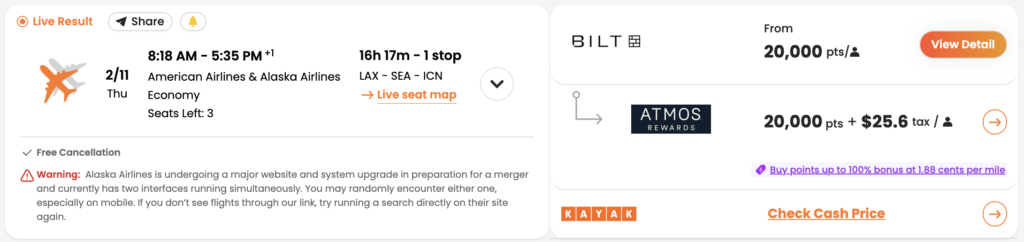
This month’s Global Getaways offers feature six destinations across Europe and Asia. One-way economy flights start at 20,000 Atmos Rewards points.
The promotion covers travel between January 15 and March 8, 2027, but there’s a relatively short window to take advantage of the deals. You’ll need to book by October 10, 2026.
October Atmos Rewards Global Getaways Deals
Six destinations are included in October’s promotion.
Destination
One-Way Starting Price
Seoul, South Korea (ICN)
20,000 points
Paris, France (CDG)
25,000 points
Helsinki, Finland (HEL)
25,000 points
Munich, Germany (MUC)
25,000 points
Stavanger, Norway (SVG)
30,000 points
Sapporo, Japan (CTS)
30,000 points
The advertised prices are starting rates, and the number of points required will depend on your departure airport and travel dates.
You’ll be on the hook for the necessary taxes and fees, too.
POINTSYEAH
Seoul is the least expensive destination in this month’s promotion, while Paris, Helsinki, and Munich all start at 25,000 points one-way.
And with the travel window running through early March, these deals could be useful for anyone considering a winter trip to Europe or Asia.
One lesser-known benefit of redeeming points and miles for flights is that, with some airlines, those trips can still count toward earning elite status.
Yes, it’s possible to fly using your miles and earn credit toward qualifying for elite status at the same time.
Not every airline offers this benefit, but it’s worth knowing about if you’re working toward a new status tier or trying to maintain the one you already have.
Here’s a look at five airline loyalty programs that offer elite status credit on eligible flights booked with points and miles.
Alaska Airlines Atmos Rewards
Atmos Rewards is particularly generous when it comes to earning elite status credit on flights booked with points.
Through the end of 2026, members earn 1 status point for every mile flown on eligible flights booked with Atmos Rewards points. That includes flights operated by Alaska Airlines, Hawaiian Airlines, and eligible partner airlines.
For example, a 2,500-mile flight booked with points could earn 2,500 status points, regardless of how many points you redeemed for the ticket.
But things are changing in 2027.
Starting January 1, Atmos Rewards members will be able to choose how they earn points and status points. And that choice will also determine how much status credit they earn on flights booked with points.
Segments flown: 500 status points per flight segment
For example, a 2,500-mile nonstop flight booked for 20,000 Atmos Rewards points would earn 2,500 status points under the distance-based option, 1,000 under the price-based option, or 500 under the segment-based option.
Of course, the math can change depending on the routes you fly and how many points you’re redeeming. One earning method could be considerably more rewarding than another.
One important distinction is that flights booked with points earn status points only, not additional redeemable Atmos Rewards points.
The earning rate is pretty simple: members earn 1 MQD for every 100 SkyMiles redeemed.
So, a Delta flight costing 40,000 SkyMiles would earn 400 MQDs toward Medallion status. And this benefit also extends to eligible upgrades purchased with miles.
However, Delta’s Main Basic fares are excluded from earning MQDs through mileage redemptions.
Members earn 1 PQP for every 100 MileagePlus miles redeemed, along with one PQF for each eligible United or United Express flight.
For example, a nonstop United flight costing 30,000 miles would earn 300 PQP and one PQF toward Premier status.
Eligible seat upgrades purchased with miles can also earn PQP.
The benefit also applies to United-operated segments on itineraries that include partner airlines. However, flights operated by those partners won’t earn PQP or PQF from the mileage redemption.
Another useful detail is that PQP goes to the person flying, not necessarily the person who redeemed the miles.
So, if you use your MileagePlus miles to book a flight for someone else, that traveler receives the qualifying credit.
United also allows members to use PQP earned from flights booked with miles toward additional PlusPoints, not just Premier status.
Unlike Delta and United, which calculate status earnings based on the number of miles redeemed, Virgin Atlantic awards a fixed number of Tier Points depending on the cabin.
Members earn the following amounts on eligible flights booked with points.
Economy: 25 Tier Points
Premium: 50 Tier Points
Upper Class: 100 Tier Points
That means two passengers redeeming different amounts of points for the same flight and cabin could earn the same number of Tier Points.
The benefit applies to eligible Virgin Atlantic-operated flights, not partner airline redemptions.
Qantas Frequent Flyer
Qantas offers a similar benefit, although there’s an additional requirement.
The number of Status Credits depends on the route and cabin. For example, an eligible business-class flight between Australia and the U.S. West Coast earns 72 Status Credits.
However, Qantas is retiring Points Club on December 8, 2026. Existing eligible members will retain their benefits through the end of their next membership year, so this benefit won’t disappear immediately for everyone.
What About Other Airlines?
The majority of major airline loyalty programs don’t offer elite status credit for flights booked with points and miles.
American Airlines AAdvantage, Air Canada Aeroplan, and Southwest Rapid Rewards are among the programs that exclude these flights from their standard flight-based elite qualification requirements.
It’s also worth distinguishing between earning elite status credit and earning additional redeemable miles. Even when a flight booked with points counts toward status, it generally won’t earn more miles for future travel.
If you’re working toward elite status, it’s worth checking whether flights booked with points count toward qualification. Depending on the airline, you could use points for your next trip without giving up progress toward your next status tier.
A few thousand airline points might not seem particularly useful. But with Atmos Rewards, they can get you farther than you might expect.
Short flights are one of the more interesting parts of the Atmos Rewards redemption charts. Partner flights within the Americas covering less than 600 miles start at just 4,500 points each way in economy.
Flights operated by Alaska or Hawaiian Airlines work a little differently. Routes covering less than 700 miles can also be particularly cheap, and we’ve found some starting below 4,500 points.
Here are seven examples we’ve found on PointsYeah, from the Bahamas and Canada to Hawaii and Alaska.
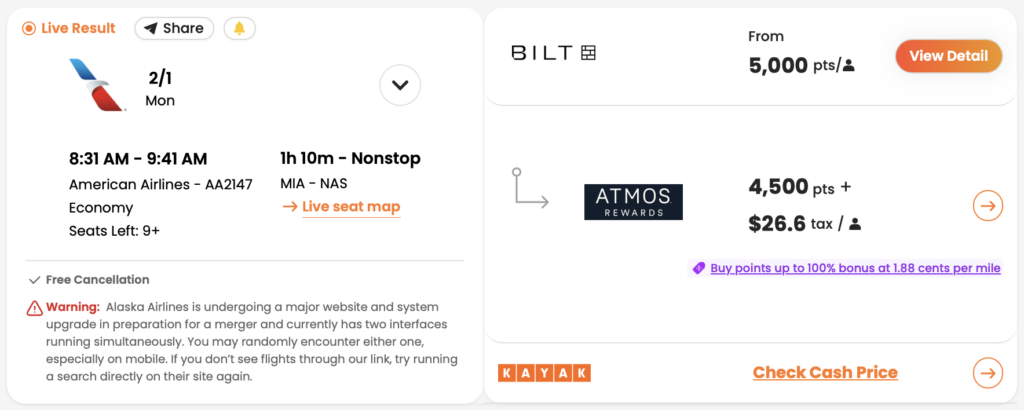
Miami to Nassau on American Airlines
One of the more fun uses of 4,500 points doesn’t even keep you in the U.S.
American Airlines flies from Miami (MIA) to Nassau (NAS). That flight covers less than 200 miles. And when the lowest partner price is available, it costs just 4,500 Atmos Rewards points in economy.
That’s not bad for a flight to the Bahamas.
POINTSYEAH
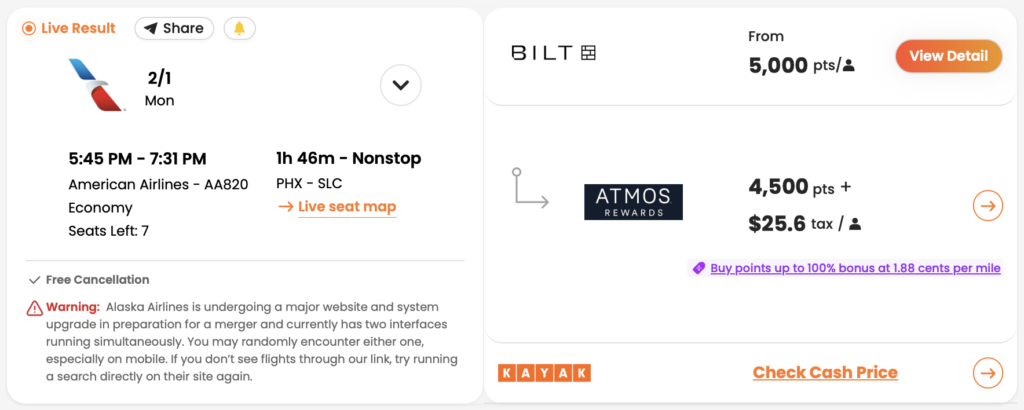
Phoenix to Salt Lake City on American Airlines
The same pricing works for more ordinary domestic travel.
American’s flight from Phoenix (PHX) to Salt Lake City (SLC) falls within the lowest distance band, and we’ve found seats for 4,500 points.
It’s a good example of how a small balance can cover a practical trip, too.
POINTSYEAH
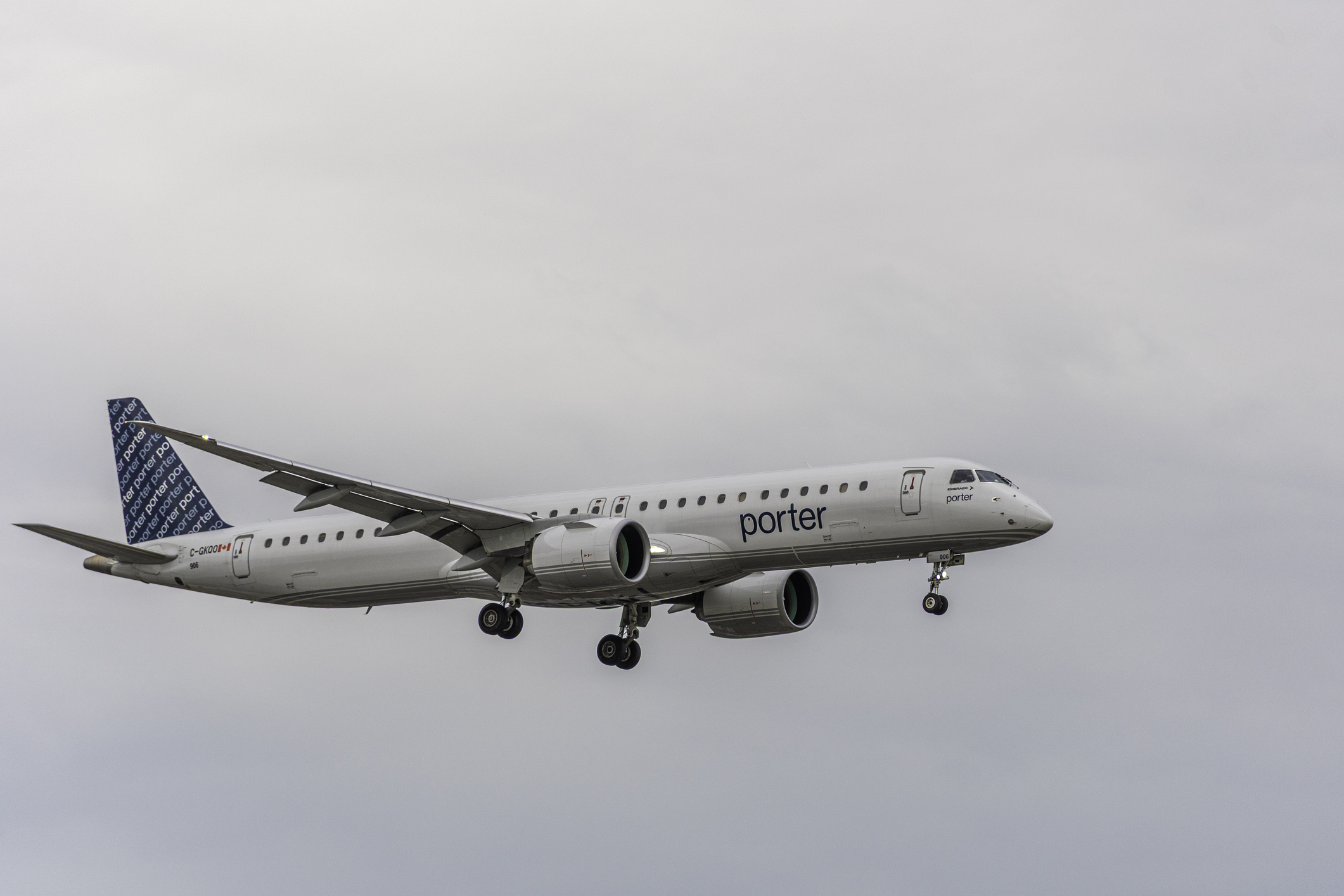
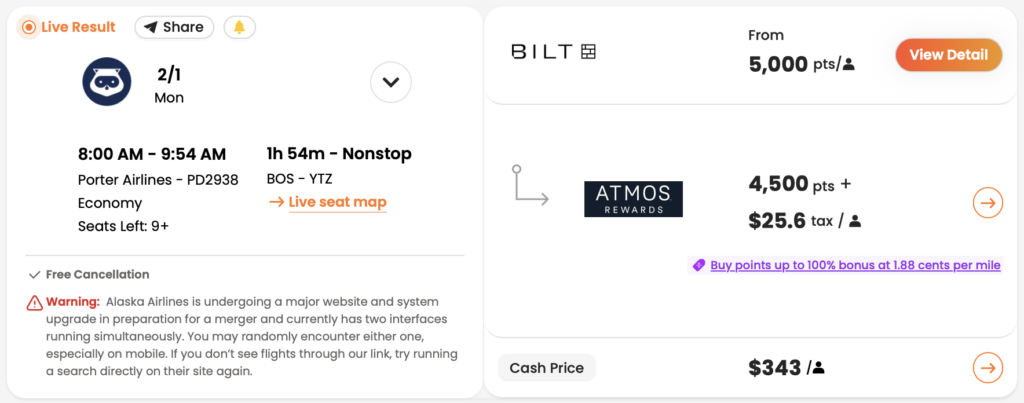
Boston to Toronto on Porter Airlines
Porter Airlines opens up another set of possibilities. The Canadian carrier joined Alaska’s partner network in 2023, and it gives Atmos Rewards members access to its growing network in Canada and the U.S.
Its flight from Boston (BOS) to Toronto’s Billy Bishop Airport (YTZ) is available for 4,500 Atmos Rewards points.
Billy Bishop sits just outside downtown Toronto. It’s also a much smaller (and more convenient) airport than Toronto Pearson (YYZ).
POINTSYEAH
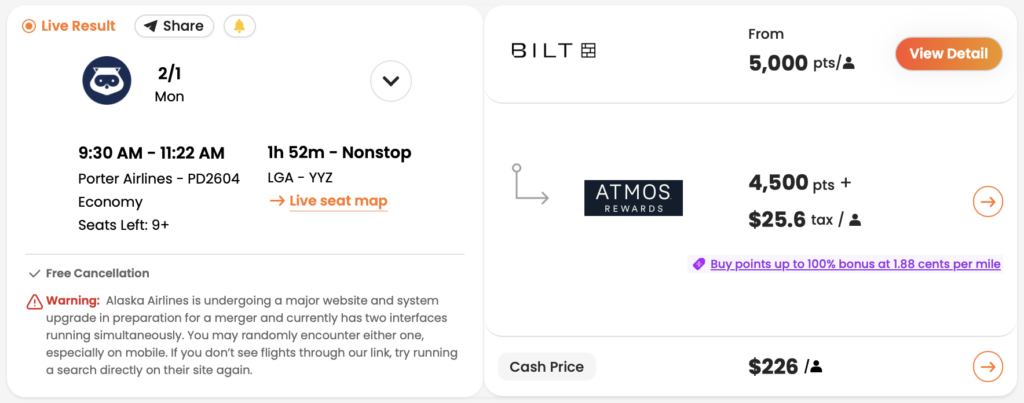
New York to Toronto on Porter Airlines
Porter also flies from New York-LaGuardia (LGA) to Toronto Pearson (YYZ).
We’ve found the route starting at the same 4,500-point price, giving Boston another inexpensive way to get to Toronto with Atmos Rewards points.
POINTSYEAH
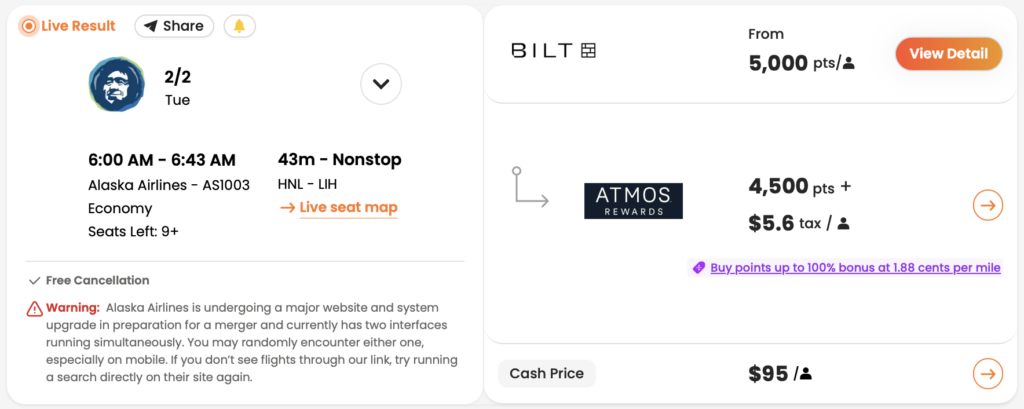
Honolulu to Lihue on Hawaiian Airlines
Atmos Rewards can also be useful for getting between the Hawaiian Islands.
Hawaiian Airlines flights from Honolulu (HNL) to Lihue (LIH) is available for 4,500 points. Similar pricing can show up on other Neighbor Island routes as well.
POINTSYEAH
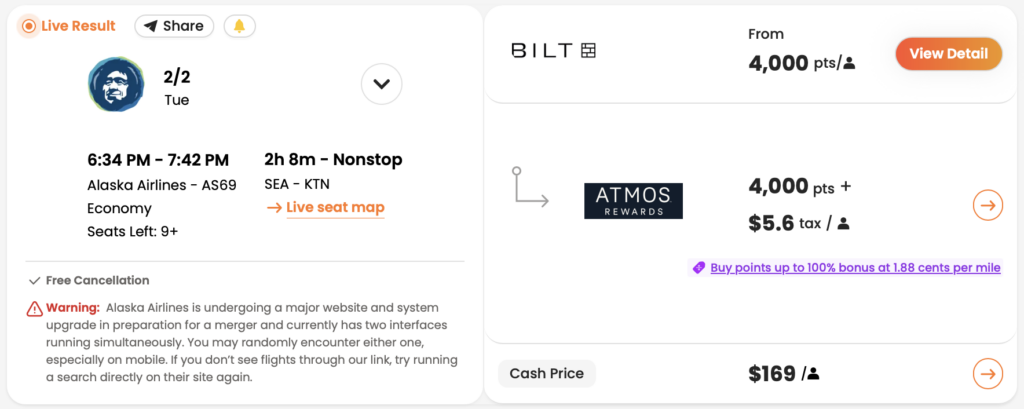
Seattle to Ketchikan on Alaska Airlines
Here’s where the pricing gets a little more interesting.
Alaska-operated flights use a different chart, and some short flights actually dip below 4,500 points.
We’ve found Seattle (SEA) to Ketchikan (KTN) for as few as 4,000 Atmos Rewards points, getting you from the Lower 48 to Southeast Alaska.
POINTSYEAH
Anchorage to Kodiak on Alaska Airlines
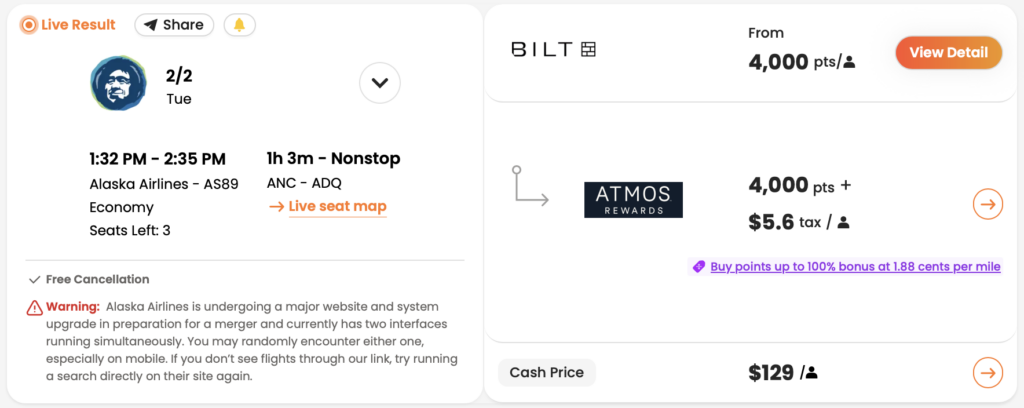
We’ve also found Anchorage (ANC) to Kodiak (ADQ) starting at 4,000 points.
That’s below the 4,500-point starting price for short partner flights within the Americas.
POINTSYEAH
Search Beyond These 7 Routes
These are just a few examples. It’s nowhere near a definitive list. American and Porter alone operate plenty of other routes short enough to fall within the lowest partner distance band, while Alaska and Hawaiian have their own short-haul possibilities.
{{ search-widget mode=”flight” }}
Availability and pricing vary by date. But a balance of 4,000 or 5,000 Atmos Rewards points can be more useful than it may seem at a glance.
Buying airline points might sound like an unnecessary extra step. After all, if a flight is available, why not just pay for it?
Sometimes there’s a good reason. Buying the points needed to book a flight can cost less than paying for airfare directly.
Alaska Airlines sells Atmos Rewards points throughout the year and periodically runs promotions that lower their cost. There’s little reason to buy just because a sale is happening. But with a trip already in mind, it takes only a few minutes to see whether buying points could save money.
Current Atmos Rewards Buy Points Offer
Alaska Airlines is currently offering up to a 120% bonus when buying Atmos Rewards points through October 19.
There’s a catch with that “up to” language. The offer appears to vary by member, and it’s not clear what determines who gets the full 120% bonus. A 100% bonus appears to be more widely available.
With a 100% bonus, Atmos Rewards points cost about 1.88 cents each after the 7.5% federal excise tax. Members targeted for the 120% bonus can buy them for about 1.71 cents each.
Current promotion: Up to 120% bonus
Price per point: About 1.71 cents with a 120% bonus; about 1.88 cents with a 100% bonus
Offer ends: October 19, 2026
Purchase limit: Up to 100,000 points per transaction before the bonus
Annual limit: 150,000 points purchased or received as gifts; no annual purchase limit for Atmos Rewards elite members
Alaska runs points sales periodically, so there’s rarely a reason to buy solely because a promotion is ending. The history below shows how the current offer compares with previous ones. Click the arrow to see past offers.
The easiest way to decide whether buying points makes sense is to compare what the flight costs in cash with what it would cost to buy the points needed to book it.
The math is simple:
Points needed × current price per point = cost to buy the points
Say a flight is available for 20,000 Atmos Rewards points. At roughly 1.88 cents each with a 100% bonus, buying those points would cost about $376.
If the same flight costs $500 in cash, buying the points could come out ahead. If it costs $300, paying cash is the easy choice.
Members targeted for the 120% bonus have slightly better math. Those same 20,000 points would cost about $342 at roughly 1.71 cents each.
That’s why the percentage bonus isn’t especially useful on its own. What matters is the price of the flight, how many points it requires, and what those points cost to buy.
There’s little reason to stock up on Atmos Rewards points without a trip in mind. Alaska sells points regularly and runs purchase promotions periodically.
Instead, start with the flight. Check the cash price, search how many Atmos Rewards points it requires, and calculate what those points would cost to buy.
Sometimes cash wins. Sometimes points do.
And when buying the points costs less, it can be a straightforward way to save on a flight that was already in the plans.
Atmos Rewards Communities are personalized groups that offer program members extra perks and benefits on travel. And some of these benefits are designed to make the program a lot more engaging.
Six different communities are live as of October 1, each with its own benefits.
6 Unique Communities With Different Benefits
These Atmos Rewards Communities offer program members (Atmos Rewards is free to join) benefits tied to the way they travel.
Huaka’i by Hawaiian: Free bags, Neighbor Island discounts, and 50% more points on inter-Island travel starting January 1, 2027. Only for Hawaii residents.
Club 49: Free bags to, from, and within Alaska, plus intra-state deals and cargo discounts. Only for Alaska residents.
Global Locals: Earn 10% more status points on flights that begin and/or end outside the United States.
Culinary Journeys: Earn up to 10,000 points on travel to culinary destinations, plus 20% off food and wine experiences with Atmos Rewards Unlocked.
Active Escapes: Earn up to 10,000 points at outdoor-oriented destinations, plus 20% off outdoor experiences with Atmos Rewards Unlocked and special partner offers.
Families On the Go: Get 20% of points back on award travel for kids 12 and under. Plus, earn up to 10,000 points at top family destinations.
Elite status with Atmos Rewards isn’t a prerequisite for joining a community. And neither is there a cash outlay for joining.
Joining is free and can be done by logging into an Atmos Rewards account, clicking on the community that sounds most interesting, and clicking the “Join” button.
And the nice part is that members can change communities every year to take part in the benefits that most align with how they travel.
6 Atmos Rewards Community Benefits Worth Knowing About
Loyalty programs are becoming a lot more personalized to boost engagement. And there are benefits within each community that should pique the interest of all kinds of people.
Six in particular are worth knowing about.
In the Huaka’i by Hawaiian community, the benefit most worth knowing about is 50% more points on flights between the islands. This community is designed for commuters, and if flights between the islands are a regular occurrence, they’ll get more rewarding once this perk goes live on January 1.
Club 49 is similar to the one above. Alaska residents can join for savings on both luggage and freight. So if packing light isn’t an option, members can take advantage of two free bags when traveling to or from Alaska, or three free bags when flying entirely within Alaska on Alaska Airlines.
Things get more broadly appealing with the Global Locals community. Members can expedite their way to status with 10% more status points on flights that begin or end outside the U.S.
DAVEALAN / ISTOCK
Culinary Journeys is more useful for those who like to eat, or just happen to travel to traditionally foodie-oriented destinations. Community members can earn up to 10,000 bonus points and status points after flying to 10 acclaimed dining destinations, including Tokyo, New York, Chicago, London, and more. Destinations are set to rotate again in 2028.
Active Escapes offers something similar. Community members can earn up to 10,000 bonus points and status points after visiting 10 gateway cities to U.S. national parks. Destinations for this year and next include Bozeman, Jackson Hole, Kona, and more, and will rotate again in 2028.
Atmos Rewards’ Families On the Go community is perhaps the most benefit-rich. The crown jewel perk is 20% of points back on kids’ award flights. If you redeem Atmos Rewards points for a child 12 or under on a flight operated by Alaska, Hawaiian, or one of their redemption partners, 20% of those points will be returned once you fly.
Atmos Rewards is on the verge of becoming a lot more customizable.
Starting October 1, members will be able to choose how they earn points and status points on flights, join new groups that unlock benefits based on how they travel, and get several new perks.
And there’s considerably more coming in 2027.
Alaska Air Group announced a broad expansion of Atmos Rewards on Tuesday, September 29, including a new debit card and the ability to transfer points from eligible Bank of America cards. The latter could make Atmos Rewards points considerably easier to earn without flying Alaska or Hawaiian or spending on one of their cobranded credit cards.
There’s a lot changing, and some of it takes effect this week.
Atmos Rewards Members Can Choose How They Earn
Starting October 1, Atmos Rewards members can select one of three ways to earn points and status points on flights: distance traveled, dollars spent, or segments flown.
The choice will apply to flights departing January 1, 2027 or later.
Existing members who don’t make a selection will continue earning based on distance, while new members joining January 1 or later will default to earning based on the price of the ticket. Members can change their selection once per calendar year for future flights.
It’s an unusual amount of control for an airline loyalty program.
Someone taking frequent short flights could choose to earn based on segments, while another member could stick with distance. Higher-spending members have the option of tying earnings to the price of their tickets instead.
And earning is only one part of the customization Alaska is adding.
DAVEALAN / ISTOCK
New Atmos Rewards Communities Come With Different Benefits
Atmos Rewards is expanding its Communities program from two groups to six on October 1.
Club 49 and Huakaʻi by Hawaiian, which are built around Alaska and Hawaii residents respectively, will be joined by Global Locals, Families on the Go, Culinary Journeys, and Active Escapes.
Depending on the group, perks can include free checked bags, flight deals, bonus point challenges, partner offers, discounts on Atmos Rewards Unlocked experiences, bonus status points for international travel, and discounts on points bookings for children.
The last one is particularly interesting for families, while the international status point bonuses give Atmos Rewards another way to reward members differently based on how they actually travel.
Bank of America Points Will Become Transferable to Atmos Rewards
One of the bigger changes isn’t arriving until 2027.
Alaska says customers with eligible Bank of America cards will be able to transfer points directly into Atmos Rewards.
There are still some important blanks. Alaska hasn’t said which Bank of America cards will participate, which rewards will be transferable, or what the transfer ratio will be.
But the concept itself is notable.
Bank of America already issues the Atmos Rewards credit cards. Allowing points from other eligible cards to transfer into Atmos Rewards would create another path into the program without requiring spending directly on an Atmos Rewards card.
And Bank of America won’t necessarily be alone. Alaska says Atmos Rewards eventually plans to add points transfers from other select financial institutions around the world.
An Atmos Rewards Debit Card Is Coming, Too
Atmos Rewards is also moving beyond credit cards.
A new Atmos Rewards debit card is planned for the first quarter of 2027, with preregistration open now. The card will earn Atmos Rewards points and status points on purchases, but Alaska is also teasing something less typical for a debit card: the ability to earn rewards on savings.
Other announced benefits include an annual flight discount, discounts on flights and onboard purchases, free points sharing, no foreign transaction fees, and the ability to use points toward certain account fees.
MAK STUDIO / ISTOCK
There aren’t many specifics yet about how earning on purchases or savings will work, or the value of the annual flight discount.
There is, however, an incentive to register early. Atmos Rewards members who join the early access list by October 31 will receive a code for 20% off an eligible Alaska flight for travel from January 6 through March 10, 2027. Registration doesn’t open an account or guarantee eligibility for the debit card.
The card will be issued by Cross River Bank and managed by Alviere rather than Bank of America, which issues the Atmos Rewards credit cards.
There’s another card update coming sooner. Alaska plans to refresh its Atmos Rewards Visa Business Card later this year with lounge passes, free same-day confirmed flight changes, and 10X points on eligible purchases through Atmos Rewards for Business.
More details are expected later this fall.
More Benefits Are Coming for Platinum and Titanium Members
Higher-tier Atmos Rewards members are getting another change beginning November 2.
Platinum and Titanium members will be able to bring eligible children and one companion into Premium Class at no additional charge when space is available.
Alaska has also introduced a dedicated Titanium check-in facility in Seattle and is offering Titanium members global upgrades into Alaska’s premium cabins.
There’s a lot happening to Atmos Rewards at once, but the common thread is choice. Members can choose how they earn, join communities based on how they travel, and soon have more ways to earn or move points into the program.
The Bank of America piece could be particularly important once Alaska fills in the missing details. For now, though, the first round of changes starts October 1.
Alaska Airlines has spent the last couple of years building a much bigger airline. Now it’s starting to show what it wants that airline to become in the years ahead.
On Tuesday, September 29, Alaska Air Group announced new premium cabins for both Alaska and Hawaiian Airlines, a new premium economy product, and multiple major lounge projects. The changes will start arriving over the next couple of years as Alaska expands farther into Europe and Asia.
There’s a lot here. But some of the more interesting changes isn’t happening on a long-haul Dreamliner.
Alaska Is Putting Lie-Flat Seats on Some 737s
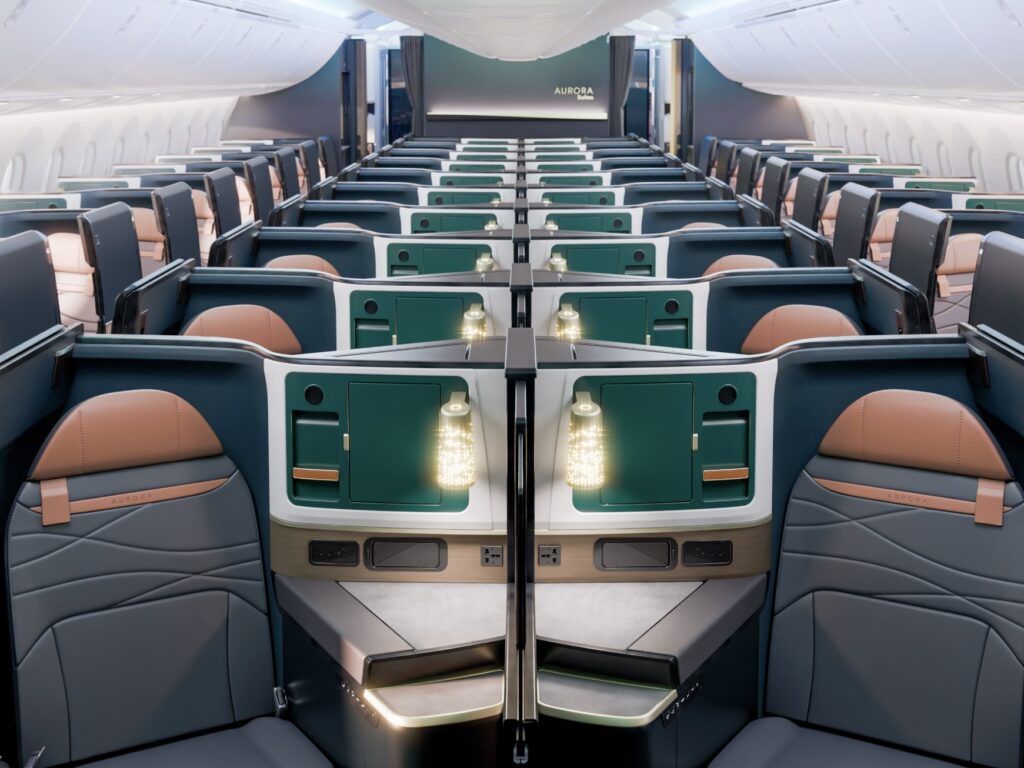
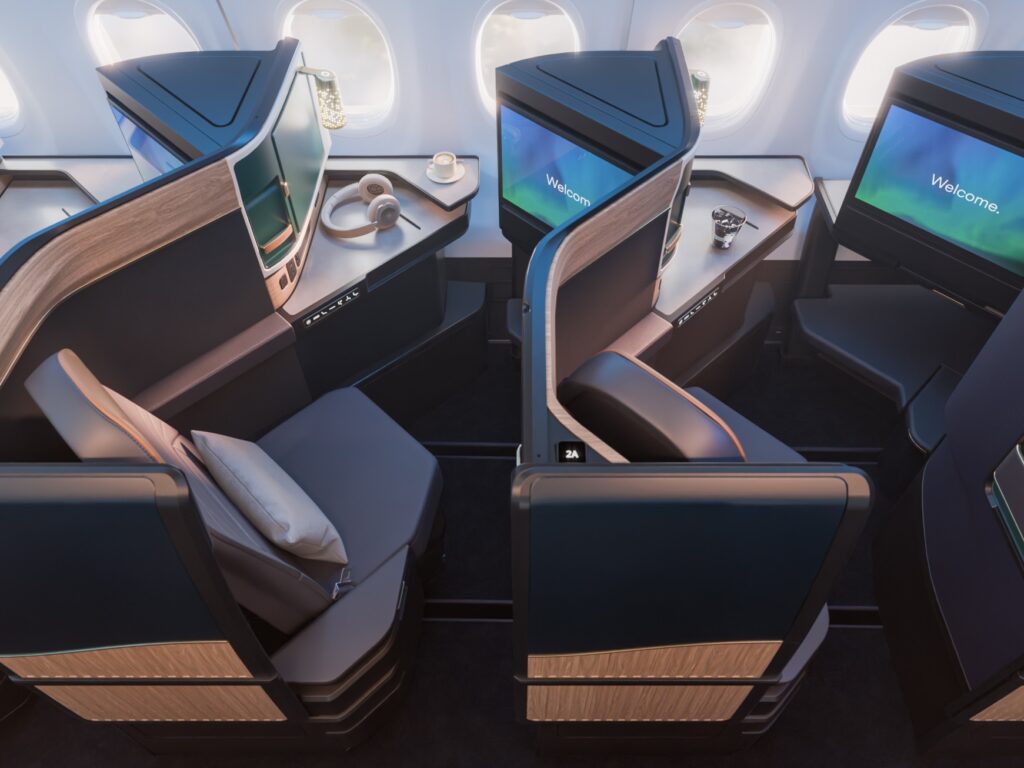
Alaska’s new top-end product will be called Aurora Suites, and it’ll eventually appear on both the airline’s Boeing 787 Dreamliners and at least 25 new Boeing 737-10s.
The 787-9 will have 34 Aurora Suites with lie-flat beds, privacy doors, direct aisle access, 19-inch 4K screens, and upgraded dining. The updated aircraft will be about 46% premium seating, up from 38% today.
ALASKA AIRLINES
The 737-10 is where things get more interesting.
At least 25 will be configured with 12 lie-flat Aurora Suites. Alaska says they’ll be used on select transcontinental flights beginning in 2028, bringing lie-flat seats to the airline’s narrowbody fleet for the first time.
ALASKA AIRLINES
These won’t exactly blend into the rest of Alaska’s 737 fleet. They’ll wear the same northern lights-inspired Aurora livery as the 787s and add another 12 Premium Reserve seats behind the suites.
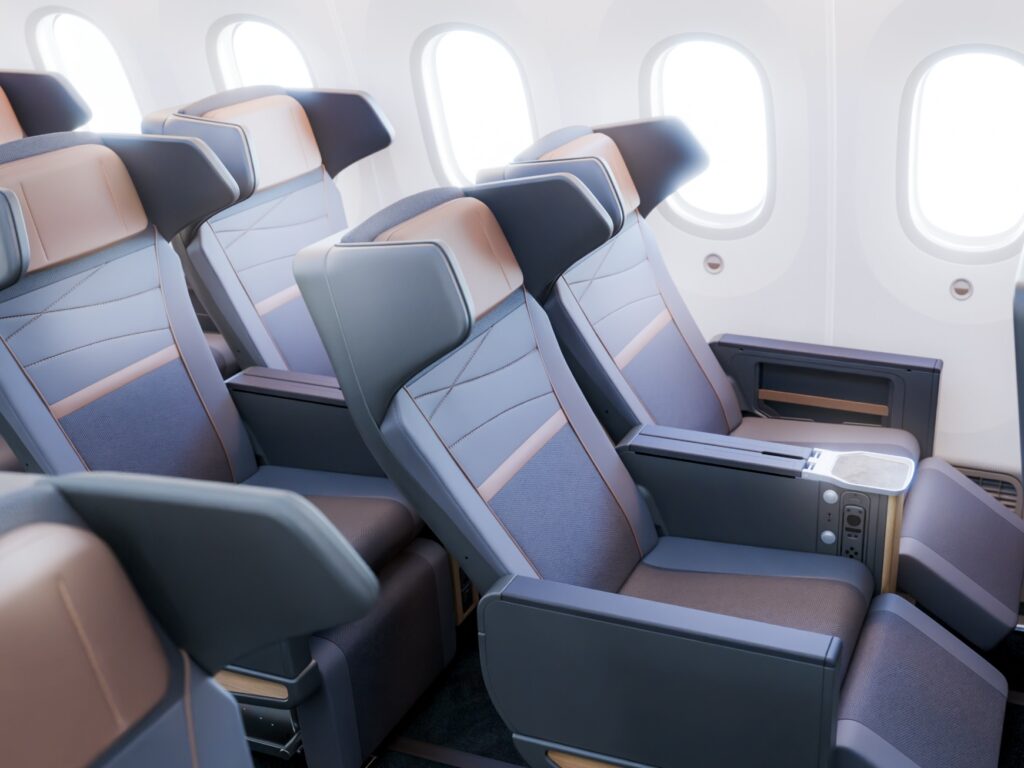
Premium Reserve is Alaska’s new premium economy cabin, sitting above the extra-legroom economy seats it currently sells as Premium Class. Seats will have 38 inches of pitch, more recline, leg and calf rests, 16-inch 4K screens, and upgraded dining.
There will be 35 Premium Reserve seats on Alaska’s 787s, 28 on Hawaiian’s A330s, and 12 on the specially configured 737-10s. The seats go on sale next summer before entering service in 2028.
ALASKA AIRLINES
The Aurora experience won’t start at the airplane, either. Suite passengers will get dedicated check-in and concierge service in Seattle, access to a separate Aurora Lounge, and upgraded onboard dining. Complimentary Starlink Wi-Fi will also be available to Atmos Rewards members.
Put it all together and Alaska is creating a pretty unusual 737, with lie-flat suites and premium economy ahead of its existing Premium Class and Main Cabin.
Hawaiian’s A330s Are Getting Rebuilt Too
Hawaiian isn’t getting the same cabin with a different logo.
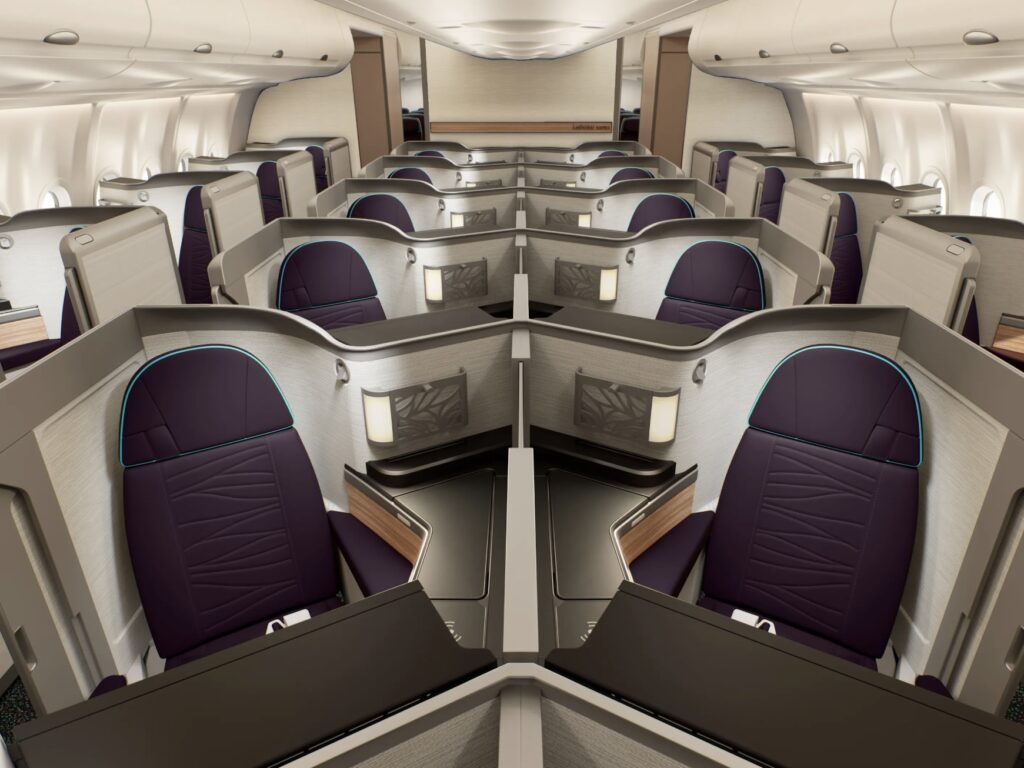
Its fleet of 24 Airbus A330s will receive completely new interiors beginning in 2028, including 22 new Leihōkū Suites. They’ll have lie-flat seats with privacy doors and direct aisle access, along with 19-inch 4K screens, hotel-quality bedding, and upgraded dining.
ALASKA AIRLINES
Another 28 seats will be Premium Reserve.
Altogether, about 40% of the A330 will be premium seating, up from 30% today. The rest of the airplane is getting attention too, with new interiors throughout and upgraded entertainment with 4K screens and Bluetooth connectivity.
The Leihōkū experience will also include dedicated check-in and concierge service in Honolulu and Seattle.
Keeping Aurora and Leihōkū separate is also intentional. Alaska and Hawaiian are increasingly becoming one airline behind the scenes, but the company is still trying to preserve what makes the two brands distinct.
That extends to the food. Seattle chef Renee Erickson will develop menus for Alaska’s European flights, including London, Rome, Athens, and Paris, while James Beard Award-winning chef Brady Ishiwata Williams will handle routes to Asia. Hawaiian will continue building its menus around local chefs and ingredients.
Seattle Is Getting a 41,000-Square-Foot Lounge Complex
The premium push starts well before boarding.
Alaska plans to open a nearly 41,000-square-foot lounge complex in Seattle’s expanded C Concourse in late 2027. The airline says it’ll be Seattle-Tacoma International Airport’s largest lounge and one of the largest in the country.
ALASKA AIRLINES
It’s actually two connected lounges.
A 500-seat Alaska Lounge will occupy the main level and follow Alaska’s existing access policies. A separate 200-seat Aurora Lounge will be reserved for Aurora Suites passengers traveling on intercontinental flights.
The complex will have an outdoor patio with a fireplace, private work pods, three bars, a pizza oven, and what Alaska calls a coffee lab.
The Aurora side goes further with private showers, wellness spaces, made-to-order food, à la carte dining, and tableside service.
Hawaiian is getting a substantial lounge of its own. A nearly 13,000-square-foot, 200-seat lounge is scheduled to open in Honolulu in early 2028. Alaska also plans a new 14,000-square-foot lounge in San Diego that year.
ALASKA AIRLINES
All of this starts to make more sense alongside where Alaska wants to fly.
The company currently serves seven intercontinental destinations and plans to reach at least 15 by 2030. Long-haul flying is expected to grow from about 8% of capacity today to roughly 15% by then.
Premium is becoming a bigger part of the business, too. Alaska expects premium revenue to grow from 35% to more than 40% of total revenue by 2030.
Alaska Airlines is planning a sizable expansion at Paine Field, giving the Seattle area’s secondary airport considerably more service over the next year.
The expansion includes one new destination, San Jose, along with more flights or larger aircraft on several existing routes.
Alaska plans to begin twice-daily flights between Paine Field and San Jose on April 14, 2027, operated by Horizon Air with Embraer E175 aircraft.
Los Angeles will also increase to twice-daily service, with both flights moving to larger Boeing 737 aircraft. Portland grows to two flights per day, while Alaska is adding seats to San Diego and San Francisco.
Paine Field Is Becoming a Bigger Part of Alaska’s Seattle Network
None of the individual route changes is especially dramatic. Taken together, though, a 50% increase in seats is meaningful for an airport that offers an alternative to Seattle-Tacoma International Airport (SEA).
Paine Field sits roughly 25 miles north of downtown Seattle in Everett, making it considerably closer for parts of northern Seattle and communities north of the city. Its small passenger terminal also offers a very different experience from Alaska’s much larger operation at SeaTac.
The expansion doesn’t turn Paine Field into another major hub. Most of Alaska’s Seattle-area flying will continue to operate from SEA.
But by summer 2027, PAE will offer substantially more Alaska capacity to several major West Coast destinations. For anyone living north of Seattle, that makes checking both airports before booking a trip a little more important.