Evergreen airline-focused content that isn’t primarily news. Includes airline reviews, fleet and cabin guides, loyalty program explainers, and airline-specific reference content.
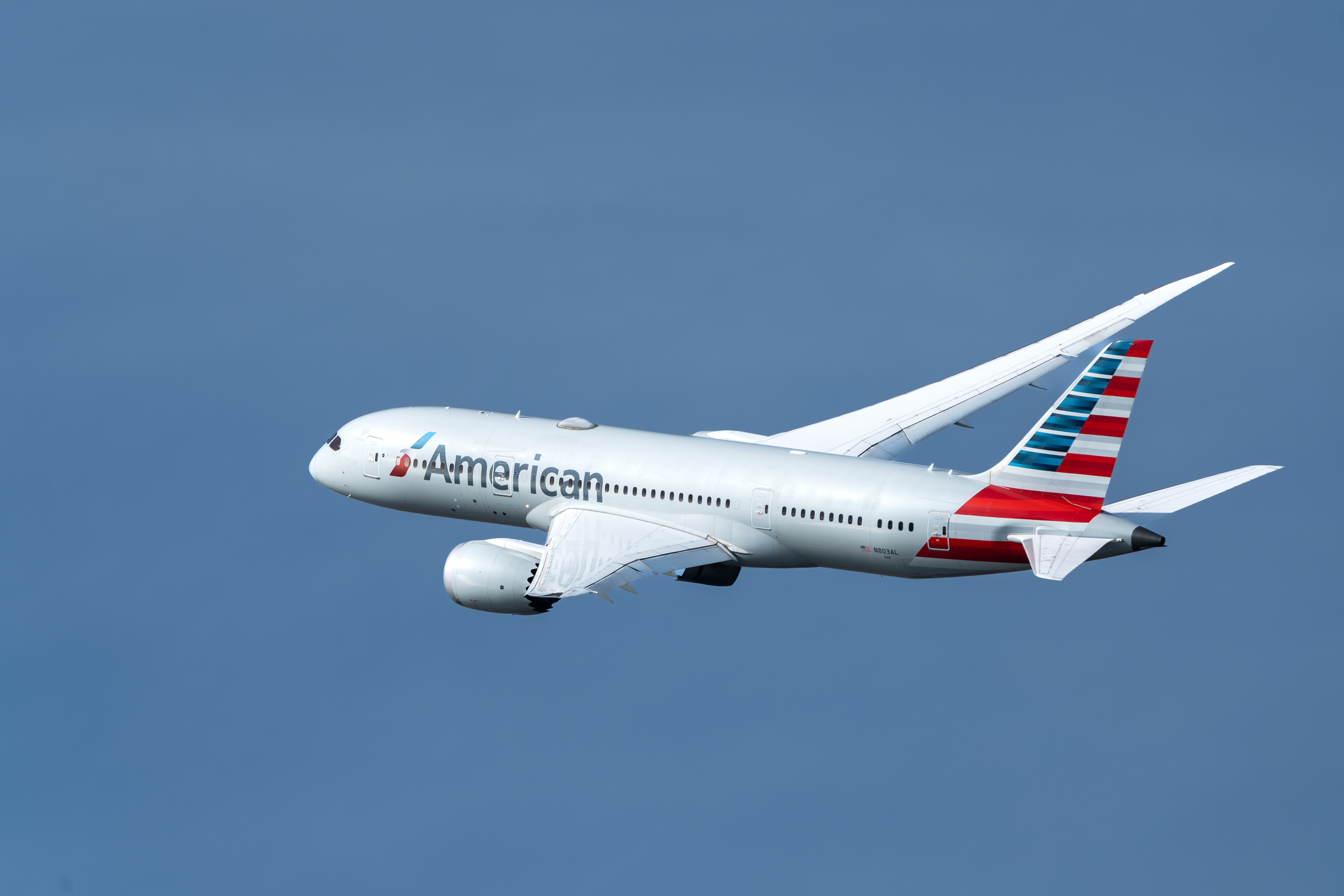
American Airlines has launched a new promotion offering eligible business travelers up to 50,000 bonus AAdvantage miles on flights through the end of 2026.
The offer awards 5,000 bonus miles per eligible flight segment to or from the New York City area, Los Angeles, or Chicago.
The promotion appears to be targeted at select corporate and AAdvantage Business travelers, so not every AAdvantage member will qualify.
How to Earn 5,000 Bonus Miles Per Flight
Eligible travelers must register, book, and complete their flights by December 31, 2026, at 11:59 p.m. CT.
The promotion covers flights to or from five airports:
New York Kennedy (JFK)
New York LaGuardia (LGA)
Newark (EWR)
Los Angeles (LAX)
Chicago O’Hare (ORD)
You’ll earn 5,000 bonus miles per eligible segment, up to a maximum of 50,000 miles. For example, a nonstop round trip between Los Angeles and Dallas would earn 10,000 bonus miles.
A few restrictions apply:
Registration is required before booking. Previously ticketed flights won’t qualify.
Only American-marketed flights qualify. Basic Economy tickets and flights booked with miles are excluded.
Business travel identifiers are required. Corporate travelers must have their company’s identifiers attached to their reservations and AAdvantage Business travelers must have their business account information included.
Worth noting: bonus miles won’t count as Loyalty Points, so they won’t help you qualify for elite status.
Check Your Eligibility Before Booking
Having an AAdvantage Business account or booking through a corporate travel program doesn’t necessarily guarantee eligibility, so you’ll need to log in and check your account.
If you’ve received the offer, it’s worth registering before booking any qualifying flights. A couple of business trips could earn you thousands of additional AAdvantage miles.
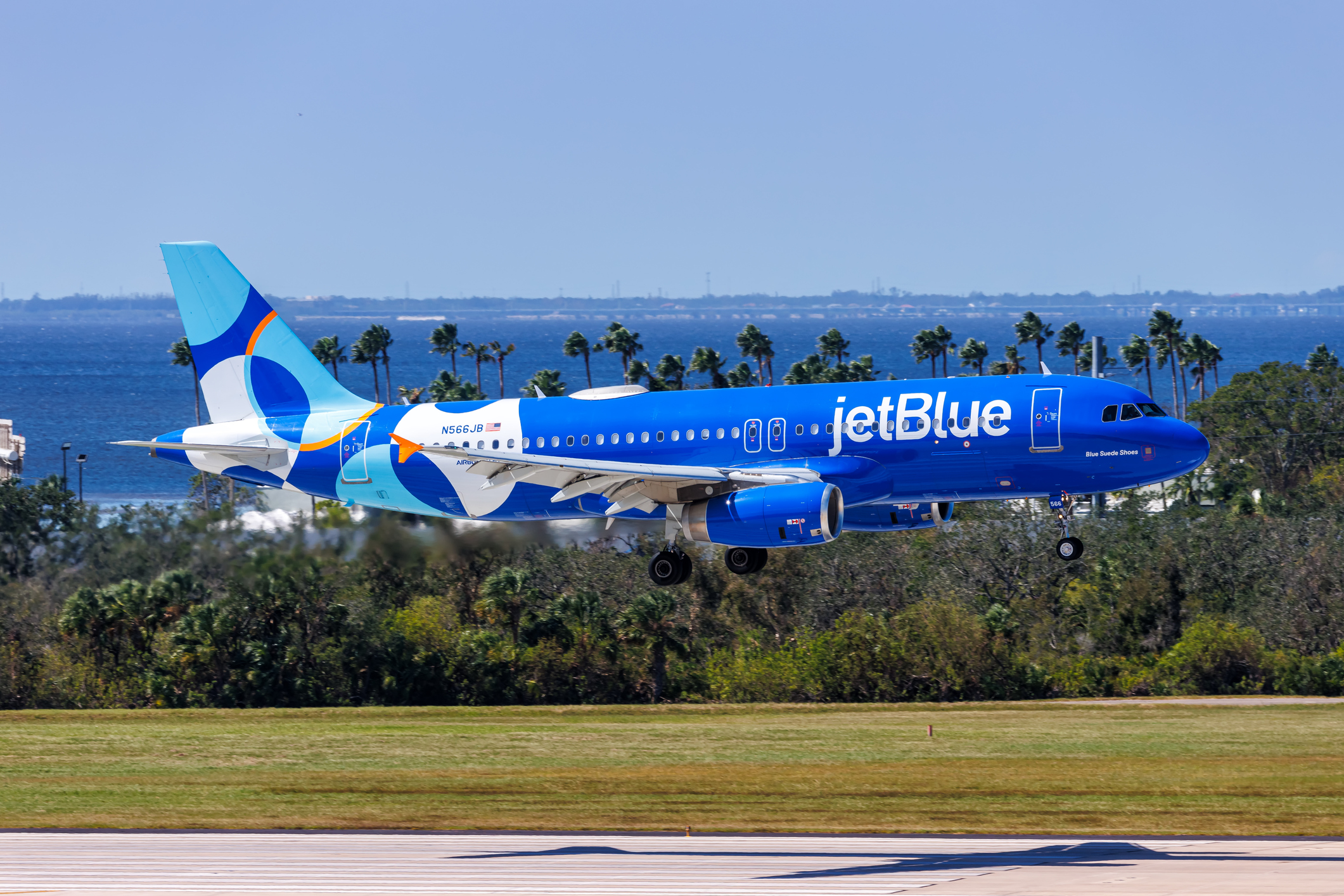
JetBlue’s new BlueFirst cabin is officially on sale. And the first flights take off on December 8, 2026.
The airline unveiled BlueFirst in September, and travelers can now book the new first class product with cash or TrueBlue points on more than 30 routes.
There’s also an incentive to try it out. JetBlue is also offering introductory fares starting at $249 one-way.
Where You Can Book JetBlue BlueFirst
The first BlueFirst flight is scheduled for December 8 between Boston (BOS) and Fort Lauderdale (FLL). BlueFirst service between New York LaGuardia (LGA) and Fort Lauderdale commences shortly afterwards on December 12.
And additional routes will launch over the coming months, including:
Route
BlueFirst Launch
Boston (BOS) ↔ Fort Lauderdale (FLL)
December 2026
New York LaGuardia (LGA) ↔ Fort Lauderdale (FLL)
December 2026
Fort Lauderdale (FLL) ↔ Washington, D.C. (DCA)
December 2026
Boston (BOS) ↔ Austin (AUS)
January 2027
New York JFK (JFK) ↔ Cancun (CUN)
January 2027
Fort Lauderdale (FLL) ↔ Aruba (AUA)
January 2027
Fort Lauderdale (FLL) ↔ Dallas Fort Worth (DFW)
February 2027
Boston (BOS) ↔ Denver (DEN)
April 2027
BlueFirst won’t necessarily operate on every flight along these routes, since availability depends on the aircraft scheduled.
JetBlue plans to eventually offer BlueFirst throughout its network on aircraft without Mint, including flights to Latin America and the Caribbean.
Introductory BlueFirst Fares Start at $249
To celebrate the launch, JetBlue is offering introductory BlueFirst fares on three routes:
Route
Starting One-Way Fare
New York LaGuardia (LGA) ↔ Fort Lauderdale (FLL)
$249
Boston (BOS) ↔ Fort Lauderdale (FLL)
$299
New York JFK (JFK) → Liberia (LIR), Costa Rica
$299
You’ll need to book by October 16, 2026, at 11:59 p.m. ET. Travel dates and blackout periods vary by route.
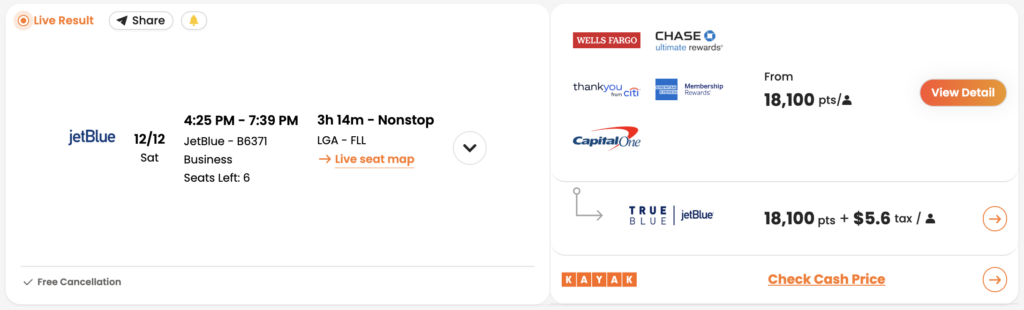
For example, we found a BlueFirst Base fare from LaGuardia to Fort Lauderdale on December 12 for $249 or 18,100 TrueBlue points.
On that same flight, the standard BlueFirst fare costs $294 or 20,700 points. The more flexible BlueFirst Flex fare costs $469 or 32,500 points.
POINTSYEAH
The three fares offer the same onboard experience, but differ in baggage allowances, seat selection, and change and cancellation policies.
Find BlueFirst Flights With PointsYeah
BlueFirst will offer JetBlue travelers a more premium experience on planes that don’t have the airline’s lie-flat Mint product. And unlike Mint, BlueFirst will eventually be available across much more of JetBlue’s network.
Worth noting: you can already find BlueFirst flights using PointsYeah. Just filter your search by business class rather than first class to see what’s available and what it costs.
Southwest Airlines is making some of its biggest changes yet to Rapid Rewards, introducing a new elite status tier, overhauling Companion Pass qualification, and allowing members to redeem points for international flights on partner carriers.
The airline announced the slew of changes during its Media Day event in Dallas on Thursday, October 15. It also shared new details about its upcoming airport lounges and plans to bring Starlink Wi-Fi to its entire fleet.
Most of the changes will take effect in 2027. Some will give members more ways to use their points, while others will make familiar benefits harder to earn, particularly for those who have relied on credit card bonuses to qualify for Companion Pass.
Here’s what’s changing.
Southwest Is Introducing Three Elite Status Tiers
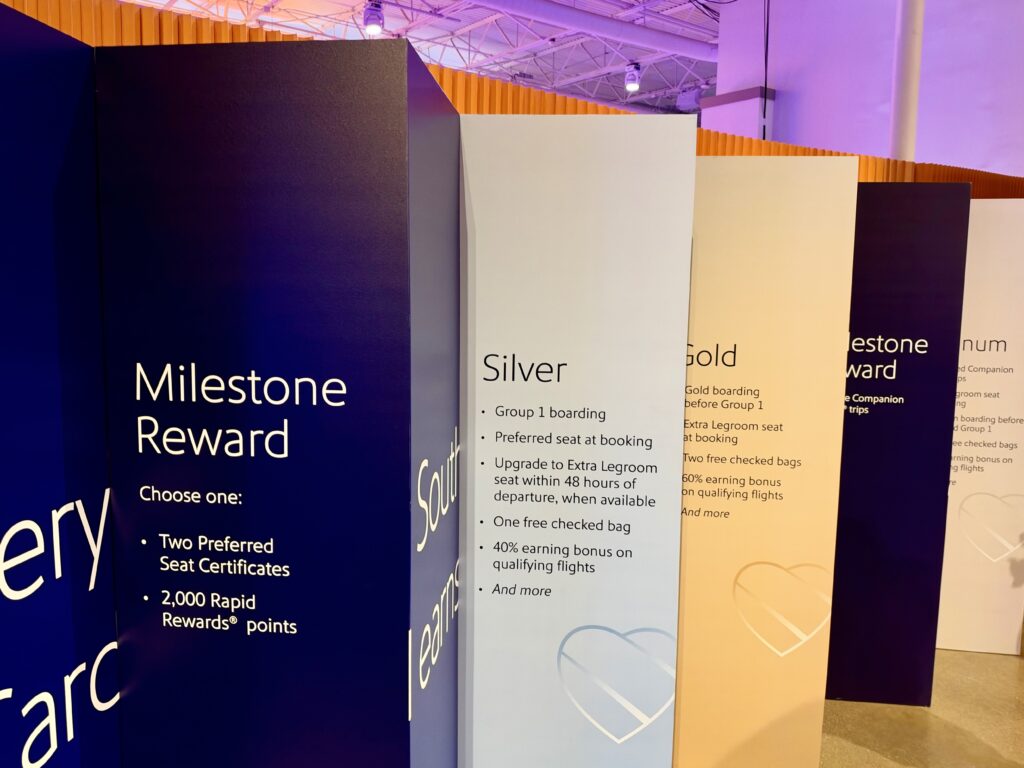
Beginning January 1, 2027, Southwest will replace its familiar A-List and A-List Preferred status levels with a new three-tier structure: Silver, Gold, and Platinum.
The names are generic by design. Executives said the familiar terminology should make Rapid Rewards easier to understand for customers coming from other airlines.
Existing A-List members will transition to Silver, while A-List Preferred members will become Gold. Platinum is an entirely new tier above Gold, offering Southwest’s most frequent flyers (or biggest spenders) additional benefits, including unlimited Companion Pass trips.
Standard or Preferred at booking; Extra Legroom within 48 hours
Any seat at booking
Any seat at booking
Boarding
Group 1
Before Group 1
Before Gold
Companion Pass
—
—
Unlimited trips
Members who qualify for A-List or A-List Preferred status in 2026 will automatically transition to Silver or Gold, respectively, on January 1, 2027. Their status will remain valid through December 31, 2027.
There are a couple of differences worth pointing out.
Silver members will earn a 40% bonus on qualifying flights, up from the 25% currently offered to A-List members. Gold members, however, will earn a 60% bonus, down from the 100% currently offered to A-List Preferred members.
Southwest is grandfathering that benefit for existing A-List Preferred members who qualify for 2027 status through their 2026 activity. They’ll retain the 100% earning bonus through December 31, 2027.
TYLER GLATT / POINTS INSIDER
Platinum is (obviously) the biggest addition. Along with unlimited Companion Pass trips, members will receive three free checked bags, a 120% flight points bonus, priority boarding ahead of Gold members, and complimentary Extra Legroom seat selection at booking.
Southwest is also introducing Milestone Rewards, which will allow members to choose benefits as they work toward higher status levels. Rewards include bonus Rapid Rewards points, seat selection certificates, and, between Gold and Platinum, three Companion Pass round trips.
Beginning January 1, 2027, all Southwest Rapid Rewards credit cards issued by Chase will earn one Tier Qualifying Point (TQP) for every dollar spent on eligible purchases, including the entry-level Plus card.
Members can also earn TQPs through qualifying Southwest flights, purchases on the Rapid Rewards debit card, Getaways by Southwest vacation bookings, and qualifying Southwest Groups bookings.
Companion Pass Is Changing, Too
Southwest is also overhauling Companion Pass.
Yep, finally. It’s a benefit the airline seemed reluctant to touch for somewhat obvious reasons, but the day has come.
Members will have two ways to unlock Companion Pass benefits:
95,000 TQPs or 75 qualifying flights: Earn three Companion Pass round trips through a Milestone Reward.
140,000 TQPs or 100 qualifying flights: Reach Platinum status and unlock unlimited Companion Pass trips.
Currently, members can earn unlimited Companion Pass trips after accumulating 135,000 Companion Pass qualifying points or completing 100 qualifying flights in a calendar year.
The flight requirement for unlimited Companion Pass isn’t changing. However, the switch to TQPs will change how members qualify through credit cards and other activities.
And here’s how.
Beginning in 2027, credit card welcome bonuses, referral bonuses, anniversary points, and bonus points earned from spending will no longer count toward Companion Pass qualification. Points earned through participating hotel and rental car partners will also be excluded.
Members will still earn redeemable Rapid Rewards points from those activities, but they won’t count toward Companion Pass.
Instead, Southwest credit cardholders will earn one TQP for every dollar spent on eligible purchases, regardless of which Southwest Chase card (or cards) they carry.
That means someone who previously earned Companion Pass through a combination of credit card welcome bonuses and spending won’t be able to follow the same strategy in the future.
Members will still be able to designate one companion at a time and change that person up to three times annually.
Already have Companion Pass? Members who earn it under the existing rules in 2026 will keep their unlimited Companion Pass trips through December 31, 2027.
Southwest will also honor existing Companion Pass promotions. Members who meet the requirements of their current offer will receive the benefits promised for that promotion’s specified period.
Southwest Points Will Soon Be Redeemable for International Partner Tickets
One of the more interesting announcements from Thursday’s event is that Rapid Rewards points will soon be useful for flights well beyond Southwest’s own network.
Beginning in spring 2027, members will be able to earn and redeem Rapid Rewards points through partnerships with Icelandair, China Airlines, and Etihad Airways.
Etihad is the newest addition to Southwest’s growing list of international airline partners.
Southwest confirmed that members will be able to redeem points for economy and premium cabin flights on these airlines. Reservations will be available through Southwest’s website, though pricing has yet to be announced.
We also heard from multiple members of Southwest’s Rapid Rewards team that more airline partners will become available for redemptions (and potentially fairly quickly).
Until now, Rapid Rewards redemptions have largely been limited to Southwest’s own flights, aside from international flights available through the More Rewards portal.
But there are still some big unknowns.
Southwest hasn’t announced how it will price partner redemptions or whether members will be able to combine Southwest flights and partner-operated flights on a single reservation.
Southwest Is Adding More Ways to Spend Points
International flights aren’t the only new redemption option coming to Rapid Rewards.
Beginning in November 2026, members will be able to redeem points for rental cars through participating partners at cars.southwest.com.
Later in 2027, Southwest will also allow members to use Rapid Rewards points to pay for seat selection, including Preferred and Extra Legroom seats.
That option will be available after booking and before check-in. Pricing will vary by flight and seat type.
Southwest Shares More About Its New Airport Lounges
The new network will be called Southwest Icon Lounges, and the first location expected to open in the fourth quarter of 2027.
Chatter at the event suggested Nashville (BNA) is a leading candidate for the first location, although Southwest hasn’t officially confirmed which lounge will open first.
Each Southwest Icon Lounge will incorporate design elements inspired by its location. Southwest says the spaces will emphasize comfort, hospitality, and local character while retaining elements of the airline’s identity.
TYLER GLATT / POINTS INSIDER
The lounge network is being developed in partnership with Chase, which already operates its own Sapphire Lounge network.
Southwest also confirmed plans to introduce a new premium Rapid Rewards credit card issued by Chase in 2027. The card will provide access to Southwest Icon Lounges.
However, the airline hasn’t announced the card’s annual fee, additional benefits, or launch date.
Another unanswered question is whether existing Chase Sapphire Reserve and Sapphire Reserve for Business cardholders will receive lounge access when flying Southwest.
It seems plausible, but when Points Insider asked representatives from both Southwest and Chase about that possibility during Media Day, neither company offered any details that would indicate which direction it’ll go.
For now, the new Southwest premium card is the only confirmed credit card access option.
Starlink Is Coming to Southwest’s Entire Fleet
Southwest is also moving ahead with plans to install Starlink, the fast (and popular) satellite internet service operated by SpaceX, across its entire fleet.
The airline expects to complete the rollout by fall 2027, which executives touted would make Southwest the first major U.S. airline to offer complimentary Starlink on every aircraft.
During Thursday’s presentation, Tony Roach, Southwest’s chief customer and brand officer, said 47 aircraft were already equipped with Starlink.
Installation is expected to accelerate in the first quarter of 2027. Southwest’s forthcoming Boeing 737 MAX 7 aircraft will also enter service with Starlink already installed.
The rollout is part of Southwest’s broader cabin modernization effort, which includes new seats, larger overhead bins, and in-seat power. Southwest expects essentially its entire fleet to have in-seat power by around October 2027.
Singapore Airlines just released its latest round of Spontaneous Escapes. This month, the airline is offering 30% off select flights booked with KrisFlyer miles for travel in November 2026.
The monthly promotion covers destinations across Singapore Airlines’ network, including several routes connecting the United States with Europe and Asia.
To take advantage of the discounted rates, KrisFlyer members must book by October 31, 2026, for travel between November 1 and 30, 2026.
Discounted Singapore Airlines Flights From the U.S.
This month’s promotion includes several routes to and from the United States. Discounts are available in economy and premium economy, but not business class.
Here are the eligible routes and their discounted one-way prices:
Route
Cabin
Miles Required
New York (JFK) → Frankfurt (FRA)
Premium Economy
39,900
Frankfurt (FRA) → New York (JFK)
Premium Economy
39,900
Singapore (SIN) → San Francisco (SFO)
Premium Economy
55,300
New York (JFK) → Frankfurt (FRA)
Economy
19,250
Frankfurt (FRA) → New York (JFK)
Economy
19,250
Los Angeles (LAX) → Singapore (SIN)
Economy
30,800
Singapore (SIN) → Los Angeles (LAX)
Economy
30,800
San Francisco (SFO) → Singapore (SIN)
Economy
30,800
Singapore (SIN) → San Francisco (SFO)
Economy
30,800
Seattle (SEA) → Singapore (SIN)
Economy
30,800
Singapore (SIN) → Seattle (SEA)
Economy
30,800
Blackout dates vary by route, and not every flight during November will qualify. Singapore Airlines has published the full list of eligible flights and dates on its Spontaneous Escapes page.
What to Know Before Booking
Spontaneous Escapes discounts apply to both one-way and round-trip bookings, although all flights on a promotional round-trip ticket must fall within the eligible travel period.
Most importantly, though, bookings made under this promotion cannot be changed or canceled, even if the ticket is entirely unused.
Don’t have KrisFlyer miles? Singapore Airlines is a 1:1 transfer partner of American Express Membership Rewards, Chase Ultimate Rewards, Citi ThankYou Rewards, and Capital One miles. All four transfer at a 1:1 ratio.
Marriott Bonvoy points can also be transferred to KrisFlyer, though at a 3:1 ratio (plus a 5,000-mile bonus for every 60,000 points you transfer).
For travelers with flexible November plans, Spontaneous Escapes is a useful way to put your KrisFlyer miles to use. Just check the eligible flight numbers and blackout dates before transferring points or making a reservation.
World of Hyatt and Air Canada Aeroplan launched a new promotion that lets members earn points with both programs on the same hotel stay.
Through February 14, 2027, eligible members can earn 1.5 bonus Aeroplan points per $1 spent on qualifying Hyatt stays, on top of the World of Hyatt points they’d normally earn.
World of Hyatt members normally earn 5 base points per $1 spent on eligible hotel stays (or 2.5 points per $1 at Hyatt Studios).
With this promotion, members can earn an additional 1.5 Aeroplan points per $1 spent and collect rewards in both programs on the same stay.
For example, a qualifying $1,000 Hyatt stay would earn:
5,000 World of Hyatt base points
1,500 bonus Aeroplan points
That’s before accounting for any additional Hyatt points earned through elite status or other eligible promotions.
The offer applies to participating Hyatt properties worldwide. Stays must be completed between October 14, 2026, and February 14, 2027, after registration.
Only the room occupied by the member qualifies. Bonus Aeroplan points may take up to eight weeks to post and won’t count toward Aeroplan Status Qualifying Credits.
For travelers with upcoming Hyatt stays, this is an easy opportunity to earn additional airline points without giving up their usual World of Hyatt earnings.
Delta is making some big changes to its Delta One business class experience. And for once, the seats themselves aren’t the focus.
On October 14, Delta announced what it calls its largest overhaul of the Delta One experience in nearly 30 years. The changes include new menus, upgraded dining service, additional amenities, and more flexibility for passengers who would rather sleep than eat.
The rollout begins this fall on transoceanic Delta One flights departing Los Angeles International Airport (LAX), before expanding across the airline’s global network in early 2027.
What’s Changing in Delta One?
The biggest changes involve dining. Delta partnered with several chefs to redesign its menus, introducing dishes such as a Wagyu beef burger, roasted sea bass, braised lamb, and beef short ribs.
The airline is also refreshing its beverage selection. Blanton’s bourbon joins the menu in December, alongside an expanded Champagne Taittinger partnership and a new wine program featuring 13 wines from 11 different wineries.
Delta One passengers will also be able to preorder their entrées until 18 hours before departure, six hours later than before. The airline is introducing lighter meal options and allowing passengers on long-haul flights to skip the usual pre-arrival meal in favor of a coffee and croissant.
Other changes include:
New amenities: Updated Missoni amenity kits arrive November 3, while additional pillows and Bombas socks will be available on select flights.
More drinks: New cocktails and mocktails, plus premium Japanese sake on flights to and from Tokyo-Haneda.
Updated service: New tableware and changes to how meals are presented.
Expanded Porsche fleet: Delta plans to increase its fleet of airport vehicles from 40 to 70 across 15 airports by 2028. Porsche service is available to Delta One customers who book VIP Select.
A Continued Focus on the Premium Experience
These changes focus on Delta’s soft product (food, service, bedding, and other amenities) rather than its hard product (the physical seats and cabin).
Delta has spent years expanding its premium cabins and opening dedicated Delta One lounges. The latest investment focuses on the onboard experience.
And the rollout will begin with transoceanic flights departing Los Angeles this fall, with the rest of the Delta One network following in early 2027.
As the year winds down, United Airlines is among the first major U.S. carriers to announce changes to its loyalty program for 2027.
And some of them are pretty significant.
The airline is eliminating one of the two ways travelers can qualify for MileagePlus Premier status and increasing the requirements for Premier 1K.
The changes, announced October 13, are most consequential for frequent flyers who have traditionally qualified through a combination of Premier qualifying flights (PQF) and Premier qualifying points (PQP).
United is also changing how members receive their annual starter PQP deposits. To spoil it: The benefit will become exclusive to eligible credit cardholders. Meanwhile, the airline is increasing the number of PQP members can earn through spending on its premium United Club credit cards.
Here’s what’s changing for 2027.
United Is Eliminating Its Flight-Based Qualification Option
Currently, MileagePlus members have two ways to qualify for Premier status: earn a combination of PQF and PQP, or earn a higher number of PQP without meeting the additional flight-count requirement.
Starting January 1, 2027, United will eliminate the PQF-based qualification option. Members will instead qualify based on PQP earned through eligible flights and credit card spending.
Here’s how next year’s requirements compare to this year’s:
Premier Status
2026 PQP + PQF Requirement
2026 PQP-Only Requirement
2027 PQP Requirement
Silver
5,000 PQP + 15 PQF
6,000 PQP
6,000 PQP
Gold
10,000 PQP + 30 PQF
12,000 PQP
12,000 PQP
Platinum
15,000 PQP + 45 PQF
18,000 PQP
18,000 PQP
1K
22,000 PQP + 60 PQF
28,000 PQP
32,000 PQP
Members will still need to take at least four flights operated by United or United Express each year to qualify for Premier status.
For travelers who already qualify through PQP alone, the requirements for Silver, Gold, and Platinum aren’t changing.
Those who previously relied on the combination of flights and PQP, however, could face considerably higher requirements.
For example, a traveler who currently qualifies for Premier Gold with 30 flights and 10,000 PQP will need 12,000 PQP under the new system, regardless of how frequently they fly.
JANICE CHEN / ISTOCK
The biggest increase is at the top of the program rather than the bottom.
Premier 1K will require 32,000 PQP in 2027, up from the current PQP-only requirement of 28,000. That’s an increase of more than 14%.
For someone who previously qualified through 60 flights and 22,000 PQP, the new requirement represents an additional 10,000 PQP.
These changes apply to qualification activity in 2027, generally toward Premier status for 2028. They don’t change the requirements for members currently working toward status in 2026.
Annual Starter PQP Will Now Require a United Credit Card
United is also changing who receives its annual starter PQP deposit.
For 2026, United gave qualifying Premier members a head start on re-qualification by depositing PQP into their accounts based on their existing status level, regardless of whether they held a United credit card.
Starting in 2027, that benefit will be limited to members with an eligible United credit card.
Here’s how the deposits compare:
Premier Status
2026 Starter PQP
2027 Starter PQP
Silver
300
300
Gold
600
600
Platinum
900
900
1K
1,400
1,600
To qualify for the 2027 deposit, members must have an eligible United credit card open by December 31, 2026, and hold Premier status as of February 1, 2027. The card must remain open and in good standing when the PQP are deposited.
For Silver, Gold, and Platinum members, the deposit amounts aren’t changing. Premier 1K members will receive an additional 200 PQP.
Members without an eligible credit card, on the other hand, will lose the benefit entirely.
Starter PQP are awarded per member rather than per card, so holding multiple eligible cards won’t increase the deposit. Authorized users also aren’t independently eligible.
Members with the United Quest or United Club cards will continue receiving their existing annual card bonus PQP in addition to any starter PQP they qualify for.
CHUYN / ISTOCK
United Is Increasing Credit Card PQP Limits
United already allows MileagePlus members to earn PQP through spending on eligible cobranded credit cards.
Starting in 2027, the United Club Card and United Club Business Card will each allow cardholders to earn up to 32,000 PQP annually, an increase from the current 28,000-PQP cap.
Here’s how the major United credit cards compare:
United Credit Card
2026 PQP Limit
2027 PQP Limit
United Explorer Card
1,000
1,000
United Quest Card
18,000
18,000
United Club Card
28,000
32,000
United Business Card
4,000
4,000
United Club Business Card
28,000
32,000
The increased Club Card limits match the new Premier 1K qualification threshold.
That means cardholders can theoretically earn enough PQP through credit card spending alone to qualify for Premier 1K, provided they also complete the required four United-operated flights.
Of course, that would require a ton of spending.
The United Club cards earn 1 PQP for every $15 spent on eligible purchases. At that rate, earning 32,000 PQP entirely through purchases would require $480,000 in credit card spending, before accounting for any applicable PQP deposits.
Other eligible United cards generally earn 1 PQP for every $20 spent, subject to their respective annual limits.
For most travelers, credit card spending will supplement PQP earned from flying rather than replace it entirely.
United Is Also Moving to Dynamic PlusPoints Pricing
United’s announcement also includes a reminder about an upcoming change to PlusPoints upgrades.
As previously announced, United will introduce dynamic PlusPoints pricing for travel beginning February 1, 2027.
Rather than requiring a fixed number of PlusPoints for a particular upgrade, the cost will vary based on demand and available seats.
That means the number of PlusPoints needed to upgrade could differ depending on the flight.
All in all, though, travelers working toward Premier status in 2026 can continue under the existing qualification rules. But anyone planning to re-qualify next year will have a different set of requirements to consider.
Airfares have climbed a lot this year, largely because airlines are paying considerably more for fuel. But travelers hoping cheaper oil will spell cheaper ticket prices might be disappointed.
Delta Air Lines CEO Ed Bastian suggested during the airline’s 2026 third-quarter earnings call on October 9 that recent fare increases could stick around, even after fuel prices return to more normal levels.
Bastian acknowledged that Delta has raised fares by roughly 20% this year to offset higher fuel costs. What surprised the airline, though, was how little resistance it encountered from customers.
Speaking about consumers’ willingness to pay more, Bastian described the response as an encouraging sign for the industry’s future.
And Delta isn’t particularly eager to give up those pricing gains when fuel becomes cheaper.
Airfares Are Up More Than 23% in a Year
The latest government figures show just how much more Americans are paying to fly.
According to the Bureau of Labor Statistics, airline fares increased 23.4% between August 2025 and August 2026, substantially outpacing the 3.4% increase in overall consumer prices during the same period.
August’s airfare index was also approximately 19% higher than in August 2019 (before the pandemic).
The increase hasn’t exactly been steady. Fares reached their highest point of 2026 so far in May before declining somewhat over the summer. Even after that retreat, August prices remained considerably higher than a year earlier.
The government’s airfare index measures changes in ticket prices rather than the average cost of a flight. It also reflects industry-wide pricing, not just Delta’s fares.
WIRESTOCK / ISTOCK
Why Cheaper Fuel Might Not Mean Cheaper Flights
Airlines have traditionally adjusted fares in response to fluctuating fuel costs. When fuel becomes more expensive, carriers try to recover those costs through higher ticket prices.
This year, the industry has also responded by limiting the number of seats available for sale.
Delta kept its capacity essentially flat during the third quarter while increasing revenue by 16%. For the final three months of the year, the airline expects capacity to grow approximately 3%, with fewer Main Cabin seats available than during the same period last year.
Other airlines have also reduced capacity, particularly on routes where profits haven’t been easy to come by.
With fewer seats available, airlines have more room to maintain higher fares.
Bastian believes the industry’s response to elevated fuel costs could have a lasting impact on pricing, even after the immediate financial pressure subsides.
Whether airlines can hold on to those gains is another question.
Competition, weakening demand, or additional capacity could eventually push fares lower. And while Delta reports that customers continue to spend (particularly higher-income households and corporations), that doesn’t necessarily reflect the financial circumstances of every traveler.
For now, though, Delta’s outlook suggests that falling fuel prices alone may not be enough to bring airfares back down.
Airlines Are Exploring Other Ways to Charge More
Another exchange during Delta’s earnings call touched on a different aspect of airline pricing.
A JPMorgan analyst raised the issue of international airlines beginning to vary fuel surcharges based on the day of the week, with higher charges on peak travel days.
Fuel surcharges are additional charges some airlines impose on tickets, including certain flights booked with miles. Unlike the underlying fare, these charges can carry over even when a passenger uses rewards to cover the ticket.
Delta Chief Commercial Officer Joe Esposito acknowledged the development and described it as a relatively new practice.
He said Delta hasn’t adopted the approach and stopped short of suggesting it would.
For travelers booking with points and miles, it’s something worth watching. Depending on how an airline structures its charges, flying on a Tuesday rather than a Sunday could affect how much cash a traveler has to pay when redeeming miles.
KIRK FISHER / ISTOCK
What Travelers Can Do About Higher Fares
There isn’t much an individual traveler can do to influence airline pricing, but flexibility can help keep costs down.
Flying a day earlier or later, considering nearby airports, or choosing a different airline can sometimes produce substantial savings.
Points and miles can also provide an alternative to increasingly expensive cash fares. Some loyalty programs closely follow cash ticket prices, while others use different pricing structures that can make certain flights considerably cheaper when booked with miles.
Of course, points aren’t always a bargain. Some redemptions require large numbers of miles, and certain international bookings carry substantial taxes and carrier-imposed surcharges.
It’s worth comparing the cash price against the points required, plus any out-of-pocket charges, before deciding how to book.
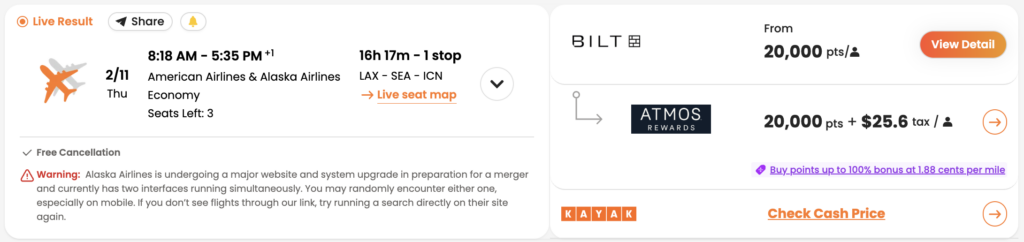
This month’s Global Getaways offers feature six destinations across Europe and Asia. One-way economy flights start at 20,000 Atmos Rewards points.
The promotion covers travel between January 15 and March 8, 2027, but there’s a relatively short window to take advantage of the deals. You’ll need to book by October 10, 2026.
October Atmos Rewards Global Getaways Deals
Six destinations are included in October’s promotion.
Destination
One-Way Starting Price
Seoul, South Korea (ICN)
20,000 points
Paris, France (CDG)
25,000 points
Helsinki, Finland (HEL)
25,000 points
Munich, Germany (MUC)
25,000 points
Stavanger, Norway (SVG)
30,000 points
Sapporo, Japan (CTS)
30,000 points
The advertised prices are starting rates, and the number of points required will depend on your departure airport and travel dates.
You’ll be on the hook for the necessary taxes and fees, too.
POINTSYEAH
Seoul is the least expensive destination in this month’s promotion, while Paris, Helsinki, and Munich all start at 25,000 points one-way.
And with the travel window running through early March, these deals could be useful for anyone considering a winter trip to Europe or Asia.
One lesser-known benefit of redeeming points and miles for flights is that, with some airlines, those trips can still count toward earning elite status.
Yes, it’s possible to fly using your miles and earn credit toward qualifying for elite status at the same time.
Not every airline offers this benefit, but it’s worth knowing about if you’re working toward a new status tier or trying to maintain the one you already have.
Here’s a look at five airline loyalty programs that offer elite status credit on eligible flights booked with points and miles.
Alaska Airlines Atmos Rewards
Atmos Rewards is particularly generous when it comes to earning elite status credit on flights booked with points.
Through the end of 2026, members earn 1 status point for every mile flown on eligible flights booked with Atmos Rewards points. That includes flights operated by Alaska Airlines, Hawaiian Airlines, and eligible partner airlines.
For example, a 2,500-mile flight booked with points could earn 2,500 status points, regardless of how many points you redeemed for the ticket.
But things are changing in 2027.
Starting January 1, Atmos Rewards members will be able to choose how they earn points and status points. And that choice will also determine how much status credit they earn on flights booked with points.
Segments flown: 500 status points per flight segment
For example, a 2,500-mile nonstop flight booked for 20,000 Atmos Rewards points would earn 2,500 status points under the distance-based option, 1,000 under the price-based option, or 500 under the segment-based option.
Of course, the math can change depending on the routes you fly and how many points you’re redeeming. One earning method could be considerably more rewarding than another.
One important distinction is that flights booked with points earn status points only, not additional redeemable Atmos Rewards points.
The earning rate is pretty simple: members earn 1 MQD for every 100 SkyMiles redeemed.
So, a Delta flight costing 40,000 SkyMiles would earn 400 MQDs toward Medallion status. And this benefit also extends to eligible upgrades purchased with miles.
However, Delta’s Main Basic fares are excluded from earning MQDs through mileage redemptions.
Members earn 1 PQP for every 100 MileagePlus miles redeemed, along with one PQF for each eligible United or United Express flight.
For example, a nonstop United flight costing 30,000 miles would earn 300 PQP and one PQF toward Premier status.
Eligible seat upgrades purchased with miles can also earn PQP.
The benefit also applies to United-operated segments on itineraries that include partner airlines. However, flights operated by those partners won’t earn PQP or PQF from the mileage redemption.
Another useful detail is that PQP goes to the person flying, not necessarily the person who redeemed the miles.
So, if you use your MileagePlus miles to book a flight for someone else, that traveler receives the qualifying credit.
United also allows members to use PQP earned from flights booked with miles toward additional PlusPoints, not just Premier status.
Unlike Delta and United, which calculate status earnings based on the number of miles redeemed, Virgin Atlantic awards a fixed number of Tier Points depending on the cabin.
Members earn the following amounts on eligible flights booked with points.
Economy: 25 Tier Points
Premium: 50 Tier Points
Upper Class: 100 Tier Points
That means two passengers redeeming different amounts of points for the same flight and cabin could earn the same number of Tier Points.
The benefit applies to eligible Virgin Atlantic-operated flights, not partner airline redemptions.
Qantas Frequent Flyer
Qantas offers a similar benefit, although there’s an additional requirement.
The number of Status Credits depends on the route and cabin. For example, an eligible business-class flight between Australia and the U.S. West Coast earns 72 Status Credits.
However, Qantas is retiring Points Club on December 8, 2026. Existing eligible members will retain their benefits through the end of their next membership year, so this benefit won’t disappear immediately for everyone.
What About Other Airlines?
The majority of major airline loyalty programs don’t offer elite status credit for flights booked with points and miles.
American Airlines AAdvantage, Air Canada Aeroplan, and Southwest Rapid Rewards are among the programs that exclude these flights from their standard flight-based elite qualification requirements.
It’s also worth distinguishing between earning elite status credit and earning additional redeemable miles. Even when a flight booked with points counts toward status, it generally won’t earn more miles for future travel.
If you’re working toward elite status, it’s worth checking whether flights booked with points count toward qualification. Depending on the airline, you could use points for your next trip without giving up progress toward your next status tier.