Author: Tyler Glatt

  • Southwest’s New Card Offers Could Help You Earn a Companion Pass Through 2027

    Southwest’s New Card Offers Could Help You Earn a Companion Pass Through 2027

    Chase’s three Southwest Rapid Rewards personal cards all have new welcome offers of up to 90,000 Rapid Rewards points. But there’s a timing element that matters more than the bonus sizes alone.

    Eligible new cardmembers who are approved on or before December 2, 2026, and meet the welcome-bonus spending requirement can have those bonus points count as 2026 Companion Pass qualifying points — even if they meet the spending requirement in early 2027. A Companion Pass earned under the current rules would be valid through December 31, 2027.

    That’s important because Southwest won’t allow credit card welcome bonuses to count toward Companion Pass qualification starting next year.

    Beyond the bonuses, each card has a different annual fee and set of Southwest benefits.

    Here’s how they compare.

    Southwest Rapid Rewards Plus Credit Card

    {{ credit-card-widget uri=”plus” }}

    The Plus card is the least expensive of the three personal Southwest cards and currently offers 80,000 Rapid Rewards points after spending $1,000 on purchases within the first three months of account opening.

    This offer ends December 2, 2026.

    The card has a $99 annual fee. Benefits include a free first checked bag for the cardmember and up to eight others on the same reservation, complimentary Standard seat selection within 48 hours of departure when available, and boarding no later than Group 5.

    It also comes with 3,000 anniversary points, a 10% flight discount promo code each cardmember year (Basic fares excluded), and a 10,000-point Companion Pass qualifying boost each year.

    Click “Learn More” above for the current offer, full benefits, and application details.

    Southwest Rapid Rewards Premier Credit Card

    The Premier card currently offers 85,000 Rapid Rewards points after spending $2,000 on purchases within the first three months of account opening.

    This offer ends December 2, 2026.

    The card has a $149 annual fee. Like Plus, it includes a free first checked bag for the cardmember and up to eight others on the same reservation, plus boarding no later than Group 5. Seat selection steps up to Preferred or Standard seats within 48 hours of departure when available.

    It also comes with 6,000 anniversary points, a 15% flight discount promo code each cardmember year (Basic fares excluded), and a 10,000-point Companion Pass qualifying boost each year.

    Southwest Rapid Rewards Priority Credit Card

    {{ credit-card-widget uri=”swapriority” }}

    The Priority card is the top-tier personal Southwest card and currently offers 90,000 Rapid Rewards points after spending $3,000 on purchases within the first three months of account opening.

    This offer ends December 2, 2026.

    The card has a $229 annual fee. Cardholders can select Preferred or Standard seats at booking when available, rather than waiting until 48 hours before departure. It also provides complimentary upgrades to Extra Legroom seats within 48 hours of departure when available, for the cardmember and up to eight others on the same reservation.

    Other benefits include a free first checked bag for the cardmember and up to eight others on the same reservation, 7,500 anniversary points, a 10,000-point Companion Pass qualifying boost each year, and boarding no later than Group 5.

    Click “Learn More” above for the current offer, full benefits, and application details.

    These Offers Can Help Toward a Companion Pass

    Southwest’s Companion Pass lets a member designate one person to fly with them for only the taxes and fees whenever they fly Southwest, including when the original ticket was booked with points.

    Under the current rules, earning a Companion Pass requires 135,000 qualifying points in a calendar year (or 100 qualifying flights). Points from Southwest credit card welcome offers count toward that requirement, and each of these cards also provides a 10,000-point Companion Pass qualifying boost each year.

    Put differently, an 80,000- to 90,000-point welcome offer takes care of a substantial chunk of the 135,000-point requirement.

    But starting January 1, 2027, Companion Pass qualification moves to Tier Qualifying Points and flights, and new cardmember welcome bonuses will no longer count. That makes these limited-time offers a particularly interesting opportunity for anyone working toward a Companion Pass valid through the end of 2027.

    Denver, Colorado, USA - June 7, 2025: Passengers on a Southwest Airlines Boeing 737-MAX8 aircraft settle in during a flight from Denver International Airport (DEN) to Washington Dulles International Airport (IAD) in Virginia.
    JOHN CHASE / ISTOCK

    Who Is Eligible for the Offers?

    The eligibility rules are the same for all three personal Southwest cards, and there’s an important restriction to keep in mind.

    According to Chase’s offer terms, you aren’t eligible for any of these cards if you currently hold another Southwest Rapid Rewards personal credit card or received a welcome bonus on any Southwest Rapid Rewards personal card within the past 24 months.

    In other words, the restriction applies across all three personal cards, not separately to each product.

    The restriction doesn’t apply to Southwest Rapid Rewards business cards or employee cards. So holding a Southwest business card won’t, by itself, prevent you from qualifying for one of these personal-card offers.

  • Bilt Changes for 2027: New Ways to Earn Rewards, Plus Changes to Bilt Cash

    Bilt Changes for 2027: New Ways to Earn Rewards, Plus Changes to Bilt Cash

    Bilt is making some significant changes to its rewards program in 2027, including eliminating guaranteed points on rent and mortgage payments for members without a Bilt credit card.

    The changes, announced October 27, 2026, will roll out over the next few months. Some will make rewards easier to use, while others introduce new restrictions.

    The biggest change is coming January 15, when members who pay rent or a mortgage through Bilt without a Bilt Card will receive a new type of reward instead of the guaranteed points they earn today.

    There are also changes to Bilt Cash (a separate rewards currency that can be used toward eligible purchases and benefits), hotel redemptions, and credit card benefits.

    Here’s what you need to know.

    Guaranteed Rent and Mortgage Points Are Going Away for Some Members

    One of Bilt’s main selling points is that it lets members earn rewards on rent and mortgage payments. These are big expenses that traditionally don’t earn points.

    Currently, you don’t necessarily need a Bilt credit card to participate. But that’s changing on January 15, 2027.

    Starting then, members who pay rent or a mortgage through Bilt without a Bilt credit card will no longer earn guaranteed points on those payments. Instead, they’ll receive something Bilt calls a “Daily Reward.”

    Here’s how it works.

    Each on-time rent or mortgage payment unlocks a Daily Reward. Members can also unlock one each day by completing a qualifying activity with a participating neighborhood business, such as dining at a restaurant, taking a fitness class, or booking a Lyft ride.

    Each Daily Reward presents two options, and you choose which one to claim. These could include Bilt Points, Bilt Cash, other credits, or collectibles that count toward a chance to win larger prizes.

    Bilt is advertising prizes that include $1 million toward a home, 10 million Bilt Points, a year of free rent or mortgage payments, and free Lyft rides for a year.

    The full rules and prize details haven’t been released yet, so it’s unclear how likely members are to receive any particular reward.

    But more importantly, if you have a Bilt credit card, you’ll continue earning points on rent and mortgage payments as you do today. Daily Rewards will be an additional benefit rather than a replacement.

    One thing Bilt’s announcement doesn’t address is whether members will still be able to earn bonus airline miles on rent payments through eligible United MileagePlus or Alaska Atmos Rewards credit cards. Those partnerships aren’t mentioned in the update, and there’s no indication they’re being discontinued. So while we’d expect those earning opportunities to stick around, that hasn’t been explicitly confirmed, though it’s something we’re looking into.

    Bilt Cash Will Last Longer, but Hotel Redemptions Are Changing

    Bilt also announced two changes to Bilt Cash, which is different from the Bilt Points members can transfer to airline and hotel partners.

    Bilt Cash can be earned through certain credit card spending and used toward eligible benefits, including hotel bookings.

    The first change is positive: Bilt Cash will no longer expire at the end of the calendar year.

    Instead, it will remain valid through the end of the month, 12 months after it was earned. For example, $100 in Bilt Cash earned in February 2026 will now expire on February 28, 2027.

    That’s a welcome improvement, particularly for members who earn Bilt Cash toward the end of the year.

    However, starting January 1, 2027, members will only be able to redeem Bilt Cash toward eligible hotel bookings through Bilt twice per calendar year, rather than monthly.

    How much you can redeem depends on your Bilt membership level:

    Bilt Membership LevelMaximum Per Hotel RedemptionAnnual Maximum
    Blue and Silver$50$100
    Gold and Platinum$100$200
    Eligible Palladium cardholders$200$400

    Bilt’s existing two-night minimum stay requirement will still apply.

    And just to note: through December 31, 2026, the current monthly redemption rules will continue to apply.

    Bilt Credit Card Benefits Are Changing, Too

    Bilt is also simplifying how its credit cards earn rewards, although this part of the update is a little more complicated (but isn’t this whole thing complicated?).

    Currently, eligible Bilt cardholders can choose an option called Flexible Bilt Cash, which earns 4% back in Bilt Cash on everyday purchases. That Cash can then be redeemed for eligible benefits.

    Bilt is retiring that option for cardholders who move to its new benefits structure.

    Instead, the new structure focuses on earning points on housing payments. Cardholders will be able to earn up to 1.25X Bilt Points on rent or mortgage payments, depending on their everyday card spending.

    That said, existing cardholders have a choice.

    If you already have a Bilt Card, or open one by December 31, 2026, you can opt out of the new benefits before your next card anniversary and keep the existing Flexible Bilt Cash option and eligible annual credits.

    If you don’t opt out, you’ll automatically move to the new benefits structure on your card anniversary.

    Bilt says cardholders who opt out won’t be able to switch between Flexible Bilt Cash and the new housing-focused earning option afterward, so it’s worth reviewing the differences before making a decision.

    One thing that isn’t changing is how many points Bilt credit cards earn on regular everyday purchases.

    Bilt has also made eligible card upgrades available through its app.

    Changes to annual card credits

    Bilt is also changing some of the annual benefits on its higher-end Obsidian and Palladium credit cards.

    For Palladium cardholders, the existing $200 Bilt Cash credit and $400 hotel credit will be combined into a single $600 annual Bilt Cash credit.

    For Obsidian cardholders, the existing $100 hotel credit will become $100 in annual Bilt Cash.

    The benefit of these changes is flexibility. Rather than having credits reserved specifically for hotel bookings, cardholders will be able to use their Bilt Cash toward a broader range of eligible redemptions.

    These annual credits will also be issued on each cardholder’s account anniversary instead of January 1.

    Obsidian and Palladium cardholders who move to the new benefits structure will retain access to Point Accelerator, which lets them redeem Bilt Cash for additional points-earning opportunities.

    More Benefits for Bilt Elite Members

    Bilt is also planning a few new benefits for members who have earned elite status in its rewards program.

    Starting in 2027, Gold and Platinum members will be able to redeem Bilt Points toward stays at participating Home Away from Home hotels, including access to eligible luxury hotel benefits.

    There are also new rental car status matches planned:

    • Platinum members: SIXT ONE Platinum and Hertz President’s Circle.
    • Gold and Silver members: SIXT ONE Gold and Hertz Five Star.

    Bilt hasn’t yet announced the full terms or timing for these status matches.

  • Two Citi AAdvantage Cards Are Getting More Expensive (and More Benefits)

    Two Citi AAdvantage Cards Are Getting More Expensive (and More Benefits)

    Citi and American Airlines are refreshing two cards in the AAdvantage portfolio. And starting January 24, 2027, both will cost more to keep.

    The Citi / AAdvantage Platinum Select World Elite Mastercard and Citi / AAdvantage Business World Elite Mastercard will each see their annual fees increase from $99 to $150 on that date.

    Along with the fee increases, both cards are getting expanded earning rates and a handful of new travel and lifestyle benefits. But the perks that make these cards attractive in the first place (like free checked bags, preferred boarding, and their core American Airlines earning rates) aren’t going anywhere.

    What’s New on the Platinum Select Card

    The Platinum Select is American Airlines’ card designed for occasional travelers, and the refresh leans into everyday spending and a few lifestyle perks.

    Cardholders will earn 3X AAdvantage miles on eligible bookings through AAdvantage Hotels and AAdvantage Cars. The existing 2X gas station category will also expand to include EV charging stations.

    New 2X categories include select streaming services and eligible Rides and Rails purchases (including ferries, commuter railways, subways, taxis, limousines, car services, rideshare services, passenger railways, tolls, parking, and bus lines).

    The American Airlines flight discount earned after spending $20,000 in a cardmember year and renewing the card will also increase from $125 to $150.

    Citi is adding up to $120 toward a Global Entry or TSA PreCheck application fee every four years, plus up to $100 annually in statement credits for inflight purchases. Primary cardmembers will also receive a complimentary annual Walmart+ membership and a 50% discount on an annual FOX One subscription.

    New travel protections include trip delay, trip cancellation and interruption, car rental coverage, and lost baggage protection.

    What Stays the Same on Platinum Select

    Several staple benefits aren’t changing.

    Cardholders will continue earning 2X miles on eligible American Airlines purchases and at restaurants, 1X on everything else, and one Loyalty Point for every $1 spent on eligible purchases.

    The card also retains up to $180 annually in Turo credits (up to $30 per eligible trip), 10% savings on eligible American Airlines Vacations packages, preferred boarding for the cardmember and up to four companions on the same reservation, and a free first checked bag on domestic American Airlines itineraries for the cardmember and up to four companions.

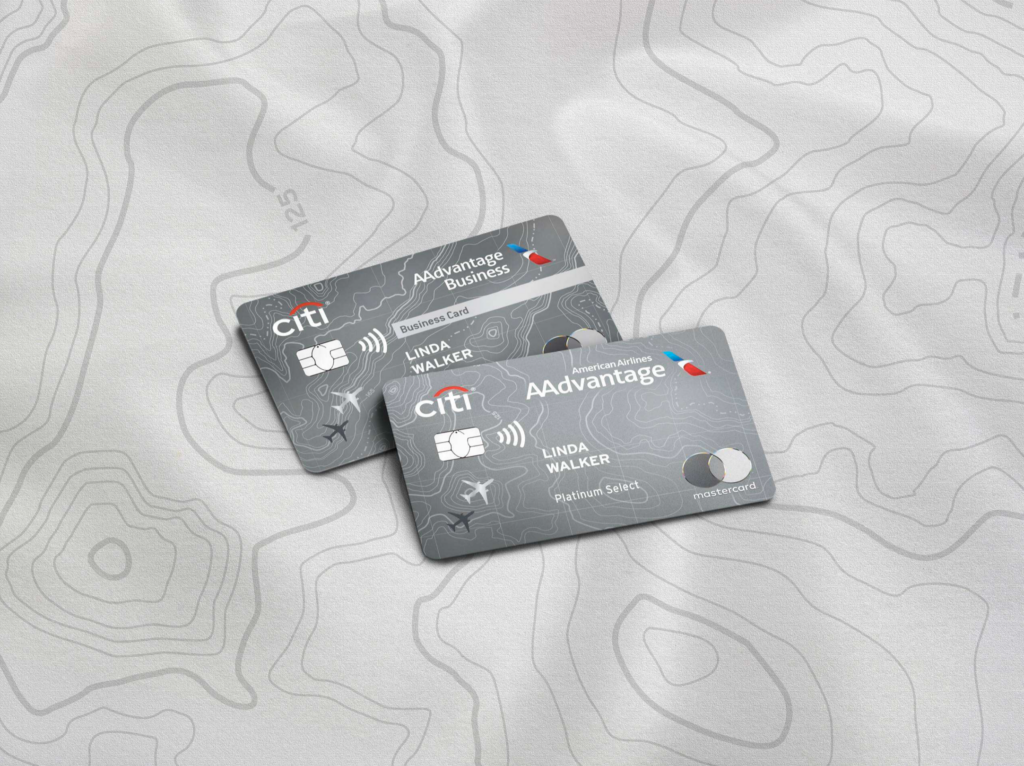
    Overhead shot of two American Airlines / Citi credit cards.
    CITIBANK

    What’s New on the Business Card

    The Business card’s refresh focuses more on earning flexibility rather than lifestyle perks.

    Cardholders will earn 3X miles on eligible AAdvantage Hotels and AAdvantage Cars bookings. They’ll also be able to select one category for 2X miles: U.S. shipping providers, office supply stores, or U.S. advertising services.

    Citi is also adding up to $120 toward Global Entry or TSA PreCheck every four years, up to $100 annually in inflight statement credits, 25% off a Melio subscription plan (bill paying software for businesses), and travel protections covering trip cancellation and interruption, lost or damaged baggage, car rentals, and trip delays.

    What Stays the Same on the Business Card

    The card’s core earning rates aren’t changing. Cardholders will continue earning 2X miles on eligible American Airlines purchases, car rental merchants, gas stations, and telecommunications, cable, and satellite providers, plus 1X on everything else.

    Businesses will continue earning one Loyalty Point per dollar of eligible card spending for each cardmember. Primary cardmembers will also keep earning one additional Loyalty Point per dollar spent by authorized users through December 31, 2028.

    After spending $30,000 in a cardmember year and renewing the card, cardholders will still receive a $99 American Airlines Companion Certificate for a qualifying domestic round-trip Main Cabin flight.

    Preferred boarding for the cardmember and up to four companions on the same reservation, a free first checked bag on domestic American Airlines itineraries (for the cardmember and up to four companions), and 10% savings on eligible American Airlines Vacations packages are all staying on board, too.

    What to Do Before January 24, 2027

    Nothing is changing with how either card works today.

    Cardmembers will get access to the new benefits on January 24, 2027, when the higher annual fees also take effect. Existing cardholders will pay the new fee when their cards renew on or after that date.

    That gives you time to try the new benefits and decide whether they’re worth the additional $51 per year.

    On the personal side, there are other AAdvantage cards worth considering if the refreshed Platinum Select no longer makes sense. Two sit above it with more benefits and higher annual fees, while the no-annual-fee AAdvantage MileUp offers a cheaper alternative with fewer perks.

    On the business side, options are more limited. The Citi / AAdvantage Business card is currently the only AAdvantage business credit card available to new applicants, so there isn’t another Citi AAdvantage business product to move to if the refresh doesn’t appeal to you.

    That said, the expanded earning categories are a welcome improvement. Earning flexibility has long been one of the Business card’s weaker points, and these changes help address that, even with the higher annual fee.

    Ultimately, refresh or not, it’s worth periodically reviewing the cards in your wallet to make sure you’re getting enough value from their benefits to justify keeping them.

  • WestJet Is Raising Status Thresholds Again for 2027

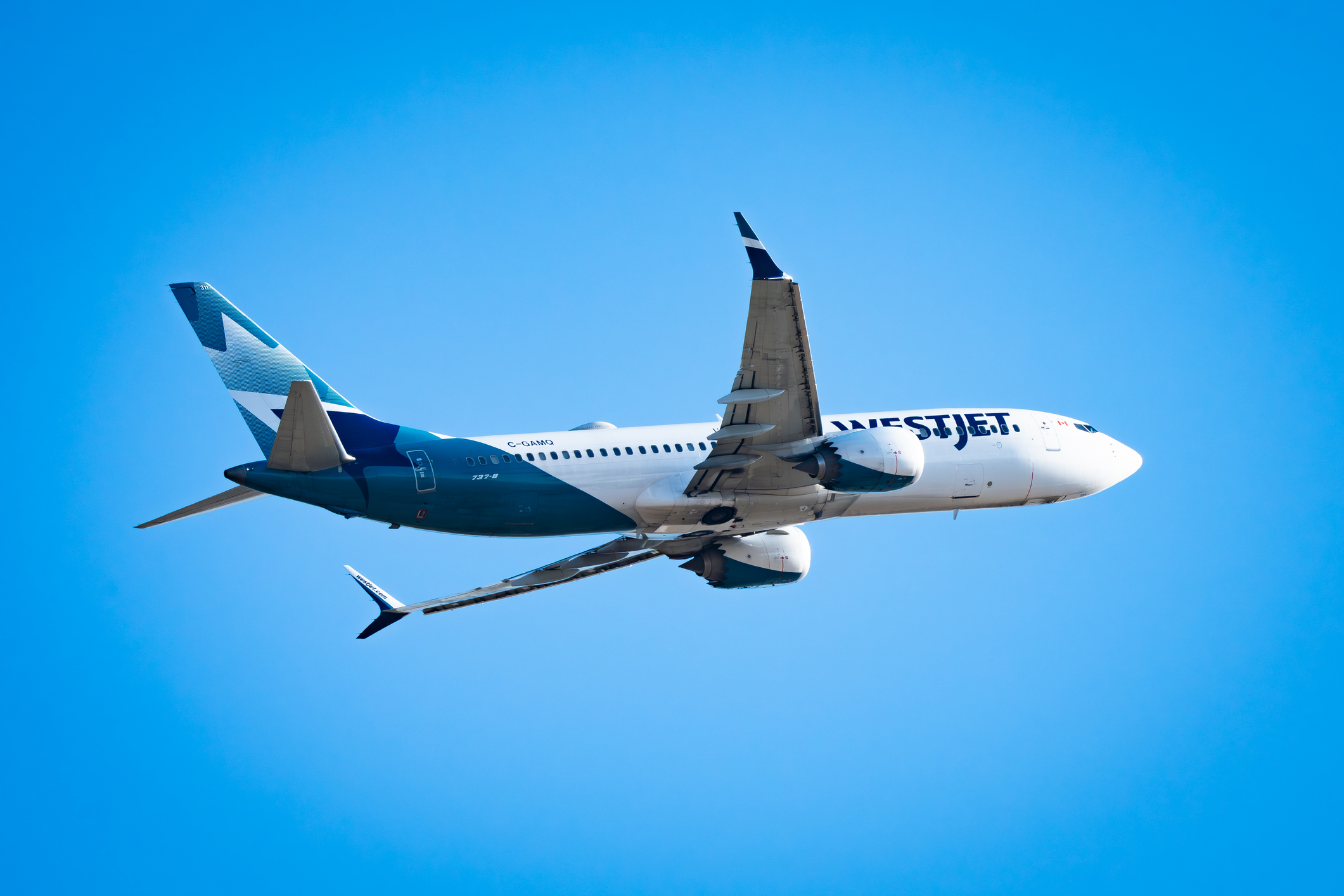
    WestJet Is Raising Status Thresholds Again for 2027

    WestJet is making it more expensive to earn elite status next year.

    Starting January 1, 2027, you’ll need more Tier Qualifying Spend (TQS, measured in Canadian dollars) to earn Silver, Gold, or Platinum status in WestJet Rewards. This marks the second increase in just two years, following the last round of changes on January 1, 2025.

    But unlike the previous changes, WestJet isn’t adding or removing benefits at each tier this time. It’s simply raising the spending requirements to earn the same perks during the next status year.

    What’s Changing for 2027

    Compared to the current requirements, Silver will require 25% more TQS, Gold about 33% more, and Platinum 50% more.

    Tier2026 TQS2027 TQS
    Silver$4,000$5,000
    Gold$6,000$8,000
    Platinum$10,000$15,000

    Hit Your 2026 Threshold by December 31

    If you meet the current qualifying spend requirements by December 31, 2026, you’ll keep your earned status benefits throughout 2027. The TQS you earn during 2027 will then determine your status for 2028.

    So if you’re close to reaching a new tier this year, you still have until the end of December to qualify under the existing requirements.

    The Second Increase in Two Years

    In January 2025, WestJet raised its status qualification requirements for the first time since 2018. Silver increased from $3,000 to $4,000, Gold from $5,000 to $6,000, and Platinum from $8,000 to $10,000.

    After seven years without an increase, that first adjustment wasn’t entirely surprising. But another round of increases just two years later is a different story.

    To put it in perspective, earning Platinum status in 2027 will require 50% more qualifying spend than it does today, and nearly twice as much as it did before 2025.

  • Citi Adds $200 in Dining Credits to Its Recently Refreshed AAdvantage Executive Card

    Citi Adds $200 in Dining Credits to Its Recently Refreshed AAdvantage Executive Card

    Citi just added another perk to its top American Airlines credit card. And this one has nothing to do with flying.

    As of October 25, 2026, Citi / AAdvantage Executive World Legend Mastercard cardholders can get up to $200 annually in dining credits through the inKind app.

    The credit is split into two $100 semiannual allotments — one from January through June and another from July through December. And the good news for existing cardholders (or prospective cardholders who apply by the end of the year) is that the current $100 credit is already available through the end of 2026.

    How the Credit Works

    inKind is a dining platform with several thousand restaurants, bars, and cafes in its U.S. network. The new credit works a bit like a gift card you can use at participating establishments.

    To use the benefit, download the inKind app and add your eligible AAdvantage Executive card. The credit will then apply automatically to qualifying purchases.

    Note that primary cardmembers and authorized users share the same $100 semiannual credit, and unused credits don’t roll over to the next six-month period.

    So it’s a use-it-or-lose-it type of benefit.

    How We Got Here

    The new dining credit comes just two months after Citi refreshed the AAdvantage Executive card in August. Those changes included renaming it a World Legend Mastercard (an upgrade from its previous World Elite Mastercard designation) and increasing its annual fee from $595 to $695.

    That refresh also introduced several new benefits, including up to $500 in American Airlines Vacations credits, up to $100 in statement credits for inflight and eligible Admirals Club purchases, and an increase in annual Lyft credits from $120 to $180.

    It also added 12X miles on eligible AAdvantage Hotels and AAdvantage Cars bookings, the ability to earn up to 40,000 bonus Loyalty Points, Omni Hotels Champion status with an annual free night after a qualifying stay, and complimentary Avis President’s Club status.

    Unlike the August refresh, though, the new inKind benefit doesn’t come with another annual fee increase. It’s simply an additional perk for AAdvantage Executive cardholders.

  • When Do Airline Miles Expire? Rules for 7 U.S. Airlines

    When Do Airline Miles Expire? Rules for 7 U.S. Airlines

    Do airline miles expire? It depends on which loyalty program you’re using.

    Most major U.S. airlines have eliminated mileage expiration. This means you don’t have to worry about losing your rewards just because you haven’t flown in a while. But a few programs still have expiration rules, and they’re not all the same.

    Here’s how mileage expiration works across seven U.S. airline loyalty programs, including what you can do to keep your points and miles from disappearing.

    American Airlines AAdvantage

    American Airlines AAdvantage miles expire after 24 months without qualifying account activity.

    Fortunately, keeping your miles alive is fairly easy. Earning or redeeming miles resets the clock, including through eligible partner activity (like using the AAdvantage eShopping portal, for example) or by buying, gifting, or transferring miles.

    There are also two important exceptions. Members under 21 are exempt from mileage expiration until they turn 21. And if you’re the primary cardmember on an open AAdvantage co-branded credit card, your miles won’t expire under the standard 24-month rule.

    United MileagePlus

    United MileagePlus miles don’t expire, regardless of how long your account has been inactive.

    As long as your MileagePlus account remains open and in good standing, your miles won’t go anywhere. There’s no activity requirement to keep them.

    Delta SkyMiles

    Delta SkyMiles don’t expire, either.

    You can go years without earning or redeeming miles and still keep your balance. However, Delta can close accounts under certain circumstances, which may result in forfeiting any remaining miles.

    As long as your account remains open and in good standing, there’s no mileage expiration deadline to worry about.

    Southwest Rapid Rewards

    Southwest Rapid Rewards points don’t expire.

    Like United and Delta, Southwest doesn’t require you to earn or redeem points periodically to keep them active.

    However, closing your Rapid Rewards account will result in forfeiting any points you haven’t redeemed. So if you have a balance, keep the account open even if you’re not flying Southwest regularly.

    JetBlue TrueBlue

    JetBlue TrueBlue points never expire.

    There’s no inactivity requirement, so you don’t need to book flights or earn additional points just to preserve your balance.

    Alaska Airlines Atmos Rewards

    Atmos Rewards points don’t expire.

    That policy carried over when Alaska Airlines introduced Atmos Rewards and replaced its former Mileage Plan program.

    Although accounts may be locked after extended inactivity and require identity verification to regain access, the points themselves don’t expire.

    So there’s no need to earn or redeem points periodically just to keep your balance. Just make sure you can still access your account when you’re ready to use them.

    Breeze Breezy Rewards

    Breeze Airways is a notable exception. BreezePoints expire 24 months after they’re issued, regardless of whether you’ve had other account activity since then.

    That means earning more points won’t reset the expiration date on your existing balance. Each batch of points has its own 24-month validity period, and Breeze uses your oldest points first when you redeem them.

    There is one way around this: Primary cardmembers with an open Breeze Easy Visa account in good standing are exempt from points expiration. If you close the card, the points remaining in your account receive a new 24-month expiration period beginning on the closure date.

  • Citi ThankYou Points Can Now Transfer to Copa ConnectMiles

    Citi ThankYou Points Can Now Transfer to Copa ConnectMiles

    Citi’s list of ThankYou Rewards transfer partners just gained another airline.

    As of Sunday, October 25, Copa Airlines now appears on Citi’s Points Transfer page. And effective immediately, eligible cardholders can transfer ThankYou Points to the airline’s ConnectMiles program.

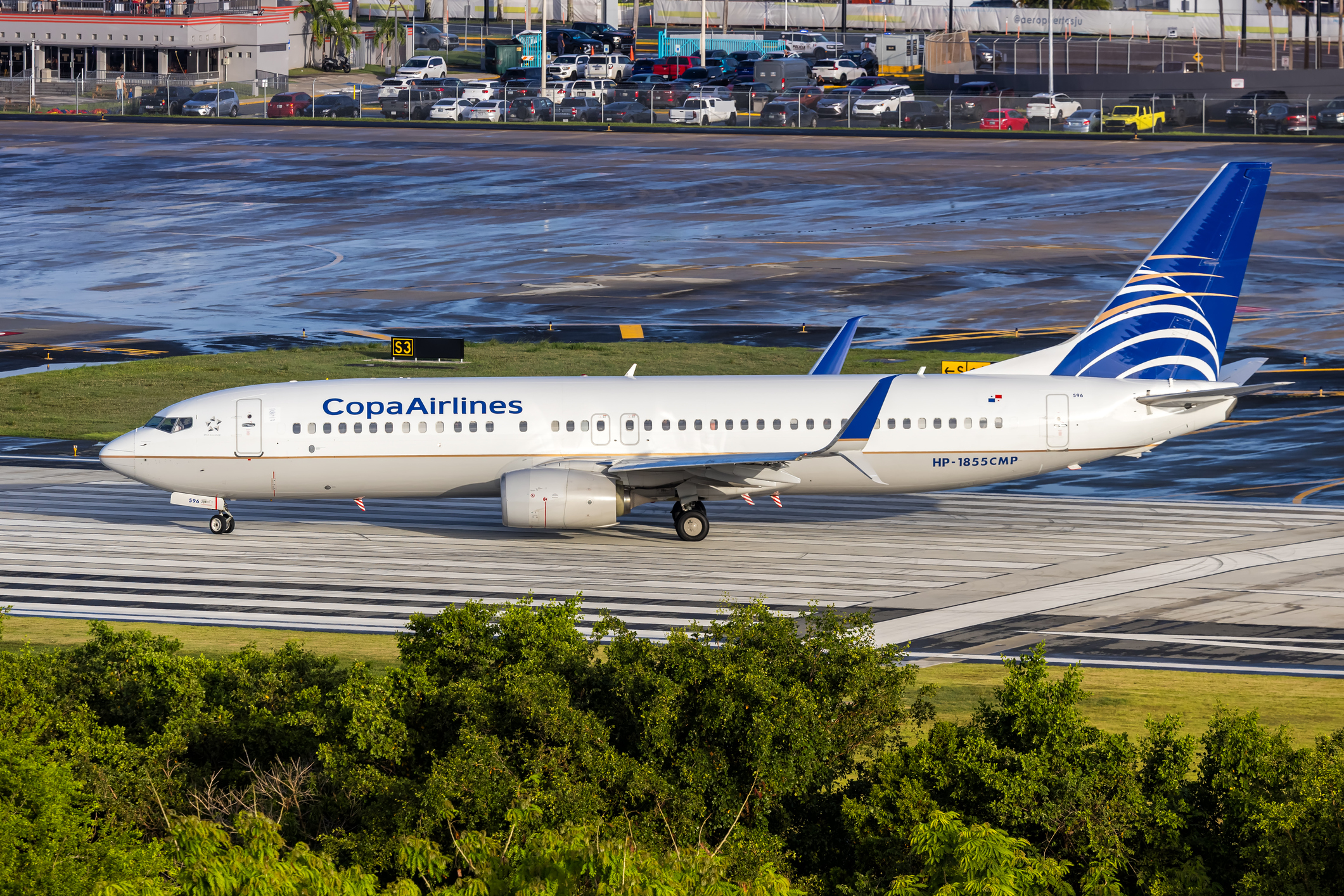
    Copa is a Star Alliance carrier based in Panama City (PTY), and ConnectMiles can be used to book flights on Copa, other Star Alliance airlines, and a handful of non-alliance partners.

    The program can be quirky to use, but it’s a neat addition for Citi.

    How Citi–Copa Transfers Work

    As with other Citi transfer partners, the transfer ratio depends on which Citi card you have.

    Premium ThankYou cards — including the Citi Strata Elite, Citi Strata Premier, and Citi Prestige (no longer open to new applicants) — transfer at a 1:1 ratio. The AT&T Access More card also offers 1:1 transfers.

    Citi’s no-annual-fee, points-earning cards, including the Citi Double Cash, Citi Strata, and Citi Custom Cash, transfer at a 1,000:700 ratio.

    More on This: How to Convert Credit Card Points to Airline Miles

    What You Can Do With ConnectMiles

    Copa ConnectMiles publishes a fixed award chart for Copa-operated flights and a separate chart for partner flights.

    Here are a few examples of one-way Saver award rates:

    • North America 1 to Panama, Central America, or the Caribbean: 15,000 miles in Copa economy or 30,000 in Copa business. This region includes Florida, Texas, Georgia, and several nearby Southeastern states.
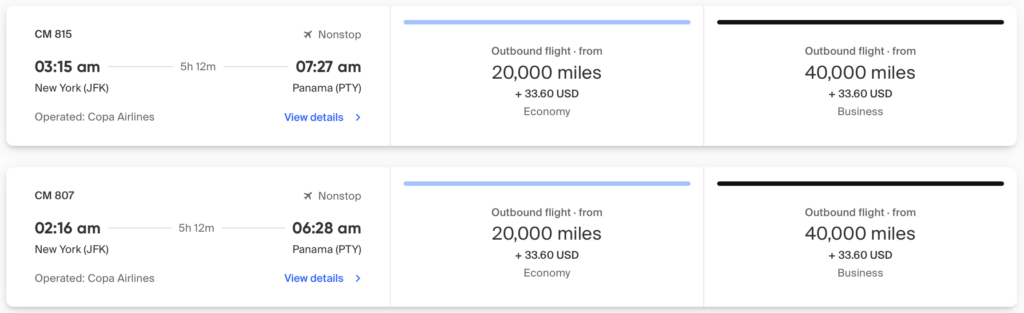
    • North America 2 to those same destinations: 20,000 miles in Copa economy or 40,000 in Copa business. This region covers the rest of the continental U.S. and Canada.
    • U.S. or Canada to Europe on Star Alliance partners: 30,000 miles in economy or 70,000 in business.

    You can review Copa’s award regions here.

    JFK to PTY bookable with Copa ConnectMiles.
    COPAAIR.COM

    Beyond Copa’s own flights, ConnectMiles can book flights on Star Alliance carriers, including United, Avianca, ANA, Singapore Airlines, and Turkish Airlines. Non-alliance partners you can also book with miles include Emirates, Azul, GOL, and KLM.

    Partner awards are generally limited to Saver availability, although Copa also offers Standard United awards. That gives you more booking options for United flights, though Standard awards cost double that of Saver awards.

    One particularly notable redemption is Emirates business class from the U.S. to Dubai, which can cost 80,000 ConnectMiles one-way with relatively low taxes. However, finding available award seats is by no means easy.

    All in all, though, this is a welcome addition to Citi’s transfer partner lineup, particularly for travelers looking to book Copa or other Star Alliance flights.

    But as always, we’d recommend finding the award you want before transferring any points. Flights you find on other Star Alliance sites (say, United) don’t always appear on Copa’s site. Plus, other Citi airline partners may offer the same flights at different rates, so it’s worth comparing your options before initiating an irreversible transfer.

  • Fly Alaska, Ski Free: 9 Resorts Offering Perks This Winter

    Fly Alaska, Ski Free: 9 Resorts Offering Perks This Winter

    Alaska Airlines’ ski-and-snowboard perks are back for another winter.

    The idea is pretty simple: fly Alaska to a participating destination, show your boarding pass, and unlock free or discounted perks on the mountain.

    Alaska calls the promotion Atmos Rewards Alpine Getaways (though you might also know it as the Fly Alaska, Ski Free program). The returning offer gives Atmos Rewards members access to benefits at participating resorts throughout the 2026–2027 ski season.

    How It Works

    According to Alaska’s ski page, you’ll need to present your inbound boarding pass and Atmos Rewards number, either through the Alaska app or by email, at the participating resort.

    Alaska doesn’t explicitly mention award tickets. However, since the terms require an inbound boarding pass rather than proof of a cash purchase, flights booked with Atmos Rewards points should qualify, too.

    Offers, blackout dates, and redemption procedures vary by resort, so check the details for your destination before traveling.

    Where You Can Use It

    Alaska’s current list includes nine participating resorts, each offering different benefits.

    • Alyeska Resort (Anchorage, ANC): Ski free on arrival day.
    • Arctic Valley Ski Area (Anchorage, ANC): Free same-day lift ticket.
    • Bogus Basin (Boise, BOI): Free same-day lift ticket.
    • Crystal Mountain (Seattle, SEA): First Tracks access and complimentary summit coffee on select Atmos Members Days for eligible members during the 2026–2027 season.
    • Eaglecrest Ski Area (Juneau, JNU): Free same-day lift ticket.
    • Jackson Hole Mountain Resort (Jackson Hole, JAC): Free full-day lift ticket.
    • Palisades Tahoe (Reno-Tahoe, RNO): Complimentary half-day lift tickets from March 1 through April 30, 2027.
    • Schweitzer Mountain Resort (Spokane, GEG): Ski free on arrival day.
    • Sun Peaks Resort (Kelowna, YLW): Ski free on arrival day or the following day.

    Most participating resorts offer a free lift ticket on the day you arrive, provided you show your boarding pass and ID. Crystal Mountain and Palisades Tahoe have more specific eligibility requirements, so pay particular attention to their terms.

    You can search for flights to any of these destinations using PointsYeah.

    {{ search-widget mode=”flight” }}

    Pack the Skis Without the Oversize Fee

    There’s a baggage perk worth knowing about, too.

    When flying Alaska, properly packed skis and snowboards can exceed the usual 62-inch linear size limit, up to 115 inches, without incurring an oversize baggage fee. As long as the bag weighs 50 pounds or less, you’ll pay the standard checked-bag fee.

    Alaska also counts one pair of skis and poles, or one snowboard, plus a separate boot-and-helmet bag as a single checked bag. However, that additional bag can’t contain clothing or other gear.

    Overweight fees still apply to bags exceeding 50 pounds, and Alaska notes that baggage policies are subject to change.

  • Mailbag: Flying a Family of 5 to Madrid on Points, Plus 3 More Questions

    Mailbag: Flying a Family of 5 to Madrid on Points, Plus 3 More Questions

    In the October 22 edition of the Points Insider newsletter, we opened up the floor to you.

    You’ve been sending in questions, and this week I’m answering four of them. (Three of you also wrote in just to say you share my last name, which I appreciate, because there aren’t many of us.)

    We’ve got a family of five headed to Madrid, a question about overlapping Delta and Amex benefits, my take on using points for hotels versus flights, and a quick one on Atmos credit cards.

    Flying a Family to Europe on Points

    A reader asks: “I have a family of 5, and we’re hoping to travel from Washington State to Madrid next May to visit family. I’m a beginner when it comes to maximizing rewards points. My husband and I both have a Chase Sapphire Preferred, but are hoping to take advantage of a welcome bonus to make our flight as affordable (dare I even say, comfortable?) as possible. Should I be looking at a general travel credit card with a good welcome bonus, or an airline credit card specific to our route? We have 3 little kids (4, 2, and 6 months) so we don’t travel frequently.”

    I’d start with the number of seats you’ll have to book. Your 2-year-old needs a seat, and your youngest will still be under 2 next May, so you’re looking at four seats plus one lap infant (a baby under 2 who flies on your lap instead of in their own seat).

    From there, a few things come to mind:

    • Account for the points you already have. If you’ve built up a decent balance of Chase Ultimate Rewards points between your two Sapphire Preferred cards, see what you can book before applying for anything else. PointsYeah is great for this, and you can filter results to show only flights bookable with Chase points.
    • Look for a program with reasonable lap infant pricing. Personally, I’ve been a fan of Air Canada Aeroplan for several years for this very reason. On international award tickets, a lap infant costs 2,500 points or CAD 25 each way, and you can usually add the baby online. Taxes and fees on Aeroplan awards can be reasonable, too.
    • Consider Atmos Rewards. This isn’t a Chase transfer partner, but Alaska Airlines’ loyalty program recently changed its lap-infant policy. On long-haul international award bookings, lap infants now cost only the applicable international taxes, although you’ll need to call to add the baby. You can also join the free Atmos Rewards “Families on the Go” community and get 20% of the points redeemed for children 12 and under back after your trip. (You can belong to only one community at a time.)
    • Look beyond Seattle. If you’re not finding much from Washington State, check Portland or San Francisco, too. Flying or driving to another airport to start your trip is called “positioning,” and it can open up additional options.
    • Don’t rule out paying cash. Sometimes the cash fare is competitive enough that using points isn’t the best deal. Depending on your card, you may be able to redeem points toward a travel portal booking or use them to offset a travel purchase.

    The next question is whether another credit card would help.

    Say you find flights you want to book through Aeroplan but don’t have quite enough points. You could look for a card with a welcome bonus that transfers to Aeroplan (lots do) and use it to top up your balance.

    An airline-specific card could work, too, but those points generally aren’t as versatile. And depending on the ticket you book, you might not even need some of the card’s benefits (like a free checked bag, if your fare already includes one).

    So, I’d start with transferable points, find the flights you want, and work backward from there. You could even consider buying the remaining points outright if the math works.

    Airport Terminal: Beautiful Mother and Cute Little Daughter Wait for their Vacation Flight, Looking out of Window for Arriving and Departing Airplanes. Young Family in Boarding Lounge of Airline Hub
    OZGYRCANKAYA / ISTOCK

    Delta Reserve and Amex Platinum: Where the Benefits Overlap

    A reader asks: “Is it worth having both the Delta SkyMiles Platinum Reserve and the Amex Platinum Card? There is a fair amount of crossover. If not, what would be the best balance?”

    First, tally the cost. Between the Delta SkyMiles Reserve ($650) and the Amex Platinum ($895), you’re paying $1,545 in annual fees.

    There’s definitely some overlap, but each card also offers benefits the other doesn’t.

    Delta Sky Clubs: This is probably the biggest crossover. The Reserve gets 15 visits per Medallion Year, while the Platinum gets 10, so holding both gives you 25. The Amex Platinum requires a same-day Delta-operated flight, while the Reserve also covers flights marketed by Delta under its own flight number. Reserve cardholders can unlock unlimited visits after $75,000 in calendar-year spending.

    Centurion Lounges: Both cards offer access, although the Reserve requires you to book your Delta flight with the card. The Amex Platinum doesn’t have that restriction.

    Overlapping credits: Both cards offer Resy credits (up to $400 annually on the Platinum and $240 on the Reserve), along with Global Entry/TSA PreCheck credits. There’s also $200 in Uber Cash on the Platinum and $120 in rideshare credits on the Reserve. Some benefits require enrollment.

    Only on the Reserve: An annual companion certificate after renewal, $2,500 in Medallion Qualification Dollars each year (a head start toward Delta status), 15% off eligible Delta award flights, a free first and second checked bag, and a $200 Delta Stays credit.

    Only on the Amex Platinum: 5X points on flights booked directly with airlines, up to $600 in lodging credits, Priority Pass and access to a wider lounge network, plus credits for CLEAR+, digital entertainment, Lululemon, Walmart+, and more. Membership Rewards points can also transfer to a variety of airline (and hotel) programs, not just Delta. Some benefits require enrollment.

    All that to say, there’s a case for keeping both cards, and just as much of a case for keeping one and pairing it with something else.

    I’d look at which benefits you actually use, rather than trying to assign value to every credit on paper. The risk is paying for two expensive cards without getting enough out of them to justify the annual fees.

    Card Points for Hotels or Flights?

    A reader asks: “Do you use card points for hotel stays, or do you prefer to use points for airlines only?”

    Personally, the only card points I typically use for hotel stays are those I earn through co-branded hotel cards (either from spending or a welcome bonus).

    And there are plenty of reasons to keep a co-branded hotel card around, at least for brands you stay with somewhat regularly. Lots of hotel cards with annual fees offer some form of annual free night award (although some require hitting a spending threshold first).

    In most cases, I find that free night is worth more than the card’s annual fee, even before factoring in benefits like complimentary elite status.

    When it comes to transferable credit card points, though, I almost always use them for flights.

    I’ll either transfer them to an airline loyalty program or — particularly with Capital One — book through the travel portal and then use points to cover the charge once it posts.

    Here’s why.

    With some exceptions, transferable points programs offer hotel and airline transfers at the same 1:1 ratio. But I generally get more mileage (and save more out of pocket) by transferring points to airlines, then paying cash for hotels or buying hotel points when they’re on sale.

    For example, it’s pretty common to find Hilton or IHG points on sale for around half a cent each.

    If I have a transferable credit card point worth at least 1 cent toward travel, why would I exchange it for a hotel point I could buy for half a cent?

    There are exceptions, of course, but that’s generally how I approach it.

    Bedroom at the InterContinental Yokohama Pier 8.
    InterContinental Yokohama Pier 8. IHG

    Does a Second Atmos Card Mean Another Hard Pull?

    A reader asks: “If I apply for another Atmos card, will they do another hard pull from my credit report?”

    Yes, I’d expect another hard inquiry.

    Each Atmos card requires a separate Bank of America application, and Bank of America’s own credit guide identifies credit card applications as hard inquiries. These can temporarily lower your credit score by a few points.

    Holding one Atmos card doesn’t prevent you from getting another, and you can potentially earn the welcome bonus on each.

    Just keep Bank of America’s commonly reported 2/3/4 rule in mind. Generally, that means no more than two new Bank of America cards in 30 days, three in 12 months, or four in 24 months (for personal cards).

    And remember, approval isn’t guaranteed. Bank of America’s pre-qualification tool uses a soft credit check, but being pre-qualified doesn’t necessarily mean you’ll be approved.

    If you’re considering the Summit (a card quite a few of us on the PointsYeah team admire), you can find the current offer below.

    More on This: Current Atmos™ Rewards Summit Visa Infinite® Credit Card Welcome Offer

    Ask Your Own Question

    Got a points question of your own? Email us at newsletter@pointsyeah.com, and we’ll answer a few each week.

  • Delta Confirms Medallion Status Requirements Won’t Change Next Year

    Delta Confirms Medallion Status Requirements Won’t Change Next Year

    If you’re chasing Delta Medallion Status next year, the targets aren’t going to move.

    A Delta spokesperson confirmed to Points Insider that the airline doesn’t plan to change its qualification requirements, meaning MQD thresholds for the upcoming Medallion Year will remain the same.

    How Many MQDs Do You Need for 2028 Status?

    Delta awards Medallion Status based on the Medallion Qualification Dollars (MQDs) you earn during the previous calendar year. That means your 2027 activity will determine your status for the 2028 Medallion Year.

    Here’s how much you’ll need to earn to qualify:

    Medallion TierMQDs Needed
    Silver Medallion$5,000
    Gold Medallion$10,000
    Platinum Medallion$15,000
    Diamond Medallion$28,000

    Delta has held these thresholds since its 2023 loyalty program overhaul, when it moved to MQD-only qualification and subsequently lowered its proposed requirements following pushback from members.

    How You Earn MQDs Today

    Under Delta’s current rules, you earn $1 MQD per $1 spent on eligible Delta-marketed flights, excluding government taxes and fees. Eligible Delta Vacations packages also earn MQDs, while Delta Main Basic (Basic Economy) fares don’t.

    Select Delta SkyMiles American Express Cards offer a $2,500 annual MQD Headstart, plus additional MQDs through everyday spending.

    MQDs don’t roll over, so your balance resets to zero on or about January 1 each year, regardless of how far past a status threshold you finish.

    Delta Is Bucking the Trend

    Delta’s biggest competitors, meanwhile, are making changes to their loyalty programs.

    United is raising its Premier 1K qualification requirement and dropping its flight-count qualification path for 2027, while Southwest is replacing A-List and A-List Preferred with new Silver, Gold, and Platinum tiers. JetBlue just announced its own slate of changes, too.

    For now, Delta seems to be the lone holdout. Time will tell if that’s the case next year as well.